Living Among the Wild Beasts

Samuel Clemons (“Mark Twain”) wrote in his autobiography words akin to the Gospel of Mark’s briefest description of Jesus’s 40 days and nights in the wilderness:

“With the going down of the sun my faith failed and the clammy fears gathered about my heart. Those were awful nights, nights of despair, nights charged with the bitterness of death. In my age as in my youth, night brings me many a deep remorse.

None of us is ever quite sane in the night. Our faith fails. The clammy fears gather in our hearts. Despair descends. It is into this primitive night of the soul that Jesus enters when Mark describes Jesus’s wilderness temptation with one line:

“He was with the wild beasts, and angels ministered to him.”
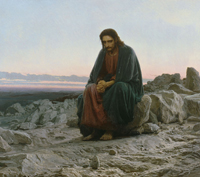
Christ in the Wilderness -Kramskoi

Christ in the Wilderness -Kramskoi

In Mark’s Gospel there is none of the later Gospel’s three temptations. Jesus simply enters that frightening solitude Gerard Manley Hopkins described as a miserable soul “gnawing and feeding on its own miserable self.”

The wild beasts of Mark and of the Hebrew Scripture are symbols representing the violence and arrogance of nations and empires: the lion that threatened David’s sheep; the lion with wings and a bear gnawing insanely on its own ribs in Daniel’s dream; a leopard and a dragon with great iron teeth destroying everything in its way. The beasts of Daniel and the Hebrew Scripture symbolize the deepest threats, threats to human wellbeing and existence itself. In Daniel’s dream, when the Ancient of Days takes his judgment seat and gathers the nations (wild beasts), they are as nothing before him, but “of his kingdom there shall be no end.”

Like Samuel Clemons, with the going down of the sun [our] faith fails and the clammy fears gather about my heart.

In his book Man Before Chaos Dutch philosopher-theologian Willem Zuurdeeg argues that all philosophy and religion is born in a cry. Whether the great philosophies of Plato or Aristotle or Hegel, whether Buddhism, Judaism, Islam, Christianity or what we arrogantly describe as ‘primitive’ religions; whether the political philosophy of Western democracy or Islamic theocracy or one or another economic theory – capitalist, socialist, communist, or communitarian – all philosophy and religion is born in a cry for help. It is the primal cry of human vulnerability, our  contingency, our finitude, our mortality. It is the cry for order, protection and meaning in the face of the chaos without and within.

Separated from all social structure and from all the answers that express or muffle the cry, removed from civilization and all distraction – no computers, no video games, no reading material, no play stations, no TV, no artificial noise, nothing unreal to distract him – in the wilderness of time, “he was with the wild beasts.”

“He was with the wild beasts” is a kind of cliff notes for Jesus’ entire life and ministry. He would dwell among the wild beasts – the unruly principalities and powers that defy the ways of justice, love and peace.  He lived and died among the wild beasts that mocked him at his trial – “Hail, King of the Jews!” – stripped him of his clothing, plaited a crown of thorns believing they had seen the end of him. But after the beasts of empire had torn him to shreds, he become for us the crucified-risen King whose love would tame us all.

There are times for each of us when the beasts are all too real, moments when faith falters, nights in the darkness when despair gnaws and paws at us, and hope has all but disappeared.

A young woman sits in the Atlanta airport. She is returning home from a year of study abroad. All flights have been delayed because of a storm. She is anxiously awaiting the final leg of her journey home. But home as she had known it no longer exits. Her mother and father have separated. Her father has entered treatment for alcoholism. She has entered a wilderness not of her own choosing. The beasts are tearing her apart. Her ordered universe has fallen apart.

She goes to the smoking lounge to catch a smoke. A stranger, her father’s age, sits down. He jolts her out of her fog. “Do you have the time?” he asks. As strangers are sometimes wont to do, they begin to talk. Unaware of her circumstances, he tells her that he is a recovering alcoholic, a former heavy drinker whose drinking was destroying his marriage until his wife became pregnant. The impending birth of his daughter snapped him into treatment and sobriety. “I thought I was going to die,” he says, “but it was the beginning of a resurrection, a whole new life.”

The young woman begins to feel a burden lifting. The stranger finishes his cigarette and disappears. She never gets his name.

The loudspeaker announces her flight’s departure. She boards her flight, and as the plane rises through the clouds, she finds herself momentarily sandwiched between two sets of clouds – one below, one above – and the space between is filled with rainbow light, a world whose grandeur and grace exceed all reasons for despair. She is strangely calm in the face of what lies ahead. A sense of peace descends. She is sure that the man has been given to her as a gift. She has been with the wild beasts. An angel has ministered to her.

During these 40 days and nights of Lent we live more consciously with the wild beasts, praying that the angels of our better nature will minister to us in the wilderness of time, dreaming with Daniel and Jesus of the Ancient of Days taking his judgment seat and gathering the nations. They are as nothing before him, but of his kingdom there shall be no end.

  • Gordon C. Stewart, Chaska, MN, Feb. 14, 2016.

Sermon on most divisive Christian claim

“I am the way, the truth, and the life; no one comes to the Father but through me [Jesus]” is sometimes used as a billy club, as in, “if you believe, you’re ‘in’ – if you don’t, you’re ‘out’.” According to Matthew Myer Boulton, the statement has nothing to do with belief. Read in context, this line in the Gospel According to John is the opposite: an assurance of divine comfort and inclusion.

Matthew (“Matt”) Myer Boulton, President of Christian Theological Seminary in Indianapolis, is the son of Wayne and Vicki Boulton, friends of Gordon and Steve for 51 years. Matthew’s leadership is a source of great joy. He is the author of God Against Religion and Life in God.

Making the nation great again?

Vincent_Willem_van_Gogh_037

Prisoners exercising in the Yard – Vincent Van Gogh

Might Vincent Van Gogh’s painting of the Prisoners Exercising have been inspired by conflicting biblical texts, like the ones read in many churches two Sundays ago?

The reading from the Book of Nehemiah tells the story of rebuilding the walls of Jerusalem.

In the absence of leadership, the people’s confidence – their sense of national destiny – has been shaken. The citizens have intermarried. They’ve welcomed and married foreigners. Now Jerusalem’s exiled leaders have returned to restore the nation’s religious identity, to rebuild a nation that has lost its way. Ezra, the priest, and Nehemiah, the governor, are rallying the people to make the nation great again.

Sound familiar?

Jesus, Ezra, and Nehemiah shared a common faith. They were children of Abraham, Isaac, and Jacob. Their lives were rooted in Torah. Each interpreted Scripture in his own time, according to his own lights. Ezra and Nehemiah re-built the wall. Jesus doesn’t like walls.

Jesus returns to his home town synagogue in Nazareth. He opens the scroll to the Book of Isaiah, and selects the reading announcing good news to the poor, release to the prisoners, recovery of sight to the blind, freedom for the oppressed.

There is nothing about building walls. Nothing about isolation. Nothing about privilege. Nothing about rebuilding the nation. Nothing about the nation at all. Nothing about building the walls of a self-imposed penitentiary.

When he came to Nazareth, where he had been brought up, he went to the synagogue on the sabbath day, as was his custom. He stood up to read, and the scroll of the prophet Isaiah was given to him. He unrolled the scroll and found the place where it was written:

“The Spirit of the Lord is upon me,
because he has anointed me
to bring good news to the poor.
He has sent me to proclaim release to the captives
and recovery of sight to the blind,
to let the oppressed go free,

to proclaim the year of the Lord’s favor.”

And he rolled up the scroll, gave it back to the attendant, and sat down. – Luke 4: 16-18

No more prison. No more wall. No more other! Every Other is a BrOther. Otherwise, we’re all exercising in the prison yard.

  • Gordon C. Stewart, Chaska, MN, Jan. 31, 2016

Verse – Packin’ heat for Jesus

“Pack some heavy heat, Boys,”
said Jesus to the Apostles
on his way to pray in the
Garden of Gethsemane

and off again to the Mount
of Olives – that liberal
haunt with olive branches,
doves, and sh-t like that –

“Conceal and carry, Boys,”
he’d said, in the Upper Room
where that sissy John
laid against his breast –

“Get your guns, Boys,
the Fags, Commies, and
Mohammad-lovers are
comin’ to kill our faith.

“You have heard that it was
said, ‘love your neighbor’,
but I say, take ‘em out, Boys,
we’re ‘the home of the brave’.”

by J. Feelwell, Re-imagining Jesus, Crusaders Press, Lynchburg, VA, Dec. 9, 2015

  • Gordon C. Stewart, Chaska, MN – Satire Press :-), Dec. 9, 2015.

Dueling Presidents: Obama and Falwell

President Obama speaks from the Oval Office during prime time, seeking to calm a jittery nation following terrorist attacks abroad and in California. I questioned the wisdom of devoting so much of a speech on national security to domestic relations with our own Muslim neighbors …until this morning I watched Jerry Falwell, Jr., President of Liberty University, urging his students to apply for conceal-and-carry permits so that they could “end those Muslims.”

http://www.stuff.co.nz/world/americas/74836735/us-college-president-tells-students-to-carry-guns-to-end-those-muslims

The media describe Liberty University as “a leading evangelical Christian college” in Virginia. It’s not. It’s a poor excuse for a university or college, a right-wing fundamentalist school led by the son of Jerry Falwell, founder of the Moral Majority, an arch-conservative fundamentalist religious-political movement to take back the country from liberals… you know…people like Jimmy Carter.

Three days after telling his students to buy guns and on the eve of President Obama’s Sunday evening address to the nation, Falwell tweeted that his reference to “those Muslims” was meant only for those Muslims who commit acts of terror. But Jerry, Jr. is not stupid. The deafening applause from the Liberty auditorium was still ringing in his ears.

President Obama and President Falwell both know we are shivering. Only the non-preacher President represented the spirit and ancient counsel of Baruch: “Take off the garment of your sorrow and affliction, O Jerusalem, and put on forever the beauty of the glory from God” [Baruch 5:1-9; 2nd Century BCE].

We can freeze ourselves to death wearing living in the garment of sorrow, affliction, and fear. Or we can take it off to put on the warm garment of beauty – the glory of God shining in mutual consolation, hope, and steadfast determination to live in peace with our neighbors.

If you can imagine Jesus telling his students (disciples) to apply for conceal-and-carry permits, pack some heat, and put an end to anyone, you’re making that Jesus up. You don’t get to make Jesus up in your own image.

“You have heard that it was said, ‘Love your neighbor and hate your enemies.’  But I say to you, love your enemies. Pray for those who hurt you. If you do this, you will be true children of your Father in heaven. He causes the sun to rise on good people and on evil people, and he sends rain to those who do right and to those who do wrong. If you love only the people who love you, you will get no reward. Even the tax collectors do that. And if you are nice only to your friends, you are no better than other people. Even those who don’t know God are nice to their friends. So you must be perfect, just as your Father in heaven is perfect.” – Jesus, Sermon on the Mount, Gospel According to Matthew 5:43-48, NCB.

  • Gordon C. Stewart, Presbyterian minister, would-be disciple of Jesus, Chaska, MN, Dec. 7, 2015


Sermon: Testify to the Truth

Yesterday’s Christ the King Sunday sermon by Rev. Anne Miner-Pearson on John 18:33-37 at Trinity Episcopal Church in Excelsior deserves a greater audience. We’re pleased to publish it on Views from the Edge.

“Testify to the Truth”

Pontius Pilate with his Prisoner - Antonio Ciseri

Ecce homo – “Here is the man”

Pilate and Jesus are an odd couple. We usually meet them in Holy Week when their conversation is part of Jesus’ journey to his crucifixion. Because Good Friday and the cross are looming closer and larger, we pause only briefly in Pilate’s headquarters. But today is Christ the King Sunday and we encounter this odd couple under different circumstances. We are on the cusp of the Church year – the end of 52 Sundays facing into Sunday, Advent I, awaiting God’s move to enter human flesh as Jesus, beginning his life in birth like us, and ending his life in death like us.

Yet, before our church year begins, tradition asks us to pause and hold on to the bigger story of Jesus. There is a larger and more eternal back-story to the one that opens with shepherds, a star, some straw in a manger and even Mary. There is another birth story in John’s gospel and we enter toward the end as Pilate and Jesus talk. What an unlikely conversation it is. Pilate, Pontius Pilate, the 5th prefect of the Roman province of Judaea calls – no, “summons” – an accused religious heretic to his headquarters. Pilate has already questioned the Jewish leaders and could be done with the matter. Undoubtedly, he has more important issues awaiting his attention than dealing with the process leading to a crucifixion. They happen all the time and aren’t on his radar.

So, they are an odd couple. A man with impeccable Roman familial and political credentials, Pilate stands in expensive robes, perfumed and fresh from his morning bath. Jesus’ home address is Nazareth. His profession listed as carpenter. His clothing hardly deserve the name – practically rags after the torture and stripping, smelly from sweat and blood. But Jesus is no country bumpkin. He knows at least 4 languages – Aramaic, Hebrew, Greek and the Latin he uses with Pilate. However, Jesus’ linguistic skills don’t make him a king. Yet, that is the direction the conversation goes.

“Are you the king of the Jews?”, Pilate begins, a question Jesus later returns to. “My kingdom is not from this world.”, Jesus answers. “So you are a king?”, Pilate inquires. With that question, Pilate introduces what makes him and Jesus the oddest pair. They are both “kings”, but the descriptions are polar opposites: Power-Love, Higher-Lower, Divided-One, Hold on-Give away, Boundaried-Open, Petty-Generous, Unjust-Just, Manipulating- Embracing, Triumphant-Humble.

Yet, Jesus, without actually answering, takes the title of “king” in a whole different direction. “For this I was born, and for this I came into the world, to testify to the truth.” Here Jesus tells his own “nativity” story, but remember, this is John’s gospel. To understand what Jesus is saying to Pilate as his earthly life is about to end, we have to go back to the beginning, way back to the beginning to understand Jesus’ kind of king.

“In the beginning was the Word and the Word was with God, and the Word was God. He was in the beginning with God. All things came into being through him, and without him, not one thing came into being. What has come into being in him was life, and the life was the light of all people….. And the Word became flesh and lived among us…”

Jesus understands himself as king and where his kingdom is from radically different. Pilate doesn’t get it. The crowds don’t get it. Even Jesus’ close disciples haven’t gotten it yet. In that humble peasant, from the virgin womb of Mary, God entered the world, breaking through all categories, possibilities and imaginings. The Word of God who first spoke all creation and universes into being now has spoken again. A second holy Word took form but this time the birth came as God was and is willing to become empty. The apostle Paul captures it in the mystical hymn in Philippians: “…thought he was in the form of God, did not regard equality with God… but emptied himself, … being born in human likeness.” Jesus’ kingdom is not from this world, but in this world, grounded in and flowing from the eternal God, what we now call the Trinity: God, Creator, God, Christ, and God, Spirit.

It’s like when God birthed the created worlds, God already had another birth in mind. God’s Word would speak another creation. The Spirit Breath who give human life and form from the dust was not finished. The Trinity was not complete until the human experience could join in the circle, the abundant, ever-flowing Love. And now God’s experience in human form nears the end, the pain and suffering of crucifixion.

But, ponder this thought by a contemporary mystic, Bernadette Roberts. Maybe the hardest thing for Jesus was not the crucifixion, but the incarnation – to leave the circle and connection of Love to learn and teach how to hold on to and live in that flow of Love caught in bodily form. And we can picture that Circle, can’t we, the world of Christ the King, the kingdom Jesus is from. It’s the picture we see on the icon of the Trinity by Rublev.

Angels at Mamre Trinity, Rublev

Angels at Mamre Trinity, Rublev

We all know it – the beloved the one we take with us on vacation and hold up for photos on Facebook. I brought my personal one this morning and it’s on the altar. It was “written” in 2000, (the verb used when making an icon) by Eugenia. At that time, she was imprisoned in the largest women’s prison in Europe, outside of St Petersburg, Russia. Her crime was counterfeiting. However, Father Nicolai, pastor to the prison, thought her counterfeiting skills could be redeemed. Released under Father Nicolai’s watch, Eugenia was taught icon “writing” to help support her 3 daughters. Before she paints the copy of an icon, Eugenia goes through all the traditional rituals, including prayer and fasting.

Through the vision of a monk on Mount Athos, Greece, around 1260, and the hand and heart of an alcoholic felon, we see the “dance of the Trinity” – gathering in communion, gazing in a circle of love, pouring out within and beyond that Love to all creation. Given the three figures dominating the scene in their bright robes and adoring gazes, perhaps you have missed a small detail in the icon. I have. It was just pointed out to me recently. It’s under the table, a small brown box.

An ancient story about the the Rublev icon is that originally there was a mirror on top of the box. So, as one sits in front the icon and ponders the kingdom of God, the Trinity, one is able to see oneself as the fourth figure in the circle, at the table, in the flowing love always moving, expanding, tumbling out to all creation, in all time. From the beginning, God envisioned a fourth place in the Love.

Jesus said, “For this I was born, and for this I came into the world, to testify to the truth.” “Pilate asked him, ‘What is truth?'” Jesus spoke no answer that day. His life was and is the answer. The truth Jesus lived and died is that each of us, Eugenia, Pilate, all people have a place at God’s Table, in God’s heart, in Christ the King’s kingdom. Our response is to see ourselves in the mirror and claim our place. Amen.

All the World – tout le monde, kl alealam

Christian Theological Seminary‘s “Statement on Attacks on Beirut and Paris” (11.16.15) is one for the ages.

“Friends,

“All the world – tout le monde – grieves and stands with France in the midst of these harrowing days. All the world – kl alealam – grieves and stands with Lebanon. As people of faith, our hearts can only break when God’s children turn against each other in the name of God. And the most elemental, effective way to counter such “turning against” is to reverse the gesture, turning toward one other in solidarity, compassion, and hope.

“On Friday night, I attended the student-organized vigil against racism, a gathering powerfully proclaiming that Black Lives Matter. CTS student body president Whittney Murphy spoke eloquently that we are like the candles we held that night: sometimes flickering in the wind, or even going out, but then rekindled by the lights of others. The shadows may fall and the winds threaten, but together we can walk in the promise that God is with us, and that God is a light the world’s shadows cannot and will not overcome.

“As we stood together in the vigil that night along Michigan Road, the attacks in Lebanon were only a day old, and the news was just beginning to come in about the attacks in Paris. On one level, these various events – the vigil and the attacks – seem separate and distinct. But on a deeper level, they are profoundly connected. The same dehumanizing act of dividing the world into “us” on the one hand and “our enemies” on the other is the root of both racism and religious intolerance. The peace and equality for which the vigil called here at home is the same peace and equality we need in France, Lebanon, and beyond. And what’s more (and more troubling), while France has received a public outpouring of support and solidarity from around the world, Lebanon has not. For many, this has understandably raised the question: When it comes to the world’s solidarity and concern, don’t Lebanese lives matter as much as French ones? If our hearts (or Facebook pages) now bear the French flag’s blue, white, and red, shouldn’t they also bear Lebanon’s red, white, and green?

“In the New Testament Gospels, Jesus’ signature move is to stand with outsiders, with the forgotten or marginalized, and to reach across religious and ethnic lines of hostility. Following Jesus as best we can, we can only heed the call to do the same. Jesus is in Lebanon. Jesus is standing along Michigan Road. Jesus is in France, and in so many other places around the world, mending the brokenhearted, calling for justice, calling for love. Wherever the shadows fall, there Jesus goes, the flickering, quickening light of the world.

“And so we give thanks for student leaders, their voices clear, their faces illuminated by candles of hope. We give thanks for all of those committed to helping to turn these horrifying attacks into renewed resolve to work toward reconciliation. For as we approach the coming Season of Advent, those four weeks of lament and prayer that lead to a once-forgotten backwater not far from Lebanon, we know our lives depend on the love that binds us together. So much depends on that love. All the world – tout le monde, kl alealam – depends on it.

“God’s shalom,

Matthew Myer Boulton

Matthew Myer Boulton

Matthew Myer Boulton
President and Professor of Theology
Christian Theological Seminary
1000 W. 42nd Street, Indianapolis, IN 46208″


Hope from the Bowels of Forsakenness

Vulnerable. Weak. Lonely. Frightened. Anxious. Forlorn. Forsaken.

The hospitalized teenager suffering a sudden, undiagnosed illness of the bowels, wondering whether he’s dying, fearful there is no cure, came to my attention during the day. The consciousness of it remain through the night. Awakening in the morning, I look for something that will speak to the helpless feeling of his parents and grandparents.

Opening the Psalter, the opening verse of Psalm 22 leaps from the page — “My God, my God, why have you forsaken me?” — the tortured cry from the cross Jesus quoted many centuries after Psalm 22 had embedded itself in the collective consciousness of the Jewish people.

That the Newer Testament Gospels would put these words on Jesus’s lips is, it strikes me this morning, a Jewish code to look deeper for something much more complex, both tragically realistic and surprisingly hopeful in the psalm’s entirety. Though the forsakenness cry repeats itself immediately — “Why are You so far from helping me, and from the words of my groaning?” — Psalm 22 goes on to recall poetically the existential-spiritual history of Israel’s suffering at the hands of the nations and its deliverance from the same, ending with “They (i.e., our descendants) shall come and make known to a people yet unborn the saving deeds that He has done.”

Jesus’s cry from the cross strikes me as the kind of cry we might read or hear in the writings of Auschwitz survivor Elie Wiesel – honest yet faithful to the Jewish tradition because the tradition itself expresses the horror of god-forsakenness and faith in the absent God at the same time.

Jesus on the cross has this history in his bowels and his bones. The teenager in the hospital has no active faith community, no wisdom tradition or practice, except for the faith and prayers of his grandparents whose faith has been kept at a distance for many years.

The week before learning of the teenager’s plight I had been filled with questions about another young man: the 26 year-old who gunned down the nine students in Oregon who suffered a nano-second of god-forsakenness in the classrooms where they had presumed to be safe from death at the community college that became their execution chamber. The grizzly scene of the shooter asking people about their faith, telling those who rose that they were about to meet their Maker, chilled me to the bone, raising the question of what the shooter’s experience of Christians had been that would so fill him with anger at them and their religion. Was he one of the many in America who, for reasons explainable or inexplicable, feel forsaken and despised? Alone. Isolated. Scorned. Forlorn. Angry.

To be human is to be intrinsically vulnerable. We are all at risk; all headed inevitably toward death. We are not immortal, eternal, timeless, invulnerable. Was the young man turned executioner mocking his death row victim’s belief in an afterlife? Was he saying loudly that there is nothing on the other side of death – a message to the world that this is all there is and that religion is a cruel hoax?

Death is our common lot, but the irony is that it does not wait until the end; it takes hold of us in the middle – between birth and death – as much as at the end. The foreshadowing of it sends us running for cover, running for relief, for an escape. It appears under the guises of control, power, invulnerability. Sometimes its disguise is a pistol or an assault rifle. Other times its disguise is religion that entertains illusions of immortality, belief systems that include and exclude, like “are you a Christian?”

This morning I’m freshly struck by the entire Psalm whose first line has echoed through the centuries every Good Friday: “Eloi, Eloi, lama sabachtani?” —“My God, my God, why have your forsaken me?”. I’m wishing our bowels could hear it, feel it, digest it, weep it, and find the hope and trust that smiles the conviction that the forsakenness we feel is not the final word.

  • Gordon C. Stewart, Chaska, MN October 8, 2015

A prisoner of my own violence

Pope Francis quoted the American Cistercian monk Thomas Merton in his address to Congress.

“I came into the world. Free by nature, in the image of God, I was nevertheless the prisoner of my own violence and my own selfishness, in the image of the world into which I was born. That world was the picture of Hell, full of men like myself, loving God, and yet hating him; born to love him, living instead in fear of hopeless self-contradictory hungers.”

Perhaps Mark had something like that in mind when he attributed to Jesus a grotesque instruction about following in the way of Christ. The images of Mark 9 are ludicrous, violent, grotesque.  Cut off a foot or a hand. Tear out your eye if it causes you to “stumble” — if it causes you to lead a child toward the fire of hell.  It is better to enter the Kingdom of God with one eye than to enter hell with two.

Author Flannery O’Connor seems to have known the genius of these jarring metaphors.

“I use the grotesque the way I do because people are deaf and dumb and need help to see and hear.”

Watching the news of grotesque crimes against humanity, we ask how anyone could behead another human being. How, indeed? And always in the name of God, in the name of righteousness, the children of light against the children of darkness.

Jesus’ words from Mark 9 were read aloud last Sunday in many churches around the world. They are as off-putting now as they were spoken into an earlier violent time, a world that was for Jesus and for Mark what Merton’s was for him: a picture of hell.

But for Jesus, the word we translate “hell” was not a place of divine punishment. It was the name of a place outside of Jerusalem. Paul Nuechterlein writes in last week’s Girardian Reflections:

‘Gehenna’ in Mark’s Greek rendering would have been ‘Ben Hinnom’ in Jesus’ own Hebrew/Aramaic. It’s the valley referred to in Jeremiah 7:30-33:

For the people of Judah have done evil in my sight, says the LORD; they have set their abominations in the house that is called by my name, defiling it. And they go on building the high place of Topheth, which is in the valley of the son of Hinnom, to burn their sons and their daughters in the fire — which I did not command, nor did it come into my mind. Therefore, the days are surely coming, says the LORD, when it will no more be called Topheth, or the valley of the son of Hinnom, but the valley of Slaughter: for they will bury in Topheth until there is no more room. The corpses of this people will be food for the birds of the air, and for the animals of the earth; and no one will frighten them away.

‘Hell,’ ‘Gehenna,’ ‘ben Hinnom’ is the place of human sacred violence that has never even come into God’s mind. It is our violence that we need to fear, not God’s. Jesus is speaking grotesquely of lesser sacrificial violence like cutting off one’s hand, as being better than amped-up sacrificial violence like the child sacrifice of Jeremiah’s day — or the Nazi Holocaust of our day. [bold print added by VFTE]

Self-criticism, prayerful introspection, the opening of one’s own divided heart to Divine judgment and mercy are the stuff of which heaven is made; hell would be when we remain prisoners of our own selfish violence, a place filled with people just like me.

  • Gordon C. Stewart, Chaska, MN, September 28, 2015.

Speaking very clearly


I’m going to speak very clearly now Gordon, in the form of a single question.

How in the name of God can you claim to be a Christian and a Democrat in the same breath?

I don’t know the person who put the question. We’re complete strangers.  We’ve never met. We live in different worlds.  Our understandings are foreign to each other, so strange that suspicion and name-calling, or the fear that the other is calling the other “a nut job”, undermines the possibility of real discussion.

I … read a few of your other posts, needless to say; everything I read merely confirmed my original “understanding” of who you are. In other words Gordon, (and I say this with both respect and disdain) You do not fool me, I knew you from your first words, your Credentials simply confirmed what was obvious from the start. Take that as you will.

At this point, I’m pretty sure that you are convinced that I am some sort of zealot or just another “right-wing nut job”, but in truth I am just another American. A Christian American.

I’m going to speak very clearly now Gordon, in the form of a single question.

How in the name of God can you claim to be a Christian and a Democrat in the same breath?

The writer was responding to Views from the Edge‘s post of Japanese theologian Kosuke Koyama’s speech on Hiroshima Day, 2006. Nothing in that post would lead a reader to assume, or to conclude, knowledge of my political party affiliation.

I asked myself how to respond. I pondered not replying at all. I chose to respond in writing as best I could, assuring the writer that I don’t call people right-wing nut jobs, and addressing other sections of the comment. After an exchange of blog comments and an email inviting a phone conversation, we shared some of the milk of human kindness over the phone long distance.

In further reflection I realized that the writer’s question articulates a point of view that rarely speaks so clearly. It assumes that Christian faith and the Democratic Party are polar opposites. Others on the left assume a Christian cannot be a Republican. Parts of America we are living in two separate worlds – on two different sides without much clear speaking. It’s not surprising that the “Nones” – those who now declare no religious affiliation in national polls – are growing in America.

The writer’s comments repeatedly refer to “the real war” in heaven and on earth, spiritual warfare between Satan and God. Until “the real war” is over, the argument goes, there will be cruelty and wars because of the fallenness of human nature, and there’s nothing we can do to change. In the midst of time we must chose which “side” we are on.

Views from the Edge’s first Hiroshima Day piece and the one that followed it had called attention to the hubris of all claims (Japanese or American) to national exceptionalism.

The writer therefore, as best I can tell, concluded I must be a Democrat, i.e. someone who doesn’t love his country, someone who thinks that America is not a Christian nation. Someone who might be a …. “You don’t fool me.”

The commenter was right that I’m a Christian but mistaken in assuming I’m a Democrat. The Democratic Party and the Republican Party are, in my view, the left wing and the right wing of a single American party. Both wings belong to Wall Street. They march in parades on Main Street at election time, but the parades are funded by Wall Street and America’s wealthiest 1%. We do not live in a democratic republic. We are living under an oligarchy.

Jesus has a few things to say about that.  J.J. Von Allmen (A Companion to the Bible, Oxford University Press, 1958) makes a powerful case that Jesus’s teaching about money is original to him. He is the first to call money “Mammon”: “No one can serve two masters, for either he will hate the one and love the other, or he will be devoted to the one and despise the other. You cannot serve God and Mammon” (Matthew 6:24). Jesus choice to personify wealth stands out as an exception to his normal way of speaking. Mammon and its distribution are at the heart of Jesus’s preaching and teaching. There is the Kingdom of God and there is the Kingdom of Mammon. One cannot serve both.

Had the commenter’s question been “How can you be a Christian and a socialist?” the answer would have been easy.

  • Gordon C. Stewart, Chaska, MN, August 15, 2015