“The Resignation of Donald J. Trump,” Part 3 by John M. Miller.

GOP Leaders MUST Convince the President to Resign
Donald J. Trump is an extreme narcissist. As such, he is in the highest possible position to do the greatest amount of damage to the United States of America. Already he has thrown American government and politics into an unprecedented quandry.
The President must leave the presidency at the earliest possible date. More and more people in the news media, in Congress, and in the American public are stating this with undisguised candor and concern.
Neither an impeachment trial in Congress nor congressional action utilizing Amendment XXV can occur nearly quickly enough to evade the increasing and inevitable chaos which awaits our nation and the world should the President continues in office for another three-plus years. America cannot afford to wait until the election of 2020 to resolve this crisis at the ballot box. It must be firmly addressed and terminated soon.
Mr. Trump is clearly so mentally debilitated that his continuation in office inevitably nourishes a rapidly-growing malignancy on the presidency. Our democracy simply shall not survive in its present form, because Mr. Trump is dismantling it far too quickly. His erratic behavior is undermining political structures that have taken decades or centuries to erect. For the healthy future of America, the President must resign, and as soon as possible.
But how can such a monumental step be arranged? Because of the nature of his mental condition, the President will not voluntarily resign unless he is subjected to such extreme pressure he realizes he has no other option. And there are no publicized concerted measures being taken to insure that herculean option shall occur anytime soon.
The Singular Historical Precedent and the Current Situation
Within a few days and weeks of his assuming the presidency, a few news pundits and others began comparing the Watergate scandal to the avalanche of Trump alleged illegal or unwise actions. Months ago, however, most students of political history said President Trump’s activities were of quite a different character from those of President Nixon, and the Watergate analogy was widely dismissed.
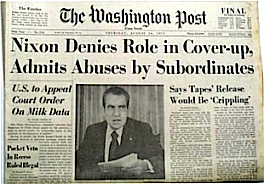 The Watergate scandal is the only such abuse of presidential power in the nation’s history that forced the resignation of an American President. But as the Trump presidency has rapidly plummeted, it is painfully instructive to compare 2016-17 to 1972-74.
The full breadth of Watergate could not be evident when the July, 1972 break-in occurred at the Democratic National Committee headquarters in the Watergate office building in Washington. What was described by President Nixon as a third-rate burglary actually seemed like a third-rate burglary at the time, a failed caper of an inept gang who couldn’t shoot straight. But then the story slowly began to grow.
Before the election of 2016, there were isolated rumblings about a dubious Russian connection in the Trump campaign. After Mr. Trump’s election, the rumblings grew louder. Investigative reporters in the news media kept bringing up stories that appeared to validate the suspicions of Russian skullduggery in the 2016 election, possibly encouraged by candidate Trump himself.
In a televised speech in August of 1973, President Nixon denied any White House involvement in Watergate. Most Americans believed him.
In a string of speeches and tweets since early 2017, President Trump has denied any Russian irregularities or illegalities. Initially, many American believed him, but many others were viscerally unwilling to believe anything he said. As personalities, Nixon and Trump are mentally and temperamentally more unalike than alike, even though there are many similarities.
In the fall of 1972 Nixon ordered the CIA to impede the FBI’s investigation. In the meantime, seven Watergate conspirators were indicted. Five pled guilty to avoid a trial, and two were convicted at trial in January of 1973.
In mid-2017 President Trump ordered FBI Director James Comey to stop the FBI investigation into the Russia connection and other potential irregularities or illegalities. When Comey refused, he was fired. A new FBI director was eventually approved. In the meantime, Congress appointed a Special Counsel, Robert Mueller, a former FBI director, to begin an investigation of President Trump. The President has threatened to fire Mueller, but on the very strong advice of many White House and congressional counselors he has refrained thus far from doing so.
In the fall of 1972, the Senate formed its own committee to investigate Watergate. Judge John Sirica, who presided at the trial of the Watergate conspirators, began to demand more information as the trial proceeded.
In the spring of 2017 the Senate and the House Intelligence Committees began their own investigations into allegations regarding Russia and other potential improprieties in the Trump administration.
John Dean, President Nixon’s White House attorney, revealed under oath that President Nixon secretly taped every White House conversation he ever had with anyone. Judge Sirica demanded that the tapes be turned over. In the summer and early fall of 1973, Mr. Nixon postulated that executive privilege allowed him to refuse to do so. Archibald Cox, the Special Prosecutor who had been named, Judge Sirica, and the Senate Investigating Committee again demanded the turnover of the tapes.
In the summer of 2017, many people have asked whether all presidential conversations in the White House are taped. To date Mr. Trump has declared there are no such tapes, and even if there were, he said executive privilege would protect them from outside investigation.
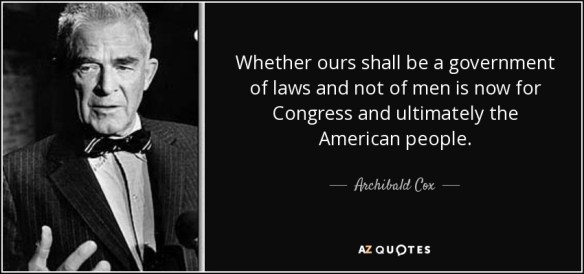 October 23, 1973 was the date of the infamous “Saturday Night Massacre.” In it Richard Nixon fired Archibald Cox. Several high-ranking Republicans in the Justice Department resigned in protest.
Since he took office, Donald Trump has fired several key members of his administration. Regularly he hints at firing even more.
On March 1, 1974, after much legal wrangling, President Nixon finally turned over most, but not all, of the White House tapes. A grand jury also indicted seven White House aides, referring to the President “an un-named co-conspirator.”
In July of 1974 the Supreme Court ordered all the White House audio tapes to be released. Mr. Nixon resisted the order, and the House of Representatives initiated an impeachment trial against him.
On August 5, 1974 Mr. Nixon at last relinquished all the tapes. They proved his part in the Watergate cover-up beyond any doubt. On August 8, after consultation with his closest associates, the President resigned.
The English political philosopher Edmund Burke made a statement which has rung true ever since he said it almost three centuries ago: “Those who don’t know history are doomed to repeat it.”
The Relationship of Donald Trump to the GOP
When there were seventeen people vying for the Republican nomination for the presidency, sixteen of those candidates declared in varying ways and with varying words that Donald Trump was not really a Republican. His behavior during the campaign and since his election has sometimes, but not always, proven them correct. Mr. Trump’s appeal is based on populism, not on traditional Republican principles, although many of his decisions in office certainly do reflect a time-honored conservative philosophy.
The Wall Street Journal has probably been a Republican-leaning newspaper as long as it has existed. During the primary campaign, their opposition to Mr. Trump was very obvious. Since his election, their support of his policy decisions has been squeamishly tepid at best.
Recently, WSJ published a story about the President’s remarks to a group of law enforcement officers in which he urged them, “Don’t be too nice” when arresting “thugs.” Other law enforcement officials took strong issue with the President’s get-tough remarks. The Journal article seemed to side with the more irenic observations of the executive director of the Major Cities Chiefs Association than with the President.
Another WSJ story had the headline, “Trump Deepens GOP Divide.” It cited how the President’s attacks on the attorney-general, the collapse of the GOP health bill, the demand to bar transgender people from the military, and the White House staff shake-ups have caused serious fissures in the Republican Party. It quoted former Rep. John Jolly, a Republican from Florida, who said, “Particularly among some of my former colleagues in the House, there is a frustration and lament about opportunities squandered in what should be a prime time for the Republican legislative agenda.”
A recent USA Today story was entitled “War with his own party risks isolating Trump.” The writer, Susan Page, wrote, “(The President’s) ability to reach voters drawn by his personal appeal rather than his party affiliation has been a source of his political strength and possibility in a nation where allegiance to Republicans and Democrats has eroded.”
Therein lies a major factor in the unique political dilemma Donald Trump represents. He is as strong as ever with his base. But his base cannot be equated to the traditional Republican base. Instead it is solely the Trump base of support and not the wider Republican base.
Daily he tweets to his base. When under severe attack, he immediately stages a rally of his supporters to cheer him up and cheer him on, as he did recently in West Virginia. His tweet that transgender people should not be allowed into the military appealed to many of his most ardent followers. But because it was simply a tweet, and not an official presidential order, the military has very noticeably done nothing and apparently intends to do nothing to implement the mercurial twitter.
Mr. Trump’s erratic actions are enormously disruptive. They often represent no carefully-considered or official policies. Instead, they represent only the momentary mental meanderings of an unstable mind.
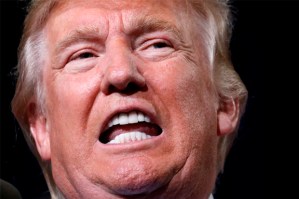 Donald Trump is a bully. Every objective biography of the man chronicles that he has been a lifelong bully. Narcissists usually exhibit that behavior. Typically, bullies are defeated only when confronted by the employment of overwhelming force or by the threat of overwhelming force. Before tanks surround the White House, there is a logical and increasingly obvious means of resolving the Trump Dilemma.
Donald Trump cannot be faulted for being an irremediable narcissist. No one with any mental disorder would ever choose it. But it is inadvisable, unpredictable, and unacceptable for any government, especially a democratic one, to enable someone who is mentally unstable to remain in its highest office.
No one knows Donald Trump’s long-range intentions, including Donald Trump. Probably he is mentally too flighty to have any long-range political plans. But his day-to-day decisions are so damaging that for the sake of American stability, he must quickly be removed from the presidency.
Very soon, a sizable coalition of Congressional Republican leaders plus some of the highest members of the Trump administration must confront the President, demanding his resignation. The nation cannot afford the lengthy time it would take to go through an impeachment trial or an Amendment XXV congressional hearing. And we certainly cannot risk waiting forty-plus months to vote Mr. Trump out of the White House.
Whether Donald Trump is a genuine Republican is, and always will be, debatable. But he ran for the presidency as a Republican, he won as a Republican, and, at least for the present, he has not disavowed the Republican Party.
Therefore it is only Republican leaders who can bully the bully into resignation. If they fail to do that, they shall irreparably damage their party in the 2018 congressional election and the 2020 presidential and congressional election.
This country needs two responsible political parties. Whether the Democrats are currently acting responsibly is also a debatable and ongoing question. But fact is this: The necessity for restoring the political health of our nation now rests primarily on the backs of the most influential Republican leaders.
Throughout the tumultuous Trump presidency, there has been a widespread sanguine opinion that the USA will survive Donald Trump, whatever might happen in the next three and a half years. We have managed to survive numerous other crises in our 240+ years of history. But when you consider what has happened in just the last seven months, it may be a very sanguine view that we shall inevitably muddle through once again.
It took more than two full years for Watergate to be resolved. The past seven months feel like seven years. If we wait nearly three and a half more years, it will seem like an eternity. Remember Edmund Burke.
A sanguine attitude toward the current crisis could be the correct one. If so, the dark musings of these three essays are all in vain. If such a view is incorrect, however, a laissez faire opinion may eventually be perceived to incur as much guilt and condemnation as the presidency of Donald J. Trump.
- John Miller is a writer, author, lecturer, and preacher-for-over-fifty-years who is pastor of The Chapel Without Walls on Hilton Head Island, SC



 When one grew up in the shadow of a father who had been arrested and discharged,
  I was 17 the day I learned about groceries in America.
 On Pennington Island the kids from Philadelphia and the Philadelphia suburbs spent nights together in the same cabins, rose early for “morning watch”, played games, ate the same food at the same tables in the mess hall, swam in the same swimming pool, and sang hymns and spirituals like Jacob’s Ladder. We were living in the same economy while climbing somewhere together.
 As we began to unload the groceries from the ’55 Buick, Tony’s eyes grew bigger. There was more than one bag. Never had he seen multiple grocery bags. When the Lewises had a little money, they’d bring home what they needed for the day…or maybe two, on a good day. There were never five, six, seven bags of groceries.
 “Grandpa, the President just said he wants me to feel safe to play outside, right?”





 Tony’s older brother Danny didn’t like white people. He had left the church to become a convert to
  Some Chronos moments are Kairos moments, as the day with Tony was for me. Others are time bent over a toilet seat. The difference is as clear as black and white, poor and rich. How many of the women from Berean rose every morning to put on their maid uniforms to catch the subway and the Red Arrow bus to become invisible, forgotten “soldiers of the cross” in the wealthy homes on the Main Line an hour’s ride west of Philadelphia?
