Synchronizing tolerance and intolerance

Holding together two opposite thoughts and feelings is a challenge these days.

I’m trying to synchronize very different things I “know” to be true.

So far, I’m failing –one is almost always taller and stronger than the other.

Or maybe being out of sync isn’t a failure. Perhaps insisting on synchronicity is childish. Maybe being all grown up and stuff means being able to listen to Beethoven while watching a baseball game. Some things you don’t have to synchronize. Some contrasts don’t have to be resolved. Some opposites are worth maintaining for one’s mental health.

Take, for instance, tolerance and intolerance. Is it possible, or morally permissible, to be tolerant or intolerant, or do we have to synchronize them, and, if we do, what would that look like? You can’t be tolerant and intolerant of everything! Some decisions must be made. But maybe you still can synchronize them according some deeper sense of self and world — like the search for beauty, truth, and goodness.

Intolerant people whip up my intolerance for intolerance.

It’s very hard to synchronize when you feel like your country is drowning!

Gordon C. Stewart, May 24, 2019, “drowning in Chaska” MN.

The Inland Sea

Black-eyed Susans

Do the Black-eyed Susans
above the seawall hear
the pounding of the waves
or do they only see the
tumult of the Inland Sea?

Do they know their October
eyes are only for a season
while they themselves abide
through winter storms to
bloom again in summer?

Do they resent the coming
freeze that buries them all
above the wall or do they
wait in a Black-eyed Susan
Inland Sea for eyes to see?

— Gordon C. Stewart, North Shore of Lake Superior, Two Harbors, MN, copyright, 2014

Elijah’s Second Birthday . . . Again

Happy Birthday, Elijah!

Thanks, Bumpa! I’m two again for the first time!

I know. Grandma and I are coming over to celebrate your second birthday with you and Mom.

Right now?

First I have to finish cooking the bacon.

Why?

Why what?

I was already two!

I know. You were. You were two MONTHS old. It’s confusing. Today you’re two YEARS!

Yeah, I don’t know stuff like that yet. I’m still liddle. But I’m not a baby!!!

So . . . Whatcha doin’, Elijah?

Baking cookies!

You’re baking cookies?

Well . . . Mom’s baking the cookies. I’m helping. I love Mom!

That makes me happy. How are you helping?

I’m gonna take the cookies out of the oven, Bumpa! You’ll see when you come over.

Wow! You couldn’t do that the first time you were two. Be careful, okay?

I am, Bumpa. HOT, HOT! I’ll put my mittens on. Happy Birthday to me!!!

Elijah and Mom baking cookies for Elijah’s second birthday party

Gordon C. Stewart (Bumpa), Chaska, MN, May 19, 2019

Smiling on the Way Home

Readers of Views from the Edge know we’ve been offline for a while. There’s enough gloom in the world, and I’ve been feeling kind of gloomy. No one needs one more Gloomy Gus. So I’ve kept the words to myself, reading and writing for edification and a character adjustment.

You might say, I haven’t been home lately. Except for moments with grandson Elijah, whose latest word is ‘home’, laughter has come harder than words. Elijah sends me home to the self I’d almost lost — the childlike self not yet weighed down by adult concerns. Then, this morning, something akin to Elijah’s joy hit me. Turning again to William Britton’s Wisdom from the Margins: Daily Readings, it was almost as though I had been commanded home to joy.

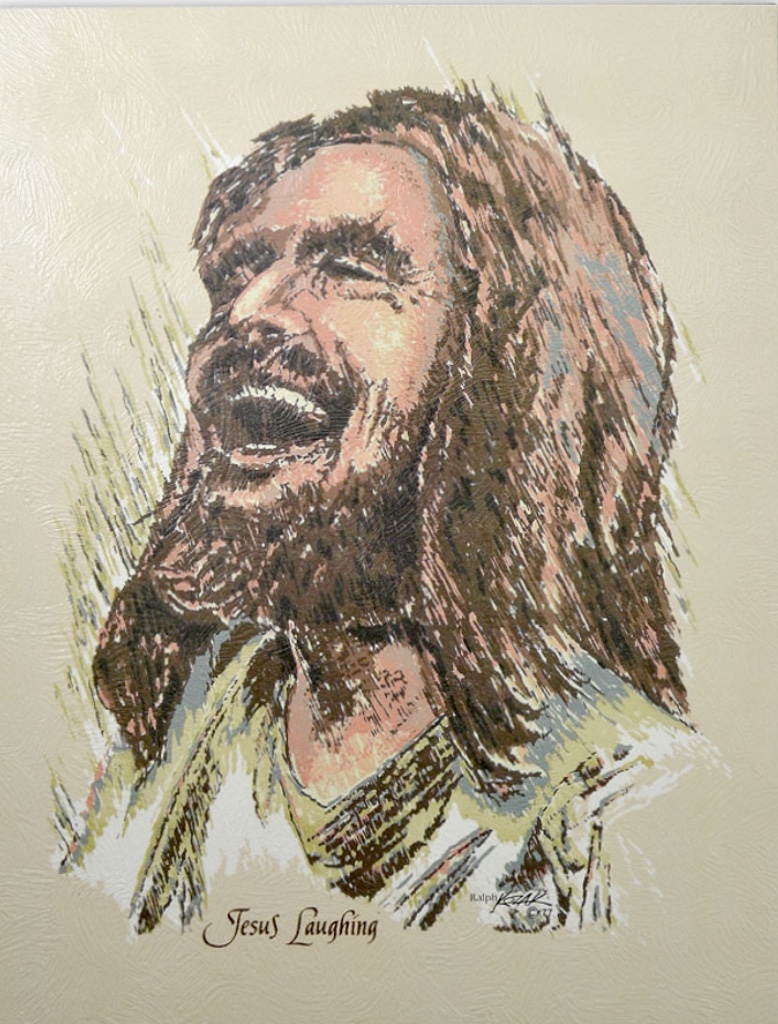
The Laughing Christ

“When I imagine Jesus, it is not simply as a person who heals the sick, raises the dead, stills the storm, and preaches good news. It’s also as a man of great goodwill and compassion, with a zest for life . . . brimming with generous good humor. Full of high spirits. Playful. Even fun. Interestingly, in the past few decades two images of a joyful Jesus have enjoyed some popularity. The first is The Laughing Christ by Willis Wheatley, a sketch that shows Jesus’s head throw back in open-mouthed laughter. The second is The Risen Christ by the Sea, a colorful portrait of Jesus wearing a broad smile and standing beside a fishing net, painted by Jack Jewell, a seascape artist in the 1990s. These two paintings, among others, serve to counteract countless images of the gloomy Messiah. . . . But I wonder if some eschew these portraits because of . . . their subject material. Is there something about a smiling Jesus that threatens our understanding of the man?”

James Martin, Between Heaven and Mirth

“Okay, “I said. I’ve been AWOL for a while, painting myself in the likeness of the faithful man of sorrows who weeps over the city, a serious, joyless man who didn’t smile much and laughed rarely, if at all, on the way to the cross.

Reading Jesus’ response to his critics gives a clue to a different character more like The Laughing Christ. Jesus’s rebuke to his critics — “The Son of Man came eating and drinking, and they say, ‘Here is a a glutton and a drunkard, a friend of tax collectors and sinners “(Mt 11:18 NIV) — offers a clue to a laughing Jesus. There’s a glimpse of truth in most criticisms. Many Christians quickly rise to Jesus defense. We’re okay with the criticism that he ate and drank with sinners; we’re not okay with the accusation that he was a glutton and a drunkard. We become like my six year-old cousin and I charging up the stairs to tell Aunt Gertrude (Dennis’s mother) we’d discovered a six-pack in the basement refrigerator we were forbidden to go near: “I didn’t know my father was a drinkin’ man!” said Dennis. Surely Jesus was not a drinking man! “ There was never any beer in Jesus’s refrigerator. “Jesus was not a glutton and a drunkard!”

Both criticisms must have had a hint of truth to them. “Why do the disciples of John fast often, and make prayers, and likewise the disciples of the Pharises; but yours eat and drink?” (Luke 5:13.) Jesus must have savored the taste of a home-cooked meal, and lifted a glass or two in light-hearted moments at a party, not just at the Last Supper. The alternative to Jesus’s critics is not that Jesus never got a little tipsy or ate too much at a party. It would be ludicrous to criticize a tea-totaller on Weight Watchers for being “a glutton and a drunkard”! Jesus was no Gloomy Gus who never laughed. He wasn’t solemn or holy enough for his critics.

So here I am today, back online, opening my eyes to “The Laughing Christ” and “The Risen Christ by the Sea” that challenge the gloomy spirituality of gloom and doom, on my way home to a more buoyant joyful spirit the news can’t take away.

— Gordon C. Stewart, Chaska, MN, May 17, 2019.

America as Babylon

THE BACK STORY: Introduction to Martin Gonzalez Sostre

It was during our weekly Wednesday evening program with prisoners in Dannemora, NY  that I first learned about the case of Martin Gonzalez Sostre, held in solitary confinement in resistance to dehumanizing prison practices, and joined the campaign for his release.

A year later at the Gunnison Memorial Chapel of St. Lawrence University I delivered a sermon inspired by a fresh reading of the Book of Revelation and what I had learned about Martin. The sermon – “Worship and Resistance: the Exercise of Freedom” – was  published by The Christian Century in March, 1974.

The first half of the “Worship and Resistance: The Exercise of Freedom” introduces the hearer/ reader to Martin Sostre’s resistance as a political prisoner incarcerated in solitary confinement at Clinton Correctional Facility in Dannemora, NY, known as “New York’s Siberia” or, as the inmates refer to it, “the Hell Hole of the New York Prison system”.

THE CONTINUING STORY: resistance as worship

Excerpts from “Worship and Resistance: The Exercise of Freedom:

“Incarcerated on the Aegean Island of Patmos, a penal settlement of the Roman Empire in the first century A.D., was a political prisoner named John. He wrote a political-religious manifesto declaring open resistance to the Roman Empire. The Revelation to John – the Apocalypse, the last book of the Bible – is the earliest extant Christian tract deliberately and openly directed against the pretensions of the world’s greatest power. In the Revelation to John, resistance to Roman power and authority is so inextricably bound together with worship of God that they constitute two sides of the same coin. Worship and resistance are the twin sides of faith’s freedom to celebrate God’s gift of life. The unity of resistance and worship is expressed with notable clarity in the passage where the fall of mighty Babylon occasions a celebration in heaven. The destruction of Babylon is joined to the salvation of the world itself and is the sign of God’s power and righteous rule over the nations. Only those who profit by Babylon’s wealth, power and injustice have reason to mourn her fall, while those who have ‘come out of her’ – who have disentangled themselves from her oppression, corruption and imperial claims – have cause to worship God and sing joyful hymns of praise.”

….

“Babylon is the state or nation in its presumption to be God. Babylon is any state, nation, or constellation of principalities and powers, which attempts to rule as final judge of persons and nations. Babylon is any such power – in any time or place – which makes its people subjects, calling them into idolatry of the nations, and any state or nation that persecutes its prophets of righteousness, peace and justice while rewarding the aggressive supporters and the silent ones who acquiesce. America is Babylon.”

….

“Envision once more a visit to Clinton Correctional Facility. Remember the disorienting sensation of having left everything familiar on the other side of the wall, the feeling of walking out of a real world into a nightmare, the shock induced by the size of the walls and the presence of the guards – strange and terrifying.

“But the closer one gets to the prison reality, the more one comes to realize that it is not so strange, that it is simply a more exaggerated and visible form of our own everyday reality in the face of death. Here on the outside, the walls are not visible, but they are much higher. Out here the guards do not stand poised with machine guns, but they are real and far more powerful – the guards our own fears provide.”
….
“Then I heard another voice from heaven saying, ‘Come out of her, my people, lest you take part in her sins…’” (Rev. 18:4 RSV).

THE FRONT STORY: 2017

I see more clearly now what I took into the pulpit at St. Lawrence in 1974, magnified a thousand times over in the name of a false patriotism that turns love of country into worship of America. “We’re going to make America great again!”

In the Book of Revelation Babylon is the mythic city that dehumanizes its people, the “bad” city (to use a favorite word of our current president) which people of faith and conscience are called to resist. Worship requires it. Without resistance, worship is dead. So is the U.S. Constitution and a democratic republic.

  • Gordon C. Stewart, Chaska, MN, April 1, 2017

By the Rivers of Babylon (Dennis Aubrey)

Dennis Aubrey of Via Lucis became a friend after we found each other’s work through the web. As he has many times before, Dennis has spoken for me.

Dennis Aubrey's avatar

By the rivers of Babylon, there we sat down
Yea, we wept, when we remembered Zion.
We hanged our harps upon the willows in the midst thereof.
For there they that carried us away captive required of us a song;
And they that wasted us required of us mirth, saying, Sing us one of the songs of Zion.
How shall we sing the Lord’s song in a strange land?

Psalm 137:1-4 (King James Version)

When I lived in Los Angeles from 1972 to 2000, the city was filled with men and women who lived and died on the streets. It seemed an inevitable part of urban life, where displaced humanity would collect in the hidden corners of our cities. Facilities for the mentally ill had closed, prices for homes had accelerated and more people lost their ability to own or even rent. I knew what was happening in the rust…

View original post 761 more words

Truth and Lies

This brief video addresses questions that continue to stump me. Will we ever get it back? Whatever one’s view of Barack Obama, one cannot refute the flagrant juxtapositions between the values the current Republican Party professes and the real life disdain for those same values.

President Barack Obama to Republican supporters of Donald Trump.

It’s time to stop the White House’s frontal assault on the equality among the three branches of federal government defined under the U.S. Constitution. Time for us, the American people, to tell those in Congress to do what Congress is supposed to do. Contempt of Congress is partisan. It is contempt for the institution itself, and for the Constitution that establishes and protects the American experiment under the rule of law. It’s time for boldness.

Anyone who witnessed Attorney General Barr’s testimony before the Senate Judiciary Committee saw and heard the AG’s disdain for truth-telling. He lied. The next day he refused to appear before the House Committee. This is not time for patience. It’s time for Congress to act swiftly and boldly with arrests for contempt of Congress.

  • Gordon C. Stewart, Chaska, MN, May 3, 2019.

Tell me what you know

“I notice that as soon as writers broach this question, they
begin to quote. I hate quotations. Tell me what you know.”
— Ralph Waldo Emerson, Journals

If we don’t say what we know, what happens next will be on us. We can’t let that happen.

The question to which Ralph Waldo Emerson referred in his journal was different from the one we broach now, but — with apologies for the quotation he would have hated — his challenge to us would be the same: Tell me what you know. If we don’t speak what we know, the shredding of the U.S. Constitution’s system if checks-and-balances among three equal branches of government will be on us.

Emerson was referring to immortality. He knew what many others did not. No one really knows about immortality. Not first-hand. His advice can be understood differently by reading the last sentence aloud, stessing different words— tell me what you know, or tell me what you know — but no matter where you put the emphasis, Emerson’s point seems to have been the same. Don’t speculate. Speak of what you know from your own experience..

What you see with your eyes, hear with your ears, smell with you nose can be delusional, but seeing, hearing, and smelling are the ways mere mortals know whatever we know, or think we know.

What my EYES know

Whenever Donald Trump comes into view — I see a peacock. A peacock’s feathers are stunning. They’re beautiful. And they know it. They strut. A peacock commands everyone’s attention. You can’t help but look. Such confidence! Look at all those eyes!

But, as I Iearned years ago visiting wealthy parishioners whose peacocks had free reign on the grounds of their estate, you keep your distance from a peacock. If you get too close, they make a ruckus. They shriek to put you on notice. Come closer and you will pay the price. Peacocks are mean.

Donald Trump speaking at CPAC 2011 in Washington, D.C. photo by Gage Skidmore from Peoria, AZ.

Watching the current American president feels like that. I see facial expressions when he tells an audience what he knows they want to hear instead of what he knows. He’s lying. Even his secure base knows it. I see the 2020 rallies, the crowds cheering for a peacock strutting around, fanning his feathers.

What my EARS know

You don’t need to have stood in the Rose Garden to know when a peacock is feeling cocky. Or threatened. You know from the sound. Bring a friendly television camera crew to show off his feathers by fanning his tail, and give him a microphone with free range and the peacock is in his glory. Camera crews permitted on his property have taken orher photos of the peacock strutting across the lawn with one of his harem, knowing the cameras already are rolling to show other TV-watching peacocks what he has that they don’t — except in their dreams — a hen with feathers like that! The peahen is all show. She never makes a squack. She only speaks out to shine the light on school bullies, guys like Daryl at my elementary school and like whoever bullied her peacock before he learned to preen and parade his way to the world’s biggest playground.

The peacock hardly ever tells the truth. Everyone knows he lies all the time. He may know it; he may not. It’s hard to tell. He speaks convincingly as one who knows, and knows more than all the other peacocks and members of the camera crews. He never quotes anyone, routinely referring to himself in the third person, as though someone else is speaking about him. What we hear is very strange. Ornotholigists provide a more objective description of the peacock’s behavior.

The peacock’s behavior is a common cause for fear. They are known to be aggressive, fiercely territorial birds…. The peacock’s low intelligence has caused wild peacocks in urban areas to attack dark-colored luxury cars: the birds see their reflections, interpret it as a second bird and attack. Peacocks have also been seen chasing people to take their food. At the same time, when a peacock is angry they have a tendency to spread themselves out – and seeing a bird your size or larger fan out, with feathers that could be misconstrued as eyes, is more than enough to cause a child to develop a long-standing phobia.

–Blake Flournoy, “Reasons to Fear Peacocks,” Sciencing, 2018.

I hear loud shrieks as the peacock chases the camera crews off the property. But the shrieks are not loud enough to drown out the sound of paper shredders shredding the papers the camera crews have come to see.

What my NOSE knows

I have a long-standing fear of fire. I remember watching the flames and smelling the smoke from the four alarm fire I watched through my bedroom window. My father, a volunteer fireman, had left home that night to put out the fire. I was afraid he wouldn’t come back.

I’m no longer five years old, but my nose knows the smell and knows that where there’s smoke, there’s fire. I smell smoke coming from the White House. I smell the Constitution burning, and see a peacock running loose, attacking his own reflection on the presidential limousine.

Leave YOUR COMMENT to widen the conversation. Tell me what you know.

–Gordon C. Stewart, Chaska, MN, April 26, 2019.

Donald Trump Photo Attribution: Donald Trump speaking at CPAC 201; photo by Greg Skidmore.

Elijah asks Grandpa about lying

Bumpa, put your hearings in. I got a question. It’s serious.

Okay. Just a minute. Now, what’s your question, Elijah?

We’re not supposed to lie, right?

Right. We should always tell the truth. We don’t want be liars.

Why? Everybody’s doing it?

No they’re not, Who’s everybody?

The mean guys!

What mean guys?

The Publicans!

You mean Republicans?

Yea, them. The Publicans.

Where’d you get that, Elijah?

I saw it on Rachel!. We couldn’t watch Simple Songs at daycare!

What did you see?

The Publicans putting little Mexican children in prison. I saw it on TV.

Okay, I see. Anything else?

Yes. Marissa says we don ‘t have to worry about dictators. We shouldn’t have to worry about dictators. Right, Bumpa? What’s a dictator?

Ah, I see. Dictators do whatever they want. They lie and cheat and get away with murder. Their countries don’t have constitutions to check their power. Understand?

We live in America, right?

Well, yes. We live in North America, like Canada, but yes, our country is called The United States of America. Does that make sense?

Bumpa, I’m only 23!

No, you’re not 23. You’re almost two. You’re 23 months, not years. You have 16 more years before you can vote.

That’s not fair! One last question before you clean your hearing aids, and don’t make it complicated.

Okay, shoot. Try me.

You said we don’t have a dictator. Do we really have a constitution?

Preamble of the United States of America

— Gordon (Bumpa) and Elijah, Chaska, MN, April 27, 2019.

The Miracle of Reconciliation– Two Memories of Good Friday

MY M0THER AND THE THREE MARYS

I remember my mother’s tears on this day, Good Friday, and wondering why she was so sad. Jesus had been crucified a long, long time ago. It wasn’t happening now. But, to Mom, it was. Like the three Mary’s at the foot of the cross, Mom was weeping in her pew. I remember the white handkerchief dabbing the corners of her eyes.

I was five or six years old the first time I saw Mom at the foot of the cross with the three Marys. The Marys were all gone. Only Mom and her white handkerchief continued the vigil, and it happened every year on Good Friday. It was in junior high school that I began to get under the tears and weep them for myself. I “got” the cruelty of it.

The pounding of nails into wrists and feet. The soldiers laughing at him while they gambled for his clothes. If they were gambling for his clothes, was Jesus naked in front of the whole world? Was the crown of thorns the only thing he wore? Were the thorns cutting into his head? “I thirst.” They give him vinegar on the end of stick! He looks down at John. “Behold your mother; woman, behold your son.” Take my mother home! Mary doesn’t go home. She stays by him until the end. She winces at the nightmare she cannot end: “Eloi, Eloi, lama sabstachtani?” (My God, my God, why have You abandoned me?), watches as a soldier puts a hole in his side; weeps inconsolably when it is finished, and they take him away.

How could Mom not cry hearing that? How could anyone not reach for a handkerchief?

“GOD WAS IN CHRIST, RECONCILING THE WORLD TO HIMSELF”

Years later, Ken and Ilse Beaufoy and I observed Good Friday in the pews of Shepherd of the Hill Presbyterian Church. Aside from one or two others who dropped by for a short time each year, we were alone in the church. Beginning at noon, at half hour intervals, we read aloud a portion of the Passion narratives, paused in silence, listened to the corresponding musical movement from Rutter’s Requiem, spoke a brief prayer, and sat in the stillness until the next half hour.

The Good Fridays with Ken (and Ilse, before she died) were unique. An American Presbyterian minister with a married couple, Ken, a former Biitish soldier, and Ilse, a former member of the Luftwaffe. Ken and Ilse met at a dance sponsored by the Allied occupation that followed the end of WW II.

Ilse was one of two women soldiers awarded the Iron Cross for standing her post during the Allied bombing of Hamburg.

Despite objections and death threats from family members, Ken and Ilse committed themselves to the bonds of marriage. What else but the reconciling love of God could bridge the gulf of former enemy combatants? Five decades later, Ilse died moments after hearing the words of permission that would only have meaning to a decorated war hero who had stayed at her anti-aircraft post atop the Hamburg bunker to protect the civilians below. “You no longer need to stand your post. You no longer need to fight. It’s time to go home. Go in peace.” From that day on, there were just the two of us staying by the cross from noon to 3:00 on Good Friday.

Rutter’s “Pie Jesu” did not explain the crucifixion or the peace it brought Ken and Ilse Beaufoy. It didn’t need to. Some things cannot be explained. They can only be lived…with thanksgiving for abounding grace while dabbing the corner of your eyes with a handkerchief.

— Gordon C. Stewart by the wilderness, Minnesota, Good Friday, April 19, 2019