The Return of the Night Visitor

He slinks down Pennsylvania Avenue, head down in a hoodie at 3:00 A.M., disguised as a homeless man, escaping the watchful eye of the Secret Service and the television cameras, returning to the dilapidated tenement in the poorest part of the city.

FBI Unabomber sketch

The tenement dweller who owns nothing has been waiting for him since their last visit. The apartment door is ajar, as it always is, in anticipatory welcome of all the homeless.

“Welcome, Donald. I wondered when we’d have another visit.” As he had during the first visit, he lifts the heavy coat from the visitor’s slumping shoulders, and points to the furniture he’d rescued from a dumpster — an old folding chair missing a slat, and the torn red-leather wingback, facing each other each as they had before. The night visitor pauses and chooses the high wingback.

The scene is the same as previously. The room is dimly lit by a small table lamp, the kind of late night or early morning light that creates an ambiance of calm and invites intimate conversation. The tenement dweller takes his seat in the folding chair. The visitor sits in silence, his hoodie still covering his head, not wanting to be seen, but wanting to be seen. The room is silent.

“I’ve been very concerned, friend. I see you’ve been tweeting a lot again. It must be lonely inside the wall. But it doesn’t show outside your wall. Others can’t see it. The you who’s visible to those outside the wall is cruel, vengeful, because in the world outside your wall And you’ve shut down the government over the wall. What’s that about? Tell me about that.”

“I can’t sleep. The family’s gone to Florida. I’m alone here with no one but the maids, the cooks and the butlers. My mind won’t stop. I watch television to settle down but now it only makes things worse. Even my favorite network may be turning on me.”

“What brings you here? It’s 3:30 A.M.

“I don’t know.” The table lamp flickers.

“Feels pretty dark, doesn’t it?”

“Very dark. Very dark! The darkest ever!”

“Why is that?”

The visitor lowers his head, like a child confessing to his parents. “I have all the power in the world but I’m helpless to help myself. I can’t stop tweeting. It’s like it’s not real. I could destroy the world with the push of a button. I’ve shut down the government. The power scares me. And there are all these investigations. My mind never stops. I can’t sleep.”

The tenement dweller in the small folding wood chair sits quietly in the hush that comes when truth has been spoken. His eyes are full of compassion for the homeless man who had opted for the big red leather wingback. The visitor has regressed since their last conversation. His need for self-assurance has grown worse. The walls have gone up.

“Remember our last visit, Donald? Your disguise is not a disguise. You’re hiding something. Do you ever watch ‘Ray Donovan‘?

Ray Donovan

“No. Why? Who’s Ray Donovan?”

“Ray’s’a fixer’, like Michael, but that’s not why I asked. Ray’s a lot like you, Donald. Ray’s running from what was done to him in childhood. He was molested by the man he trusted. His parish priest. He’s not been the same since. Ray built a wall around his heart. He’s cruel. He’s heartless. But inside the wall? He’s very tender, Donald. He’s homeless within his own wall. You can’t live inside the wall.”

From his small, wood chair, the tenement dweller reaches out his hand. They share a long silence before the host put Donald’s heavy coat back on his shoulders. In the pre-dawn darkness, the disguised night visitor returns to his homeless place on Pennsylvania Avenue. He hears singing from the street below.

“Softly and tenderly Jesus is calling—
  Calling for you and for me;
Patiently Jesus is waiting and watching—
  Watching for you and for me!
“Come home! come home!
  Ye who are weary, come home!
Earnestly, tenderly, Jesus is calling,
    Calling, O sinner, come home!”
Will Lamartine Thompson (1847-1909)

The tenement dweller smiles at the sound, but h knows it won’t be long before he comes back.
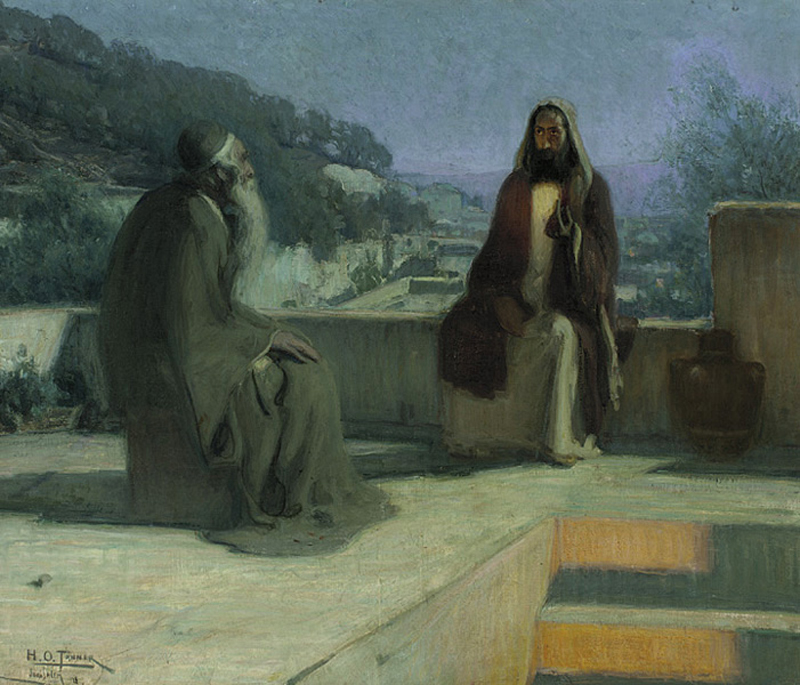
Nicodemus and Jesus on a rooftop, Tanner, Henry Ossawa, 1859-1937
Nicodemus and Jesus on a rooftop, Henry Ossawa Tanner (1859-1937)

Gordon C. Stewart, Chaska, MN, March 12, 2017.

“and there arose such a clatter. . . “

The Word that cannot be domesticated keeps showing up in the strangest places, even where the culture has turned the crucified Jesus into a plastic babe in a manger. Or Santa Claus, at whose coming “there arose such a clatter . . . .” (A Visit from Saint Nicholas). But sometimes the Word that makes such a clatter comes from a pulpit, as it did this Christmas Eve where two unexpected visitors came to kneel before the manger at the National Cathedral (Episcopal) in Washington, D.C.

Click HERE to read and listen Ari Shapiro’s interview with Bishop Mariann Budde on NPR.

Nativity scene, date unknown (Meister von Hoenfurth)

No more let sins and sorrows grow,
Nor thorns infest the ground;
He comes to make His blessings flow
Far as the curse is found,
Far as, far as, the curse is found.

He rules the world with truth and grace,
And makes the nations prove
The glories of His righteousness,
And wonders of His love,
And wonders, wonders, of His love. – Joy to the World.

Merry Christmas to all, and to all a good night,

— Gordon C. Stewart, Chaska, MN, December 26, 2018.

Treat Yourself This Morning

The morning of Christmas Eve is a treasured moment in our household. We listen to The Festival of Nine Lessons and Carols from King’s College Chapel, Cambridge, England on National Public Radio (NPR).

The Festival of Nine Lessons and Carols airs live this morning at 10:00 EST in the USA. Put on the headphones, tune out everything else, and enjoy the sounds of reverence and praise.

Merry Christmas from our home to yours.

God bless us, every one,

Gordon C. Stewart, Chaska, MN, December 24, 2018.

Habits and Inspiration

I’ve never been a big fan of habits. In spite of what Octavia Butler believes — “Habit will sustain you, whether inspired or not” — I have scorned habits in favor of a more creative, spontaneous, non-habitual life. But this morning I came to my senses. I’ve not been inspired, and I’ve gotten out of a habit that sometimes brings inspiration.

Elijah joy IMG_9566

Elijah

I’ve felt like the psalmist . . .  or like poor little Elijah just 24 hours ago when he couldn’t keep anything down. Not even the Gatorade. When a joyful 19 month-old child gets sick, he doesn’t know what hit him. Sometimes his 76 year-old grandfather doesn’t know either.

Some viruses can’t be seen under a microscope. Some illnesses require more than an Internist’s diagnosis. Their origins defy medical explanation and resist our usual remedies: a stiff drink, an anti-depressant, vitamin and mineral supplements, exercise, or a change of diet. Which is where habits come in.

It’s been weeks since I got out of the habit of morning prayer. Flailing about at four o’clock this morning, I remember the line from Chaim Potok’s The Chosen: it’s the four-o’clock-in-the-morning questions that trouble us over a lifetime. I’ve gotten out of the habit of greeting the day with readings from the Book of Common Prayer (BCP), spending a quiet time pondering the psalms and other readings assigned by a calendar prescribed by doctors of the soul. I need to return to a healthy diet.

My best friend is hospitalized, awaiting surgery required by complications from pancreatic cancer. His time is limited. So is mine. Fifty-four years of friendship soon to vanish like the morning mist. Whatever happens today on the operating table, it won’t be long before one of us is gone. I open the BCP. “What profit is there in my blood, if I go down to the Pit? Will the dust praise you or declare your faithfulness? Hear, O LORD, and have mercy upon me; O LORD, be my helper,” cries the psalmist (Psalm 30:10-11, BCP), recognizing that there is no quick fix for what ails him.

My friend knows this feeling. He also has a habit that serves him well when the raindrops keep falling on his head. When the four-o’clock-in-the-morning clouds and torrential rains come over him, he turns, as do I this morning, to that which he has not made up, and crawls inside the psalmist’s faith that “weeping may spend the night, but joy comes in the morning” (Ps. 30:6, BCP).

Returning to the habit I’d neglected, I read the psalm again and pray for my friend. But I’m not seeing my friend. I’m seeing someone else. I’m looking at Elijah. He has crawled inside his mother’s watchful care…in the bathtub. He is smiling, playing, and splashing the bath water with no hint of memory of last night when he couldn’t even keep down the Gatorade.

“You have turned my wailing into dancing; you have put off my sack-cloth and clothed me with joy. Therefore my heart sings to you without ceasing; O LORD my God, I will give you thanks for ever” (Ps. 30:12-13. BCW).

— Gordon C. Stewart, Chaska, MN, December 15, 2018.

Escape at Dannemora

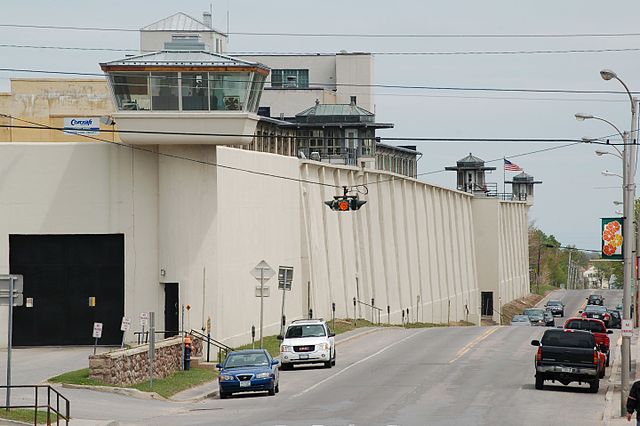
Watching the first episode of Showtime’s new series Escape at Dannemora was a de ja vu experience. The small town of Dannemora, tucked away in the far northeast corner of New York State, had been invisible to the public eye until June 6, 2015 when two inmates escaped from the town’s principal employer, the state penitentiary, Clinton Correctional Facility.

Clinton_correctional_facility,_Dannemora,_NY,_2007

Clinton Correctional Facility, Dannamora, NY

How I learned of Martin Sostre

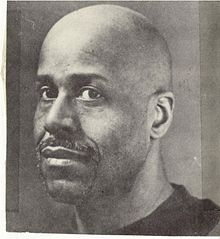
It was during the weekly Wednesday evening programs and visits with inmates at Dannemora that I learned about the case of Martin Gonzalez Sostre. Martin, who had owned and operated a radical black liberation bookstore in Buffalo, NY, insisted on his innocence, claiming he was a prisoner of conscience framed by a police set-up. Before his transfer to Dannemora from Attica, Martin he had filed and won the human rights court case — Sostre v. Rockefeller — that ruled against the routine practice of rectal searches following prisoner visitations with family and friends. Transferred from Attica to “New York’s Siberia” Dannemora, Martin continued to refuse all visitations. He was held in solitary confinement without access to anyone beyond the prison walls. A campaign for Martin’s release and pardon was happening without the benefit of direct access to Martin.

Martin Sostre and the Book of Revelation

No book of Christian scripture is more egregiously abused than the last book in the New Testament. The Apocalypse of John (Book of Revelation) is read as though it were a palm reader or a crystal ball. It wasn’t. Its author was a prisoner of conscience held by the Roman Empire on the Isle of Patmos. It was then, and is now, a work of social criticism expressed in the strange apocalyptic literary genre of its time. It’s not about the future. It’s about now.

The new series on the escape from Dannemora takes me back to my time with the inmates and guards within the prison walls, and the published sermon that came from that experience. Below are excerpts from the sermon at the Gunnison Memorial Chapel of St. Lawrence University in Canton, New York inspired by a prisoner of conscience named Martin Sostre and a fresh reading of The Book of Revelation through the eyes of the oppressed. The sermon “Worship and Resistance: the Exercise of Freedom,” was published soon after by The Christian Century (March, 1974).

“Worship and Resistance” links the case of Martin Gonzalez Sostre’s imprisonment in solitary confinement at Clinton Correctional Facility with the witness of faith by the prisoner of conscience in his own kind of solitary confinement on the Isle of Patmos. Dannemora is its own kind of island, known by inmates across the State of New York Correctional System, as “New York’s Siberia” — “the Hell Hole” of the New York prison system.

Excerpts from “Worship and Resistance: The Exercise of Freedom”

“Incarcerated on the Aegean Island of Patmos, a penal settlement of the Roman Empire in the first century A.D., was a political prisoner named John. He wrote a political-religious manifesto declaring open resistance to the Roman Empire. The Revelation to John – the Apocalypse, the last book of the Bible – is the earliest extant Christian tract deliberately and openly directed against the pretensions of the world’s greatest power. In the Revelation to John, resistance to Roman power and authority is so inextricably bound together with worship of God that they constitute two sides of the same coin. Worship and resistance are the twin sides of faith’s freedom to celebrate God’s gift of life. The unity of resistance and worship is expressed with notable clarity in the passage where the fall of mighty Babylon occasions a celebration in heaven. The destruction of Babylon is joined to the salvation of the world itself and is the sign of God’s power and righteous rule over the nations. Only those who profit by Babylon’s wealth, power and injustice have reason to mourn her fall, while those who have ‘come out of her’ – who have disentangled themselves from her oppression, corruption and imperial claims – have cause to worship and sing joyful hymns of praise.”

+++

William Stringfellow

William Stringfellow

“Babylon is the state or nation in its presumption to be God. Babylon is any state, nation, or constellation of principalities and powers, which attempts to rule as final judge of persons and nations. Babylon is any such power – in any time or place – which makes its people subjects, calling them into idolatry of the nations, and any state or nation that persecutes its prophets of righteousness, peace and justice while rewarding the aggressive supporters and the silent ones who acquiesce. America is Babylon.” –William Stringfellow, An Ethic for Christians and Other Aliens in a Strange Land.

“Envision once more a visit to Clinton Correctional Facility. Remember the disorienting sensation of having left everything familiar on the other side of the wall, the feeling of walking out of a real world into a nightmare, the shock induced by the size of the walls and the presence of the guards – strange and terrifying.

“But the closer one gets to the prison reality, the more one comes to realize that it is not so strange, that it is simply a more exaggerated and visible form of our own everyday reality in the face of death. Here on the outside, the walls are not visible, but they are much higher. Out here the guards do not stand poised with machine guns, but they are real and far more powerful – the guards our own fears provide.”
+++
“Then I heard another voice from heaven saying, ‘Come out of her, my people, lest you take part in her sins…’” (Rev. 18:4 RSV).

Meeting Martin Face-to-Face

Martin Sostre

Martin Gonzalez Sostre

Sometime following the sermon at Gunnison Memorial Chapel, a Dannemora guard informed us during the Wednesday visits with prisoners that Martin had been transferred temporarily to the Federal Detention Center in lower Manhattan, NYC, as a witness in someone else’s trial.  Unlike the state system, there are no body searches after visitations in the federal system. Martin would be free to accept visitors.

As a “man of the cloth” it fell to me to attempt a face-to-face visit on behalf of the committee working for Martin’s release. I drove the eight hours to lower Manhattan,  put on my clerical collar and presented myself to the kindly woman at the Detention Center reception desk as Martin’s pastor, hoping that 1) the prison officials would be unaware that Martin was not a Christian, and 2) Martin himself would accept the visitation from a complete stranger who claimed to be his pastor. A description of the experience just before the face-to-face visit appeared previously on Views from the Edge. Click “Robert” Who? for that part of the story.

The Release of Martin Sostre

In December 1973 Amnesty International put Sostre on its “prisoner of conscience” list, stating: “We became convinced that Martin Sostre has been the victim of an international miscarriage of justice because of his political beliefs . . . not for his crimes.” In addition to numerous defense committees in New York State, a Committee to Free Martin Sostre, made up of prominent citizens, joined in an effort to publicize Sostre’s case and petition the New York Governor Hugh Carey for his release. On December 7, 1975, Russian Nobel Peace Laureate Andrei Sakharov added his name to the clemency appeal. Governor Carey granted Sostre clemency on Christmas Eve of 1975; Sostre was released from prison in February 1976. Governor Carey eventually issued a pardon. — Wikipedia.

Worship and resistance are two sides of the same coin.

  • Gordon C. Stewart, Chaska, MN, December 16, 2018

Gratitude in Place and Time

Blake_jacobsladder

William Blake, Jacob’s Dream

Thanksgiving 2018 arrives as a welcome interruption. It invites us into a sacred pause in this time and place of national division. One place to pause is the story of Jacob wrestling with God, the Nameless Presence (Genesis  ), and the song “We are climbing Jacob’s ladder.” The Genesis story is Jacob’s dream the night before he would come face-to-face with the estranged brother he had every reason to fear. After many years of separation, Jacob is about to face the brother he had tricked and had stolen Esau’s right to the family inheritance. Jacob does not want to meet his brother. Neither do we Americans who will sit down to a turkey dinner with family members on the other side of the political fence from us. Discussion of Jacob’s Ladder might bring an insightful Thanksgiving 2018 around the tables where Donald Trump is the turkey the family is afraid to carve .

The origins of “Jacob’s Ladder”origins — African slaves singing in the cotton fields under the plantation owner’s nose — gives a different meaning to the song. Jacob’s Ladder and the biblical text from which it comes represent a great reversal in human consciousness. After Jacob was defeated by the Nameless Presence, his spirituality took a 180 degree turn. “Surely God was in this place, and I did not know it!” His encounter wth his estranged brother turns the tables from fear and the rule of violence to the unexpected gift of reconciling love.

Gratitude Doubled

Human_Infant_in_Incubator

Infant in incubator photo by Chris Horry, 2002.

As our way of offering Thanksgiving greetings, we share John Buchanan’s “Gratitude Doubled” reflection on becoming a great-grandfather of new-born twins in an incubator.

This Thanksgiving also marks the 18-month anniversary of grandson Elijah’s birth. Great-grandfather joy will have to wait a few years, but the sense of life as John speaks of it is immediate. Wishing you a grateful Thanksgiving.

Family of John M. Buchanan's avatarHold to the Good

Yesterday I experienced the most unlikely, most wonderful thing that has ever happened. I carefully extended my sanitized hand through the small, round opening in the incubator and, with my forefinger, gently touched the cheek of my brand new great-granddaughter, just 18 hours old. And then I did it again, reached through the small, round opening and touched the cheek of her identical twin sister, my second great-granddaughter.

I never thought much about great-grandparenthood. No one did. My great-grandparents were long gone when I was born and I have only vague memories of my parents talking about them, their grandparents. They were remote, to say the least.

But now, I am one, a great-grandfather and my new status has set me to ruminating – on, among other things, my own age. Unlike my great-grandparents, I’m still here, alive, well and reasonably active and healthy. And – I have seen and…

View original post 227 more words

Open Letter to President Trump

November 15, 2018

Dear Mr. President,

I’m concerned for the country. I’m also worried about you. The two go hand-in-hand, yet they are not the same. Though we have never met, we share something: we were baptized in Presbyterian churches. Neither of us can remember that moment. We were infants. We had no choice.

Because we do have a choice now, I write to share with you the story of another person who, unlike us, was old enough to choose.

Kosuke Koyama was 15 years old at the time. Japan was his country. Tokyo was his home. The United Church of Japan was his church family. The scene of his baptism could not be more different from ours. It was 1945 during the American fire bombing of Tokyo. The worshipers could hear the bombs exploding all around the church. Through the windows they could see the flames.

His pastor gently took  Koyama’s face in his hands, looked him in the eye, and charged him with words that succinctly say what baptism into Christ means:”Kosuke, you are a disciple of Jesus Christ. You must love your enemies. Even the Americans.” It was a defining moment for the rest of Kosuke’s life.

Kosuke Koyama - RIP

Kosuke Koyama (1929-2018 “Well done, good and faithful servant” (Mt. 25:23) RIP

Through the eyes of faith, Koyama later plumbed the depths of that moment, and came to a deeper understanding of what had happened to his native country. Japan had come to regard itself as exceptional — a singularly superior nation and culture. Japan had made itself into its own house god. It had twisted love of country (patriotism) into nationalism, and nationalism gave license for imperialist adventures that led to unimaginably horrific consequences. In 1967 the United Church of Japan issued a Confession of Responsibility During World War II as a way of restoring the church’s integrity.

Kosuke Koyama died in 2009 after a distinguished professional career that officially ended with his retirement from the John D. Rockefeller Chair of World Religion at Union Theological Seminary in your home city. Robert McAfee Brown, who wrote the book you and I were assigned to read in confirmation class, The Bible Speaks to You, was Koyama’s faculty colleague. During his 14 years at Union Seminary, and following his retirement, Dr. Koyama created a legacy that lives on in his books (Water Buffalo Theology, Mount Fuji and Most Sinai, No Handle on the Cross, and others) and in the lives of those he influenced by his teaching and humble character.

World War I centenary

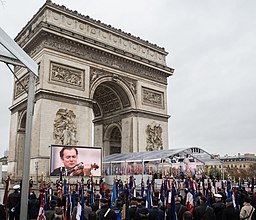
World War I Centenary, Paris, France, Nov. 11, 2018

Today you call yourself a nationalist. You have embraced the great sin that Kosuke came to see so clearly in his native country. Watching you at the Arc de Triomphe last week for the 100th anniversary of the armistice that ended World War I, I saw you through Koyama’s lens of faith. You sat among the company of other world leaders, but you looked very alone. Sitting very nervously away from the spotlight, you waved back to someone, as if to assure yourself of your importance. I saw a very lonely man without the company of friends and allies. In that moment, I felt a bit of sympathy for you. I wished you could slip away to a nearby cafe where we could talk, just the two of us as pastor and president.

Trump and Macron III July 2017Then I heard the President of France, Emmanuel Macron, step to the podium to issue a rebuke to nationalism as “a betrayal of patriotism” that eliminates what makes a nation great: its moral compass. While my heart leaped for joy, I wondered what you were feeling and thinking all alone there in Paris.

Patriotism is the exact opposite of nationalism. Nationalism is a betrayal of patriotism. By saying “our interests first, who cares about the others,” we erase what a nation holds dearest, what gives it life, what makes it great and what is essential: its moral values. I know there are old demons which are coming back to the surface. They are ready to wreak chaos and death. History sometimes threatens to take its sinister course once again.

I thought again of Koyama and wondered whether it would have made a difference if your pastor had baptized you during a bombing raid when you were old enough to choose, looked you in the eye, and said, “Donald, you are a disciple of Jesus Christ. You must love your enemies [and friends], even the French.” New York Avenue Presbyterian Church, a short walk from the White House. It was President Abraham Lincoln’s home church during his presidency. Mr. and Mrs. Lincoln worshiped there to hear a word from a free pulpit which they knew they could not command. It could become a home for you, Melania, and Baron, too.

I will pray for you. I will love our country. But I will not worship it. Neither should you.

Respectfully,

Gordon C. Stewart

Retired Minister (HR), Presbyterian Church (USA), Chaska, MN


No other gods — Je suis Français!

Je suis Français! Remember when Je suis Français (I am French) was everywhere on Facebook? That was three years ago after the November 13, 2015 terrorist attack in Paris. Americans identified with the French. Yesterday I felt like that again.

Marking the 100th anniversary of the armistice that ended World War I — “the War to End all Wars” — at the Arc de Triomphe in Paris, French President Emmanuel Macron spoke of the chaos and death unleashed by nationalism. Here’s an English translation of an excerpt:

Patriotism is the exact opposite of nationalism. Nationalism is a betrayal of patriotism. By saying “our interests first, who cares about the others,” we erase what a nation holds dearest, what gives it life, what makes it great and what is essential: its moral values. I know there are old demons which are coming back to the surface. They are ready to wreak chaos and death. History sometimes threatens to take its sinister course once again.

One need not be French to applaud Mr. Macron’s statement. Days before the national election in America, I wrote a piece on nationalism as the rising god of our time.  A wise friend advised against publishing it. He likely was right at the time. But Mr. Macron’s words at the Arc de Triomphe lead me to share a bit of what has been burdening my conscience.

Kosuke Koyama - RIP

Kosuke Koyama (1929-2009) RIP

Those of you who have followed Views from the Edge know how I see the world through the lens of faith. Be Still! Departure from Collective Madness (2017, Wipf & Stock) is dedicated to Japanese theologian Kosuka Koyama. “There is only one sin,” he said during a casual lunch. “Exceptionalism.” Born in 1929, Koyama had grown up with the myth of Japanese exceptionalism. The emperor could do no wrong. Japan had become its own god. Ko saw the same myth rising in America where he had settled with his his wife, Lois, a native Minnesotan.

Paul Tillich observed that whatever is one’s “ultimately concern” is a person’s or nation’s god. Tillich was one of earliest critics of the rising god of German nationalism that led to World War II and the Holocaust. Dismissed from his professorship at the University of Frankfurt i 1933, Paul Tillich, like Koyama, was invited to join the faculty of Union Theological Seminary in New York. It was Reinhold Niebuhr of Moral Man and Immoral Society who paved the way for Tillich, and later, Dietrich Bonhoeffer, to join the theological work of the academy on American soil.

My Christian understanding of faith and life is rooted in Niebuhr, Tillich, Bonhoeffer, Bonhoeffer’s friend Paul Lehmann, and Koyama. Only Koyama lived long enough to observe the old dead god rising to life again on American soil. All of them would have applauded Mr. Macron’s statement that nationalism is a betrayal of patriotism. “History sometimes threatens to take its sinister course again.”

To be human is by nature to be anxious. We know we are not God. We are mortal. Our time is mortal. “Time, like an ever-flowing stream, Soon bears us all away. We fly forgotten as a dream Dies at the opening day.” People who profess faith in the tradition of Abraham — Jews, Christians, Muslims — understand how quickly we turn to the “other gods” for our identity and security.

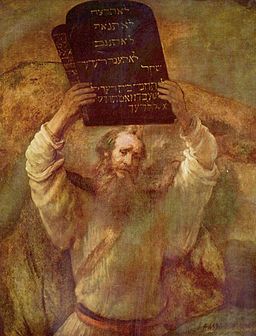
Rembrandt Moses and Commandments

Rembrandt’s painting of Moses crashing the Ten Commandments

“I am the LORD your God, who brought you up out of the land of Egypt, out of the house of bondage,” says the First Commandment. “You shall have no other gods before Me” (Exodus 20:2-3).

The “house of bondage” is not limited to geography or time. It is any nation that exalts itself as exceptional, any nation that practices hardness of heart to the foreigner, the alien, and sojourner. The First Commandment identifies “the house of bondage” as a god from which the LORD God of heaven and earth sets a person, a nation, and a planet, free.

I am an American. I love my country. But I don’t worship it. Today I say, again, “Je suis Français!”

— Gordon C. Stewart, Chaska, MN, November 12, 2018


Two Minute Silence

Veterans Day poster 2018

Veterans Administration poster

I remember standing with my classmates at Marple Elementary School for a period of silence on November 11. It was Armistice Day, the anniversary of the end of World War I.

Observing the silence was hard! It wasn’t happy; it was sad. It was an enforced unhappy silence to remember what none of us kids wanted to remember: those who had died in an antique time in service to their country, and the horrors of war itself. I must have wondered why our teachers would enforce a sad silence that made us unhappy. In 1954 Armistice Day became Veterans Day in America. (Click HERE for information about the change.)In Canada, Europe, Great Britain, and Australia, November 11 is called Remembrance Day.

Malcolm Guite — Anglican priest, song writer and poet in Cambridge, England — recalls his experience of the public Two Minutes Silence of Remembrance Day in Silence: a Sonnet for Remembrance Day,

On Remembrance Day I was at home listening to the radio . . . when the time came for the Two Minutes Silence. Suddenly the radio itself went quiet. I had not moved to turn the dial or adjust the volume. There was something extraordinarily powerful about that deep silence from a ‘live’ radio, a sense that, alone in my kitchen, I was sharing the silence with millions. I stood for the two minutes, and then, suddenly, swiftly, almost involuntarily, wrote this sonnet. You can hear the sonnet, as I recorded it on November 11th three years ago, minutes after having composed it, by clicking . . . clicking on the title.

Silence

November pierces with its bleak remembrance
Of all the bitterness and waste of war.
Our silence tries but fails to make a semblance
Of that lost peace they thought worth fighting for.
Our silence seethes instead with wraiths and whispers,
And all the restless rumour of new wars,
The shells are falling all around our vespers,
No moment is unscarred, there is no pause,
In every instant bloodied innocence
Falls to the weary earth, and whilst we stand
Quiescence ends again in acquiescence,
And Abel’s blood still cries in every land
One silence only might redeem that blood
Only the silence of a dying God.

— Malcolm Guite, Sounding the Seasons

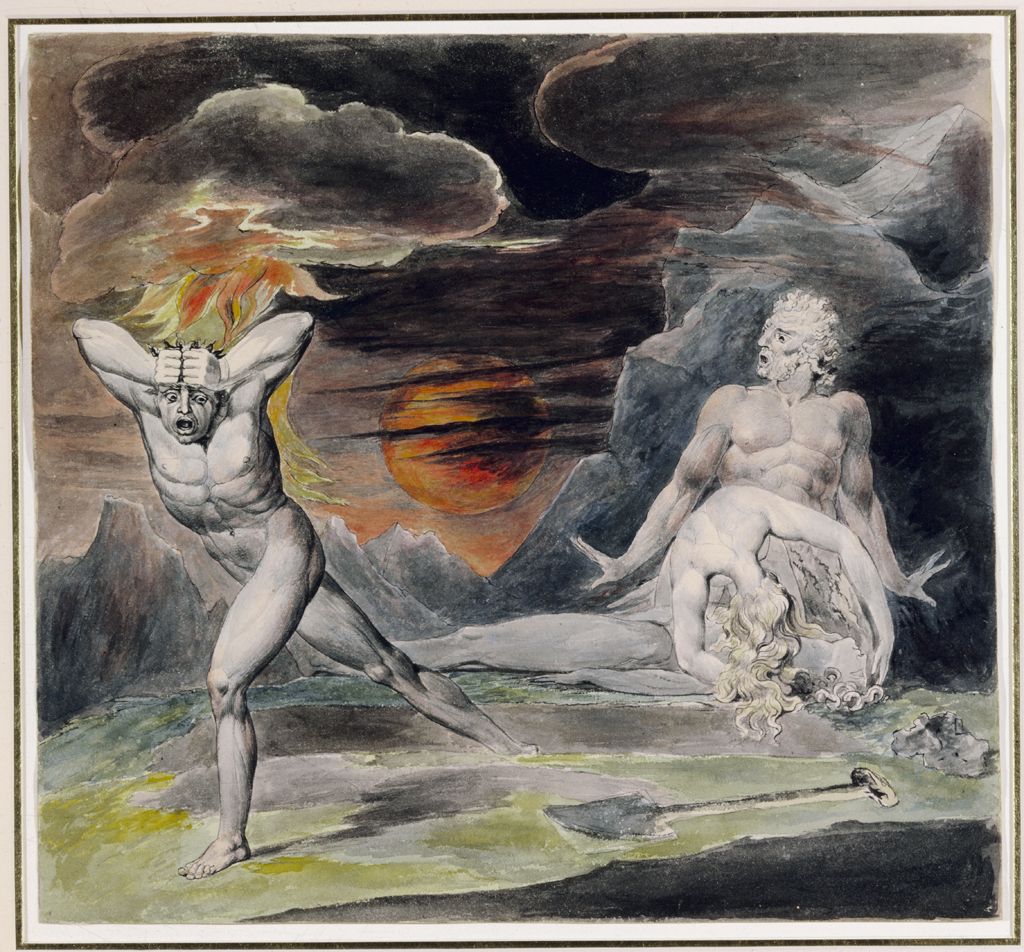
Blake_Cain_Fleeing_from_the_Wrath_of_God_(The_Body_of_Abel_Found_by_Adam_and_Eve)_c1805-1809

William Blake painting of “Cain fleeing from the wrath of God “as Adam and Eve look on in horror following the fratricide.

All these years later, I still struggle with silence on November 11, and on days like yesterday, the 80th anniversary of The Night of Broken Glass (Kristallnacht). Yet, as a person of faith who knows darkness as well as light, I have learned over the years to silence the radio for an unenforced Two Minute Silence.

Abel’s blood still cries in every land
One silence only might redeem that blood
Only the silence of a dying God

— Gordon C. Stewart, Chaska, MN, November 11, 2018.