MLK, Dr. Hayling, and Mr. James Jackson

Be where you are. If you stay there, really LIVE there, dig into the place, listen to the voices, watch the faces and people movements, you’re likely to discover the deeper streams of courage and frailty that make a place what it is.

Take yesterday, for example. Kay and I attend the “Hands Up!” educational event at St. Paul’s African Methodist Episcopal Church, around the corner from where we’re living this January. Mr. James Jackson, who seems to know a great deal about the law, citizens’ rights, and how to deal with law enforcement, sits behind us. There’s something different about him, a weathered face and voice that come with experience.

Dr. Robert B. Hayling and Mr. James Jackson

Dr. Robert B. Hayling and Mr. James Jackson

When the opportunity presents itself, we step outside for conversation. James Jackson was  a Southern Christian Leadership Conference (SCLC) Field Officer in St. Augustine with the Rev. Dr. Martin Luther King, Jr. I listen to what he tells me about the tumultuous time in St. Augustine that led to the passage of U.S. Civil Rights Act. “The bill was sitting on Johnson’s desk,” he says, “but he didn’t want to move forward with it. What happened here in St. Augustine [referring to the acts of civil disobedience to de-segregate the public beaches] drew national attention and put pressure on Washington.”

After the “Hands Up!” workshop a google search for James Jackson leads to more information about him, Dr.  Robert B. Hayling, a dentist, and another who were kidnapped by the Ku Klux Klan. Gwendolyn Duncan tells the story.

Dr. Robert HaylingFor [Dr. Hayling’s] continued fight to right the injustices perpetrated upon him and his fellow Black Citizens, his home was shot into, barely missing his wife and killing his dog which was within the home. His wife and children escaped without injury. On another occasion, Dr. Hayling, along with Mr. Clyde Jenkins, Mr. James Hauser, Mr. James Jackson were kidnapped by the Klu Klux Klan.


All of the men, except Mr. James Jackson were beaten unmercifully and left semi-conscious. If not for the compassion of a white minister, Reverend Irvin Cheney, who slipped from the rally and called the State Highway Patrol in Tallahassee, Dr. Hayling and his fellow activists, who were stacked like firewood, would have been burned alive with gasoline. Dr. Hayling received the most serious injuries, suffering hospitalization for fourteen days, losing eleven teeth, and several broken ribs. Scars he is known to have said, “I’ll take to my grave.” He and the others were charged with assault but charges were dropped because the Klan never showed up to court. The Klan was never prosecuted in this case.

— Copyright © 2004, Gwendolyn Duncan, “Veterans of the Civil Rights Movement – Dr. Robert B. Hayling”

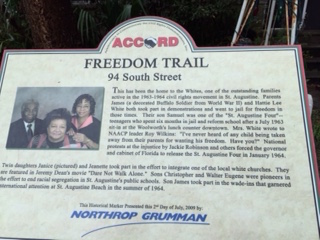
Dr. Hayling’s house is three blocks from where Kay and I are staying. Before meeting Mr. Jackson yesterday, we read the Freedom Trail plaque walking by the house around the corner here in Lincolnville.

Be where yo are. If you stay there, really LIVE there, dig into the place, listen to the voices, watch the faces and the people movements, you’re likely to discover the deeper streams of courage and frailty that make a place what it is.

– Gordon C. Stewart, Jan. 18, 2015


The House Next Door on the Freedom Trail

We knew nothing about St.Augustine when we rented the house at 96 South Street for the month of January. It turns out that the house next door played an important part in the Civil Rights Movement. 94 South Street is on “The Freedom Trail” tour in St. Augustine in Lincolnville, the district settled by freed slaves in 1866.

94 South Street, St. Augustine, FL

94 South Street, St. Augustine, FL

Newly arrived, we notice that a group  gathers each day outside the house. Our second evening I walk by the house at dusk and greet the gray-bearded man sitting in a chair. He rises with his cane.

“Good evening.”
“Good evening,” he responds.
“You live here?” I ask.
“No, my friend does.”
“My name’s Gordon,” I say, extending my hand.
“Mr. _____” [I cant’ hear what he says]. “So tell me about this house. It’s an historic house, right?”
Freedom trail plaque“Read the sign,” he says, limping to the plaque next to the sidewalk. “Read it.”

I read it out loud.

Home of the White Family – Lincolnville

This has been the home to the Whites, one of the outstanding families active in the 1963-1964 civil rights movement in St. Augustine.  Parents James (a decorated Buffalo Soldier from World War II) and Hattie Lee White both took part in demonstrations and went to jail for freedom in those times.  Their son Samuel was one of the “St. Augustine Four”–teenagers who spent six months in jail and reform school after a July 1963 sit-in at the Woolworth’s lunch counter downtown.  Mrs. White wrote to NAACP leader Roy Wilkins, “I’ve never heard of any child being taken away from their parents for wanting his freedom.  Have you?”  National protests at the injustice by Jackie Robinson and others forced the governor and cabinet of Florida to release the St. Augustine Four in January 1964.

Twin daughters Janice and Jeanette took part in the effort to integrate one of the local white churches.  They are featured in Jeremy Dean’s movie “Dare Not Walk Alone.”

Sons Christopher and Walter Eugene were pioneers in the effort to end racial segregation in St. Augustine’s public schools.  Son James took part in the wade-ins that garnered international attention at St. Augustine Beach in the summer of 1964.

This marker is erected by ACCORD to honor all of the members of the family for their efforts to make St. Augustine, America, and the world a better place.

Christopher still lives in the house.

So here we are vacationing next to history. Look for more posts from conversations with Christopher and the people at St. Paul A.M.E. Church after the “Hands Up” workshop this Saturday.

– Gordon C. Stewart, Thursday, January 15, 2015


New Legislators, Selma and MLK

Verse – Advice to New Legislators

Support each capital IDEA
(notice the capital letters)
made in the State Capital
(but not always in the CapitOl building)
which will gain financial capital
(if it garners enough political capital)
by making good use of social capital
(without wasting natural capital)
and be sure to capitalize on it.

-Steve Shoemaker, Urbana, IL, Jan. 14, 2015

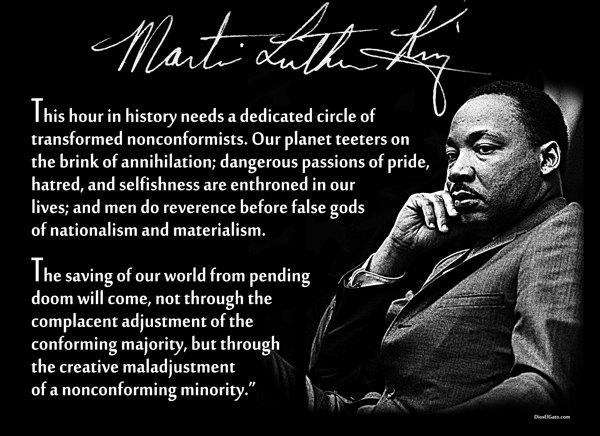
This hour of history - The Rev. Dr. Martin Luther King, Jr.

This hour of history – The Rev. Dr. Martin Luther King, Jr.

The Rev. Dr. Martin Luther King, Jr., whose life America celebrates this weekend, had a different IDEA. His was of a world “in which men no longer take necessities from the masses to give luxuries to the classes.

A mutual friend who marched with Dr. King from Selma to Montgomery and had just seen “Selma” sent the line, reminding us of “the lessons that are severe, easily forgotten amidst the King mythology, but as relevant today as they were when he first voiced them.

Verse for New Year’s Day 2015

ghost kites

ghost kites


Old Year, New Year: Old Kite, New Kite

A large blue Delta from Oregon
with two wide trailing tails
mice-eaten, torn by storms,
but still flying. The line knotted,
re-tied after “Hands up, don’t shoot”
and “I can’t breath” and cops killed.

ISIS and drones, beheadings and bombs,
spying on all, torture for some,
my country bought by corporations,
yet Vivaldi still sung, crops harvested,
children born and hugged and taught.
Last year’s kite crashed many times.

A large red Delta for Christmas
with a new line, new tails.
So far blue skies and a steady breeze,
but storms are predicted, injustices
multiply like mice, discord does not die.
This year’s kite, too, is fragile, vulnerable.

– Steve Shoemaker, Urbana, IL, January 1, 1015

White Privilege (with a Twist)

In the year that brought us “Hands up!” and “die-ins” that drew national attention once again to race in America, the SALT Project produced this video.

Thanks to Matthew and Elizabeth Myer Boulton and the SALT Project for permission to blog their commentary. Click HERE for the SALT Project website. Matthew is President of Christian Theological Seminary in Indianapolis. Liz, like Matthew, is an ordained minister of the Church of Christ (Disciples) and leading light of the SALT Project.

Cuba: The Embargo Wall

“SOMETHING there is that doesn’t love a wall,

That sends the frozen-ground-swell under it,

And spills the upper boulders in the sun;

And makes gaps even two can pass abreast.”

Robert Frost, “Mending Wall”

Two human beings passed abreast through a wall yesterday: the invisible wall between the U.S. and Cuba.

The wall was built by human hands. It’s coming down by human hands. Like the Berlin Wall and “the Iron Curtain” that went up during the Cold War between the East and West.

Here in the States the story was that the wall and the curtain had gone up to keep people in. And that’s what I thought until the summer of 1966 while living “behind” the wall with the Schulz family in Bratislava as The Experiment in International Living’s Chicago Ambassador to Czechoslovakia.

A visitor from the West was immediately struck by the absence of bill boards. There were no advertisements like in Chicago. Bratislava struck me at first glance as a gray place, a dull place, a colorless place, a depressing place. But depression and beauty are in the eye of the beholder.

“The wall isn’t there to keep us in,” said my hosts at the third floor walk-up apartment at #7 Legionarska Street. “It’s there to keep you OUT.” Their story was altogether different. They were trying to keep Western materialism, Western greed and commercialism on the other side of the wall.

They built the wall, they said, to make possible the building of a new character: a more generous, less predatory, more social community beyond the old disparities of wealth and poverty.

“Today Robert Fronts-Diaz, who owns a Twin Cities translation and communications business, says the U.S. embargo was ‘an opportunity for Cuba to build character… Since I was a little kid, I wanted the Cuban embargo to be lifted,’ Fonts-Diaz said, his voice breaking with emotion. ‘I am very deeply touched that my request has been fulfilled,’” [“For state’s Cuban, change was a long time coming,” StarTribune, Dec. 18, 2014]

“SOMETHING there is that doesn’t love a wall….” In the end, over time, they all come down

[Eternity] “spills the upper boulders in the sun;

And makes gaps even two can pass abreast.”

Cuba – Finally a Breakthrough

Goliath’s bullying is almost over. After 53 years, by the good offices of Pope Francis and Canada, and  by order of U.S. President Barack Obama and Cuban President Raúl Castro, the U.S.A. and Cuba are taking steps to normalize relations. At long last, Cuba and we will be neighbors again.

FLASHBACK:

It’s later afternoon in 1979. A 37-year-old minister/college pastor from Wooster, Ohio is mixing with other guests from all over the world at a social hour on the veranda of the residence of the Rev. Dr. Jose Arce Martinez, Dean of the ecumenical Protestant seminary in Matanzas, Cuba.

Thirteen years earlier, the young minister, then a seminarian, had been sent by the City of Chicago Chapter of the Experiment in International Living to live for three months in Bratislava, Czechoslovakia. There he had participated in the Christian-Marxist Dialogue founded by Czech theologian and former Princeton Theological Seminary Professor of Theology Josef Hromadka. In Bratislava he had lived with the Schulz family.Mr. and Mrs. Schulz were employed by the Department of Economics and the Department of Justice. Pan (Mr.) Schulz, after welcoming him to their home with a shot of Slivovitz (plum brandy), had said with a a smile, “I’m a whole lot Marxist…but still a little bit Lutheran.”

The 75 international guests at the Matanzas seminary are Christian theologians, bishops, and pastors from Angola, Mozambique, Zimbabwe, South Africa, Argentina, Venezuela, Chile, Mexico, Uruguay, Peru, the U.S.S.R, East and West Germany, France, and the U.S.A. They’ve been convened at the invitation of the seminary with the consent of the government of Cuba following the Pope’s conference on human development at Puebla, Mexico.

Earlier that day the guests had stood on the lonely beach of Playa Girón, site of the Bay of Pigs invasion, where the air was still heavy from the deaths of the CIA-led invasion of Cuba that had failed. Being at Playa Playa Girón had been chilling. A Cuban Pentecostal minister who lost a leg in the battle at Playa Girón explained the scene of the American invasion to his North America visitor.

That afternoon, they return to the seminary for the social hour where they are joined by a small number of members of the Cuba government. The young minister engages in a conversation with someone named Raúl who asks him what it means to him to be a Christian. He answers that to be a Christian is to be a disciple of Jesus, and that to be a disciple of Jesus means to give oneself to the Kingdom of God. He tells Raul that Marx’s classless society is borrowed from Jesus’s teaching and that he shares that vision.

Raúl smiles and says that they will have to see whether it is of God or of Man that it comes. Only time will tell. They shake hands as brothers in a common cause to end human misery and agree that only time will tell.

Today Raúl Castro and Barack Obama agreed to pursue normal relations between little David and the giant Goliath.

Thanks you, Barack. Thank you, Raúl. Thank you, Canada. Thank you, Pope Francis. Thank you, God!


The Lonely Blogger and Steve Martin

It’s been lonely. Traffic is down on Views from the Edge. I ask myself why. But I suspect I know the answer. I’ve broken blogging rule #1. Blogs are mostly about entertainment, not serious stuff . People go to blogs to get away from serious stuff. Not that this one is all that serious, but it’s hardly a rendition of Steve Martin’s happy feet.

Then two comments arrive. The first is from Gary who shares the experience of being influenced early on by Ernest Becker’s seminal work, The Denial of Death.  The second comes from Jim, a former classmate. Both Gary and Jim went on to become teachers.

Gary wrote:

The book title Amusing Ourselves To Death by educator Neil Postman comes to mind. Postman believes we have reduced most values to equate with entertainment. Education he says has to be entertaining. We demand constant amusement through sports, films, travel etc. There is a constant search for entertaining experiences to make us feel alive. It is as though our existence is so fraught with escaping death that the only antidote to dying is amusement. Just as everyone uses humor to take the edge off of awkward social encounters, humor has become the background context of existence. Humor is used as a cover for what human nature really is about and that is “Real Politic” or the feeling that what needs to be done is whatever is practical to survive.

Two other books by Peter Gay and Karl Marx come to mind: Gay’s The Enlightenment: The New Paganism and Marx’s The Communist Manifesto. Gay suggests the Enlightenment led to a loss of traditional religious metaphors to live by, resulting in new forms of paganism arising to supplant the old worldviews. These include everything from “consumerism” to “new age” religions like Scientology. Karl Marx says in his “Manifesto” that “capitalism will destroy all that is permanent”. I think we can say Groucho Marxism seems to be the preferred way to analyze our culture’s ills. Everything has to be couched in humor or it is considered boring. At best we can say humor functions as the sigh of the oppressed as we try to take the edge off of everyday existence that seems to be all about a belief in human society as a survival of the fittest existence. We all want something better but science has been hijacked by capitalism for its own need to constantly revolutionize production to keep novel products arriving to allow us to feel alive when we no longer can see loving people as the real antidote to a preoccupation with fending off death. That was Christ’s reason for sacrificing himself in the face of a pagan Roman Empire. We have come full circle. Hopefully the Coliseum isn’t next as we escalate the need to amuse ourselves to death.

Jim wrote:

Folks get twisted in knots over things which they have neither read nor understood. Back in the days of teaching I had students read a writer who argued that under pure capitalism if profits are to be maximised there are several alternatives: Raise prices; Lower Wages. Then you have a product your workers cannot afford to buy. Because there are more workers than capitalists they will soon suffer. They liked the argument until they learned its author was Lenin.

Thanks, Steve Martin. Thanks, Gary. Thanks, Jim. I feel better.

Four-letter Words

Two four letter words are clean as a whistle until placed side by side.

‘Karl’ could be just another guy, like George Karl, the NBA coach, Karl Malden…or maybe Karl Rove.

‘Marx’ could be Groucho, Harpo, Chico, or maybe Richard. Or it could be mistaken for the word ‘marks’ as in grades in school. Or for targets, as in ‘marksmanship’.

Each name by itself has four letters but is not yet a four-letter word. Either can be spoken out loud. But speak the two together, as in ‘Karl Marx’, and heads will turn, fingers will wag, charges will be brought, electronic ears will be listening.

It’s popular to be a Groucho, Harpo, Chico, or Richard. It’s not so safe if your name is Karl, unless your last name happens to be Rove.

The older Karl grew up in a white house in Trier, Germany, but he never occupied the White House

Karl Marx Haus in Trier

Karl Marx Haus in Trier

The White House

The White House

In the Footsteps of Mary

A sermonic reflection on America today, Dec. 14, 2014.

Today’s texts speak indirectly to the national outrage over the deaths in Ferguson, Cleveland, and Staten Island and to the larger context of the economic Law – Capitalism – under which they’ve taken place.

The Spirit falls upon Isaiah

…to provide for those who mourn in Zion– to give them a garland instead of ashes, the oil of gladness instead of mourning, the mantle of praise instead of a faint spirit….They shall build up the ancient ruins, they shall raise up the former devastations; they shall repair the ruined cities, the devastations of many generations. (Is. 61:2-4)

I am in mourning. Even in the midst of Zion. Though I already taste the fruit of the Kingdom of God which is yet to come in fullness, I am in mourning. In ashes. Faint in spirit. Living among the ancient ruins, the former devastations, the ruined cities, the devastations brought on by many generations including my own.

There is anger out there. Lots of it. There are calls for justice out there. There are “die-ins” on Interstate Highways blocking traffic, interrupting business as usual. And it’s good. It’s right. It’s an American thing to do.

But, like most movements, this one will pass in a few weeks or maybe months. It will go the way of Occupy Wall Street.

For while protesters were were being hand-cuffed for “die-ins”, Congress was taking the hand-cuffs off Wall Street and the “too-big-to-fail” banks. The Dodd-Frank restrictions enacted following the 2008 meltdown were being quietly removed by hidden-away paragraphs in the down-to-the-wire spending bill. There will be no more hand-cuffs. No more probation. No more accountability to the American people. The legal limits on dealing in the “derivatives” market were being deleted on Capitol Hill, and, perhaps worse, the Dodd-Frank provision prohibiting a second government bailout was replaced by a commitment to bail them out again.

While on Capitol Hill the Law was being re-written to deliver automatic bail to Wall Street, individuals protesting law enforcement tyranny on the streets were hauled off to jail hoping a friend would bail them out.

Only within the larger economic puzzle do the various pieces begin to make sense.

For all of America’s national wealth, we are among the poorest of nations. We are a classist society bordering on a caste society. Class has always been the issue in America. Race and class have always gone hand-in-hand, but classism has other hands as well.

The wider context surrounding the law enforcement racial divide is the classism embedded in a global capitalist economic structure.

We are living still amid the “ancient” devastations brought on by rich white slave traders who captured Africans like animals for a zoo to work their plantations for profit. Racism is a class issue, an ownership issue, an issue of economic privilege, before it is anything else. The coupling of race and class is as clear now as it ever was, despite the Civil Rights Movement and the election of America’s first African American president.

Capitalism is the issue. The accumulation of wealth. The increasing concentration of wealth. The hoarding of wealth. Wealth disparity, power disparity, racial disparity, electoral disparity, legal disparity; what’s enforced and what’s not; who’s in handcuffs and who’s not; who’s bailed out and who’s not; who’s charged and who isn’t; who’s in prison for what and who’s not; who’s on probation or parole and who’s not; who’s elected to Congress and who’s not; who owns what and who doesn’t; who can pay for an election and who can’t – are all about class, the control of the means of production and capital and the expropriation of cheap labor and natural resources that can’t talk back.

Enter now into this world the psalmist of today’s readings who dared to dream of a great reversal of fortunes:

When the LORD restored the fortunes of Zion, we were like those who dream.

Then our mouth was filled with laughter, and our tongue with shouts of joy; then it was said among the nations, “The LORD has done great things for them.”

“The LORD has done great things for us, and we rejoiced.

Restore our fortunes, O LORD, like the watercourses in the Negeb.

May those who sow in tears reap with shouts of joy.

Those who go out weeping, bearing the seed for sowing, shall come home with shouts of joy, carrying their sheaves.”[Psalm 126:1-6]

The tears of weeping bear the seeds for sowing and reaping of the sheaves of the new economic order. It is no accident that the psalmist mixes the metaphors of weeping, seeds, sowing, and shouts of joy, and sheaves. It is, as it were, a vision for the Earth itself. Honest weeping is the beginning – the sowing – that leads to earthly transformation and shouts of joy.

Mary, the newly pregnant peasant girl, becomes the representative, singing her song amid the ancient devastations, announcing the hope that will engage the powers of class “to provide for those who mourn” [Is.61:1]:

My soul magnifies the Lord, and my spirit rejoices in God my Savior, for he has looked with favor on the lowliness of his servant. Surely, from now on all generations will call me blessed; for the Mighty One has done great things for me, and holy is his name. His mercy is for those who fear him from generation to generation. He has shown strength with his arm; he has scattered the proud in the thoughts of their hearts. He has brought down the powerful from their thrones, and lifted up the lowly; he has filled the hungry with good things, and sent the rich away empty. He has helped his servant Israel, in remembrance of his mercy, according to the promise he made to our ancestors, to Abraham and to his descendants forever.” [Luke 1:46b-55]

Put differently by Philip Clayton, Ingraham Professor of Theology at Claremont School of Theology, we are living

“…at the dawn of a new form of human civilization. Individuals, societies, and nations are now deciding whether to keep fighting to preserve the dying order, or whether to take leadership in building the new. It’s not a matter of waiting for more data; we already know what the old practices are doing to our planet, and we know what it takes to build a global society that is socially, economically, and environmentally sustainable. The ones who make the greatest difference are those who work and live with wisdom, with diplomacy, and with restraint, placing the good of the whole planet first.” [Philip Clayton and Justin Heinzekehr, Organic Marxism: An Alternative to Capitalism and Ecological Catastrophe, Process Century Press, 2014]

I’m still mourning. But I feel better. I know that the mourning is a holy thing, the hint of a coming “garland instead of ashes, the oil of gladness instead of mourning, the mantle of praise instead of a faint spirit” and so, I write. I pray. I sing. I mourn to the tune of Isaiah. I march to the dream of the Psalmist. I walk in the footsteps of Mary.

– Rev. Gordon C. Stewart, Honorably Retired, Views from the Edge, Third Sunday of Advent, Dec. 14, 2014.