Walter Brueggemann is one of the world’s great Biblical scholars. Consider Election Day as you listen.
- Gordon C. Stewart, Chaska, MN 55318

Walter Brueggemann is one of the world’s great Biblical scholars. Consider Election Day as you listen.
It happened on Block Island, RI years ago on the driveway of William (“Bill”) Stringfellow and Anthony Towne’s home, the temporary home of fugitive war protester Father Daniel Berrigan, S.J.
As the FBI loaded Dan into the back of the squad car, Marmaduke, the canine member of the household, walked to the passenger side of the vehicle, and – as if on behalf of Bill and Anthony and all things just – lifted his left leg on the front passenger side tire.
“It was,” said Bill, a theologian as well as Father Berrigan’s lawyer, “an act of God.”
 Noting the FBI Director’s selective decisions that may affect the outcome of the 2016 national election, I lift my glass to Mamaduke, the latter day biblical prophet, for getting a leg up on the FBI.
`- Gordon C. Stewart, Chaska, MN, November 3, 2016
During the course of this election season much has been written about Narcissus, the self-absorbed figure of the classical myth of Narcissus. Less attention has been paid to the larger context in the myth itself and its application to the American political scene: the figure of Echo and the Pond which reflect back Narcissus’s claims for himself.
Without Echo, the scorned, talkative nymph who loses her voice except to echo Narcissus’s words, and without the Pond which reflects back the beautiful image Narcissus lives and dies to see, there would be no Narcissus.
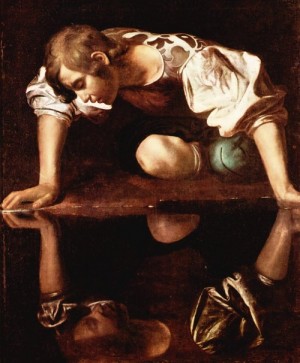
Narcissus painting by Caravaggio
The American Psychiatric Association’s Diagnostic and Statistical Manual of Mental Disorders (DSM-5) describes Narcissistic Personality Disorder as “a pervasive pattern of grandiosity (in fantasy or behavior), need for admiration, and lack of empathy, beginning by early adulthood and present in a variety of contexts . . . .”
The Mayo Clinic summarizes DSM-5’s symptoms of Narcissistic Personality Disorder as follows:
• Having an exaggerated sense of self-importance
• Expecting to be recognized as superior even without achievements that warrant it
• Exaggerating your achievements and talents
• Being preoccupied with fantasies about success, power, brilliance, beauty or the perfect mate
• Believing that you are superior and can only be understood by or associate with equally special people
• Requiring constant admiration
• Having a sense of entitlement
• Expecting special favors and unquestioning compliance with your expectations
• Taking advantage of others to get what you want
• Having an inability or unwillingness to recognize the needs and feelings of others
• Being envious of others and believing others envy youBehaving in an arrogant or haughty manner.
If Donald Trump is elected President, it will be because he successfully channeled long-festering sources of anger—“Make America Great Again” as in a former age when Mexican immigrants, blacks, and non-Christians knew their place in a white, Christian nation with a manifest destiny—or because he echoed the American public’s deep frustration with political gridlock and partisan posturing.
If, on the other hand, Mr. Trump is refused the Oval Office, Echo will continue to be obsessed with his voice. Though not as alarming as a Narcissist with a nuclear arsenal at his command, there is little comfort in a disentitled Narcissus manipulating global media as his mirror.
The socio-psychic health of Echo and the Pond (the social mirror) will determine the extent to which the dynamics of the Narcissus myth become the permanent disorder of American political life.
It may help to remember that, according to Tiresias, the blind prophet of Thebes, Narcissus will “live to a ripe old age, as long as he never knows himself.”
How long Narcissism prevails in American society depends on the American Echo and the mirror into which Narcissus looks—whether the American electorate will choose to see Narcissus and ourselves as we really are —a sad man with a public echo without self-knowledge.
In the ancient myth, Narcissus grows increasingly thirsty, but his reflection in the water is more important than slaking his thirst. Enamored with his own reflection but dying of thirst, he refuses to drink because he loses the reflected image whenever he gets close enough to sustain his life. Narcissus dies of thirst, and, according to the Greek myth, at that moment, a lovely flower – a Narcissus (daffodil or joncus) – blooms next to the pond.

Narcissus (daffodil)
In the wake of this electoral flirtation of Echo and Narcissus, the story won’t be over no matter who occupies the Oval Office. Yet there remains the hope that something more beautiful and natural than a personality disorder will rise next to the pond of what remains of the American democratic republic, and that Echo will get back her own voice.
• Gordon C. Stewart, Chaska, MN, Oct. 25, 2016
Fourth Presbyterian Church-Chicago Pastor Emeritus John Buchanan stood with other worshipers to applaud Shannon Kershner’s sermon calling for people to stand with the widow in this election year. The sermon “The Persistent God” was posted here yesterday.
I have resisted the temptation to weigh in more than I already have on the Donald Trump phenomenon because we are saturated. Television news and the newspapers can’t keep their eyes off of him and I confess that I watch the 7:00 a.m. news because I don’t want to miss the latest outlandish thing he has said or done. I am changing my mind about writing because I heard a superb sermon yesterday by the Rev. Shannon J. Kershner, at the Fourth Presbyterian Church of Chicago. Shannon skillfully inverted the traditional interpretation of Jesus’ parable of the persistent widow and unresponsive judge who finally gives the widow the justice she is pleading for simply to make her stop asking and go away. Shannon said that maybe God is not the judge here. We are the judge. God is speaking through the widow, persistently urging and pleading to us for justice…
View original post 564 more words
America’s four-year presidential election cycle poses a unique challenge for churches, synagogues, and mosques, and for their priests/ministers, rabbis, and imams.
Retired after years behind the pulpit, I now take my rightful place in the pew. I come to pray, sing the hymns, listen to the Scripture readings, and hope for a word from the pulpit that speaks a powerful Word into the wordy world that has hurt my ears all week.
Like author Annie Dillard, I wear a crash-helmet to worship. I expect something to happen. I expect to be “in an accident” with the Word of God, a word that rattles my bones, awakens me from lethargic acquiescence, and—as it did to Isaiah in the temple in the year that old king Uzziah died,—fills the house with the smoke of divine majesty, shakes the foundations, and elicits Isaiah’s response. “Here am I. Send me. (I have a crash-helmet.) Send me!”
I don’t go to worship to escape. Nor do I go for a partisan rally. I go on Sunday morning for worship—to make what the psalmist called “a joyful noise to the LORD”, my only rock and salvation, and to celebrate the gospel’s transforming assurance and challenge which my own troubled heart and mindI cannot produce for myself. I need the worshiping community. I need public worship that cuts through the partisan babel that saturates America’s anxious public life. Divine worship is a public event.
But religious institutions and their leaders live on the razor’s edge between public engagement and spiritual irrelevance.The tax code’s 501c(3) status recognizes the importance of religious traditions and institutions to the health of the body politic. It also prevents them from endorsing candidates for public office, which poses an interesting dilemma for leaders adherents.
The last two weeks, worship has been down in the church I attend. I’ve wondered why.
Research shows that worship attendance soars on Sundays following national tragedies like 9/11. People need a word to console and strengthen them. In the midst of a national election campaign the likes of which we’ve never seen, one might logically suppose attendance would rise, not fall. Unless . . . .
“Unless what?” I ask myself. Unless a church’s leaders are ignoring the faithful who come into the pews wearing crash-helmets? Or unless, perhaps, the people expect from the pulpit the rancorous echoes of partisan righteousness? Or, perhaps, the worship experience itself is failing to awaken the ears of worshipers to hear the chorus Isaiah heard in the Temple in the year that the political order was at stake: “Holy, Holy, Holy Lord! God of power and might. The whole Earth is filled with your glory. Hosanna in the highest!”
I’m old. I still expect something momentous — something I don’t yet expect — to happen during worship.
The Rev. Dr. John Fry, who taught our preaching class at McCormick Theological Seminary, introduced us to crash-helmets long before Annie Dillard put the metaphor in writing. Senior Minister of Chicago’s First Presbyterian Church, John would later be summoned before The U.S. Senate Government Operations Committee’s Permanent Investigations Subcommittee, chaired by John L. McClellan (“The McClellan Committee”) because of allegations related to civil disturbances in south Chicago.
John had reached beyond the church walls to develop a relationship of trust with the gang that ruled the streets. It was John’s work that resulted in the Blackstone Rangers surrendering their guns, which were then locked in the church safe awaiting the pending truce among the Rangers, their rival gang, the Disciples, the Chicago Police Department, and the U.S. Treasury Department. When the Chicago Police Department broke terms of the agreement by shooting a disarmed gang member, the street quickly returned to its old established order. The McClellan Committee laid the responsibility, in part, on the doorstep of the Rev. Dr. John Fry and the board of First Presbyterian Church-Chicago.
The first session of our seminary preaching class is etched in our memories. John pulled the chairs into a circle to critique the student sermon we had just heard in the chapel. We commended the preacher re: matters of form, not substance: a fine introduction, good development, and solid conclusion. Then John asked,”You want to know what I think? That was a chicken sh*t sermon. The gospel cuts with a knife! Anyone who does that again in this class will get an ‘F’” We were all like chickens with our heads cut off, but we never forgot the difference between real preaching and :chicken sh*t.
John’s words have rung in our ears for 52 years. Now I sit the listening side of the pulpit, relieved of that onerous responsibility but still waiting for a word that cuts through the crap. Sometimes it comes; sometimes it doesn’t.
When it doesn’t come from the pulpit, it still comes through the Scriptures. Or it comes from a line tucked away in the Eucharistic Prayer (the prayer that precedes the Sacrament of Holy Communion), as it did yesterday:
“At the meal tables of the wealthy where he (Christ) pled the cause of the poor, he was always the guest. Unsettling polite company, befriending isolated people, welcoming the stranger, he was always the guest.”
That little line, along with the communion itself , spoke a clear word to a distressed heart and mind.. The polite company was disturbed by Christ the guest, and the service ended with a Dismissal that seemed to place Isaiah’s age-old response to God’s glory— “Here am I.Send me!” on the worshipers’ lips anew during a presidential campaign that is anything but holy:
“Take us out into the world to live as changed people because we have shared the Living Bread and cannot remain the same. Ask much of us. expect much from us, enable much by us, encourage many through us. May we dedicate our lives to your glory.”
What psychological vocabulary best describes the belief that one is the target of a global conspiracy?
“Wait! Wait! Don’t tell me!”
P a _ _ _ _ _ _ i d?
N a _ _ _ _ _ _ _ _ i c?
D e _ _ _ _ _ _ _ a l?
S o _ _ _ _ _ _ i c?
How will Donald Trump present himself in tomorrow night’s presidential town hall meeting?
A) Attempt to compare himself favorably with Bill Clinton, alleging worse comments to Hillary’s husband on the golf course? It’s just what guys do when guys are alone, and Bill’s more lewd than I am.
B) Allege, as he has already, that Hillary has had a relationship/relationships outside of marriage? “Hillary is no angel!”
C) Apologize in the manner of the evangelical advisor, declaring that the event in 2005 was before he had a spiritual awakening, and that the issue now is forgiveness for a past indiscretion?
D) Make eyes for Moderator Martha Raddatz . . . or Anderson Cooper?
E) Come out as a recovering sex addict?
F) None or some of the above? “None of the personal stuff matters. It’s about Making America Great Again! It’s about restoring America’s right to grope the world again. It’s about winning again. All the complainers and accusers are losers! They’re all pussies!”
The question now is not how big are his hands, but how big is his base?
Children feel safer when a parent reads them a story and tucks them into bed. The things that go bump in the night are not quite so scary. Mommy or Daddy says not to worry. They’re right there to make sure everything will be alright.
In some ways we are children till the day we die. We feel anxious about our security. Fear still grips us when the sirens blare in the night.
Sometimes children are exposed all day long to the threats to their well-being. They need a parent’s or grandparent’s reassurance. They need the security of knowing that Mommy or Daddy is stronger than whatever might go bump in the night.
As we grow older we learn the difference between real and false reassurance. We know that there is no one to tuck us into bed anymore. But nostalgia for fairy tales and for the parent who will make us safe lingers on. And the candidate who both scares us during the day with stories of the boogieman and tucks us into bed with a fairy tale about himself as the hero gathers the children to himself.
The nightmare is just a few winks away.
For a good dose of both truth and humor, click What every New Yorker knows, a Washington Post piece about the presidential candidate whose name we ruefully deign to mention.
Gordon C. Stewart, Chaska, MN, September 22, 2016.
We’ve been silent recently on Views from the Edge. The world doesn’t need one more blah-blah-blah pundit.
But when a candidate (we won’t use the name because the media are flooded with it, to his advantage) tells a crowd there would be “nothing you could do” to stop his opponent from stacking the Supreme Court with anti-gun justices, and follows with “although, the Second Amendment people, maybe there is, I don’t know,” a memory seems worth sharing.
During a 2013 public dialogue (First Tuesday Dialogues in Chaska, MN) to discuss the Second Amendment in light of gun violence in America, a participant proudly cited a Facebook posting that “the second best thing that could happen to Obama would be for him to be impeached.”
The speaker continues, “And we all know what the first best thing would be….”
What was said the other day in North Carolina is not new. Mr. ____ blamed the media for the widespread criticism of his remark. “Give me a break!” he said.
Insinuations of assassinations never deserve a break. It didn’t deserve a break in 2013. t does not deserve a break in 2016. It’s not a joke. It’s not funny!
Enough said. Thanks for dropping by.

 Views from the Edge