Obama and Putin 2

President Obama is not pleased by the hand on his back and the smirk on Mr. Putin’s face. Remember the Putin was KGB, the U.S.S.R. equivalent of the U.S.A.’s CIA, before he became President of Russia. CNN published this report about Russian bombers on patrol near U.S. borders.

in this picture, what do you suppose Mr. Obama and Mr. Putin thinking and feeling?

Obama: "Get your planes off our border!." Putin: "Try and stop us, Black Boy!"

Obama: “Get your bombers off our borders, you SOB!” Putin: “Try and stop us, Black Boy!”


Obama and Putin

This picture taken by AP photographer Ria Novosti at the APEC Conference in Beijing is worth a thousand words. Look at the faces of the black President and the white President patronizing Mr. Obama with his hand on President Obama’s back. Put into words: “I own you, Boy!” and “Get your hand off me!”

Putin: "He's my BOY"; Obama: "Get your hand off me."

Putin: “He’s my BOY”; Obama: “Get your hand off me.”

Losing Our Heads

Lewis Carroll knew nothing about ISIS when he wrote Alice in Wonderland, but he knew about the insanity of power in the high places of his own culture.

In the screenplay of Alice, the Queen of Hearts asks “Who’s been painting my roses red? WHO’S BEEN PAINTING MY ROSES RED? /Who dares to taint / With vulgar paint / The royal flower bed? / For painting my roses red / Someone will lose his head.”

The Card Painter responds “Oh no, Your Majesty, please! It’s all ‘his’ fault!” The Ace blames the Deuce. The Deuce blames the three. The Queen explodes.

“That’s enough! Off with their heads! I warn you, child… if I lose my temper, you lose your head! Understand?”

The very thought of beheadings chills us to the bone. It would be hard to imagine a more horrifying spectacle than what we have recently seen of American journalists losing their heads in the Middle East. The fact that British and American citizens have joined ISIS is nearly as chilling as the killings themselves; we ask why one of us would dare “to taint with vulgar paint the royal flower bed.”

There is no excuse for a beheading. It makes no difference if it’s at the hands of ISIS or David, as in the beheading of Goliath the giant Philistine, or those who sought to demonstrate their zealous support for David, sneaking into the bedroom of Ish-bosheth, the son of Saul, beheading Ish-bosheth and presenting his head to David at Hebron. (Second Samuel 4:9-13)

To their great surprise, David, who had beheaded Goliath, is not pleased. “‘[W]hen wicked men have killed a righteous man in his own house on his bed, shall I not now require his blood at your hand and destroy you from the earth?’ And David commanded his young men, and they killed them and cut off their hands and feet and hanged them beside the pool at Hebron. But they took the head of Ish-bosheth and buried it in the tomb of Abner at Hebron.” (II Samuel 4: 5-12).

We don’t hear reading like this in church. But you will hear such Scriptures read daily in a Benedictine abbey, as I did while visiting Saint John’s Abbey to get my own head and heart straight in anticipation of the death of my stepdaughter. The reading I’m remembering was just as ghastly as the beheadings of Goliath and Ish-bosheth and of David’s response cutting off the killers’ hands and feet on the public square for all to see.

“Why,” I asked my Benedictine spiritual guide, “do you read those readings? They’re horrible!”

The answer, he said, would take too long really explain, but, in essence, such stories are lifted up in the Benedictine daily worship because that sordid history – that capacity for violence and brutality is a part of us still. We must never forget.

The pictures and stories of the ISIS beheadings are meant to terrorize ISIS’s opposition in places like Iraq and Syria, and here at home in the U.S.A. But there is evidence that they also produce a widespread determination to stop ISIS before it’s too late.

“That’s enough! Off with their heads! I warn you, ISIS… if I lose my temper, you lose your head! Understand?”

Moral outrage is in order. Yet a friend asked a question I didn’t want to hear and could not answer “As grizzly as the beheadings are,” he asked, “what’s the difference between that and blowing people’s heads off – enemies and children who are ‘collateral damage’ – with bombs dropped by a drone?”

President Obama has his hands full on this one. Some argue that he’s been too cautious. But before we go much farther down the road of exercising American power in ways that have produced hatred in the past and that will undercut whatever consensus of moral outrage is developing toward ISIS, we do well to remember the brutal response of David, whose cruelty at Hebron equalled and exceeded the wrongful beheading of Ish-bosheth.

Like the Benedictine brother said, we must not forget our history. Otherwise we paint the roses red and we all lose our heads.

Ted Cruz and demagogic innuendo

Notice how it works in this speech attacking President Barack Obama. The President stood, said Ted Cruz, on the EAST side (i.e. the former Communist side) of the Brandenburg Gate. Ted Cruze’s Subtext: “Obama is a Communist.” That’s the 21st Century voice of Sen. Joseph McCarthy.

http://www.youtube.com/watch?v=iKpIWNG-T4Y

The President and Kosuke Koyama

“Our ideals and principles, as well as our national security, are at stake in Syria, along with our leadership of a world where we seek to ensure that the worst weapons will never be used. America is not the world’s policeman. Terrible things happen across the globe, and it is beyond our means to right every wrong. But when, with modest effort and risk, we can stop children from being gassed to death and thereby make our own children safer over the long run, I believe we should act. That’s what makes America different. That’s what makes us exceptional.”

Conclusion of President Obama’s Sept. 10 national address on Syria.

Kosuke Koyama

Kosuke Koyama

By the end of his life in 2009, Kosuke Koyama had concluded that there is only one sin: exceptionalism.

I wish President Obama had been able to consult with Kosuke Koyama (1929 – 2009) before delivering this speech. He might have chosen his words more carefully. Koyama was a world-renowned Japanese Christian theologian and leader in inter-religious dialogue, author of Waterbuffalo Theology, Mount Fuji and Mount Sinai: a Critique of Idols, among other books.

Koyama first heard the claim of national exceptionalism in the Japan of his childhood. Japan was exceptional. The best. Number one. The Empire of the Rising Sun. The Emperor, supported by the religion of the imperial cult, could do no wrong. He was divine. So was Japan.

Dr. Koyama and his wife Lois moved to Minneapolis following his retirement. He shared with his friends his deep sadness that the old Japanese imperial claim had become the American claim.

America’s “leadership of a world where we seek to ensure that the worst weapons will never be used” is at stake.

Fact: the worse weapons ever used (nuclear and chemical) have already been used. We used them. We are the only nation on the planet to have dropped the atomic bomb. We dropped on Hiroshima and Nagasaki, Japan. We used chemical weapons in Vietnam. Agent Orange is a chemical weapon. Napalm is a chemical weapon.

America is not the world’s policeman. Terrible things happen across the globe, and it is beyond our means to right every wrong.

We have thought of ourselves as the world’s policeman and we still do. A policeman insures that the law of the land is enforced. The law that causes such resentment in the Middle East is the law of American exceptionalism and prerogatives. For the Arab world, this is what makes America different: the presumption of American exceptionalism expressed by re-arranging the economic-political-cultural landscape to advance Western interests, as in the case of Saudi Arabia, or by imposing and disposing, as in the CIA assassination of the legitimate President of Iran and the installation of the Shah, or our support for Saddam Hussein and Iraq in the Iraq-Iran War.

Very clearly, the U.S. has not sought to right every wrong. Nor should we. But our language is hollow at best and jingoistic at worst when one surveys the history of American intervention into the internal affairs of other sovereign states as the heir of British colonialism. The arrangements in the Middle East have their genesis in deals made by wealthy British and American elites with elite Arab Sheiks and strong men like Hosni Mubarak and Muammar Gaddafi until they no longer were useful.

“But when, with modest effort and risk, we can stop children from being gassed to death and thereby make our own children safer over the long run, I believe we should act.”

International scenes of human suffering and terror abound. In some cases we have chosen to act. In others, like Darfur, we chose not to act based largely on the principle of American self-interest. If American national interests were not threatened or affected, we did not act militarily. We acted humanely with humanitarian aid, but we did not act militarily to stop the horror of genocide in Darfur.

The principle of American national security and self-interest is clear in the President’s speech where he ties together the long-term safety of American children here at home with the short-term safety of children being gassed in Syria. That is, arguably, the way it should be. The use of chemical weapons and the threat of them in the hands of those who hate us is an ominous prospect.

Whether we should act is not, however, the question. The question is how America should act? Furthermore, how we decide to act should be informed and guided by the lessons of our own historic use of weapons of mass destruction and our own involvement in the supply of chemical weapons to Saddam Hussein, used in the Iraq-Iran War and allegedly used against his own people in Iraq.

It is an essentially moral position to condemn the use of weapons of mass destruction (chemical, nuclear, or biological. It is immoral to use them –an offense against humanity, and offense against all nature, and, for religious people, an offense against God.

Unfortunately there is not an equivalent of confession for nation states when they themselves have acted against their own declared moral principles. President Obama did not drop the bombs on Japan. Nor did he or his Administration supply the chemical weapons that did in Iraq what has happened to the mothers and children in Damascus. He might wish he could wash the blood from America’s hands or erase these chapters of American history, but he cannot. He cannot because the facts are facts, and the rest of the world remembers.

<

em>“That’s what makes America different. That’s what makes us exceptional.”

“There is only one sin,” said Kosuke Koyama,.“Exceptionalism.”

The myth of American exceptionalism dates back to a great hope as the new nation was about to be born. It was spoken in a sermon by Puritan John Winthrop on the Arbella sailing the high seas from the Old World of England to the New World of America. The biblical text of John Winthrop’s sermon was the Sermon on the Mount in the Gospel of Matthew applied to the adventure of establishing an exceptional nation, “the city set upon a hill” (Matthew 5:14) to give light to the world.

Although the word ‘exceptionalism’ is foreign to most Americans except those in academia or those who are especially attuned to American politics, it is the controlling myth of American life and the ground to which succeeding American Administrations and Congresses have turned to justify American ventures – economic, spiritual, political, cultural, and military.

In some way or another it falls to each Administration to uphold the myth, even and perhaps especially, when the myth appears to be false. The aspiration of a city set upon a hill was etched in mind of the Church, not a nation-state. It was and is a call to a different way, and its original spokesman saw that city quite differently from the American military-industrial-technological-corporate complex. This Jesus, a Jewish rabbi living under the Roman occupation of the First Century C.E., was not a warrior or a policeman. He saw to the heart of the human condition and the tragedy of high moral claims that justify all forms of violence.

“Why do you see the speck in your neighbor’s eye, but do not notice the log in your own eye? Or how can you say to your neighbor, ‘Let me take the speck out of your eye’, while the log is in your own eye? You hypocrite, first take the log out of your own eye, and then you will see clearly to take the speck out of your neighbor’s eye” (Gospel of Matthew 7:3-5, NRSV).

There is only one sin.

Koyama’s last work was Theology and Violence: Towards a Theology of Nonviolent Love, published in Japanese in 2009 in Tokyo. There is, as yet, no American translation.

The Abel Project in the City of Cain

The same day America honored the 50th Anniversary of the March on Washington most remembered for Dr. King’s “I have a dream” speech, America’s first black President, who had just delivered a great speech in honor of Dr. King’s dream, appeared on the Newshour to discuss military strikes in Syria.

Irony of Ironies

Martin Luther King, Jr. was as deeply committed to peace and to non-violent, non-military solutions to global problems as he was to ending racism. As his analysis of the national, international, and human condition continued to develop, he became an outspoken critic of the Vietnam War, capitalism, and imperialism. He grasped as well as any public figure of his time, and of ours, the insidious institutional power of an unelected, undemocratic web of the economic-military-corporate complex at work behind the scenes of American public life.

President Obama’s speech from the same spot where where Dr. King had stood 50 years before at the March on Washington was a potential seminal moment of American history. It was a great contradiction to that potential to view the President’s interview on The Newshour (PBS) later in the day regarding Syria. I couldn’t put together the President’s honoring of Dr. King’s dream just hours earlier with his entertainment of military action in Syria. For whatever reason, the media did not seem to notice the incongruity and the irony.

The Newhour also featured a conversation among foreign policy experts about the advisability of “punishing” Syria for crossing the red line of chemical weapons. University of Chicago Professor John Mearsheimer’s raised the gravest voice of caution. “Stay out militarily.” He also reminded the other two panelists and the viewing audience that the United States is the only nation ever to have dropped the bomb. The world has not forgotten. Click HERE to listen to the conversation.

Martin Luther King, Jr. rose to national prominence because he issued a clarion call for the dawning of the City of Peace in the midst of the City of Cain, the city of bloodshed. In King’s view you can never get to the City of Peace by means of the methods of the City of Cain: violence, the lex talionis, or worse.

Ethical decisions, in personal life or in international affairs, are rarely simple. Our hearts go out to the innocent children, women, and men who died from chemical weapons in Syria. We want to be our brother’s and sister’s keepers. We want to help. We want to stop it. That sense of compassion is as it should be. All hearts should break over this horror. But something else is called for before we act on the impulses of the compassion.

It is also worth remembering who it was that first asked the question “Am I my brother’s keeper?” It was Cain, who made the statement to God to put the blame for his own homicide back on the One who held him responsible for the senseless murder of his brother Abel in a fit of anger. “Sin is crouching at your door, and you must master it.” Dr. King and others who choose the methods of non-violent resistance to great tragedies like the one in Syria interpret the instruction to Cain – you must master your anger – as the instruction to master one’s own knee-jerk retaliatory response. Patience is required. Taming the lion that crouches at our own door is a chief task of becoming genuinely human.

The Blood of Abel and the City of Cain

For Martin Luther King, Jr., Mohandas Gandhi, the Dalai Lama, and a host of un-noted, anonymous souls, the way of violence, even in behalf of the good, represents a failure to tame the lion crouching at our door and further entrenches the City of Cain.

Beyond the philosophical-ethical-theological considerations are other facts. The “red line” of chemical weapons is one that was crossed years ago. It was crossed in Vietnam. A trip to the nearest Veterans Hospital is a humbling reminder. It was the United States that used Agent Orange and Napalm in Vietnam, Laos, and Cambodia as part of Operation Ranch Hand. Our hands are not clean. As much as we might like, we do not speak from moral high ground. We have already crossed the red line. The moral finger we point toward Syria points back at us. To unleash even the most minimal, narrowly targeted Cruise Missile strike on Syria from a warship from the coast of a tinder-box in a far off place is like throwing out a boomerang expecting that it will not return to us in retributive violence. As Dr. King understood so well, violence begets violence.

As if that were not enough, the struggle in the Middle East is confounded by another form of political-economic-cultural-religious-military violence: the American corporate presence in the oil fields, arranged by American and Saudi elites (Sunni Muslims), and the expropriation through the United Nations of Bedouin Arab land to create a homeland for the survivors of the holocaust of World War II Germany. The intent, so far as the general public was concerned, was compassion. Provide a safe place, a homeland. But the homeland belonged to someone else when the United Nations expropriated it for the creation of the State of Israel, and the Arab world has never forgotten the way it happened.

“Am I my brother’s keeper?” drove popular sentiment to support the creation of Israel. Why the homeland was not carved out of Germany or perhaps France is an interesting question. Or why the United States did not carve out of our vast geography a territory in the United States of America as a safe haven, is a question long since ignored by nations who thought they were taking the moral ground but not forgotten by Palestinians, Shiites, and most of the Middle East.

Those questions aside, Israel today is a sovereign State in the midst of an Arab world that resents both its presence, the history of its creation, and the United States as its most faithful ally and supporter.

Behind it all stands a military-industrial-technological-corporate complex that feeds on mistakes like Iraq and Afghanistan, and the question of whether we are our brother’s keeper, responsible to play policeman to the world. Martin Luther King, Jr. never lunched on the food at the lunch counter of the military-industrial-technological-corporate complex. Nor should we. Neither should the President. Neither should Congress.

The Abel Project: We are the World

An alternative to a military response with potential catastrophic consequences for the Middle East and for us is the neglected methodology of nonviolent, passive resistance by which Martin Luther King, Jr. and Mohandas Gandhi changed the world.

If we and the rest of the world believe in the City of Peace and wish to redeem the blood of Abel in the City of Cain, let the recording artists of the world with the full support of the United Nations, the Vatican, the World Council of Churches (Orthodox and Protestant Christians), the Organisation of Islamic Cooperation, and international Jewish organizations representing the spectrum of Judaism lift the people’s voice so clearly across the world that it cannot be ignored.

Call it “The Abel Project” – named for the innocent who was lost to the world, the slain brother of Cain, whose blood still cries out to God from the ground.

Let there be candlelight prayer vigils for an end to the way of Cain in Syria. Let the lighted candles in every national capitol, every state or provincial capitol, and in cities and towns around the world make the statement that we, the people of the world, led by the three warring children of Abraham and Sarah (Jews, Christians, and Muslims), stand for the transformation of the redemption of the blood of Abel and in the name of the City of Peace.

The President can contribute to that effort but he must not attempt do it alone. Nor can he lead it.

Unleashing the potential of a worldwide vigil in the spirit of “We are the World” must rely on the untapped power of the United Nations as a force for peaceful resolution, the original dream that inspired its Charter. He must do it not only with our closest allies in the West but with the leaders of nations that resent our history in the Middle East and Southeast Asia who are suspicious of American saber-rattling from the Western presumption of moral high ground. The voice of the world must include the two warring branches of Islam – Sunni and Shiite – whose tensions and hatreds also lie at the center of the conflict in Syria and most of the Middle Eastern Arab States.

If he does, the irony between the August 28, 2013 commemoration of the 50th anniversary of the poor people’s march on Washington and the evening news will resolve itself in a new decision to honor the legacy of the fallen witness to the power of non-violent resistance and the power of love as the only method and power that ever really change the City of Cain. For the sake of Abel, our slain ancestral brother, let the candles be lit across the world.

Irony of Ironies: MLK and Syria?

The same day America honored the 50th Anniversary of the March on Washington most remembered for Dr. King’s “I have a dream” speech, America’s first black President appeared on the Newshour to discuss military strikes in Syria.

Martin Luther King, Jr. was as deeply committed to peace and to NON-VIOLENT, non-military solutions to global problems as he was to ending racism. As his analysis of the national, international, and human condition continued to develop, he became an outspoken critic of the Vietnam War, capitalism, and imperialism.  He grasped as well as any public figure of his time the institutional power of an unelected, undemocratic web of the economic-military-corporate power at work behind the scenes of American public life.

I was proud of President Obama’s speech from the same spot where where Dr. King had stood 50 years before at the March on Washington.  I can’t put that together with his entertainment of military action in Syria.  For whatever reason, the media did not seem to notice the incongruity.

Last night’s PBS Newhour featured a conversation about the advisability of “punishing” Syria. University of Chicago Professor John Mearsheimer’s statements, in my opinion, hit the nail on the head. “Stay out militarily.”  Click HERE to listen to the conversation. 

The military-industrial-technological-corporate complex feeds of mistakes like Iraq and Afghanistan. Martin Luther King, Jr. never lunched on their food. Nor should we. 

The President’s Speech on the Economy

Aired earlier today on All Things Considered (MPR, KNOW, 91.1 FM).

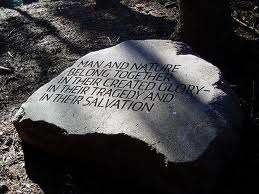
Paul Tillich quote in Tillich Park, New Harmony, IN.

Paul Tillich quote in Tillich Park, New Harmony, IN.

Today President Obama began a series of speeches about the future of the American economy. I hope he takes us back to the basics of what an “economy” is.

Economics is about a household and how to manage it. The household is a family, a state, a nation, a planet.

The English word “economy” comes from the Greek work oikos – the Greek word for house. The word “economics” derives from the Greek word oikonomia–the management of a household.

Before it is anything else, economics is a perspective, a frame of reference. Before it decides anything about household management, it knows that there is only one house. Good household management – good economics – pays attention to the wellbeing of the entire house and all its residents.

In America and elsewhere across the world, we are coming to realize that the planet itself is one house. What happens in one room of the house – one family, one city, one nation – affects what happens everywhere in the house. Paul Tillich caught the clear sense of it when he wrote that “Man and nature belong together in their created glory – in their tragedy and in their salvation.” That is to say, there is only one house.

The essential question of economics is not about systems – capitalism, communism, socialism, or something else. The essential question is spiritual, philosophical, and ethical. It’s whether we believe that there is only one oikos, one house; the subsequent question is about how best to manage it for the wellbeing of all its residents and the fragile web of nature without which the house of the living would not exist.

Very often what we call ‘economics’ is not economics. It’s not oikonomia. It’s something else. It assumes something else, and when we forget what an economy and economics really are, we enshrine greed as the essential virtue, ignoring and imperiling everyone else and everthing in the one house in which we all live.

I dream that the President will preach the old Greek common sense: that in his own way, he will reclaim the essential premise of an economy and the ethical task of economics. By bringing the Greek origins to our television sets, headsets, and iPads, he can call us to move forward out of the partisan houses of nonsense.

There is only one house.

The Voting Rights Act and the Scowl

Justices Sotomayor and Scalia

Justices Sotomayor and Scalia

The Voting Rights Act for which so many of us fought is at risk in a case before the U.S. Supreme Court.

Yesterday Associate Justice Antonin Scalia, one of the Justices who will decide on the constitutionality of Section 5 of the Voting Rights Act, called it a “perpetuation of racial entitlement.” His statement shocked the court and those in the courtroom.

Justice Scalia showed visible contempt for President Obama sitting behind the President at the Second Inauguration. He never looked up. He sat there like the Man…in his Doctor of Jurisprudence graduation hat…with a scowl on his face. His Jesuit professors are pulling their hair out.