An acrostic verse: Missa Solemnis

“Missa Solemnis”

LORD HAVE MERCY begins the Mass
Under the baton of Maestro
Dean Craig Jessop. The last word: PEACE.
Wisdom and beauty from solo
Instrument, the mass choir, voice
Go to the top of Cathedral.

Vast walls of sound show pain also,
Arising from those who are cruel.
Nothing human escapes alto,

Bass and tenor and soprano.
Even a skeptic like Ludvig
Enlisted to create music,
Tries to make out of the tragic:
Hope, faith, love, kindness, and courage.
Overwhelmed by suffering, he
Values still signs of human will.
Even though stone deaf, he can be
Nurturing peace and harmony.

– Steve Shoemaker, Urbana, IL August 7, 2013

EDITOR’S NOTE: Craig Jessop is Dean of the College of the Arts at Utah State University, and former Director of the Mormon Tabernacle Choir.

Solitude and Society

Lectio Divina

This post is written by John Buchanan, Pastor Emeritus, Fourth Presbyterian Church, Chicago.

Lectio Divina.

Are Rainbows Real?

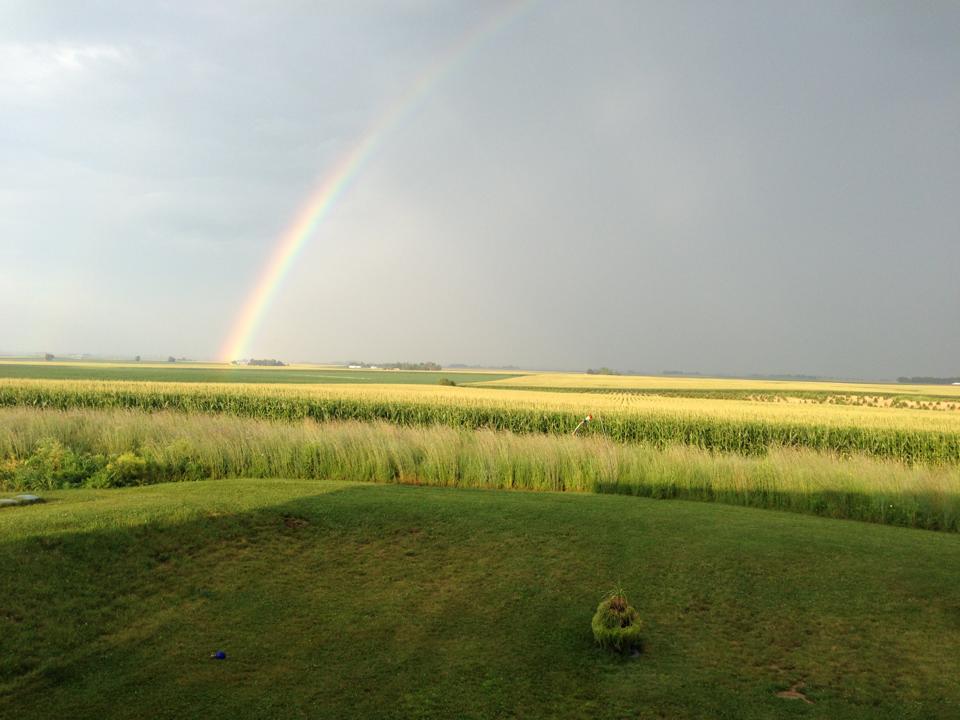
Rainbow over the IL prairie.

Rainbow over the IL prairie.

They can be seen by other eyes than mine–
but rainbows are mono-directional:

they disappear if you will face the sun.
If you move toward a rainbow you will fail

to ever reach it: always up ahead,
elusive, magical–the circle seen

only above the earth. Sometimes instead
of one, two bows appear, and in between

a darker band in contrast to the light
below the palette of diversity.

Beyond prediction, measurement or fact,
a rainbow’s truth will live inside the eye.

– Verse and photography by Steve Shoemaker on the
plain behind his prairie home in Urbana, IL.

All Things Considered commentary and audio

Click HERE and then click the audio link on the Minnesota Public Radio website to hear yesterday’s commentary on the classical spiritual-philosophical-ethical premise we need to remember. This piece was written two days BEFORE the President delivered his speech yesterday at Knox College.

    EXCERPT:

The English word “economy” comes from the Greek work “oikos” – the Greek word for house. The word “economics” derives from the Greek word “oikonomia”- -the management of a household.

Before it is anything else, economics is a perspective, a frame of reference. Before it decides anything about household management, it knows that there is only one house. Good household management – good economics – pays attention to the wellbeing of the entire house and all its residents.

The President’s Speech on the Economy

Aired earlier today on All Things Considered (MPR, KNOW, 91.1 FM).

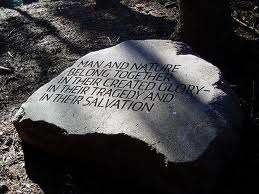
Paul Tillich quote in Tillich Park, New Harmony, IN.

Paul Tillich quote in Tillich Park, New Harmony, IN.

Today President Obama began a series of speeches about the future of the American economy. I hope he takes us back to the basics of what an “economy” is.

Economics is about a household and how to manage it. The household is a family, a state, a nation, a planet.

The English word “economy” comes from the Greek work oikos – the Greek word for house. The word “economics” derives from the Greek word oikonomia–the management of a household.

Before it is anything else, economics is a perspective, a frame of reference. Before it decides anything about household management, it knows that there is only one house. Good household management – good economics – pays attention to the wellbeing of the entire house and all its residents.

In America and elsewhere across the world, we are coming to realize that the planet itself is one house. What happens in one room of the house – one family, one city, one nation – affects what happens everywhere in the house. Paul Tillich caught the clear sense of it when he wrote that “Man and nature belong together in their created glory – in their tragedy and in their salvation.” That is to say, there is only one house.

The essential question of economics is not about systems – capitalism, communism, socialism, or something else. The essential question is spiritual, philosophical, and ethical. It’s whether we believe that there is only one oikos, one house; the subsequent question is about how best to manage it for the wellbeing of all its residents and the fragile web of nature without which the house of the living would not exist.

Very often what we call ‘economics’ is not economics. It’s not oikonomia. It’s something else. It assumes something else, and when we forget what an economy and economics really are, we enshrine greed as the essential virtue, ignoring and imperiling everyone else and everthing in the one house in which we all live.

I dream that the President will preach the old Greek common sense: that in his own way, he will reclaim the essential premise of an economy and the ethical task of economics. By bringing the Greek origins to our television sets, headsets, and iPads, he can call us to move forward out of the partisan houses of nonsense.

There is only one house.

Stevie Wonder and the Blind

Remember Stevie Wonder’s song that lifted our spirits and brought tears to our eyes? Click We are the World.

There’s a choice we’re making
We’re saving our own lives
It’s true we’ll make a better day
Just you and me

Stevie Wonder got it then, and he gets it now. He’s made a choice to help save lives.

He has announced that he will no longer appear in the state of Florida. He’s boycotting Florida and every other place with “Stand Your Ground” laws in the wake of the Trayvon Martin jury verdict.

The acquittal of George Zimmermann brings to the fore once more gun violence, race, and the Stand Your Ground laws that move the right to defend one’s home without retreat into the streets.

The dark sun glasses are a trademark of the performer who cannot see, but he sees some things very clearly. This is one time the blind need to follow the blind man who sees. “Once I was blind, but now I see,” wrote John Newton, the captain of a slave-trade ship, after he came to his senses and refused to participate any longer in the evil of the slave trade.

It’s choices like Stevie Wonder’s that help us to save our own lives. Decisions like Stevie’s shine a light on the blindness of a society whose laws in Florida and elsewhere turn back the clock to the old days of vigilante violence.

Someday hence it will be said that America suffered years of temporary blindness – that we forgot that we are the world – and that a blind man named Stevie led America in singing with joy the hymn of the old slave ship captain: “Amazing grace, how sweet the sound…I once was blind, but now I see.”

Click We are the World.

Time

My son once asked me “What is time?”

I answered, “I don’t know. It’s a perennial question of philosophers and theologians. But, so far as I can tell, time is what we have.”

Some people think that time isn’t real. It’s a human construct and only eternity is real. They think of time and place as the prison of the soul, the antithesis of, or the prelude to, eternal life.

It always seemed a bit strange to me. Like the imaginary friends children make up because they’re afraid of being alone in the dark. I could never understand.

“Time is what we have.”

The animals know what time is. They also know eternity. They wake and sleep with the rhythms of the sun – rising and setting daily – the markers of what we call time. They know nothing about clock time or the names of days, months, seasons or years, but they live in the reality of time.

Time is what we have between birth and death. Eternity is the depth of time, the Mystery beneath, within, and beyond the limits of time. We participate in the eternal, but we are not eternal. To think otherwise is to consider ourselves the exception to nature itself.

The illusion of superiority to nature – the idea that the human species is nature’s singular exception – is a fabrication peculiar to the species that considers itself conscious. The imaginary friend of eternal life may help us sleep better at night, but it leads to slaughter and, eventually, to species suicide.

Ernest Becker (The Denial of Death) saw the denial of death as bedrock to American culture. The denial of death – the refusal to acknowledge it as real; the flight from the knowledge of our mortality – not only deprecates life here and now; it takes into its hands the life and death of those different from ourselves. It builds towers to itself that reach toward the heavens while it plunders an earth it considers too lowly for its aspirations.

Time is our friend and time is our limit. We are meant for this. “Grace and pride never lived in the same place,” says an old Scottish proverb, for pride always seeks to exceed what is given (grace).

Time is what we have. Time is a participation in the glory of God. If there’s more, it will only by grace.

Catching giants

The damn giants won’t stand still long enough for me to climb on their shoulders!

When I was 20 & they were 40,
I was never jealous of their success:
I knew I would catch up to them in time.
Now that I am 70 and some of them are 90, I doubt it…

– Steve Shoemaker, Urbana, IL

Someone really died?

Verse – “We All Used to be Equal Under the Shroud”

About half way through my life
(I am now 3-score and 10)
funerals became the new
thing, “Celebrations of Life,”
with friends (no enemies would come)
saying fine or funny things
about the very special one
who sadly couldn’t be there then
because the ashes were still stored
at the crematorium
and might not ever be picked up,
or buried (unless family had
a plot already bought and paid for,
then a private internment
might for seven very short
minutes remind a few folks
that someone was dead.)

– Steve Shoemaker, Urbana, IL, July 8, 2013