My Soul Waits in Silence

A contemplative reflection on Psalm 62 at Saint Augustine Beach, Saint Augustine, FL.

For God alone my soul waits in silence, for my hope is from him. I wait in silence. [Psalm 62:5 NRSV]

I wait in silence.

Withdrawing from the noisy men next door in Saint Augustine, I am like the Hermit Crab crawling into the borrowed snail shell on Saint Augustine Beach.

This is the same beach brave souls dared to integrate in 1964, a place where then there was no place to hide, the public white beach where the Hermit Crabs refused to hide when the billy clubs swing to drive them from the white man’s beach. There are no billy clubs on the beach today but the shouting of the world we call civilized still hurts by ears.

How long will you assail a person,
will you batter your victim, all of you,
as you would a leaning wall, a tottering fence? [Ps. 62:3 NRSV]

The world is noisy. Loud. Cacophonous. Bellowing blasts, bewailing, and bedlam in Beirut, Baghdad, and Boston hurt my ears. Hoping to leave it, I come to the beach where the tides know nothing of the color of my skin, my income, my worries or fears.

For God alone my soul waits in silence,
for my hope is from him.
He alone is my rock and my salvation,
my fortress; I shall not be shaken.
On God rests my deliverance and my honour;
my mighty rock, my refuge is in God.  [Ps. 62: 5-7 NRSV]

Hermit Crab crawling into abaondoned snail shell

Hermit Crab crawling into abaondoned snail shell

At low tide I crawl inside the borrowed shell looking for a respite from the noonday heat, my deliverance, my refuge, my fortress. But, even here, the noise follows me.

The blasts, buzzes, and bellowing echo inside the shell. Silence eludes me. Even here, I am a poor man, a mere breath, walking among the vendors and hawkers, resentful, angry, beset, a man of low estate.

Those of low estate are but a breath,
those of high estate are a delusion;
in the balances they go up;
they are together lighter than a breath.
Put no confidence in extortion,
and set no vain hopes on robbery;
if riches increase, do not set your heart on them. [Ps. 62:9-10 NRSV]

Here I am a breath stripped from the delusions of high estates indulged on the other side of the sand dunes that separate the beach from the street.

I wait in silence.

I ponder the speed outside the Hermit Crab’s temporary home, the abandoned snail shell, the speed that is itself an illusion, a flight of hubris washed away by the tides of time. I remember the race to nowhere, the myths of ownership, invulnerability, control, and superiority that race through the minds of low and high estates alike.

I hear the distant shouts and screams from the integration of Saint Augustine Beach that still plunge the despondent men next door into the oblivion of cheap booze, dope, and, maybe, crack. But the longer I wait and listen, my heart grows strangely calmer. Quieter. More at peace.

I come into the deeper Silence of the Breath once heard by the psalmist.

Once God has spoken;
twice have I heard this:
that power belongs to God,
and steadfast love belongs to you, O Lord.
For you repay to all
according to their work. [Ps. 62: 11-12 NRSV]

In the wordless silence I hear the Word I’ve come to the beach to hear:

“Be still, and know that I am God.” [Ps. 46:10 NRSV]

– Gordon C. Stewart, Saint Augustine, Florida, January 31, 2015


Keystone XL Pipeline and Prairie Roots

The Keystone XL pipeline is more than a pipeline. It’s a rich man’s pipe dream that calls to mind an alternate view of reality itself: the psalmist’s tree with deep roots planted by the rivers of waters. Poets speak truth.

Blessed is the man
who walks not in the counsel of the wicked,
nor stands in the way of sinners,
nor sits in the seat of scoffers;
but his delight is in the law of the Lord,
and on his law he meditates day and night.
He is like ia tree
planted by streams of water
that yields its fruit in its season,
and its leaf does not wither.
In all that he does, he prospers.
The wicked are not so,
but are like chaff that the wind drives away.

– Psalm 1, ESV Bible

Say no to Keystone! Say it for the prairie. Say it for water. Say it for yourself. It’s good for big oil. Good for Congressional Representatives and Senators funded by big oil and and big money. Bad for the environment. Bad for national and global policy shift to renewable sources of energy. The Keystone XL lobby is, in the long run, like chaff which the wind drives away. Let the people say, “Amen!”


Verse — Chicago’s Southside, 1965

The First Presbyterian Church
and the Blackstone Rangers

All stores and resturants must serve all
after the Civil Rights law passed
in 1964. But real
change comes, that has a chance to last,
as power shifts. Our Church began
to work with gangs to help get blacks
to vote. When Stones said everyone
should register, they did! Then folks
began to see that City Hall
responded to their needs: new trucks
to fix the streets appeared, to haul
away the piles of garbage. Police
still threw around their white might, but
some liberal lawyers, black and white,
were found to fight for the release
of innocent poor folks. Some peace
between gangs even came at night…

The Reverend John Fry, ex-Marine,
on Sunday could inspire wood pews
to organize for holy fights.
On Monday words that were not clean
scorched any sinners who refused
to honor all black civil rights.

– Steve Shoemaker, Urbana, IL, Jan. 26, 2015

NOTE: This is a memoir of Steve’s years at McCormick Theological Seminary in Chicago when Steve and Nadja Shoemaker sat in the inspired wood pews listening to the Rev. Dr. John Fry’s preaching at First Presbyterian Church. Click HERE for information on the Reverend John Fry, First Presbyterian Church of Chicago, the Blackstone Rangers, and the Chicago Police Department. John Fry was an inspiration to us at McCormick, a bold preacher in the social gospel tradition who put his life where his mouth was.

Mr. Cub and Dr. Borg

Ernie Banks, known with great affection against his protestations as “Mr. Cub”, died yesterday, two days after theologian Marcus Borg.

Each excelled in his respective field, Ernie in the ivy-covered walls of  “the Friendly Confines” of Wrigley Field, Marcus in the ivy-covered walls of the academy. Though their fields were different, their way of life was the same. It was humble.

Ernie objected to the “Mr. Cub” title, arguing that the designation should be shared among team members who excelled each year.

Marcus responded to the question “How do you know you’re right?” with “I don’t know. I don’t know that I’m right.”

Each was humble, and each anticipated death.

“I may have ten years left. Not sure I want more. There comes a time to let go. And I could, with gratitude, sooner than that. My life has been very blessed.”

Dr. Marcus Borg (Mar. 11, 1942 – Jan. 21, 2015) to former student and friend, the Very Reverend Barkley Thompson, October, 2014.

“When I die, I want my ashes to be spread over Wrigley Field with the wind blowing out!”

–  “Mr. Cub” – Ernie Banks (Jan. 31, 1931 – Jan. 23, 2015)

Thank you, Gentlemen, for the memories. R.I.P.

Kurumba tribal woman of Attappadi

The weathered face and eyes of the Kurumba woman living in the interiors of the forest in Kerala, India, seems to say, “I see you. Do you see me? What do you see of me and you – I, living deep in the interior forest, and you, in whatever forest you’re living?” Thank you, Joshi Daniel, for sharing what your eyes see.

joshi daniel's avatarJoshi Daniel Photography

Black and white portrait of an old Kurumba tribe woman of Attappadi in Palakkad district of Kerala

Read more: Kurumba tribe

Nominate your favorite photoblogs for the Fifteenth Annual Weblog Awards: The 2015 Bloggies http://2015.bloggi.es/#photography

View original post

Marcus Borg Up Close and Personal

Marcus Borg

Marcus Borg

Marcus Borg (1942-2015), renowned scholar, teacher, and theologian of progressive Christianity, died January 21, 2015. (Click HERE for information on Dr. Borg.) When Don Dempsey learned of his death, he wrote to six close friends. Views from the Edge publishes it here with permission:

This morning I received notice of Marcus Borg’s death.

Marcus was one of my favorites – he spoke to me.  His “The Heart of Christianity” was one of the most meaningful books I’ve ever read!  I also used his book “Speaking Christian” for several adult ed classes.

When I served as an interim pastor at the First Presbyterian Church of Lake Forest, I coordinated and arranged for Marcus to be present for a weekend visit.  It began with a Friday night presentation, followed by a Saturday workshop, and preaching at both services on Sunday.  He was controversial to some, but I loved it all.  Saturday was standing room only with the majority who were present not from FPC.  He had quite a Chicagoland following. 

It was my honor and privilege to be his guide and host the whole weekend.  It began on Thursday as Meg and I picked him up at O’Hare airport.  We told him we’d meet him at the baggage claim.  As Meg was getting out to go in and find Marcus, she asked, “how will I recognize him?”  She found him right away. 

After picking him up on Thursday we had a delightful conversation driving him to his hotel in Lake Forest.  As we dropped him off we asked, what are your dinner plans?

He said, “What do you suggest?”  We looked at each other and quickly said “Why don’t you get settled in and we’ll be back and pick you up for dinner at our house.”

What a great evening!  Marcus was such a warm and engaging person, he wanted to know all about us, he listened so intently to our stories.  That evening sitting on our deck sharing conversation, beaking bread, and sharing wine was indeed a celebration of communion that Meg and I shall never ever forget.

He inscribed my copy of “The Heart of Christianity” on 9/16/06:

To Don and Meg,
With rich memories, gratitude for your hospitality, and best wishes.
Marcus Borg

Rest in peace my friend, your voice and your presence will be greatly missed!

Don and Meg Dempsey

Don and Meg Dempsey, gracious hosts of Marcus Borg

Don and Meg Dempsey, gracious hosts of Marcus Borg

The Rev. Dr. Donald Dempsey and and Meg live in Fort Sheridan, Highland Park, IL. Don is one of six McCormick Theological Seminary friends who gather annually for renewal of friendship and theological inquiry.


“I don’t know that I’m right”

Marcus Borg‘s answer to the question “How do you know you’re right?” is spot on.

“I don’t. I don’t know that I ‘m right.”

Barkley Thompson reports the exchange in yesterday’s posting on God in the Midst of the City following Dr. Borg’s deathre-posted today on Views from the Edge as “Tribute to Marcus Borg (1942-2015)”.

I never met Marcus Borg. I wish I had. We were born in 1942 within a few months of each other. You might say we grew up next door to each other in different towns. There’s something about time that situates people in the same location, asking the same or similar questions, searching the same search, vexed, in our case, by the early horrors of World War II, German concentration camps, the Holocaust, and the American bombings of Hiroshima and Nagasaki. As children of faith we grew up asking how we could square a loving God with the stacked bodies of Auschwitz and Hiroshima, the economic disparities of poverty and injustice of racial segregation.  As happened to a lesser extent with some of his peers, Marcus developed a theology and Christology that rose out of these compelling questions about the real world that had shaped him, and the irrepressable hope for something better that drove him deeper and wider as he grew older and wiser.

Marcus’s humble response to the questioner who asked how he knew he was right -“I don’t know. I don’t know that I’m right” – is one for the ages. If only we could clone it to create a humbler humanity of neighborliness across all the terror our world is making, we might fetch the blessing from the curse of absolute religious certainty.

“God’s dream for us is not simply peace of mind, but peace on earth.”- Marcus J.Borg & John Dominic Crossan, The First Christmas, 2007, HarperOne.

– Gordon C. Stewart, Chaska, MN, January 22, 2015


Tribute to Marcus Borg (1942 – 2015)

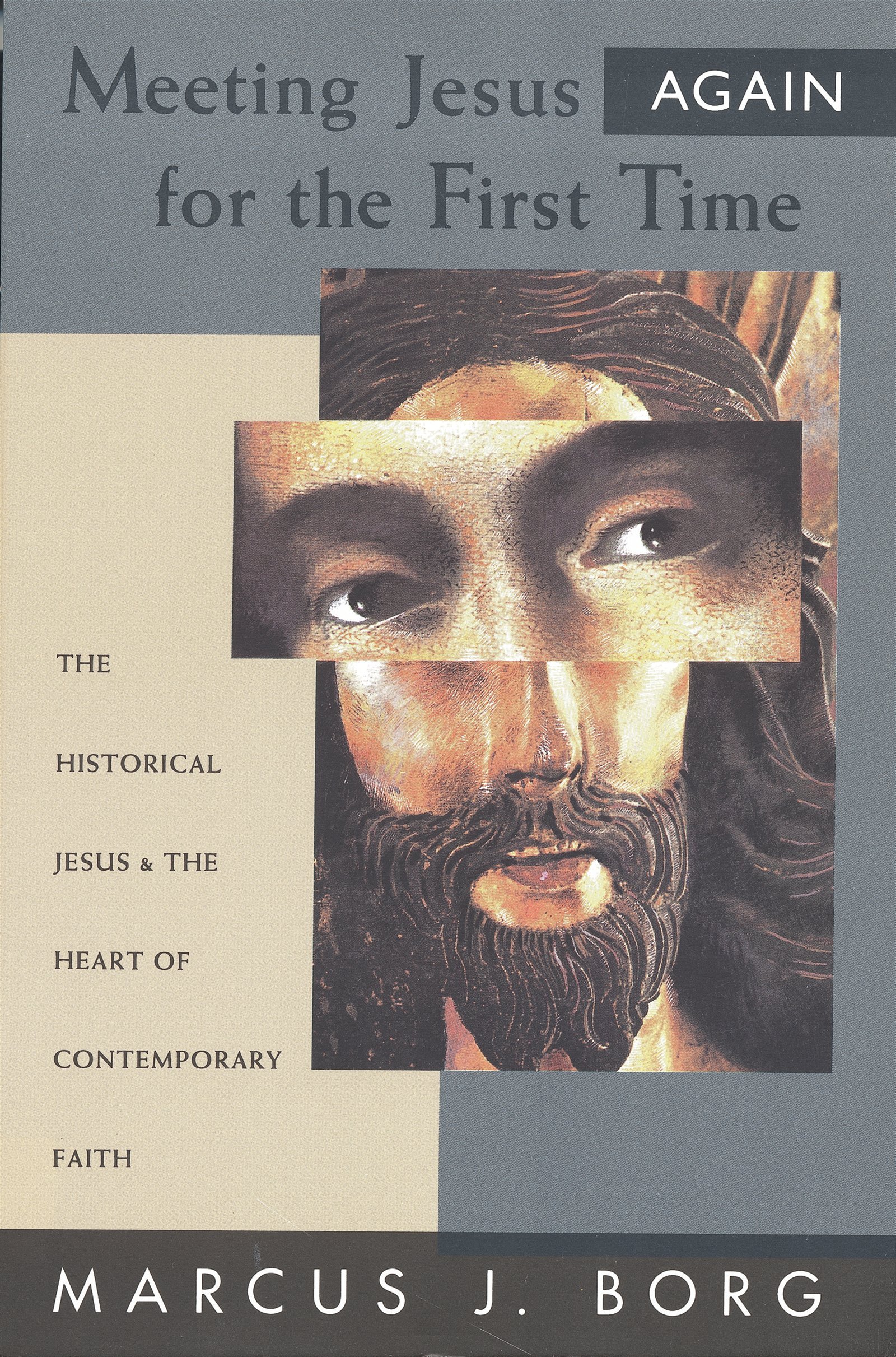
Cover of Marcus Borg book

Cover of Marcus Borg book

Marcus Borg’s writing and teaching affected millions.  Steve Shoemaker received an email of Marcus’s death yesterday from Barkley Thompson, who had quickly writtten the following tribute to Marcus on his blog “God in the Midst of the City“.

My friend, Marcus Borg
WEDNESDAY, JANUARY 21, 2015 / THE VERY REVEREND BARKLEY THOMPSON

Marcus Borg died this morning after a prolonged illness. I received a phone call this afternoon from a Cathedral parishioner and friend of Marcus, relaying the news to me.

I first became aware of Marcus Borg when I was a sophomore at Hendrix College. His landmark book, Jesus: A New Vision had just been released. It hit me at exactly the right time. I was a philosophy & religion major who knew God and increasingly knew about God, but I had little room or need for Jesus. Marcus’ book gave me an entirely new access point: to consider Jesus as Jesus had been historically, as a wisdom teacher, a healer, a social prophet, and more.

Marcus Borg

Marcus Borg

I first heard Marcus speak at Hendrix. He was the epitome of a college professor, right down to the cardigan sweater and pipe. He spoke calmly and with passion, and the first time I heard him in person was also the first time I understood how those tho things–calm and passion–could coincide.

I heard Marcus speak several other times over the years, but it was after I’d become a priest that I came to know him personally. When he was the annual Dodson Lecturer at St. John’s-Roanoke, he and I went to dinner. I was starstruck and wanted to quiz him about his research and his approach to Christianity. He’d have none of it. Marcus wanted only to talk about me, about St. John’s, about our ministry, and about my experience as a young priest in the Episcopal Church. He was solely interested in me, and I’ve never forgotten it.

Several shared meals and opportunities for fellowship later, my Christology has become higher and higher as the years have gone by. In ways I could not have done all those years ago in college, I now attest without hesitation that Jesus the Christ is God Incarnate, the hinge of history, the defeater of death, and the fulfillment in a single human life of God’s hopes for the whole world. And yet, my approach to Holy Scripture, my social convictions, and my love for the Episcopal Church mirror Marcus’ own perspectives quite closely. I once introduced Marcus to a church audience by saying, “I agree with roughly 75% of what Marcus will say to you this evening.” When he stepped into the pulpit, Marcus quipped, “I’m tempted to forego my notes and discuss with Barkley the other 25%!”

Unlike so many other writers in the field of religion (on both ends of the spectrum), Marcus was humble. Once one of my parishioners asked him during Q&A, “But how do you know that you’re right?” He paused, looked at her thoughtfully, and said, “I don’t know. I don’t know that I’m right.”

Very many people who had left the Christian faith have returned to it through Marcus’ evangelism (though he would grimace at my use of the word, I suspect). Marcus was a Christian, a follower of Jesus Christ in word and in deed. He understood Jesus (and especially the Resurrection) differently than I do. But the veracity of his faith was clear. And calm. And passionate.

Marcus and I last corresponded in late November. I’d asked how he was doing, and he responded, “I may have ten years left. Not sure I want more. There comes a time to let go. And I could, with gratitude, sooner than that. My life has been very blessed.”

Like Abraham, Marcus was blessed so that he could be a blessing. He blessed my life, and I am grateful.

NOTE: Since February 2013, Barkley serves as the eighth dean and twentieth rector of historic Christ Church Cathedral in Houston, Texas.  Click HERE for more information about the him.


MLK Day 2015 – the house next door

94 South Street, St. Augustine, FL

94 South Street, St. Augustine, FL

On Martin Luther King Day 2015 the historic house next door to us on The Freedom Trail here in St. Augustine is a faint shadow of its former self. A weathered sign by the rear entry reads:

“NO TRESPASSING by order of the City of St. Augustine. Violators will be prosecuted to the full extent of the law.”

Some of the louvered glass windows on the back porch are broken out. Sheets and blankets cover the windows.

The White family paid the price for their courage. James and Hattie were leaders in the Civil Rights Movement, as was their son Samuel. But, as Isaac Watts (1674–1748) reminds us in his poem and hymn “O God, Our Help in Ages Past”:

Time, like an ever-rolling stream,
Bears all its sons away;
They fly forgotten, as a dream
Dies at the opening day.

Time has a way of placing brackets around even the best historic moments. James, Hattie, and Samuel, their 14 year-old son, who was sent to reform school for sitting in at the downtown St. Augustine Woolworth’s, have been borne away by time. The three of them are deceased; their story and the dream is still alive.

When young Samuel and his three friends later known as “the St. Augustine Four” were arrested at Woolworth’s, the authorities agreed to release them to their parents’ custody on one condition: that they sign a statement that their children would not violate the law again. The four young men pleaded with their parents not to sign the pledge, assuring their parents that they, the sons, could make no such pledge. Mr. and Mrs. White refused to sign. Fourteen year-old Samuel was sent to reform school for a year. He served six months of the sentence before Dr. Martin Luther King, Jr., Jackie Robinson and other civil rights movement leaders came to St. Augustine to shine the national spotlight on St. Augustine. Samuel and the other incarcerated member of The St. Augustine Four were released by order of the Governor of Florida. The Civil Rights Act followed.

For all the saints, who from their labours rest,
Who Thee by faith before the world confessed,
Thy Name, O Jesus, be forever blessed.
Alleluia, Alleluia!

And when the strife is fierce, the warfare long,
Steals on the ear the distant triumph song,
And hearts are brave, again, and arms are strong.
Alleluia, Alleluia!

– William Walsham How  (1823 – 1897) 

The House Next Door on the Freedom Trail

We knew nothing about St.Augustine when we rented the house at 96 South Street for the month of January. It turns out that the house next door played an important part in the Civil Rights Movement. 94 South Street is on “The Freedom Trail” tour in St. Augustine in Lincolnville, the district settled by freed slaves in 1866.

94 South Street, St. Augustine, FL

94 South Street, St. Augustine, FL

Newly arrived, we notice that a group  gathers each day outside the house. Our second evening I walk by the house at dusk and greet the gray-bearded man sitting in a chair. He rises with his cane.

“Good evening.”
“Good evening,” he responds.
“You live here?” I ask.
“No, my friend does.”
“My name’s Gordon,” I say, extending my hand.
“Mr. _____” [I cant’ hear what he says]. “So tell me about this house. It’s an historic house, right?”
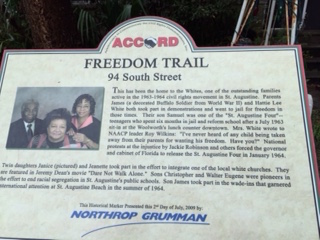
Freedom trail plaque“Read the sign,” he says, limping to the plaque next to the sidewalk. “Read it.”

I read it out loud.

Home of the White Family – Lincolnville

This has been the home to the Whites, one of the outstanding families active in the 1963-1964 civil rights movement in St. Augustine.  Parents James (a decorated Buffalo Soldier from World War II) and Hattie Lee White both took part in demonstrations and went to jail for freedom in those times.  Their son Samuel was one of the “St. Augustine Four”–teenagers who spent six months in jail and reform school after a July 1963 sit-in at the Woolworth’s lunch counter downtown.  Mrs. White wrote to NAACP leader Roy Wilkins, “I’ve never heard of any child being taken away from their parents for wanting his freedom.  Have you?”  National protests at the injustice by Jackie Robinson and others forced the governor and cabinet of Florida to release the St. Augustine Four in January 1964.

Twin daughters Janice and Jeanette took part in the effort to integrate one of the local white churches.  They are featured in Jeremy Dean’s movie “Dare Not Walk Alone.”

Sons Christopher and Walter Eugene were pioneers in the effort to end racial segregation in St. Augustine’s public schools.  Son James took part in the wade-ins that garnered international attention at St. Augustine Beach in the summer of 1964.

This marker is erected by ACCORD to honor all of the members of the family for their efforts to make St. Augustine, America, and the world a better place.

Christopher still lives in the house.

So here we are vacationing next to history. Look for more posts from conversations with Christopher and the people at St. Paul A.M.E. Church after the “Hands Up” workshop this Saturday.

– Gordon C. Stewart, Thursday, January 15, 2015