Solitude and Society Sermon
Reply

“You’re going to like Via Lucis this morning,” said Kay, as I came down for coffee.
She knows that I share much in common with the Hasidic rabbis described in Elie Wiesel’s Four Hasidic Masters and their Struggle against Melancholy. Like Rabbe Barukh of Medzebozh, anguish is part of my faith and character. “Faith and the abyss are next to one another,” said Barukh to one of his students. There are times, especially lately, when the abyss has been so close that I have considered silence, not speech and not writing, to be the better part of wisdom.
One of the benefits of creating Views from the Edge has been the discovery of Dennis Aubrey and PJ McKey through their blog Via Lucis Photography. Their posts speak to me in the way that little else does, in no small part, I think, because they combine art photography, careful research, and exquisite commentary on the Romanesque and Gothic church architecture. Their work elevates the discussion in a world filled with so many needless words. Their post this morning (click below on “Our Personal Favorites” left me speechless, humbled, and encouraged. Thank you, PJ and Dennis. One of these days we’ll meet face-to-face.
Gordon C. Stewart, August 8, 2013 copyright.
I have always been bemused by time . . . and place. I am on a train listening in the night to the eerie sound of the train whistle and the constant click-clacking of the wheels. Where were we? Where are we going – and why, just my mother and I?
We were between times and places. My father had shipped out for war in the South Pacific. Hewas somewhere on a ship and might not return. My mother and I were on our way from LA to Boston. Two different places: one hours behind, one many hours ahead. But for the time being, there was only the now of the train, the whistle, and the steady clickety-clack from the track carrying us from there to here to there, from then to now to then. Perplexity with time and place is my earliest memory.
We are all in transit. But from where to where and from when to when have become less and less my questions.
I do not share the popular view that time is an illusion or that the material world is the prison from which we will be released at death. Time and place are gifts of creaturely existence, boundaries within which we live our lives appreciatively or scornfully in the midst of the Eternal. To scorn them is to deprecate existence itself in the Promethean hope that we can steal fire from the gods to become what we are not: timeless and placeless.
Time and place are set within the larger Mystery that Rudolph Otto called the Mysterium tremendum et fascinans – the Mystery that makes us mortals tremble and fascinates us at the same time, the Mystery of the Eternal without which we are nothing that draws us to itself like iron to a magnet. Time and place – birth, finite life, death – exist within the Mystery of that which does not die: Eternity.
I am not amused by the denial of death that is so rampant in our culture. Surveys show that roughly 90% of Americans, regardless of religious affiliation, believe in life after death, by which they do not mean that life will go on without them, but that they themselves will never die.
I have come to believe that the denial of death and the fear of death lie close to the core of American culture at its worst. Ernest Becker’s The Denial of Death informs how I see the world and myself; Becker sits beside me as I turn to the Scriptures in the morning.
Psalm 90:1-5, paraphrased by Isaac Watts (1719) and sung as the hymn “O God, Our Help in Ages Past” is as much in my early memory bank as the train whistle on the ride to Boston. It has always represented a mature faith that takes seriously Otto’s Mysterium:
Before the hills in order stood,
Or earth received its frame,
From everlasting Thou art God,
To endless years the same.A thousand ages in Thy sight
Are like an evening gone;
Short as the watch that ends the night
Before the rising sun.Time, like an every rolling stream
Bears all its sons away;
They fly forgotten, as a dream
dies at the opening day.O God, our help in ages past,
Our hope for years to come,
Be Thou our guard while life shall last
And our eternal home.
Standing at the gravesites over the years, I have prayed the same prayer so many times that it has become an essential part of me. I confess that I don’t know what it means exactly but it expresses the sentiment of good faith as I have come to understand it for myself.
O Lord, support us all the day long,
until the shadows lengthen,
and the evening comes,
and busy world is hushed,
and the fever of life is over,
and our work is done.
Then, in Your mercy,
grant us a safe lodging,
a holy rest,
and peace at the last.
The shadows have grown longer since the trip to Boston and the first time I sang the hymn. Evening is closer now. The sense of the Mysterium tremendum et fascinans is different but no less real now than it was on the train to Boston. The hush of the busy world will come soon enough. Between now and the day my work is done, I want to listen more attentively for the Hush in the midst of time, and give thanks that the Silence is not empty. It is full of Eternity. I am bemused by time.
Click O God, Our Help in Ages Past for a video that captures the spirit of the hymn and the prayer.
“Missa Solemnis”
LORD HAVE MERCY begins the Mass
Under the baton of Maestro
Dean Craig Jessop. The last word: PEACE.
Wisdom and beauty from solo
Instrument, the mass choir, voice
Go to the top of Cathedral.
…
Vast walls of sound show pain also,
Arising from those who are cruel.
Nothing human escapes alto,
…
Bass and tenor and soprano.
Even a skeptic like Ludvig
Enlisted to create music,
Tries to make out of the tragic:
Hope, faith, love, kindness, and courage.
Overwhelmed by suffering, he
Values still signs of human will.
Even though stone deaf, he can be
Nurturing peace and harmony.
– Steve Shoemaker, Urbana, IL August 7, 2013
EDITOR’S NOTE: Craig Jessop is Dean of the College of the Arts at Utah State University, and former Director of the Mormon Tabernacle Choir.
This post is written by John Buchanan, Pastor Emeritus, Fourth Presbyterian Church, Chicago.
My son once asked me “What is time?”
I answered, “I don’t know. It’s a perennial question of philosophers and theologians. But, so far as I can tell, time is what we have.”
Some people think that time isn’t real. It’s a human construct and only eternity is real. They think of time and place as the prison of the soul, the antithesis of, or the prelude to, eternal life.
It always seemed a bit strange to me. Like the imaginary friends children make up because they’re afraid of being alone in the dark. I could never understand.
“Time is what we have.”
The animals know what time is. They also know eternity. They wake and sleep with the rhythms of the sun – rising and setting daily – the markers of what we call time. They know nothing about clock time or the names of days, months, seasons or years, but they live in the reality of time.
Time is what we have between birth and death. Eternity is the depth of time, the Mystery beneath, within, and beyond the limits of time. We participate in the eternal, but we are not eternal. To think otherwise is to consider ourselves the exception to nature itself.
The illusion of superiority to nature – the idea that the human species is nature’s singular exception – is a fabrication peculiar to the species that considers itself conscious. The imaginary friend of eternal life may help us sleep better at night, but it leads to slaughter and, eventually, to species suicide.
Ernest Becker (The Denial of Death) saw the denial of death as bedrock to American culture. The denial of death – the refusal to acknowledge it as real; the flight from the knowledge of our mortality – not only deprecates life here and now; it takes into its hands the life and death of those different from ourselves. It builds towers to itself that reach toward the heavens while it plunders an earth it considers too lowly for its aspirations.
Time is our friend and time is our limit. We are meant for this. “Grace and pride never lived in the same place,” says an old Scottish proverb, for pride always seeks to exceed what is given (grace).
Time is what we have. Time is a participation in the glory of God. If there’s more, it will only by grace.
Our parents took us to their church four times
each week: on Sunday, twice, and then for prayer
on Wednesday night–on Thursdays they sang hymns
in choir rehearsal while one, two, three, four
of us played on, around, and under pews.
“You boys be quiet!” they would often say.
We learned to sing in Sunday School: “Jesus
loves me,” and “Hallelu Hallelujah!”
Soon all of us were singing in the choir…
Then we grew up, our parents aged and died.
One atheist, one pantheist, one pair
of liberal Presbyterians–none tied
to our folk’s Baptist faith, yet when we drink
we sing their songs in four-part harmony.
– little stevie shoemaker, urbana, il, july 6, 2013
I’ve been silent for awhile, absorbed in preparing a manuscript for submission, and the site will remain pretty silent over the next three weeks.
Between now and then, this sermon on YouTube was preached last Sunday at Shepherd of the Hill, the wonderful congregation I’m privileged to serve in Chaska, MN.
It is based on the 51st Psalm (selected) and sees the psalm in light of a rite for the cleansing of a leper in the Book of Leviticus in which the leper presents two birds.
1 Have mercy on me, O God,
according to your steadfast love;
according to your abundant mercy
blot out my transgressions.
2 Wash me thoroughly from my iniquity,
and cleanse me from my sin.
3 For I know my transgressions,
and my sin is ever before me.
4 Against you, you alone, have I sinned,
and done what is evil in your sight,
so that you are justified in your sentence
and blameless when you pass judgment.
…
6 You desire truth in the inward being;
therefore teach me wisdom in my secret heart.
7 Purge me with hyssop, and I shall be clean;
wash me, and I shall be whiter than snow.
8 Let me hear joy and gladness;
let the bones that you have crushed rejoice.
9 Hide your face from my sins,
and blot out all my iniquities.
10 Create in me a clean heart, O God,
and put a new and right spirit within me.
11 Do not cast me away from your presence,
and do not take your holy spirit from me.
12 Restore to me the joy of your salvation,
and sustain in me a willing spirit.
13 Then I will teach transgressors your ways,
and sinners will return to you.
14 Deliver me from bloodshed, O God,
O God of my salvation,
and my tongue will sing aloud of your deliverance.
15 O Lord, open my lips,
and my mouth will declare your praise.
16 For you have no delight in sacrifice;
if I were to give a burnt offering, you would not be pleased.
17 The sacrifice acceptable to God is a broken spirit;
a broken and contrite heart, O God, you will not despise.
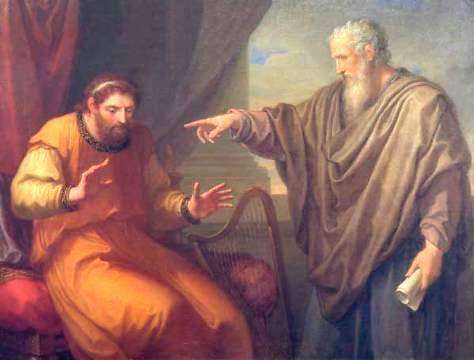
Nathan accusing David
“Behold, You seek truth in the inward being;
therefore teach me wisdom in my secret heart.” (Psalm 51:6)
What is the secret heart?
Is it the deepest place in us, the place where God is: the equivalent or synonym for “the inward being” – a poetic parallelism of Hebrew poetry?
Or is it, perhaps, the secret place where we hide from God: the hiding place where we go off to a different heart than the Divine heart?
Or could it be both synonym and antonym at the same time?
_______
Psalm 51 is a prayer attributed to David. It is not a quiet prayer. It is a wrenching, sobbing prayer, the words tumbling from David’s mouth in halting phrases and stammers with tears flooding his eyes and streaming down his face like rivers.
David’s secret heart is dirty and he knows it. He cannot wash the stain of blood from his hands. Nathan has exposed his sin. Nathan’s story-telling has seduced David into the trap where his secret is exposed to his inner being. Nathan has baited David with a story that has aroused David’s anger. “As the LORD lives,” said David to Nathan, ” the man who has done this deserves to die!” And Nathan then said to David, “YOU are the man.”
“Wash me thoroughly from my iniquity,” cries out David in Psalm 51, “and cleanse from my sin! For I know my transgressions, and my sin is every before me.”
It is a scene straight from Shakespeare’s Macbeth:
“Out, damn spot! OUT, I say…. all the perfumes of Arabia will not sweeten this little hand. Oh, oh, oh!”
_____
Hebrew Psalms are like that. The are not sanitized. They plunge the reader into the conflict between the reader’s own inmost being, the true secret heart, you might say – the heart that pumps life into us – and the secret heart of our own flight from truth and goodness, the heart of deception and self-deception.
Why is David crying out? What has he done? What is the sin that is ever before him, the blood he can’t wash from his own hands?
Psalm 51 comes in response to an accusation that has exposed the bloody behavior his secret heart heart has produced. It is Nathan, David’s commander on the battlefront, who confronts him with the truth.
Nathan, relying on a fresh report from the front line of battle, tells David that Uriah, the King’s next door neighbor, a man of valor and impeccable loyalty to King David, whom David had sent off to war to secure Uriah’s wife Bathsheba for himself, is dead! His blood is on David! Nathan has spoken the truth to power. And the way that Nathan has spoken it to the King has taken him into the deepest parts that are at war within himself.
There is no wisdom in David’s secret heart. There is only treachery.
“Create in me a clean heart, O God,
and put a new and right spirit within me.
Cast me not away from Your presence,
and take not Your Holy Spirit from me.”
“Purge me!” cries David. Imagine Richard Burton at his most dramatic. “Purge me with hyssop, and I shall be clean; wash me and I shall be whiter than snow!”
_____
What’s hyssop?
Hyssop is the foliage of an aromatic plant named in the Passover story (Exodus 12:21-27) and used in the cleansing of a healing and cleansing of a leper (Leviticus 4:51).
The rite of cleansing involves centers on two small birds. One bird is killed. The other bird is washed in the blood of the other under the flow of water and the sweetness of hyssop. The one bird dies. The second bird lives.
“Thus he (the priest) shall cleanse the house with the blood of the bird, and with the running water, and with the living bird, and with the cedarwood and hyssop and the scarlet stuff; and he shall let the living bird go out of the city into the open field; so he shall make atonement for the house, and it shall be clean.” (Lev. 14:52-53)
“Deliver me from bloodguiltiness, O God, the God of my salvation” cries Uriah’s killer curled up in a ball, hoping against all hope, “and my tongue will sing aloud of Your deliverance.”
_____
David in Psalm 51 is both birds.
He is the one who deserves to die. Yet he is also the one who lives. He lives not because of the heart that had conspired against Uriah and betrayed his own inward being – “Against You (God) only have I sinned…” (Ps. 51:4). He lives because there is more mercy in God (the inward being) than there is sin in him.
“The sacrifice acceptable to God,” he concludes, the tears still streaming down his face, but calmer now, “is a broken spirit; a broken and contrite heart, O God, You will not despise.”
His body quivers as he imagines himself as the bird released into the open field by mercy alone, “according to Your steadfast love; according to Your abundant mercy.” (Ps. 51:1) The inner being – his Deeper Being – has taught his released him for wisdom.
 Views from the Edge