Planetary Economics

The beginning of the GOOD news is HARD news, according to John the Baptist calling people out into the wilderness of Nature (Gospel of Mark 1:1-8).

“We must change,” he cries. Only a 180 degree turn can deliver us from the consequences of the actions that have led us here. He sounds like Bill McKibbon.

For John the Baptist the system at issue was Roman imperialism, an economic-political system centered in Rome expanding out, enforced by military invasions, subjugation, occupation, buffered by generous religious tolerance so long as the religious practices did not interfere with Roman prerogatives.

One could repeat the sentence in 2015 with little change: “the system at issue is [American] imperialism, an economic system centered in [Washington] expanding out, enforced by military invasions, subjugation, occupation, and religious tolerance so long as the local religious practice does not interfere with [American] prerogatives.”

It is this spiritual, moral, economic, cultural and political captivity to a global system that cannot satisfy our real needs or the world’s that produces a longing in our hearts, a readiness to make the trip to the wilderness. We are being called to abandon the house built on the quicksands of greed, manifest destiny, national exceptionalism, and the illusion of unsustainable growth.

We’re a weary people in 2015. Wearied and still disheartened 14 years after “Shock and Awe” took down Saddam Hussein on the pretense that he had weapons of mass destruction (WMDs) that threatened us and the Bush Administration’s persistent mis-association of 9/11 with Saddam Hussein. We’re wearied of lies and 11 years of un-budgeted military expenses, the loss of thousands of American soldiers’ lives and as many as 100,000 Iraqi civilians, a military venture undertaken on the assumption that the Iraqi people would welcome our presence as the onset of a new representative democracy and “free market” economy.

That belief in the goodness of American intentions hit the rocks almost as quickly as Saddam’s statue hit the pavement in Baghdad. All the while we were wearied by the earlier invasion of Afghanistan, whose original justification was a quick elimination of Osama bin Ladin and Al-Qaida untempered by realistic knowledge of the long history of the military interventions that mired the invaders in quagmires such as the Soviet Union found itself before leaving in defeat. To the Afghans it didn’t matter whether the troops were Soviet or American. They were the same. They were the occupation forces of an imperial power destined to fail.

In the midst of the weariness about what was happening abroad, the financial system at home took the American economy to the brink of disaster in 2008. Occupy Wall Street rose to the top of the news cycles. Although the movement fizzled over time, as such movements inevitably do, it caught the attention of television viewers, internet surfers, and newspaper and magazine readers. Occupy Wall Street and the spot light it placed on “crony capitalism” became a hot topic around water coolers at work and the table in the coffee shops.

For the first time in recent memory, capitalism was no longer sacred, no longer off limits. Time’s front cover asked the question whether Capitalism was dead. But, as with Occupy, public attention is short-lived. Amnesia sets in when people are weary. How soon we forget…until some new John the Baptist issues the cry for a 180 degree turn for the sake of something better.

Maybe Naomi Klein is a new kind of John the Baptist. This Changes Everything: Capitalism vs. the Climate, reviewed here by the New York Times, places the over-riding systemic issue squarely before the general public again. Senator Bernie Sanders, America’s only socialist Senator who names climate action as among his four top priorities, is gaining attention as a presidential candidate. Elizabeth Warren, the Senate’s strongest voice on holding Wall Street accountable, is a bulldog who won’t let go. Put them with Bill McKibbon and 350.org and you begin to hear the echo of John’s recognition of the prophetic hard truth-telling that is the forerunner of good news.

The hard truth that precedes good news is the discovery of the myth that couples democracy with capitalism while viewing socialism as democracy’s opposite. Ideological myopia is to nations and cultures what horse blinders are to horses on a race track: they limit vision to the narrow path of the track they’re on. They prevent their adherents from seeing beyond the track.

When the climate is changing in ways that have begun to compel our attention, and when we ask how we will make it through the changes together, the bigger question of the economic system (the track itself) comes into view by virtue of necessity. It calls us off the track of species supremacy and “man over nature” into the wilderness of Nature itself.

The words ‘economy’ and ‘economics’ derive from the Greek words for ‘house’ and ‘the management of the household’. Their real subject is not about markets, free or otherwise. The issue is what and how the managers manage and why we let them. Economics is every citizen’s business because we all live together in the one house. No exceptions. Economics in the original sense is a spiritual-ethical perspective before it creates systems that support (or contradict) its premise of shared life and responsibility for the planet.

John the Baptist with his axe laid to the root of the tree, reminds us that economics is a spiritual matter of the first order. It is what the Hebrew Bible calls “the Day of the Lord” and John the Baptist and Jesus of Nazareth called “The Kingdom [i.e. Society] of God”. Economics is not an academic discipline, or the exclusive province of Wall Street traders who understand how the free market works. Genuine economics begins and ends with the philosophical commitment to the wellbeing of the entire household of Nature and its inhabitants.

The planet — this home within Nature without which no person, society or form of life exists — requires different management. The economy for which our hearts long is the one house imagined by the psalmist and announced by John in the wilderness beyond the track of the Pax Romana: the good news waiting for longing hearts to embrace it, an economy where “righteousness and peace will kiss each other” (Psalm 85:10) and wars will be no more.

The beginning of the GOOD news is HARD news. “Repent, for the kingdom of heaven is at hand.”

– Gordon C. Stewart, Chaska, MN, June 16, 2015
President Obama’s Letter to the NYT

President Obama’s Letter to the Editor of The New York Times today responds to a thoughtful NYT article by Jim Rutenberg on the Voting Rights Act of 1965. Click HERE for a link to the NYT’s coverage of the President’s letter and the article that inspired it.

Views from the Edge posted the following comment on the NYT website:

Arguments that the key provision of the Voting Rights Act are no longer necessary are what the President says they are. State decisions to remove the Confederate flag demonstrate greater sensitivity to the continuing presence of white supremacist assumptions than is apparent in the U.S. Supreme Court and among the Republican caucus in the U.S. Congress. The President persistently keeps before the American people the historic aspiration “in Order to form a more perfect Union” and, in so doing, does the nation a great service. This president is balanced, historicaly-informed, philosophical, articulate, and personally grounded. After years of swallowing his tong in hopes of reaching bi-partisan solutions, President Obama is making use of his last years in office in ways that will place him among the greats of American history.

  • Gordon C. Stewart, Chaska, MN, August 12, 2015.

The Honesty Factor

What helps explain the unexpected rise of Donald Trump and Bernie Sanders in the polls?

E. J. Dionne’s Washington Post piece “Don’t look now, but Sanders is Rising” contains a clue to the difference between public perception of Trump and Sanders, on the one hand, and most other candidates for President, on the other.

It’s pretty simple, as it was when the people of Minnesota shocked the world (and themselves!) by electing Jesse Ventura, the former professional boa scarf wearing wrestler and straight-talking, no holds barred, Minneapolis radio talk show host, as Governor.

E. J. Dionne cites a poll by WMUR-TV in New Hampshire trying to get a handle on the primary race between Sanders and Hillary Clinton. Of all the questions, the one that stood out from the standard questions about one’s position as liberal, moderate, or conservative was this simple question: “Who is least honest?”

Thirty-one (31) percent answered Hillary Clinton. Only three (3) percent picked Bernie Sanders. To put it positively, 97 percent trusted Bernie as the straighter shooter.

Watching the Republican Presidential Candidates Debate last night, something similar was on display. I scratched my head wondering how it happens that Donald Trump was the highest rated candidate in the polls that led to the top 10 Republican candidates. When asked whether he would support the eventual party nominee, Trump said he would not make that pledge. He was booed by many in the audience. But I suspect the audience and those watching on their televisions and iPads would rate him as low on the “least honest” factor last night as the New Hampshire Democrats answered for Bernie.

Jesse Ventura was elected by Independents, Democrats, and Republicans who were disgusted by the less than honest answers of the two experienced politicians on the stage of the debates. Jesse did full Nelsons, pinning the more experienced “less honest” (i.e., more skilled at obfuscation) Skip Humphrey and Norm Coleman to the mat.

E.J. Dionne ends his column with this observation:

“As for alienation from the system, Trump and Sanders do speak to a disaffection that roils most of the world’s democracies. But their way of doing so is so radically different – Sanders resolutely pragmatic, Trump all about feelings, affect and showmanship – that they cannot easily be subsumed as part of the same phenomenon. Sanders’ candidacy will leave policy markers and arguments about the future. Trump’s legacy will be almost entirely about himself, which is probably fine with him.”

I would add that the American electorate understands feelings and affect, and that, in an entertainment culture, we have come to expect to be entertained. In the Donald and in Bernie we see and hear two men who stand against the odds, and the one thing (perhaps the only thing) that links them in the hearts of those who watch and listen is that they are “the least dishonest”.

But honesty and showmanship alone do not a good governor or president make. We need to bring our minds as well as our hearts to ringside.

Our Common Home: Pope Francis and Bernie Sanders

Pope Francis’s Encyclical Laudato Si‘: On Care for Our Common Home has caught the world’s attention. (Scroll down for the Encyclical Letter’s opening paragraphs.)

In our view, Pope Francis and Bill McKibben of 350.org are prophetic figures, i.e., they seem to utter a Word not totally their own. So does Sen. Bernie Sanders (I, VT), who is, not by accident, Bill McKibben’s close friend from Vermont, and the ONLY candidate to place climate change action among the top priorites of his presidential campaign. He speaks boldly, and his message echoes the cry of Luudato Si‘ for action now for the sake of the planet. There is no obfuscation.

“The United States must lead the world in tackling climate change, if we are to make certain that this planet is habitable for our children and grandchildren. We must transform our energy system away from polluting fossil fuels, and towards energy efficiency and sustainability.” – Excerpt from Sen. Bernie Sanders’s campaign priority on Climate Change and the Environment.

Religion, science, and politics each deal with reality, superstition, and obfuscation. The Pope’s call for global action requires political legs to make it walk. Political engagement is not optional at this moment in the history of planetary development. In that regard, no other presidential candidate is so clear on climate change and sustainability as Bernie Sanders. No other candidate speaks with such passionate conviction or knowledge. Pope Francis is a man of God, a modern John the Baptizer appearing in the wilderness, following the lead of Bill McKibben, the scientific consensus, and The Pontifical Academy of Sciences’s research and counsel.

The Pope’s position on nature, born of a more ancient wisdom than the mechanistic “man over nature” view of postindustrial society, is thoroughly catholic, the0logically classical, and steeped in scientific research.  “Man over nature” and “history over nature” are figments of our imagination. Nature always wins. We ARE nature and nature is us.

1. “LAUDATO SI’, mi’ Signore” – “Praise be to you, my Lord”. In the words of this beautiful canticle, Saint Francis of Assisi reminds us that our common home is like a sister with whom we share our life and a beautiful mother who opens her arms to embrace us. “Praise be to you, my Lord, through our Sister, Mother Earth, who sustains and governs us, and who produces various fruit with coloured flowers and herbs”.[1]

2. This sister now cries out to us because of the harm we have inflicted on her by our irresponsible use and abuse of the goods with which God has endowed her. We have come to see ourselves as her lords and masters, entitled to plunder her at will. The violence present in our hearts, wounded by sin, is also reflected in the symptoms of sickness evident in the soil, in the water, in the air and in all forms of life. This is why the earth herself, burdened and laid waste, is among the most abandoned and maltreated of our poor; she “groans in travail” (Rom 8:22). We have forgotten that we ourselves are dust of the earth (cf. Gen 2:7); our very bodies are made up of her elements, we breathe her air and we receive life and refreshment from her waters.

[1] Canticle of the Creatures, in Francis of Assisi: Early Documents, vol. 1, New York-London-Manila, 1999, 113-114.

– Gordon C. Stewart, Chaska, MN. July 28, 2015

Ego Trips

Image

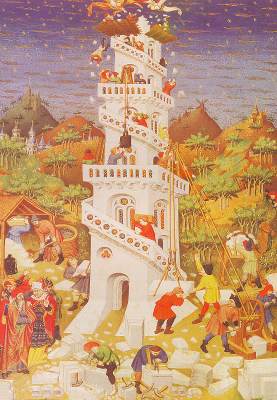
“Come, let us build ourselves a city and a tower with its top in the heavens, and let us make a name for ourselves…” [Genesis 11: 4]. No further comment needed.

Building of the Tower of Babel - Master of the Duke of Bedford

Building of the Tower of Babel – Master of the Duke of Bedford

International Trump Tower and Hotel, Chicago, IL

International Trump Tower and Hotel, Chicago, IL

Daily Riches: Pimping Religion, Confronting Empire – Part I (Dan Clendenin)

Bill Britton's avatarRicher By Far

“Amos wrote 2,800 years ago, but his prophecy reads like today’s newspaper. He lived under king Jeroboam [whose] kingdom was characterized by territorial expansion, aggressive militarism, and unprecedented economic prosperity. Times were good. Or so people thought. The people of the day interpreted their good fortune as God’s favor. Amos says that the people were intensely and sincerely religious. But theirs was a privatized religion of personal benefit. They ignored the poor, the widow, the alien, and the orphan. …Making things worse, Israel’s religious leaders sanctioned the political and economic status quo. They pimped their religion for Jeroboam’s empire. Enter Amos. Amos preached from the pessimistic and unpatriotic fringe. He was blue collar … neither a prophet nor even the son of a prophet in the professional sense of the term. Amos was a shepherd, a farmer, and a tender of fig trees. He was a small town boy who…

View original post 314 more words

Mortality and Morality

‘Mortality’ knows nothing of ‘morality’.

The words are separated by one letter, but they are foreign to each other. Mortality always trumps morality. The young die before the older without explanation or moral reasoning.

Tonight 92 year-old Bob Cuthill will participate in the celebration of his younger 72 year-old friend Phil Brown. Bob and Phil became friends professional colleagues years ago. Over the years Bob had been to Phil the wise older mentor, confidant, and friend.

Phil, 20 years Bob’s younger, was not supposed to die. He was the picture of health until two months before they diagnosed a rare, hidden Lymphoma, performed emergency surgery, and watched his life ebb away organ by organ in the post-surgery ICU. If life were ordered by moral reasoning, Phil was not supposed to die before Bob.

Tonight I’m thinking of Bob and Phil’s dear wife, Faith, gathered with Phil’s local friends at the White Bear United Methodist Church for pizza, vanilla ice cream (Phil’s favorite flavor), and story-telling back in Minnesota.

The older survivors of the deceased often ask Why? Why him? Why her? Why not I?  The answers never come. What comes instead to the fortunate is a great thanksgiving for the life that has passed and the life one has for yet awhile before others gather for pizza and ice cream.

– Gordon C. Stewart, friend and classmate of Phil Brown (1942-2015), July 6, 2015.

The Confederate Flag Outside the Library

The Hearst Free Library in Anaconda, Montana is on the National Historic Register. During our four weeks here serving St. Timothy’s Memorial Chapel in Southern Cross, I travel daily to Anaconda to use the library’s internet access.

Walking into the library this morning I noticed a pickup truck with a Confederate flag decal on the back window of the cab. The hackles went up on the back of my neck. The urge to scratch the decal from the window momentarily crossed my righteous mind until I took note of something else.

The pickup truck with the Confederate Flag decal

The pickup truck with the Confederate Flag decal

The truck was old and in poor repair. Its bed was messy, filled with a random collection of stuff. This was not a 2015 GMC Canyon or Cadillac Escalade EXT. It belonged, I surmised, to a poor white guy or woman, or a poor white couple hanging on by their fingernails to what little they have.

Anaconda, MT is a fascinating place to live for a month. Once the world center of copper mining, the city of 9,300 residents today is living with great resilience on this side of the mine’s closing in 1987 and the SuperFund clean up that continues into the present.

There is great pride here in their history and in their capacity for survival beyond the abandoned mine shaft and silent smelter stack that still stands proudly, preserved by Anacondans who opposed its demolition by Anaconda Copper’s successor, ARCO. The stack is the oldest smelter stack in the world, large enough for the Washington Monument to fit inside it.

Miners are a sturdy lot. So are their descendants. The closer a visitor draws to the heartbeat of knowledge, persistence, and compassion in Anaconda — the Hearst Free Library — the more one respects and appreciates the town once built by corporate America and left to fend for itself when its usefulness had ended.

Class is the issue in America. But as soon as class comes into play, race becomes the easier target. When the company owners whose workers produce wealth throw away a town the way we throw away paper towels, racial differentiation produces the scapegoat for poverty. A young white man enters an historic black church, sits down for the Bible study for an hour, considers not pulling the trigger because they seemed like “nice people” and blows nine people away. A poor man’s pickup with a Confederate flag decal is parked down the street from the Hearst Free Library in Anaconda, Montana. What that flag stands for can, and does, show up anywhere in America.

– Gordon C. Stewart, Georgetown Lake, MN

The Socialist Jew

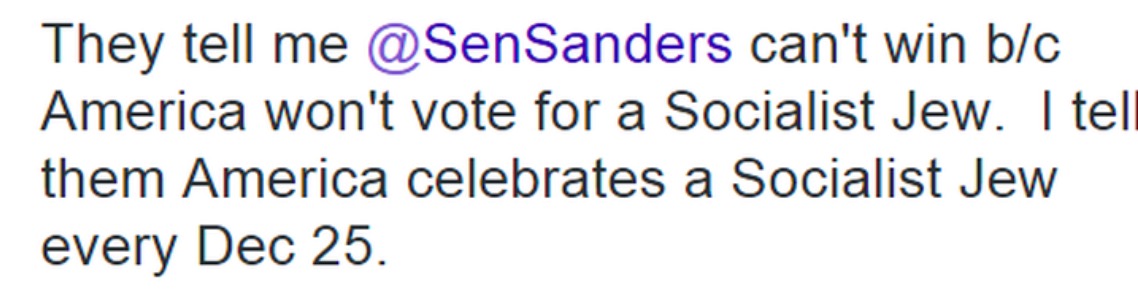
This tweet caught Steve’s attention, as well it should!

Socialist Jew Quote

Socialist Jew Quote

Bernie Sanders and Rand Paul – a Glimpse

Video

I’ve been waiting  for years for Senator Bernie Sanders (I-VT), whose recently announced candidacy for President of the United States is drawing astonishingly large crowds.

Ask him why he’s running and he tells you. And when he does, he speaks with two qualities that too often are estranged from one another: keen intelligence and passionate conviction. His voice resonates with a timber from deep within his soul. He’s not your stereotypical politician. He doesn’t answer questions by running in circles. He’s not afraid to offend potential supporters. He’s as bold as they come. What he’s bold about is common sense. The crowds in Minnesota and Iowa are coming out to meet him because they hear the voice of a truth-teller. No matter that Bernie speaks with a Brooklyn accent.

No other candidate for President during my lifetime has been as clear or concise as Bernie Sanders. Here’s a sample of Bernie engaging Senator Rand Paul (R-KY) on senior hunger back in 2011 before Bernie and Rand threw their names in the hat.

No one knows how far Bernie will go in his bid for the Presidency. But suddenly the mainstream media within the Washington Beltway and the New York Times the sneered at him a week ago are beginning to sense they’d better pay attention.

– Gordon C. Stewart, Chaska, MN, June 2, 2015.