Holding together two opposite thoughts and feelings is a challenge these days.
I’m trying to synchronize very different things I “know” to be true.
So far, I’m failing –one is almost always taller and stronger than the other.
Or maybe being out of sync isn’t a failure. Perhaps insisting on synchronicity is childish. Maybe being all grown up and stuff means being able to listen to Beethoven while watching a baseball game. Some things you don’t have to synchronize. Some contrasts don’t have to be resolved. Some opposites are worth maintaining for one’s mental health.
Take, for instance, tolerance and intolerance. Is it possible, or morally permissible, to be tolerant or intolerant, or do we have to synchronize them, and, if we do, what would that look like? You can’t be tolerant and intolerant of everything! Some decisions must be made. But maybe you still can synchronize them according some deeper sense of self and world — like the search for beauty, truth, and goodness.
Intolerant people whip up my intolerance for intolerance.
It’s very hard to synchronize when you feel like your country is drowning!
Gordon C. Stewart, May 24, 2019, “drowning in Chaska” MN.
Readers of Views from the Edge know we’ve been offline for a while. There’s enough gloom in the world, and I’ve been feeling kind of gloomy. No one needs one more Gloomy Gus. So I’ve kept the words to myself, reading and writing for edification and a character adjustment.
You might say, I haven’t been home lately. Except for moments with grandson Elijah, whose latest word is ‘home’, laughter has come harder than words. Elijah sends me home to the self I’d almost lost — the childlike self not yet weighed down by adult concerns. Then, this morning, something akin to Elijah’s joy hit me. Turning again to William Britton’s Wisdom from the Margins: Daily Readings, it was almost as though I had been commanded home to joy.
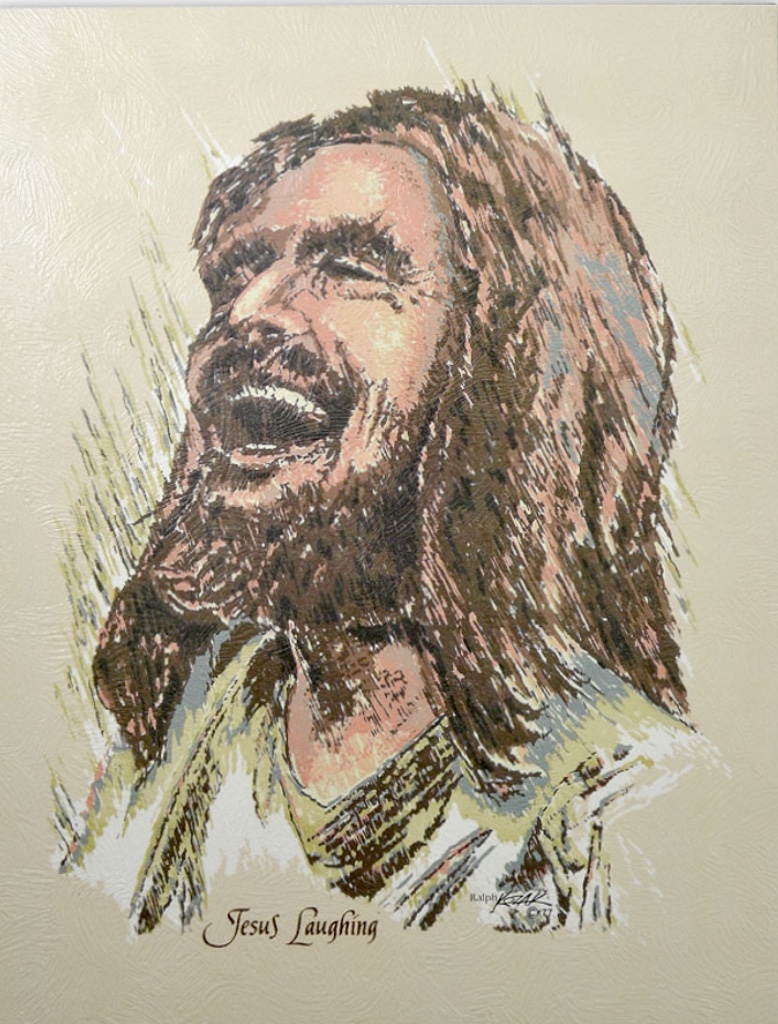
The Laughing Christ
“When I imagine Jesus, it is not simply as a person who heals the sick, raises the dead, stills the storm, and preaches good news. It’s also as a man of great goodwill and compassion, with a zest for life . . . brimming with generous good humor. Full of high spirits. Playful. Even fun. Interestingly, in the past few decades two images of a joyful Jesus have enjoyed some popularity. The first is The Laughing Christ by Willis Wheatley, a sketch that shows Jesus’s head throw back in open-mouthed laughter. The second is The Risen Christ by the Sea, a colorful portrait of Jesus wearing a broad smile and standing beside a fishing net, painted by Jack Jewell, a seascape artist in the 1990s. These two paintings, among others, serve to counteract countless images of the gloomy Messiah. . . . But I wonder if some eschew these portraits because of . . . their subject material. Is there something about a smiling Jesus that threatens our understanding of the man?”
James Martin, Between Heaven and Mirth
“Okay, “I said. I’ve been AWOL for a while, painting myself in the likeness of the faithful man of sorrows who weeps over the city, a serious, joyless man who didn’t smile much and laughed rarely, if at all, on the way to the cross.
Reading Jesus’ response to his critics gives a clue to a different character more like The Laughing Christ. Jesus’s rebuke to his critics — “The Son of Man came eating and drinking, and they say, ‘Here is a a glutton and a drunkard, a friend of tax collectors and sinners “(Mt 11:18 NIV) — offers a clue to a laughing Jesus. There’s a glimpse of truth in most criticisms. Many Christians quickly rise to Jesus defense. We’re okay with the criticism that he ate and drank with sinners; we’re not okay with the accusation that he was a glutton and a drunkard. We become like my six year-old cousin and I charging up the stairs to tell Aunt Gertrude (Dennis’s mother) we’d discovered a six-pack in the basement refrigerator we were forbidden to go near: “I didn’t know my father was a drinkin’ man!” said Dennis. Surely Jesus was not a drinking man! “ There was never any beer in Jesus’s refrigerator. “Jesus was not a glutton and a drunkard!”
Both criticisms must have had a hint of truth to them. “Why do the disciples of John fast often, and make prayers, and likewise the disciples of the Pharises; but yours eat and drink?” (Luke 5:13.) Jesus must have savored the taste of a home-cooked meal, and lifted a glass or two in light-hearted moments at a party, not just at the Last Supper. The alternative to Jesus’s critics is not that Jesus never got a little tipsy or ate too much at a party. It would be ludicrous to criticize a tea-totaller on Weight Watchers for being “a glutton and a drunkard”! Jesus was no Gloomy Gus who never laughed. He wasn’t solemn or holy enough for his critics.
So here I am today, back online, opening my eyes to “The Laughing Christ” and “The Risen Christ by the Sea” that challenge the gloomy spirituality of gloom and doom, on my way home to a more buoyant joyful spirit the news can’t take away.
Dennis Aubrey of Via Lucis became a friend after we found each other’s work through the web. As he has many times before, Dennis has spoken for me.
By the rivers of Babylon, there we sat down
Yea, we wept, when we remembered Zion.
We hanged our harps upon the willows in the midst thereof.
For there they that carried us away captive required of us a song;
And they that wasted us required of us mirth, saying, Sing us one of the songs of Zion.
How shall we sing the Lord’s song in a strange land?
Psalm 137:1-4 (King James Version)
When I lived in Los Angeles from 1972 to 2000, the city was filled with men and women who lived and died on the streets. It seemed an inevitable part of urban life, where displaced humanity would collect in the hidden corners of our cities. Facilities for the mentally ill had closed, prices for homes had accelerated and more people lost their ability to own or even rent. I knew what was happening in the rust…
Bumpa, put your hearings in. I got a question. It’s serious.
Okay. Just a minute. Now, what’s your question, Elijah?
We’re not supposed to lie, right?
Right. We should always tell the truth. We don’t want be liars.
Why? Everybody’s doing it?
No they’re not, Who’s everybody?
The mean guys!
Whatmean guys?
The Publicans!
You mean Republicans?
Yea, them. The Publicans.
Where’d you get that, Elijah?
I saw it on Rachel!. We couldn’t watch Simple Songs at daycare!
What did you see?
The Publicans putting little Mexican children in prison. I saw it on TV.
Okay, I see. Anything else?
Yes. Marissa says we don ‘t have to worry about dictators. We shouldn’t have to worry about dictators. Right, Bumpa? What’s a dictator?
Ah, I see. Dictators do whatever they want. They lie and cheat and get away with murder. Their countries don’t have constitutions to check their power. Understand?
We live in America, right?
Well, yes. We live in North America, like Canada, but yes, our country is called The United States of America. Does that make sense?
Bumpa, I’m only 23!
No, you’re not 23. You’re almost two. You’re 23 months, not years. You have 16 more years before you can vote.
That’s not fair! One last question before you clean your hearing aids, and don’t make it complicated.
Okay, shoot. Try me.
You said we don’t have a dictator. Do we really have a constitution?
Preamble of the United States of America
— Gordon (Bumpa) and Elijah, Chaska, MN, April 27, 2019.
At daybreak, far from the ranting and raving that hurt my ears, I’m alone with The Book of Common Prayer. I’ve come here for silence, interrupted only by the calls of the loons and the pair of trumpeter swans that return every spring.
For generations the swans’ inner compasses have brought them back to this unspoiled place to hatch their young before flying south again for winter. The swans and I are a lot alike; we both come back when the ice is almost gone.
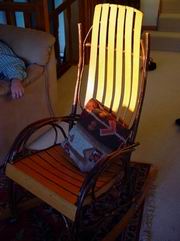
I settle into the hickory Amish rocker Jacob Miller crafted to fit my slim dimensions 40 years ago back in Millersburg, Ohio. Though its measurements are the same, It feels narrower. But we’re still made for each other. The rocker is where I rock awhile, like Jacob on his front porch after a hard day’s work, until he had to light the kerosine lamps inside.
I reach to the lamp table next to the rocker for The Book of Common Prayer that belonged to Sue Kahn until the day she gave it to me. Sue had relocated to Cincinnati to be nearer her daughter after macular degeneration had left her functional sightless. A lifelong Episcopalian who savored the language of The Book of Common Prayer, she joined her her daughter for worship with the Presbyterians. She asked one day whether I had a copy of the Book of Common Prayer. A week later, Sue stayed after worship. “I want you to have this,” she said, placing it in my hands. “I know you’ll treasure it as much as I.”
I open to the appointed Psalm for this Wednesday of Holy Week, Psalm 55.
Hear my prayer, O God; do not hide yourself from my petition.
It’s the day before release of the redacted report of Special Counsel Robert Mueller III, a report that may answer my prayer for full disclosure of the truth I suspect has been hidden.
Listen to me and answer me; I have no peace because of my cares.
The arrogance — “listen to me; answer me!” — disturbs me. Prayer is not an exercise in telling God what to do! The psalmist is arrogant and it’s selfish, more than a little Narcissistic, like the man in the Oval Office who might push the button on the red phone after typing the letters into th unsecured iPhone he uses to tweet.
But I have come to the wilderness because I have no peace watching Ari and Rachel and waiting for the nightmare to end.
I am shaken by the noise of the enemy; and by the pressure of the wicked…
I don’t like talk of ‘enemies’; it puts me off. “Love your ememies and do good to them who persecute you.” Framing one’s opponents as ‘wicked’ is the less develped morality that has not yet recognized the inertwining of good and evil. But the psalms express the vicseral feelings of the heart unfiltered by the cerebral cortex. Like the psalmist, I am shaken to the core by the noise of an enemy; the pressure of the wicked. The noise hurts me ears.
For they have cast an evil spirit upon me, and are set against me in fury.
l do not stand on solid ground. The cloud of evil and wickedness I routinely ascribe to ‘them’ hangs over me. I cannot claim to be righteous, right, or good as opposed to the unrighteous, wrong, and evil. I live under an ‘evil spell’ – the fall from essential goodness that comes with the presumption of the knowledge of good and evil — the knowledge that belongs to God alone. There is no escape from the pressure and the fury.
My heart quakes within me, and the terrors of death have fallen upon me. Fear and trembling have come over me, and horror overwhelms me.
I quake as a fish caught in a net. I thrash and tremble in darkness at noon as at midnight. The snare of terrors encompasses me.
And I said “Oh, that I had wings like a dove! I would fly away and be at rest. I would flee to a far off place and make my lodging in the wilderness.”
The crackling from the fire and the trumpet calls of the trumpeter swans across the wetland break the silence of daybreak. In this far off place, I am at rest. II make my lodging in the wilderness beyond the snare and blare of right and wrong, good and evil.
— Gordon C. Stewart by the thawing weland, April 18, 2019
“…Heaven have mercy on us all – Presbyterians and Pagans alike – for we are all somehow dreadfully cracked about the head, and sadly need mending.” — Herman Melville, Moby Dick.
Watching BBC/Netflix series The Fall — all three seasons in one huge gulp — led me to recall Arthur Miller’s play by the same title, the Genesis story, and the works of Herman Melville, William Golding … or even John Calvin. The brief appearance mid-way through the series of a 20£ bill with a note scrawled across it in red ink — He who does not love abides in death — and its unanticipated re-appearance in the series’ final scene seemed to this Presbyterian preacher like the subtext from which Allan Cubitt create The Fall.
Great literature likeMoby Dick, and insightful sermons, films and television series are sometimes rooted in, and explicate, a text, a line, an aphorism. Allan Cubitt’s choice of the series’ title calls to mind Arthur Miller’s The Fall and the Hebraic biblical story of humankind’s attempt to master paradise by the raid on what belongs to the Creator alone — the knowledge of good and evil (Genesis 3:1-8) — that quickly results in fratricide between humankind’s first children.
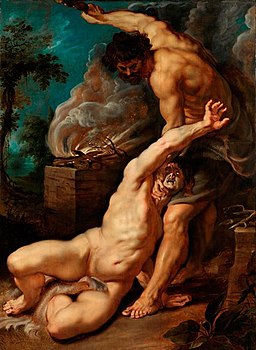
Cain murders his brother Abel. Abel is blown away. Only Cain remains. But the echo of Abel’s horror remains to spoil the good earth: “Listen; your brother’s blood is crying out to me from the ground!” (Genesis 4:10). Allan Cubbit’s title points to the Genesis story. Likewise, his work, The Pool of Bethesda, is taken from Christian scripture.
Film critic reviews like Sophie Gilbert’s “Netflix’s ‘The Fall’ Comes to a Maddening End in its Third Season” (Nov. 5, 2016) in The Atlantic — express disappointment that The Fall “forgot” to answer “the questions [The Fall] raises about misogyny, madness, and obsession.” They see the bill as a glimpse into the deranged mind of Paul Spector, the serial killer, but nothing more.
The final scene of the final episode of the series begs for more. Stella, the detective who has cracked the case, has returned to solitude in her bloodless London flat. She pours herself a glass of red wine and reads again the red ink message: ”He who does not love abides in death,” the verbatim biblical quotation carefully plucked from the New Testament epistle that focuses on love as life itself, and lovelessness as death (I John 3:14). The note’s reappearance is more than a reminder of the bloody horror Stella seems to have escaped, or a return to the vexing inner workings of Paul Spector’s lethal psyche. It serves a larger purpose: to expose the series’ subtext, throwing a light backward on the inexplicable darkness and obsession with death and raising the question of Stella’s own loveless psyche and future, leaving the viewers to ponder for ourselves the complexities of love and life, lovelessness and death.
Works of art do not give answers. Neither does Cubitt’s The Fall. They do not explain reality; they describe it — the mystifying entanglement of lovelessness and love, of evil and goodness, the inexplainable complexity of all the sisters and brothers of Cain. Cubitt’s own reflection on the BBC calls attention to another scene midway through the series in which the serial killer’s Intensive Care nurse, Sheridan, tells him she will pray for him. “My idea is that the line ‘I will pray for you’ is provocative,” said the author. “Surely he is beyond redemption? It seems Sheridan [Spector’s ICU nurse] doesn’t think so. Has anyone ever prayed for Spector before?”
This and other scenes are, by design, “subtle and nuanced and ambiguous, open to all kinds of interpretations, replete with possibilities.”
“…and Heaven have mercy on us all – Presbyterians and Pagans alike – for we are all somehow dreadfully cracked about the head, and sadly need mending.” ― Herman Melville, Moby Dick.
— Gordon C. Stewart, a Presbyterian cracked head, Chaska, MN, April 15, 2019.
In this short video Karl Barth addresses the question of how the German people were led to sacrifice a democratic constitutional republic for the dream of Adolf Hitler.
Karl Barth, theologian, professor, author, founder of the Confessing Church which refused to participate in the surrender of faith to the ideology of the Third Reich, and author of The Declaration of Barmen.
NOW: VIOLATION OF THE OATH OF OFFICE
What we see in the U.S.A. in 2019 is chilling. During his visit to the U.S.–Mexican border the American President violated his oath of office “… to the best of my Ability, to serve, protect, and defend the Constitution of the United States of America.” (Article II, Section One, Clause 8, U.S. Constitution). If, during his recent visit to Calexico, the President advised U.S. Border Patrol officers to pay no attention to judges, as reported by CNN and Jake Tapper, the President committed an impeachable offense. He not only did not serve and protect the Constitution. He openly defied it. He put himself above the law.
EYE DISEASE and THE LORDLESS POWERS
It takes what Barth called “eye disease” not to seethe systematic erosion of the rule of law by what Barth called “political absolutisms and lordless [i.e. unaccountable] powers” built around a charismatic madman’s dream. The parallels between then and now smack us in the face every day: requiring from cabinet members a sworn loyalty oath and breach of silence agreement; telling the U.S. border patrol to ignore the law and the courts and do what he says; ignoring the law and court orders upholding the legal and human rights of asylum-seekers; separating migrant children and their parents; declaring that his knowledge of world affairs superior to career State Department, Department of Defense, military, and intelligence professionals; ignoring wise advice and counsel; ridiculing past presidents as inferior to himself; assaulting freedom of the press guaranteed by the First Amendment; encouraging violence by refusing to criticize white supremacy, white nationalism, and white hate groups; replacing legitimate patriotism — love of one’s country — with national idolatry; putting personal and family wealth, power, and fame ahead of the checks and balances of the U.S. Constitution.
SEEING THROUGH OBFUSCATION AND DELAY
Wednesday’s (April 10) news further to the sense of a kind of coup d’état — the bloodless undermining of the rule of law in this constitutional republic by those sworn to uphold it. Attorney General William Barr’s refusal to answer questions posed by a Congressional committee re: his decisions about redaction and release of the Mueller Report, and Treasury Secretary Munchen’s deferral to the Department of Justice re: the Congressional demand from the IRS for the past six years of President Trump’s tax returns led me back to Barth.
FAITH AND ETHICS: UNMASKING THE LORDLESS POWERS
“We do not know what we are doing when we pray ‘Thy Kingdom come,’ namely that, negatively at least, we are asking for the gracious unmasking, overcoming, and ultimate abolition of these absolutisms that rule us per neras [i.e. by wrong].” – Karl Barth, The Christian Life, p. 219.
What can be said that isn’t being said over and over and over again and that adds something of value to public reflection on our time? Fellow Presbyterian minister John Buchanan’s personal story of worshiping with his granddaughter took me by the hand and led me home to church.
I sat beside Rachel in worship Sunday. Rachel is my 24-year-old granddaughter. She is a young woman with Down Syndrome. She is part of a remarkable program at National Louis University, lives in university housing, works part time with infants and toddlers in a day care center. She rides the El and the Chicago Transport Authority buses, loves to sing, knows the titles and words to every Beatles song and can dance for hours. Rachel starred in a motion picture, The Spy Who Knew Me, in which all the actors have special needs. It was produced by A.B.L.E.- Actors Breaking Limits and Expectations, which also puts on several stage productions per year including Shakespearean plays and original work. Many of the volunteers who work with the actors are from the Chicago theater community. Rachel greets me with more enthusiasm than anyone else, throws her arms around me as if…












 Views from the Edge