This post is written by John Buchanan, Pastor Emeritus, Fourth Presbyterian Church, Chicago.
Lectio Divina
Reply

This post is written by John Buchanan, Pastor Emeritus, Fourth Presbyterian Church, Chicago.
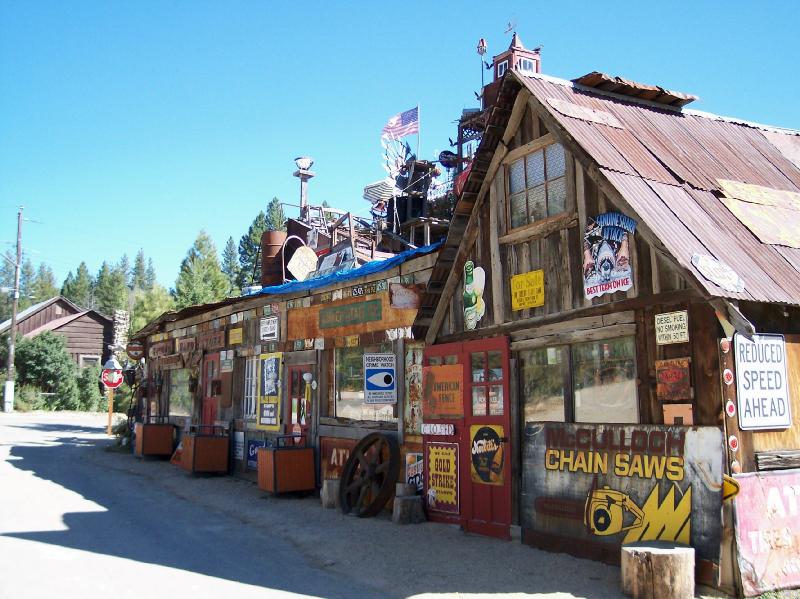
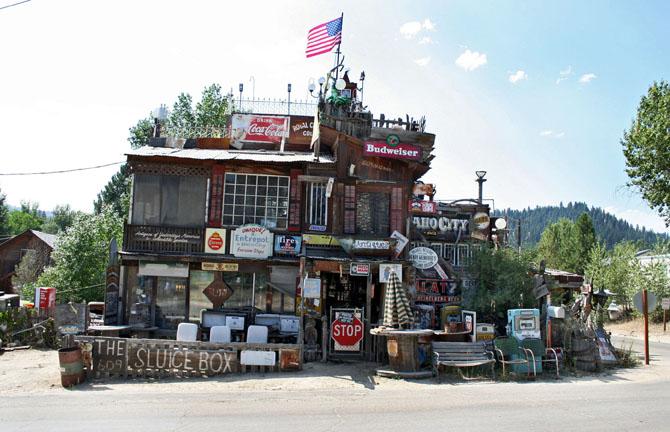
For sale in Idaho City
According to the woman who strolled up the street while Kay was taking photographs, it belonged to a fella who was “a little eccentric” whose surviving relatives didn’t want to continue “the business” so it has sat vacant for a couple of years waiting for a new owner. She said it could be ours for $350,000 – and not just the property, but ALL the valuables inside. It’s been vandalized several times, she said, but with a little attention, if the right person came along and “restored” the place, it could become a thriving operation. People would come from miles around.
Wouldn’t you like to meet the man who owned and operated The Sluice Box? Elsewhere on Views from the Edge we’ve noted famous people who were a little eccentric – people like Bishop James Pike – and suggested the world would be a better place if we were all a bit more eccentric. Whoever the man was who (sort of) maintained this old 1800s structure while collecting everyone else’s junk, he wasn’t into a throw-away culture.
A web search uncovered the current asking price: $249,900. Click HERE for the real estate listing. Turns out the house next door comes with it.
Click HERE and then click the audio link on the Minnesota Public Radio website to hear yesterday’s commentary on the classical spiritual-philosophical-ethical premise we need to remember. This piece was written two days BEFORE the President delivered his speech yesterday at Knox College.
The English word “economy” comes from the Greek work “oikos” – the Greek word for house. The word “economics” derives from the Greek word “oikonomia”- -the management of a household.
Before it is anything else, economics is a perspective, a frame of reference. Before it decides anything about household management, it knows that there is only one house. Good household management – good economics – pays attention to the wellbeing of the entire house and all its residents.
Three college classmates who didn’t have two nickels to rub together decided to hitch-hike to B.T. Biggart’s home in Reynoldsburg, OH for the Thanksgiving holiday.
One of the rides was like the one in Steve Shoemaker’s story “Hitch-hiking” posted just minutes ago here on Views from the Edge. The three of us sat in the back seat of the driver’s big 1960 Ford 500 while he and his buddy passed the bottle between them, belted out country music, and swapped stories about women that are un-publishable. Eventually, by the grace of God, they dropped us off on the interstate in downtown Cincinnati.
Soon after we had stuck out our thumbs on the Interstate about 3:00 a.m., a Cincinnati squad car pulled over.
The officer asked for identification.
I had no wallet. My wallet was back at the college.
The officer declared that he could take me in for vagrancy.
“What’s your name, son?”
“Gordon Stewart, Sir,” I answered with my heart pumping faster and my knees about to buckle.
“Where you from, Gordon?”
“Broomall, Pennsylvania, Sir.”
“What’s your father do?”
“He’s a minister.”
“What church?”
“Marple Presbyterian Church in Broomall where I grew up.”
“What kind of church?”
“Presbyterian.”
“What’d you say your name was?”
“Gordon Stewart.”
“Did your father serve in World War II?”
“Yes, sir.”
“Where did he serve?”
“Saipan, Guam, and Tinian in the South Pacific.”
(PAUSE)
“What branch of the service was your father in on Guam?”
“Army Air Force, Sir. He was a chaplain.”
“What’s your father’s first name?”
“Kenneth – Kenneth Campbell Stewart.”
“O my!!! After all these years! Red Stewart! Chappy Stewart! Well, I’ll be darned!
“You can go son. Just get a ride out of here as soon as you can. God bless you.”
…
So the cop who could have taken me in for vagrancy celebrated a vicarious reunion with his old Chaplain while we hitch-hiked to B.T Biggart’s for Thanksgiving – thankful for a serendipitous rescue from the boys in the Ford 500 and from the holding cell for vagrants.
Thanks, Dad! And thanks, Officer Anonymous! I never got his name. Grace abounds…even when you have no money and no identification.

The Hitch-hiker
– Steve Shoemaker, Urbana, IL, July 24, 2013
Aired earlier today on All Things Considered (MPR, KNOW, 91.1 FM).
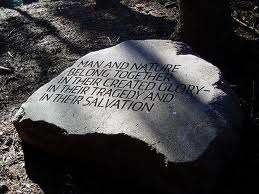
Paul Tillich quote in Tillich Park, New Harmony, IN.
Economics is about a household and how to manage it. The household is a family, a state, a nation, a planet.
The English word “economy” comes from the Greek work oikos – the Greek word for house. The word “economics” derives from the Greek word oikonomia–the management of a household.
Before it is anything else, economics is a perspective, a frame of reference. Before it decides anything about household management, it knows that there is only one house. Good household management – good economics – pays attention to the wellbeing of the entire house and all its residents.
In America and elsewhere across the world, we are coming to realize that the planet itself is one house. What happens in one room of the house – one family, one city, one nation – affects what happens everywhere in the house. Paul Tillich caught the clear sense of it when he wrote that “Man and nature belong together in their created glory – in their tragedy and in their salvation.” That is to say, there is only one house.
The essential question of economics is not about systems – capitalism, communism, socialism, or something else. The essential question is spiritual, philosophical, and ethical. It’s whether we believe that there is only one oikos, one house; the subsequent question is about how best to manage it for the wellbeing of all its residents and the fragile web of nature without which the house of the living would not exist.
Very often what we call ‘economics’ is not economics. It’s not oikonomia. It’s something else. It assumes something else, and when we forget what an economy and economics really are, we enshrine greed as the essential virtue, ignoring and imperiling everyone else and everthing in the one house in which we all live.
I dream that the President will preach the old Greek common sense: that in his own way, he will reclaim the essential premise of an economy and the ethical task of economics. By bringing the Greek origins to our television sets, headsets, and iPads, he can call us to move forward out of the partisan houses of nonsense.
There is only one house.
Remember Stevie Wonder’s song that lifted our spirits and brought tears to our eyes? Click We are the World.
There’s a choice we’re making
We’re saving our own lives
It’s true we’ll make a better day
Just you and me
Stevie Wonder got it then, and he gets it now. He’s made a choice to help save lives.
He has announced that he will no longer appear in the state of Florida. He’s boycotting Florida and every other place with “Stand Your Ground” laws in the wake of the Trayvon Martin jury verdict.
The acquittal of George Zimmermann brings to the fore once more gun violence, race, and the Stand Your Ground laws that move the right to defend one’s home without retreat into the streets.
The dark sun glasses are a trademark of the performer who cannot see, but he sees some things very clearly. This is one time the blind need to follow the blind man who sees. “Once I was blind, but now I see,” wrote John Newton, the captain of a slave-trade ship, after he came to his senses and refused to participate any longer in the evil of the slave trade.
It’s choices like Stevie Wonder’s that help us to save our own lives. Decisions like Stevie’s shine a light on the blindness of a society whose laws in Florida and elsewhere turn back the clock to the old days of vigilante violence.
Someday hence it will be said that America suffered years of temporary blindness – that we forgot that we are the world – and that a blind man named Stevie led America in singing with joy the hymn of the old slave ship captain: “Amazing grace, how sweet the sound…I once was blind, but now I see.”
Click We are the World.
My son once asked me “What is time?”
I answered, “I don’t know. It’s a perennial question of philosophers and theologians. But, so far as I can tell, time is what we have.”
Some people think that time isn’t real. It’s a human construct and only eternity is real. They think of time and place as the prison of the soul, the antithesis of, or the prelude to, eternal life.
It always seemed a bit strange to me. Like the imaginary friends children make up because they’re afraid of being alone in the dark. I could never understand.
“Time is what we have.”
The animals know what time is. They also know eternity. They wake and sleep with the rhythms of the sun – rising and setting daily – the markers of what we call time. They know nothing about clock time or the names of days, months, seasons or years, but they live in the reality of time.
Time is what we have between birth and death. Eternity is the depth of time, the Mystery beneath, within, and beyond the limits of time. We participate in the eternal, but we are not eternal. To think otherwise is to consider ourselves the exception to nature itself.
The illusion of superiority to nature – the idea that the human species is nature’s singular exception – is a fabrication peculiar to the species that considers itself conscious. The imaginary friend of eternal life may help us sleep better at night, but it leads to slaughter and, eventually, to species suicide.
Ernest Becker (The Denial of Death) saw the denial of death as bedrock to American culture. The denial of death – the refusal to acknowledge it as real; the flight from the knowledge of our mortality – not only deprecates life here and now; it takes into its hands the life and death of those different from ourselves. It builds towers to itself that reach toward the heavens while it plunders an earth it considers too lowly for its aspirations.
Time is our friend and time is our limit. We are meant for this. “Grace and pride never lived in the same place,” says an old Scottish proverb, for pride always seeks to exceed what is given (grace).
Time is what we have. Time is a participation in the glory of God. If there’s more, it will only by grace.
Verse – “We All Used to be Equal Under the Shroud”
About half way through my life
(I am now 3-score and 10)
funerals became the new
thing, “Celebrations of Life,”
with friends (no enemies would come)
saying fine or funny things
about the very special one
who sadly couldn’t be there then
because the ashes were still stored
at the crematorium
and might not ever be picked up,
or buried (unless family had
a plot already bought and paid for,
then a private internment
might for seven very short
minutes remind a few folks
that someone was dead.)
– Steve Shoemaker, Urbana, IL, July 8, 2013
Our parents took us to their church four times
each week: on Sunday, twice, and then for prayer
on Wednesday night–on Thursdays they sang hymns
in choir rehearsal while one, two, three, four
of us played on, around, and under pews.
“You boys be quiet!” they would often say.
We learned to sing in Sunday School: “Jesus
loves me,” and “Hallelu Hallelujah!”
Soon all of us were singing in the choir…
Then we grew up, our parents aged and died.
One atheist, one pantheist, one pair
of liberal Presbyterians–none tied
to our folk’s Baptist faith, yet when we drink
we sing their songs in four-part harmony.
– little stevie shoemaker, urbana, il, july 6, 2013
 Views from the Edge