I've always liked quiet. And, like most people, I've experienced the world's madness. "Be Still! Departure from Collective Madness" (Wipf and Stock Publishers, Jan. 2017) distills 47 years of experiencing stillness and madness as a campus minister and Presbyterian pastor (IL, WI, NY, OH, and MN), poverty criminal law firm executive director, and social commentator. Our cat Lady Barclay reminds me to calm down and be much more still than I would be without her.
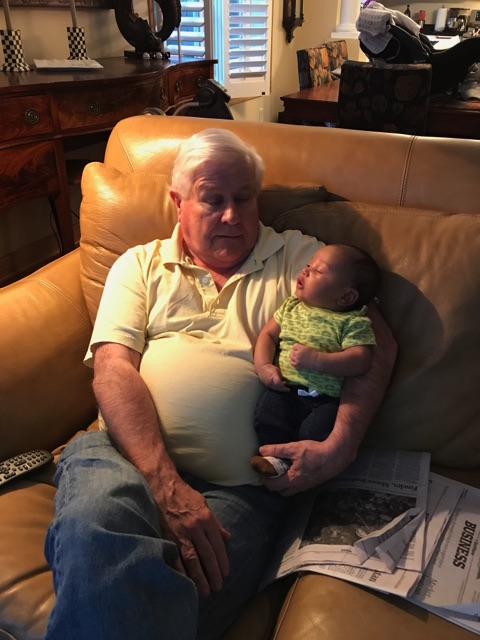
Elijah no longer watches CNN or any other news channels. He’s become a Gopher — a Minnesota Gopher fan, but he doesn’t care about sports or any kind of competition. He’s all smiles watching his mobile characters stroll across his crib, enjoying the music and his mother’s and grandmother’s voices.
Thomas and Peter are this writer’s favorite apostles. Thomas because he refused to believe unless he saw with his own eyes and confirmed “an idle tale” with his own hand; Peter because he was impetuous, quickly stepping onto the sea at Christ’s invitation only to plunge like a stone when his faith failed him.
It was through these two very different eyes — one of Thomas, the other of Peter — that we viewed Dennis Aubrey and PJ McKey’s Two Churches in the Cliffs on Via Lucis this morning.
The two churches on the cliffs appeared differently to these different eyes of faith.
Apse, Église Notre-Dame-de-l’Assomption (Alpes-de-Haute-Provence) Photo by PJ McKey
The apse of Église Notre-Dame-de-l’Assomption with its narrow vertical window immediately elicited a Petrine sense of immediate belief. It held Peter’s eye for a long time.
Perhaps it was held by the yearning for the vertical, that which transcends the horizontal banality to which a mass culture has shrunk everything not of its own making. Perhaps it is the delight of hope from above that trembles the spine of the despairing. Or perhaps it’s the beauty of the apse’s proportionality, the genius of the central Christian symbol: the intersection of the horizontal by the more gracious vertical — the horror of human cruelty interrupted and transformed by the unexpected shaft of light and the still small Voice heard by Elijah in his cave. Or all of the above and more.
But Thomas is never far beyond Peter. It is the Thomas in us that asks the hard questions, insists on separating fact from fiction, reality from illusion, good faith from what Sartre called bad faith. It is Thomas whose faith couldn’t make itself piggy-back on the shoulders of the other apostles’ story of having met the risen Christ. It was Thomas who insisted that he see for himself the evidence for “seeing” or believing in hope beyond the horror of the suffering, cruelty, and death his eyes had seen days before on the Hill of Skulls.
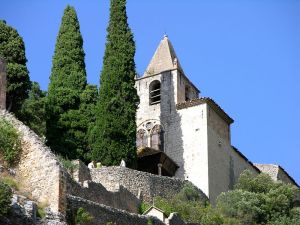
Chapelle Notre Dame de Beauvoir, Moustiers-Sainte-Marie (Alpes-de-Haute-Provence ) Photo by ICE-Marseille, courtesy of Wikipedia Commons
Which brings us to the second church on the cliff — the story ofthe stillborn in Via Lucis‘ post that awakens Thomas’ skepticism.
“Notre Dame de Beauvoir was known for its suscitations – stillborn children were carried up and baptised there, at which time they would immediately come to life and would be granted a place in heaven. This was a well-known phenomenon in the region and also known at two neighboring churches.”
While the thought of stillborn children immediately coming back to life appeals to Peter, it offends Thomas as an idle tale for the feeble of heart and mind. It’s either true or it’s not. And, if it’s true, what kind of cruel God would deny the same to the stillborn children and grieving parents who have not carried them up the steps to Notre Dame de Beauvoir for suscitations? Or is the tradition of Notre Dame de Beauvoir a sacred story of love and hope beyond what the empiricist eye of Thomas can see?
We have a left brain and a right brain, and sometimes it is true that never the twain shall meet. Likewise, faith has two eyes: Peter the believer, and Thomas the doubter — its own kind of double vision — looking out and up from one small brain.
That such carnage of the young and of the innocent should have been willed by men in cold and calculated evil, is horror upon horror. What is our response to that?
The desire, the determination, that those who did this should be detected and, if possible, brought to justice, is natural and is right. The uncovering of the truth will not be easy, and evidence that would stand up in a court of law may be hard to obtain.
Justice is one thing. But already one hears in the media the word ‘retaliation’. As far as I know, no responsible politician has used that word, and I hope none ever will, except to disown it. For that way lies the endless cycle of violence upon violence, horror upon horror. And we may be tempted, indeed urged by some, to flex our muscles in response, to show that we are men. To show that we are what? To show that we are prepared to let more young and more innocent die, to let more rescue workers labour in more wreckage to find the grisly proof, not of our virility, but of our inhumanity. That is what retaliation means.
Every Thursday afternoon in the summer of 1991 the Right Rev. Professor James (“Jim”) Whyte brewed a pot of tea and served scones to the complete stranger he’d welcomed to St. Andrews, an American Presbyterian minister seeking his tutelage in practical theology during a sabbatical from pastoral duties at Knox Presbyterian Church in Cincinnati. His hand-written prayers delivered at Hope Park Church in St. Andrews remain a priceless treasure.
Elijah is not happy when he arrives at Grandpa’s and Grandma’s at dinner time. Adult dinner-time, not his! Elijah still eats every two hours, all day, all night.
He hates his car seat.
He yells and screams at Mom for the 20-minute drive from Mom’s to his Grandparents’ home in Chaska.
The conversation begins while removing the straps of his straitjacket.
“Elijah, Mom needs you to be quiet when she’s driving. You need to be more respectful. Mom has needs, too.”
“No she doesn’t! Mom’s a warden! I hate that cell!!!”
“No, Mom loves you! She’s not a warden; the car is not a prison; and your car seat is nothing like a prison cell.”
“Uh-huh!!! I thought you were my friend! You’re just like Mom! You don’t care about me. You think I’m just a thing, like my car seat. I’m not coming here anymore.”
“I’m sorry you feel that way. Do you want me to get you out of your car seat or not?”
“No! I’m staying here just like Martin Sostre did in solitary confinement because he refused to submit to the warden’s rules.”
“Well, Martin’s case was altogether different. Martin was a political prisoner at Clinton Correctional Facility in Dannemora, New York. Chaska’s a long way from Dannemora.”
“You loved Martin more than you love me, and Martin wasn’t even your grandson!”
“Well, there’s a big difference between you and Martin. Martin was a man of courage. He didn’t scream and yell. He didn’t cry. Martin didn’t terrorize his mother.”
“You care more about people who aren’t members of the family than you do about me! That’s not right! Martin was a criminal. I’m a prisoner, but I’m no criminal.”
“Elijah, there’s a big difference. Martin was an adult. He wasn’t in solitary for his own safety. He was put there to humiliate him. Mom puts you in your car seat to keep you safe.”
“Uh-huh! And because she’s enforcing the law! Mom’s a warden and you’re a guard! How come you won’t help me! I’m your grandson! I’m gonna go on a hunger strike!”
“Well, okay. But remember. If you go on a hunger strike, you’ll still get strapped in your car seat. The only things a hunger strike would change are you’ll make Mom happy ’cause she doesn’t have to feed you every two hours . . . and you’re going to starve.”
“That’s not fair!””
“No, it’s not, Elijah. Life’s not fair. As my old football coach used to say, ‘Life is tough! You must learn to adjust.”
I had a good idea recently. Stop hyperventilating about Donald Trump and focus instead on American history; really focus. It is helping me and I highly recommend it. There is, of course, so much to hyperventilate and worry about, something new every day: Russian interference in the election and the President’s obvious unconcern, his rejection of the high moral vision expressed in American foreign policy for two and a half centuries and replacing it with a starkly different vision articulated by two top presidential advisers, H.R. McMaster and Gary Cohn in the Wall Street Journal: “The President embarked on his first foreign trip with a clear-eyed outlook that the world is not a ‘global community’ but an arena where nations, nongovernmental actors and businesses engage and compete for advantage.” That is a very different and harsh vision which David Brooks described as “moral decoupling…morality has nothing to do with anything…
Elijah and Grandpa had just read the President’s tweet about Mika Brzezinski when Elijah said a bad word.
“You need to be more respectful of the President!”
“Why?” asked Elijah. “He’s not my President! Look what he just did to Mika! What’s he have to do that for! He’s mean, Grandpa!”
“I wish I knew, Elijah. Most of his tweets happen when he wakes up early in the morning.”
“Maybe he needs to be nursed as soon as he wakes up. That always calms me down.”
“Well, I’m afraid Donald Trump’s mother is way beyond being able to nurse him. She’s really old, way older than Grandpa, Elijah.”
“Then you should call the White House. They should give him a bottle as soon as he wakes up before he attacks another mother! When he stops tweeting insults at women like Mika, I’ll stop calling him a mother.”
“Don’t forget that the U.S. was the first (and so far, only) world power to weaponize climate during the Viet Nam War (Operation Popeye).
“Whither now?”
Here’s an excerpt from Wikipedia’s article on Operation Popeye:
The cloud seeding operation during the Vietnam War ran from March 20, 1967 until July 5, 1972 in an attempt to extend the monsoon season, specifically over areas of the Ho Chi Minh Trail. The operation was used to induce rain and extend the East Asian Monsoonseason in support of U.S. government efforts related to the War in Southeast Asia.
The former U.S. Secretary of Defense, Robert S. McNamara, was aware that there might be objections raised by the international scientific community but said in a memo to the president that such objections had not in the past been a basis for prevention of military activities considered to be in the interests of U.S. national security.
The chemical weather modification program was conducted from Thailand over Cambodia, Laos, and Vietnam and allegedly sponsored by Secretary of StateHenry Kissinger and CIA without the authorization of then Secretary of Defense Melvin Laird who had categorically denied to Congress that a program for modification of the weather for use as a tactical weapon even existed.[1]
Click Operation Popeye for a history of Operation Popeye’s attempt at weaponizing the climate.
Then join John in asking “Whither now?” John’s no Leonardo da Vinci, but he represents the wisdom of the master artist from an earlier era:
“It is easier to resist at the beginning than at the end.” – Leonardo da Vinci.
Regarding “geoengineering”, maybe it’s just my depression, but I think not. The Tower of Babel has always been one of my go-to texts because it holds the paradox of the human condition. All attempts at “engineering” our way to security will fail.
There is an architecture that eludes our engineering when it comes to the planet. It’s called Nature. We are living in the time of what Bill McKibben calls “the end of Nature”. To what extend the end of Nature is the result of human disruption conceived in Western terms as “man over nature,” and to what extend climate change is attributable to non-human factors makes little difference IMHO to the call of the human species within Nature.
The Human Vocation
There are two very different creation stories in the Book of Genesis. Chapter one comes from the priestly (P) tradition.
It was the genius of the Priestly tradition’s creation story (Genesis 1) that they saw the balance of Nature as “Good” (“and God saw…and it was good!”). The artchitecture of creation is a beautiful piece of art that inspires praise and awe. To imagine something else would be to fall from praise. You might say the P writers were more like scientists who beheld and marveled at the intricate web of natural life.
No sooner do we read Chapter One that we come to the second very different creation story from the perspective of what biblical scholars call “J”, so called because of the use of the writer’s Name for God.
Genesis two and three read more like novels, expressing in very earthy terms the earth-bound character of human nature and human creature’s resistance to creaturely life — the inexplicable choice of the archetypal “earthlings” to eat the fruit of the ONLY tree among all the trees of the garden based in humankind’s tragic urge of to become “like God, knowing good and evil.”
Only when they fail to stand in awe and thanksgiving in the midst of the Good (a good which includes nature’s “limits” on their behavior) do they invoke the curse that renders them shamefully conscious of their nakedness (their naturalness) and sends them into a hiding from their Creator. Fratricide (Cain’s slaying of Abel) quickly follows their expulsion from Eden.
The continuing human calling is to see Earth itself as the theater of a glory not of our own making and to resist the illusion of the serpent: “if you eat of the one tree which is forbidden, you will become like God.” It’s the second part of that statement that is the temptation – refusing to live with the limits of Nature itself. One might even say “the Fall” is an attempt at geoengineering.
Genesis 1-11 is called the Primeval History — a history that never was but always is. The Primeval History concludes with the story of Tower of Babel — human engineering for the purpose of “making a name for ourselves”, i.e., establishing and securing our existence in time in the face of chaos.
Now it’s “GEO-engineering” – the illusion that we can fix this, that we can “engineer” our way out of the mess our geoengineering on behalf of a more perfect world has created. There’s a HUGE difference between geoengineering and being responsible. The former disturbs Nature. The latter works collaboratively with Nature…or whatever is left of her. Anything else is Babel. It is doomed to fail.
John captures in paint what his word say of his intention.
“Environmentally focused paintings and other art forms from the early 21st century build a foundational historic context for future generations. They are documents of the time of ‘the first awareness’ by the human species about the course and implications of climate disruption. As this awareness settles in, climate disruption in the form of weather (as it affects biodiversity, human society and the physical planet) has become, for me, a main topic of my work.”
Perhaps it’s not too much of a stretch to say that John Lince-Hopkins, the scientist and the painter, combines in the 21st Century the ancient wisdoms of the P writer and the J writer — the awe of Genesis 1 and the earthy calling and tragedy of Genesis 2, 3, and 11. Would that we might all do the same.
Click Art Wander for more on how John views his work as a climate change scientist and artist.
She was homeless when he welcomed her into his parents’ new townhouse. So far as the parents knew, she was “sort of” their adult son’s “girlfriend” but they weren’t exactly sure what their relationship was. It was strange. It didn’t seem romantic. She seemed different.
Among the neighbors everything seemed fine until the squad cars’ flashing red lights lit up the street and four uniformed police officers ran by their homes reaching for their holsters. Something was different.
The parents of the son who’d invited the son’s “girlfriend” to live with them had called 911 after a screaming meltdown in the upstairs bathroom where their guest had poked huge holes in the walls with the towel fixtures she had yanked from the walls and had threatened to kill everyone in the house.
When the police arrived and called upstairs, she calmly came downstairs, curious to see what the ruckus was about, appearing calm as a cucumber, without a care in the world while the son’s mother sat trembling with her head between her hands and the 35 year-old son stepped outside for a smoke.
No charges were filed. The parents had come to realize over time that the girlfriend had “some problems” and thought they could help her. The four of them continued to occupy the house after the incident was “resolved” by the police visit.
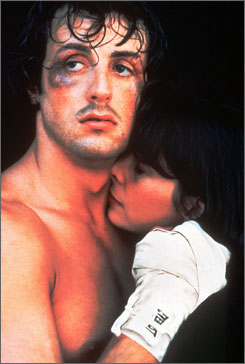
Two months later the red lights appeared again after another upstairs commotion left the son’s face looking like Rocky Balboa after his fight with Apollo Creed. This time the girlfriend was no Adrian. Adrian had acted like Apollo…with a knife.
This time Rocky was rushed to the emergency room. Adrian was taken away in handcuffs, screaming at the officers, the boyfriend, and his parents, for another committal to a mental health facility for violation of probation resulting from previous domestic assaults. The parents stayed where they are, dumbfounded how compassion can turn out so badly.
“Life is like an onion. You peel it off one layer at a time,” said Carl Sandburg, “and sometimes you weep.”
“Where you from?” he asks, as if welcoming the stranger who’s come to hid home for a stress test.
“Chaska.”
“Where?” he asks over the whine from his hearing aids.
I’m not anxious to strike up a conversation. I’m here for a stress test. I’m an introvert. Chatting with strangers when I’m gathering myself when I’m under stress, waiting for a stress test, is the last thing I want.
His gowned wife, fresh off the treadmill, returns from her stress test.
“This is my wife, Jane. She’s a lot younger than I am. I’m 96.”
“Ninety-four,” says the younger wife. “We’ve been together 15 years.”
“Chaska’s the county seat,” says Bill. “That’s where i was sworn in.” (Clearly, he’s an extrovert. He feels better when he has guests.)
“World War II?”
“February 6, 1942. Eighty of us. A lot of guys from Chaska.”
“Where’d you serve?”
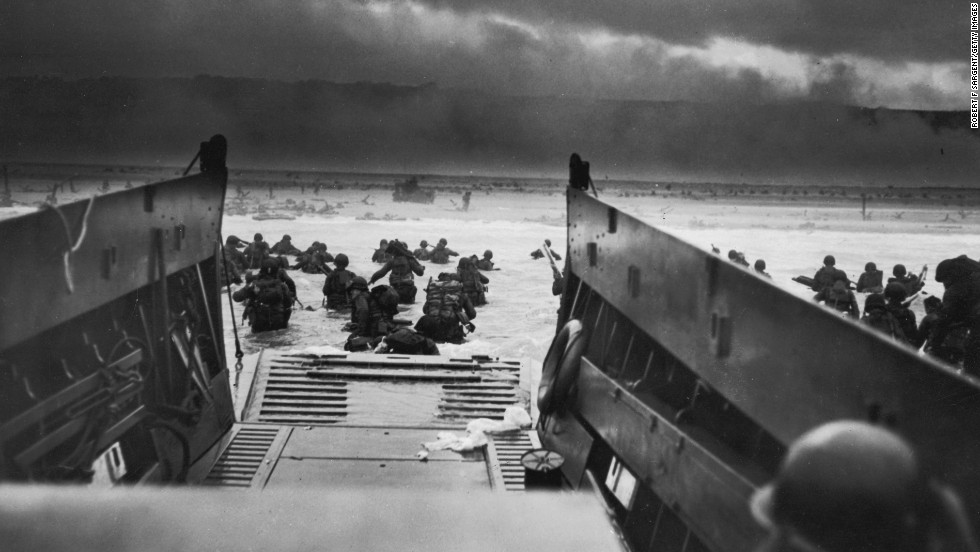
“He was part of D-Day,” answers Jane. Bill’s head sinks toward his lap. His chin begins to quiver. A long pause follows.
D-Day, WWII.
“Only 15 of us came back.”
“Were you injured?”
“No,” he says, forming his hands in prayer and looking up. “I don’t know why.” He falls again into silence.
Fort Snelling National Cemetery, Minnesota
Bill’s body is with us, but he’s not here. He’s back at Normandy Beach on D-Day.
“That’s a lot of death,” I say. “A lot of killing. A lot of loss.”
He looks up, nods, and drops his head again.
“Post-traumatic Stress,” I say quietly to Jane. “I’m a pastor. I’ve seen it so many times with Vietnam War and Iraq War veterans.”
“I think so,” she says. “He still can’t talk about it after all these years.”
The technician calls my name. “Mr. Stewart?”
As I stand to leave the stress test waiting room, Bill reaches up to say good-bye with a firm handshake and friendly smile for the whippersnapper from Chaska.
Robert Davis of Clarkston has an outpatient stress test run by exercise physiologist’s Richard Andrevzzi and Donna McCollom in the Royal Oak hospital.
I leave the waiting room and get on the treadmill, reminded that there is stress and there is stress, knowing that mine bears no comparison to Bill’s and thankful for a few moments with 94 year-old who has every reason to think he’s 96.



 With
With 
 Elijah is not happy when he arrives at Grandpa’s and Grandma’s at dinner time. Adult dinner-time, not his! Elijah still eats every two hours, all day, all night.
 “No! I’m staying here just like Martin Sostre did in solitary confinement because he refused to submit to the warden’s rules.”
 Elijah and Grandpa had just read the President’s tweet about Mika Brzezinski when Elijah said a bad word.
 “Well, I’m afraid Donald Trump’s mother is way beyond being able to nurse him. She’s really old, way older than Grandpa, Elijah.”
 This morning John Lince-Hopkins of
  “Environmentally focused paintings and other art forms from the early 21st century build a foundational historic context for future generations. They are documents of the time of ‘the first awareness’ by the human species about the course and implications of climate disruption. As this awareness settles in, climate disruption in the form of weather (as it affects biodiversity, human society and the physical planet) has become, for me, a main topic of my work.”



 Views from the Edge