Unknown's avatar

About Gordon C. Stewart

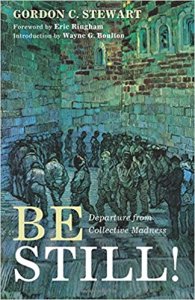
I've always liked quiet. And, like most people, I've experienced the world's madness. "Be Still! Departure from Collective Madness" (Wipf and Stock Publishers, Jan. 2017) distills 47 years of experiencing stillness and madness as a campus minister and Presbyterian pastor (IL, WI, NY, OH, and MN), poverty criminal law firm executive director, and social commentator. Our cat Lady Barclay reminds me to calm down and be much more still than I would be without her.

This Is Home!

“An ancient gift to you this morning,” read the email from my friend Wayne with a link to Gaelic Psalm-singing.

You can be pretty sure someone with the name Gordon Campbell Stewart is a Scot, or, at least, has a Scottish heritage. Three clans – and not all of them friendly to each other – combined in one name, is perhaps its own kind of DNA symbol of worldly reconciliation.

Seeing the YouTube of the Gaelic Psalm-singing that lives in my DNA brings tears to my eyes. Watching the faces, hearing the voices, longing for the simplicity of the Psalm-singing takes me to another place. This is home!

While visiting a church like this on the Isle of Skye, the faces and voices were much the same. Before the Presenter began the congregational singing, you could hear a pin drop. The worshipers observed a sacred silence. The singing voiced a Word that speaks to a noisy world out of a Deep Silence. This is home!

  • Gordon C. Stewart, Chaska, MN, July 20, 2017.

Grandpa, Who’s John Burroughs?

Elijah overhears Grandpa and Grandma talking about John Burroughs.

“Grandpa, who’s John Burroughs?”

“Well, Elijah, there’s John Burroughs and then there’s the John Burroughs. We’re not talking about the John Burroughs.”

EliC43CF607-9499-4D51-BF55-CFCEB806711C“I’m confused, and you’re confusing!”

“I understand. It is confusing. I can see why you’d be confused.”

“I’m only eight-weeks old, Grandpa! I shouldn’t have be be confused already. I have plenty of time to get like you.”

“Okay. I apologize. Grandma and I shouldn’t be talking about this in your presence. We’ll try to be more careful.”

“Thanks, Grandpa. I don’t want to be as confused as you are! So, who’s John Burroughs?”

“Okay, like I said, there are two John Burroughs. There’s a guy named John Burroughs who wrote a nice review of Grandpa’s book, and there’s the John Burroughs who’s famous. That John Burroughs died a long time ago. This John Burroughs is still alive. I know nothing about him. He likes my book.”

John_Burroughs_1909.jpg

The John Burroughs, American naturalist and essayist (1837-1921)

“Wow! You don’t know anything about John Burroughs, but he knows about your book? Maybe John Burroughs knows you quote John Muir, the John Burroughs’ close friend! Maybe this John Burroughs is the John Burroughs’ grandson!”

“No, Elijah. Not everyone who is the grandson of someone famous!”

  • Grandpa Gordon, Chaska, MN, July 20, 2017.


John Burroughs’ Review

Today we received notice of an unexpected review by John Burroughs.

Burroughs’ Bookshelf

Be Still!: Departure from Collective Madness
Gordon C. Stewart
Wipf and Stock Publishers
199 West 8th Avenue, Suite 3, Eugene, OR 97401-2960

Home


9781532600678, $41.00, HC, 190pp, http://www.amazon.com

Synopsis: In “Be Still! Departure from Collective Madness”, author and public theologian “Gordon C. Stewart echoes the call of the Navajo sage and the psalmist who invited their hearers to stop — “If we keep going this way, we’re going to get where we’re going” — and be still — “Be still, and know. . . .”.

Like pictures in a photo album taken from a unique lens, the 48 succinctly presented essays zoom in on singular moments of time where the world is making headlines, drawing attention to the sin of exceptionalism in its national, racial, religious, cultural, and species manifestations.

Informed by Japanese Christian theologian Kosuke Koyama, Elie Wiesel, Wendell Berry, and others, “Be Still!” invites the reader to slow down, be still, and depart from “collective madness” before the Navajo sage is right. Told in the voice familiar to listeners of All Things Considered and Minnesota Public Radio, these poetic essays sometimes feel as familiar as an old family photo album, but the pictures themselves are taken from a thought-provoking angle.

Critique: Thoughtful and thought-provoking, inspired and inspiring, “Be Still!: Departure from Collective Madness” is an extraordinary read that is enhanced for scholarship with the inclusion of a six page Bibliography and a twelve page Index. While unreservedly recommended for community, college, and university library collections, it should be noted for the personal reading lists of students and non-specialist general readers with an interest in the subject that “Be Still!” is also available in a paperback edition (9781532600654, $21.00) and in a Kindle format ($9.99). – John Burroughs, July, 2017, Reviewer’s Bookwatch, Midwest Book Review.

Some days are good days. Although the John Burroughs who wrote the review is not the famous naturalist of encyclopedic fame, he’s the only John Burroughs who has noticed “Be Still!”, and, for that reason, he goes to the top of this author’s friendly strangers. Every author depends on the kindness of strangers!

  • Gordon C. Stewart, Chaska, MN, July 19, 2017.

Grandpa, you gonna answer that?

When the area code on the caller ID is unfamiliar, do you take the call or let it to go into voicemail?

EliIMG_6311

“Grandpa, did you put your hearing aids in this morning?”

“Yes, Elijah. Why?”

“‘Cause the phone’s ringing!”

“I know. It’s annoying.”

“Then why don’t you answer it?”

“I don’t recognize the number on the caller ID. I get lots of calls from solicitors.”

“What’s a solicitor, Grandpa?”

“Well, a solicitor can be lots of things. But, in this case, it’s someone who’s selling something over the phone. They intrude on my privacy.”

“Yeah, we like privacy, right, Grandpa? Just you and me! just the two of us after I’ve been fed.”

“Right.”

“But the phone keeps ringing. Just because you don’t recognize the area code doesn’t mean it’s a solicitor. It could be good news, like you won the Lottery or something! Maybe it’s the New York Times Book Review or The New Yorker telling you they’re going to review your book!”


“Okay, good point, Elijah!”

I pick up the phone.

“Mr. Stewart, this is Jane from the Anglican Journal. I’m calling to let you know that we’ll be reviewing Be Still! this fall.”

Eli C43CF607-9499-4D51-BF55-CFCEB806711C“Wow, Grandpa! What’s the Anglican Journal? Is it like the New York Times?”

“No, Elijah, it’s Canadian. Jane was calling from Toronto.”

“From Canada?! You got a call from the Anglicans in Canada and you almost didn’t take it? Next time the phone rings, you’d better answer it. It could be the New York Times!”

“It’s not going to be the New York Times, Elijah! Trust me!”

“Why? You’re a minister, right? You’re supposed to know your Bible!!! Jesus said you should listen to me. It says so right there in Matthew 21:16:

have you never read, ‘Out of the mouths of infants and nursing babies you have prepared praise for yourself?’?”

  • Gordon C. Stewart, Chaska, MN, July 19, 2019

Elijah’s dimpled smile

On his eight-week birthday, Elijah lights up the world with a dimpled smile for Grandma.

ElismilingIMG_6310

Elijah on his eight-week birthday

Elijah knows nothing of adult dangers, toils, and snares — like his mother’s seven weeks of sleepless nights or the evening news that seem to erase dimples from older cheeks.

He lives completely in the moment. Today’s a really special day. The first thing Elijah saw when he opened his eyes was a different kind of dimpled smile he’d not yet seen on Mom’s face.

He and Mom are celebrating the long-suffering love that has brought them safely through the night to his eight-week birthday, the day after their first nearly full night’s sleep.

“Grandma! Look what I did!”

  • Gordon C. Stewart, Chaska, MN, July 18, 2017.

Announcing “Be Still!” Program

Be Still“BE STILL! To See More Clearly

This six-session program for churches invites you to re-examine the faith perspective (“lens”) through which you have come to “see” yourself and the world with brief selected readings from Be Still! Departure from Collective Madness.

“To see clearly, to see clearly, to see clearly–such is the great impulse and drive you meet on every page.” – Introduction to Be Still!  by Wayne. G. Boulton, Ph.D., former president of the Presbyterian School of Christian Education.

“Such essays are an eloquent rebuke to the prejudice that theological writing is abstraction from the concretions of life. I think of Stewart as an incarnational theologian like Bonhoeffer, who insisted that we pay attention to God’s presence in the concretions of our history.” – Donald Shriver, Ph.D., President Emeritus, Union Theological Seminary (NYC).

SIX One-1.5 hour SESSIONS using Be Still! Departure from Collective Madness

ONE—What is “public theology? Read and discuss the “Foreword” (ix-x), “Introduction” (xv-xviii), and Psalm 46.

TWO—The Author’s Lens. Read and discuss “The Preface (xi-xii), and the last paragraph of the “Acknowledgements” (xiv) about the Brothers of Opal Street.

THREE—Exceptionalism as Sin. Read and discuss “Only One Sin: Exceptionalism” (110-113) and “Memorial Day and the Soldier’s Helmet “ (10-12).

FOUR—Toward an Incarnational Theology. Read and discuss “Stillness at Blue Spring” (3-5) and “A Joyful Resting Place in Time” (5-7).

FIVE—No Gospel without the Blues. Read and discuss “The Forlorn Children of the Mayflower” (66-70) and “My Soul Waits in Silence” (98-100).

SIX—The Economy of God. Read “The Economy: Only One House” (114-115), “The World in an Oyster” (94-97), and “The Bristlecone Pines” (143-145).

ENDORSERS of Be Still! Departure from Collective Madness

Lucy A. Forster-Smith, Sedgwick Chaplain, Senior Minister in the Memorial Church, Harvard University:

”As a person who navigates the pleasures and perils of the twenty-first-century campus, having Be Still! at my fingertips will be like having a counselor, a guide, a very present help in these times. This volume touches the pulse of our times with the rare combination of unwavering candor and tender mercy.”

Walter Brueggemann, Columbia Theological Seminary:

”This wondrous collection of rich snippets would be of interest and value if only for the rich source material that Gordon Stewart quotes from, as it must be an inexhaustible memory and/or file. But the many words he quotes are no more than launching pads for Stewart’s expansive imagination and agile mind that take us, over and over, into fresh discernment, new territory, unanticipated demands, and open-ended opportunity. All of that adds up to grace, and Stewart is a daring witness to grace that occupies all of our territory.’’

Barrie Shepherd, author of Between Mirage and Miracle:

“Gordon Stewart has a way with words, a clean, clear, concise, and yet still creative way with words, a way that can set the reader almost simultaneously at the blood-stained center of the timely–the urgent issues of our day–and also at the deep heart of the timeless, those eternal questions that have forever challenged the human mind. Stewart looks at terror, Isis, and all their kin, from the perspective of Paul Tillich and, yes, John Lennon. He moves from Paris, Maine, by way of the town drunk, toward the City of God. This is strong medicine, to be taken in small, but serious doses. Wear a crash helmet!”

 Michael McNally, Professor of Religion, Carleton College; Author of Honoring Elders:

”Be Still! is needed at this American moment of collective madness even more than the moments that occasioned many of the essays originally airing on public radio and other venues. With a keen eye and a knack for telling the right story at the right time, Rev. Stewart speaks to the pressing issues in our politics, economy, and culture, and consistently, often poignantly, puts them in ethical and theological perspective that clarifies what too often mystifies. Great bedside reading for those of us who stay up at night concerned about where our world is heading!”

Frank M. Yamada, President, American Theological Society, former President, McCormick Theological Seminary:

”In Be Still! Stewart masterfully spins a counter-narrative to the collective madness that is gripping our world. Like the psalmist, Stewart prays thoughtfully through metaphors and religious tradition, meshing theologians with news headlines to lead the reader to a deeper, more sustained truth. Be Still! reads like part op-ed and part parable. In these troubling and anxious times, may we, who have ears to hear, listen!”

Joyce Sutphen, Minnesota Poet Laureate; Professor in English, Gustavus Adolphus College:

“Be Still!: Departure from Collective Madness, is exactly what its title proclaims: a departure from the frenzy and folly of our times. Each essay offers the reader an opportunity to breathe deep, to fall into the story or idea and consider what it means to be a citizen, a friend, a human being. The topics covered are both particular and universal (usually both at the same time), and the writing is wonderfully concise and open—much like poetry! This is a book you will want to open again and again; it’s what the world needs now, more than ever.”

ORDERING THE BOOK, INQUIRIES & SPEAKING ENGAGEMENTS

Be Still! Departure from Collective Madness is available from Amazon (paperback @$21 [shipping included w/Amazon Prime] or kindle @ $9.99), and from Wipf and Stock Publishers (paperback @$16.80 + shipping, or E-Book @$16.80). Churches and groups within 50 miles of Chaska, MN may order the book from the author @ a reduced rate.  A Study Guide is available at no cost.

Contact Gordon C. Stewart @ gordoncstewart@comast.net for speaking engagements, questions, or requests for more information.

The Hiding Place

Visiting St. John’s Abbey for the first time years ago just before noon, one of the Benedictine monks invited the guest to join the monks for mid-day prayer.

Abbey Church, St. John's University | Collegeville, MN | Marcel

St. John’s Abbey Church, Collegeville, Minnesota

Moments after declining the offer, I changed my mind. Risking the embarrassment of unfamiliarity with the Benedictine rite, I quietly made my way up the right side aisle toward the Chancel choir loft where the monks were gathering.

St John's Abbey hurch

Interior of St. John’s Abbey Church, Collegeville, Minnesota

Anxious and wanting to be as invisible as possible, I slid up the steps of the choir loft like a cockroach and found a suitable hiding place, the seat in the far corner of the top row (far right in the photograph).

I felt a tug on my left shirt sleeve. “I don’t think you want to sit there,” said the kindly Benedictine Brother with a twinkling eye, “unless you want to be the Abbot!”

Any early childhood protestant prejudice that monasteries are places where people of lesser faith go to hide came tumbling down! There is no hiding place in a Benedictine monastery. No one is a cockroach.

During a crisis years later, I returned to St. john’s for spiritual guidance and took a more lowly place in the choir loft.

  • Gordon C. Stewart, Chaska, MN, July 12, 2017.


DIDN’T A MAJORITY OF AMERICANS HAVE MEDICAL COVERAGE BEFORE OBAMACARE?

Marilyn Armstrong’s highly personal revelation connects the dots with the call for universal health care.

Marilyn Armstrong's avatarSerendipity - Seeking Intelligent Life on Earth

The question on Quora was “didn’t a majority of Americans have medical coverage before Obamacare”?


I thought about the answer. This is one of those issues in which I had — still have — a gigantic personal stake. I’m one of those people who would never get insurance without laws forcing them to give it to me. Maybe a majority of working adults had medical coverage, but among those who were not — for whatever reason — working, mostly, they had nothing. This includes disabled people, old people, people injured and unable to return to work. And, of course, children.

We were among the group who no longer had medical insurance, although we’d had it before.

I was desperately ill. Massachusetts had not gotten its own medical care system yet and the U.S. had nothing, the situation to which it seems we will shortly return. I could be fixed, but no…

View original post 830 more words

Intoxicated with Success

“[People] are undoubtedly more in danger from prosperity than from adversity, for when matters go smoothly, they flatter themselves, and are intoxicated by their success.”

This bit of wisdom from what many will consider an unlikely source invites reflection in these days when one of America’s most successful has met adversity from his peers at the G-20 meeting in Hamburg, Germany.

421DA3B800000578-4674150-image-a-95_1499432704494He sits by himself at the table while others mingle. The chairs of China and the United Kingdom, whose leaders he has scorned, stay empty until they will be filled, begrudgingly, at the very last minute. One may hope it is a sobering moment of adversity.
“As Gregor Samsa awoke one morning from uneasy dreams he found himself transformed in his bed into a gigantic insect. He was laying on his hard, as it were armor-plated, back . . . ” – Franz Kafka, The Metamorphosis.

As an infant, Donald Trump was baptized by a Presbyterian church in Queens, New York in the tradition of the controversial 16th century theologian John Calvin. Perhaps all these years later, after all the success, but suddenly regarded as a cockroach, feeling like Gregor Samsa, he’s reading the passage from John Calvin and remembering who he really is.

  • Gordon C. Stewart, Chaska, MN, July 9, 2017.


When Hope Wavers

“We should ask God to increase our hope when it is small, awaken it when it is dormant, confirm it when it is wavering, strengthen it when it is weak, and raise it up when it is overthrown.”

Plugging the ears, closing the eyes, looking away have become standard practice in response to the growing sense of despair provoked by the bellicose behavior of current occupant of the Oval Office. Each day further chips away the objective grounds for hope that the insanity and inanity will stop. Hope grows smaller, wavers, goes into hiding, becomes weak, and, on the worst of days, feels overthrown.

Is it surprising that a word from the 16th Century serves to encourage the weary?

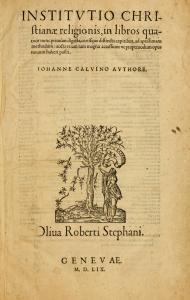
CalvinInstitutio

Institutes of the Christian Religion

Is it surprising that it comes from the pen of Jean  Calvin, the lawyer-theologian of the Genevan branch of the protestant reformation, the author of the The Institutes of the Christian Religion who had more than his fair share of days when hope was small, and whose little hope was shrunk by the many haughty, small-minded people who claimed to follow him?

I was always exceedingly delighted with that saying of Chrysostom, “The foundation of our philosophy is humility”; and yet more pleased with that of Augustine: “As the orator, when asked, What is the first precept in eloquence? answered, Delivery: What is the second? Delivery: What is the third? Delivery: so if you ask me concerning the precepts of the Christian religion, I will answer, first, second, and third, Humility.

There is no inconsistency when God raises up those who have fallen prostrate.[John Calvin, Institutes of the Christian Religion]

Holy One, increase our hope when it is small, awaken it when it is dormant, confirm it when it is wavering, strengthen it when it is weak, and raise it up when it is overthrown. Amen.