Unknown's avatar

About Gordon C. Stewart

I've always liked quiet. And, like most people, I've experienced the world's madness. "Be Still! Departure from Collective Madness" (Wipf and Stock Publishers, Jan. 2017) distills 47 years of experiencing stillness and madness as a campus minister and Presbyterian pastor (IL, WI, NY, OH, and MN), poverty criminal law firm executive director, and social commentator. Our cat Lady Barclay reminds me to calm down and be much more still than I would be without her.

Verse – Sirens

The women of the choir
were flirting as they sang,
eyes rolling, tilting heads,
the lilting voices rang
the changes in their moods
enticing males who heard
the notes and interludes,
but knew it was absurd:
to trust a single word….

– Steve Shoemaker, Urbana, IL, Dec. 22, 2014

Editor’s Note: Hmmm. I’ve often wondered why Steve sings in three choirs. Maybe Steve and the rest of the basses, tenors, and baritones come to rehearsals as Tritons, the male equivalents of  Sirens?

Triton Fountain, Rome

Triton Fountain, Rome

White Privilege (with a Twist)

In the year that brought us “Hands up!” and “die-ins” that drew national attention once again to race in America, the SALT Project produced this video.

Thanks to Matthew and Elizabeth Myer Boulton and the SALT Project for permission to blog their commentary. Click HERE for the SALT Project website. Matthew is President of Christian Theological Seminary in Indianapolis. Liz, like Matthew, is an ordained minister of the Church of Christ (Disciples) and leading light of the SALT Project.

Verse – An Old Man and His Dog

He limps as the other clicks
along the sidewalk beside him.
Slowly, they walk together,
And loneliness falls behind a few paces.
They partake of one spirit.
They know the mystery of
growing old together.

Ah yes, there’s a world beyond them,
But now they know more
Of a priceless world between them.
One glance, and a thousand worlds
spring form the depths
Knowing a direction far beyond
the concrete way beneath them.

– Dale Hartwig (1940-2012) from the window of a care center, Grand Rapids, MI.

Cuba: The Embargo Wall

“SOMETHING there is that doesn’t love a wall,

That sends the frozen-ground-swell under it,

And spills the upper boulders in the sun;

And makes gaps even two can pass abreast.”

Robert Frost, “Mending Wall”

Two human beings passed abreast through a wall yesterday: the invisible wall between the U.S. and Cuba.

The wall was built by human hands. It’s coming down by human hands. Like the Berlin Wall and “the Iron Curtain” that went up during the Cold War between the East and West.

Here in the States the story was that the wall and the curtain had gone up to keep people in. And that’s what I thought until the summer of 1966 while living “behind” the wall with the Schulz family in Bratislava as The Experiment in International Living’s Chicago Ambassador to Czechoslovakia.

A visitor from the West was immediately struck by the absence of bill boards. There were no advertisements like in Chicago. Bratislava struck me at first glance as a gray place, a dull place, a colorless place, a depressing place. But depression and beauty are in the eye of the beholder.

“The wall isn’t there to keep us in,” said my hosts at the third floor walk-up apartment at #7 Legionarska Street. “It’s there to keep you OUT.” Their story was altogether different. They were trying to keep Western materialism, Western greed and commercialism on the other side of the wall.

They built the wall, they said, to make possible the building of a new character: a more generous, less predatory, more social community beyond the old disparities of wealth and poverty.

“Today Robert Fronts-Diaz, who owns a Twin Cities translation and communications business, says the U.S. embargo was ‘an opportunity for Cuba to build character… Since I was a little kid, I wanted the Cuban embargo to be lifted,’ Fonts-Diaz said, his voice breaking with emotion. ‘I am very deeply touched that my request has been fulfilled,’” [“For state’s Cuban, change was a long time coming,” StarTribune, Dec. 18, 2014]

“SOMETHING there is that doesn’t love a wall….” In the end, over time, they all come down

[Eternity] “spills the upper boulders in the sun;

And makes gaps even two can pass abreast.”

Two Verses – Different Moods

Two good friends write verse and poetry. Yesterday Steve Shoemaker’s “Anticipation” arrived. Having just re-discovered the verses of our mutual friend Dale Hartwig (1940-2012), it seemed right and good to place the two  voices together as part of a greater whole.

Anticipation: a Pagan Poem by Steve Shoemaker

(Virgil, b 70 BC, wrote farmers
should breed oxen while
the ox’s “lusty youth lasts.”
This reminded him that for
humans our “best days
go quickly,” then on “creep
diseases and gloomy age.”)

When injured, or sick,
animals may well know
something is wrong,
without knowing
they are dying.
We humans often know
even at a young age,
even when healthy,
that we will die.

When old, we breathe
death daily, wondering
if the next shuffled step,
the next irregular heartbeat
will be our last.

Will our last word
be remembered
or even heard?

Sudden Death by Dale Hartwig (1941-2012), written on the occasion of the untimely death of George Spriggs.

So sudden death comes
With raptor claws
To pilfer our world
Break our laws.

Abruptly breath stops
To quiet the stay.
So silent the night,
So numb the day.

The heavens are rent
But little is heard
Save soft moot whispers
Of Life’s absurd.

But wait! I hear
A tiny Babe’s cries
Of Life anew
And death that dies.

And Christ is come
To walk our way,
A Man who knows
With heart, our stay.

NOTE: Some days are like the one Steve was having. Others like the one Dale was having when a voice cries “Wait!” Dale and Steve were and are painfully familiar with “stays” in the Absurd, but also with the courage and joy of “a Man who knows With heart, our stay.”

Dale served only one church in his life, a small church in Concord, Michigan where he also became the chaplain to the village over coffee.  He was one of seven seminary classmates who gather each year for renewal of friendship and for theological reflection. He died in the long-term care center in Grand Rapids where his advanced Parkinson’s had taken him several years earlier.

At the last gathering he attended in Chicago, he left copies of his poetry with us. I thought I had lost them until they suddenly reappeared when my colleague at Shepherd of the Hill Presbyterian Church, Kathy, presented me with a bag of “stuff” she’d found while cleaning out my office before my retirement.

Look for more of Dale, as well as Steve, on Views from the Edge today and in the days to come.

– Gordon C. Stewart, December 16, 2014


Cuba – Finally a Breakthrough

Goliath’s bullying is almost over. After 53 years, by the good offices of Pope Francis and Canada, and  by order of U.S. President Barack Obama and Cuban President Raúl Castro, the U.S.A. and Cuba are taking steps to normalize relations. At long last, Cuba and we will be neighbors again.

FLASHBACK:

It’s later afternoon in 1979. A 37-year-old minister/college pastor from Wooster, Ohio is mixing with other guests from all over the world at a social hour on the veranda of the residence of the Rev. Dr. Jose Arce Martinez, Dean of the ecumenical Protestant seminary in Matanzas, Cuba.

Thirteen years earlier, the young minister, then a seminarian, had been sent by the City of Chicago Chapter of the Experiment in International Living to live for three months in Bratislava, Czechoslovakia. There he had participated in the Christian-Marxist Dialogue founded by Czech theologian and former Princeton Theological Seminary Professor of Theology Josef Hromadka. In Bratislava he had lived with the Schulz family.Mr. and Mrs. Schulz were employed by the Department of Economics and the Department of Justice. Pan (Mr.) Schulz, after welcoming him to their home with a shot of Slivovitz (plum brandy), had said with a a smile, “I’m a whole lot Marxist…but still a little bit Lutheran.”

The 75 international guests at the Matanzas seminary are Christian theologians, bishops, and pastors from Angola, Mozambique, Zimbabwe, South Africa, Argentina, Venezuela, Chile, Mexico, Uruguay, Peru, the U.S.S.R, East and West Germany, France, and the U.S.A. They’ve been convened at the invitation of the seminary with the consent of the government of Cuba following the Pope’s conference on human development at Puebla, Mexico.

Earlier that day the guests had stood on the lonely beach of Playa Girón, site of the Bay of Pigs invasion, where the air was still heavy from the deaths of the CIA-led invasion of Cuba that had failed. Being at Playa Playa Girón had been chilling. A Cuban Pentecostal minister who lost a leg in the battle at Playa Girón explained the scene of the American invasion to his North America visitor.

That afternoon, they return to the seminary for the social hour where they are joined by a small number of members of the Cuba government. The young minister engages in a conversation with someone named Raúl who asks him what it means to him to be a Christian. He answers that to be a Christian is to be a disciple of Jesus, and that to be a disciple of Jesus means to give oneself to the Kingdom of God. He tells Raul that Marx’s classless society is borrowed from Jesus’s teaching and that he shares that vision.

Raúl smiles and says that they will have to see whether it is of God or of Man that it comes. Only time will tell. They shake hands as brothers in a common cause to end human misery and agree that only time will tell.

Today Raúl Castro and Barack Obama agreed to pursue normal relations between little David and the giant Goliath.

Thanks you, Barack. Thank you, Raúl. Thank you, Canada. Thank you, Pope Francis. Thank you, God!

 

The Lonely Blogger and Steve Martin

It’s been lonely. Traffic is down on Views from the Edge. I ask myself why. But I suspect I know the answer. I’ve broken blogging rule #1. Blogs are mostly about entertainment, not serious stuff . People go to blogs to get away from serious stuff. Not that this one is all that serious, but it’s hardly a rendition of Steve Martin’s happy feet.

Then two comments arrive. The first is from Gary who shares the experience of being influenced early on by Ernest Becker’s seminal work, The Denial of Death.  The second comes from Jim, a former classmate. Both Gary and Jim went on to become teachers.

Gary wrote:

The book title Amusing Ourselves To Death by educator Neil Postman comes to mind. Postman believes we have reduced most values to equate with entertainment. Education he says has to be entertaining. We demand constant amusement through sports, films, travel etc. There is a constant search for entertaining experiences to make us feel alive. It is as though our existence is so fraught with escaping death that the only antidote to dying is amusement. Just as everyone uses humor to take the edge off of awkward social encounters, humor has become the background context of existence. Humor is used as a cover for what human nature really is about and that is “Real Politic” or the feeling that what needs to be done is whatever is practical to survive.

Two other books by Peter Gay and Karl Marx come to mind: Gay’s The Enlightenment: The New Paganism and Marx’s The Communist Manifesto. Gay suggests the Enlightenment led to a loss of traditional religious metaphors to live by, resulting in new forms of paganism arising to supplant the old worldviews. These include everything from “consumerism” to “new age” religions like Scientology. Karl Marx says in his “Manifesto” that “capitalism will destroy all that is permanent”. I think we can say Groucho Marxism seems to be the preferred way to analyze our culture’s ills. Everything has to be couched in humor or it is considered boring. At best we can say humor functions as the sigh of the oppressed as we try to take the edge off of everyday existence that seems to be all about a belief in human society as a survival of the fittest existence. We all want something better but science has been hijacked by capitalism for its own need to constantly revolutionize production to keep novel products arriving to allow us to feel alive when we no longer can see loving people as the real antidote to a preoccupation with fending off death. That was Christ’s reason for sacrificing himself in the face of a pagan Roman Empire. We have come full circle. Hopefully the Coliseum isn’t next as we escalate the need to amuse ourselves to death.

Jim wrote:

Folks get twisted in knots over things which they have neither read nor understood. Back in the days of teaching I had students read a writer who argued that under pure capitalism if profits are to be maximised there are several alternatives: Raise prices; Lower Wages. Then you have a product your workers cannot afford to buy. Because there are more workers than capitalists they will soon suffer. They liked the argument until they learned its author was Lenin.

Thanks, Steve Martin. Thanks, Gary. Thanks, Jim. I feel better.

Poem #5 – Dale Hartwig (1940-2012)

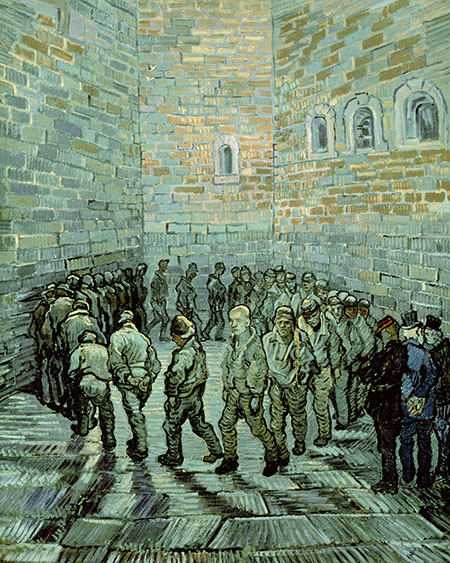
Prisoners Exercising, Vincent Van Gogh, 1890  with Van Gogh looking out and beyond.

Prisoners Exercising, Vincent Van Gogh, 1890 with Van Gogh looking out and beyond.

Dale Hartwig stood out from the crowd. He wrote for himself. His was a rich inner world, a necessity for survival as Parkinson’s shrank his world to the size of his room at the care center. His writings, shared with a group of six close friends, deserve a larger audience.

Dale’s verses and poetry often echo the Hebrew psalmists. They are visceral, sometimes crying out  like Vincent Van Gogh exercising in his asylum at Saint-Remy, and at other times delighting at the sight of a fluttering leaf or falling snowflake outside his care center window. None of Dale’s pieces have titles.

Like prisoners, they only have numbers – the order in which he wrote them, as best we can tell.

Poem #5

Behind and before, Thou goest, O Lord.
Like the wind I cannot see.
But why so silent in ways of my need?
To let you but walk to trust in me.
O my steps are oft frozen from fear,
And my thoughts locked to the darkness around.
O God, only You can move me beyond
The prison that seems to abound.
Come, Lord, and move me, just one small step
Toward the One who would give me so much.
I am who I am, so little sometimes
But, with You, so much, so much.

The last time Dale joined the annual Gathering of classmates in Chicago, he surprised us. He wasn’t supposed to leave “home” – but he did. He somehow managed to get himself to the train station in Grand Rapids, Michigan, board a train for Chicago, and make his way from Union Station to Hyde Park by public transportation carrying a suitcase on the stiffening legs he still exercised daily.

When it came his time to share what had been happening in his life, he handed me a sheaf of papers and pointed to the number 5 on one of the pages he had typed. I read it aloud for him. Every face was wet. “I am who I am, so little sometimes But, with You, so much, so much.”


Four-letter Words

Two four letter words are clean as a whistle until placed side by side.

‘Karl’ could be just another guy, like George Karl, the NBA coach, Karl Malden…or maybe Karl Rove.

‘Marx’ could be Groucho, Harpo, Chico, or maybe Richard. Or it could be mistaken for the word ‘marks’ as in grades in school. Or for targets, as in ‘marksmanship’.

Each name by itself has four letters but is not yet a four-letter word. Either can be spoken out loud. But speak the two together, as in ‘Karl Marx’, and heads will turn, fingers will wag, charges will be brought, electronic ears will be listening.

It’s popular to be a Groucho, Harpo, Chico, or Richard. It’s not so safe if your name is Karl, unless your last name happens to be Rove.

The older Karl grew up in a white house in Trier, Germany, but he never occupied the White House

Karl Marx Haus in Trier

Karl Marx Haus in Trier

The White House

The White House

Verse – One State, Two States?

Jesus was a Palestinian,
born, by some accounts,
in the West Bank town
of Bethlehem.
If the sobriquet
Jesus of Nazareth
is more accurate,
that region of Judea
is also Palestinian today.

He was born in poverty,
not privilege, in a territory
occupied by a cruel
and ruthless military.
His family was taxed, but had
no voice. He was a target
of official violence
and brutality from his birth
to the last week of his life.

Born of a Jewish mother,
Jesus was a son of David
as well: was circumcised,
studied and taught
in the Jerusalem Temple,
was called Rabbi.

With whom would Jesus
identify today?

– Steve Shoemaker, Urbana, IL, Dec. 16, 2014