Never, ever, ever mention the name Marx! Americans hate that. Especially in a sermon. [See yesterdays’ “In the Footsteps of Mary“].
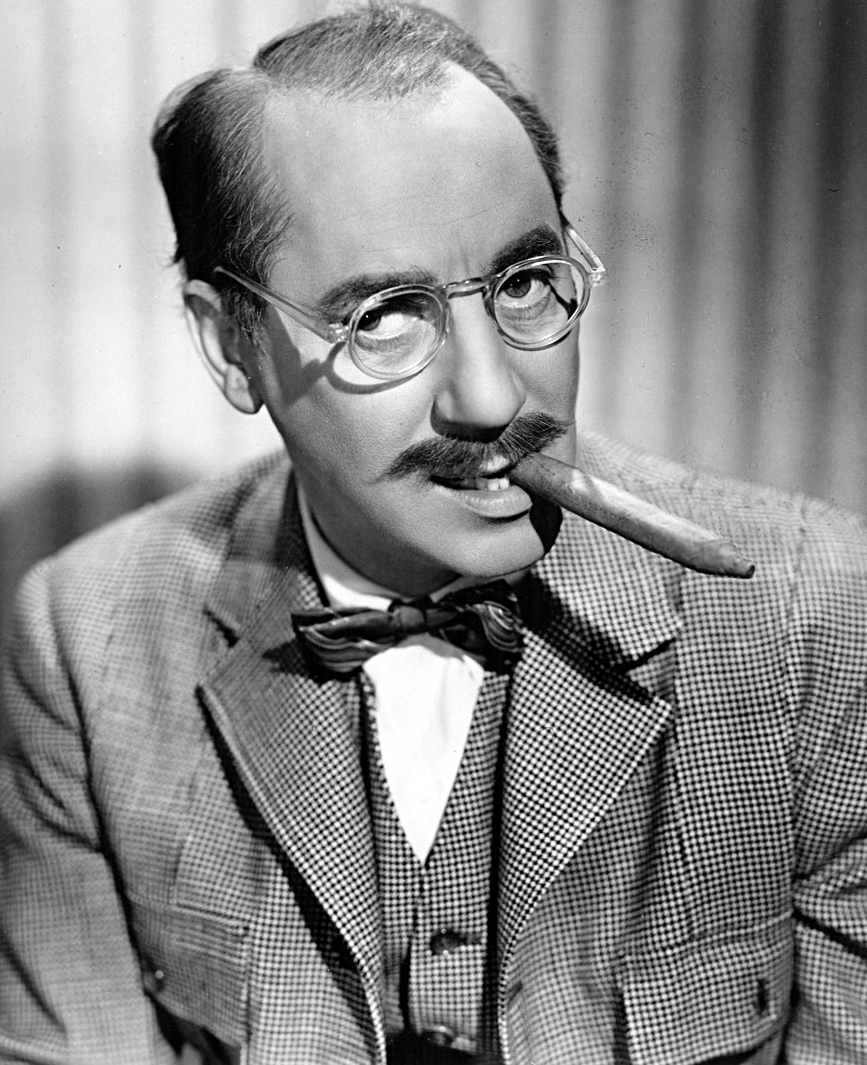
Unless it’s Groucho.
“All people are born alike – except Republicans and Democrats.” – Groucho Marx
Never, ever, ever mention the name Marx! Americans hate that. Especially in a sermon. [See yesterdays’ “In the Footsteps of Mary“].
Unless it’s Groucho.
“All people are born alike – except Republicans and Democrats.” – Groucho Marx
A sermonic reflection on America today, Dec. 14, 2014.
Today’s texts speak indirectly to the national outrage over the deaths in Ferguson, Cleveland, and Staten Island and to the larger context of the economic Law – Capitalism – under which they’ve taken place.
The Spirit falls upon Isaiah
…to provide for those who mourn in Zion– to give them a garland instead of ashes, the oil of gladness instead of mourning, the mantle of praise instead of a faint spirit….They shall build up the ancient ruins, they shall raise up the former devastations; they shall repair the ruined cities, the devastations of many generations. (Is. 61:2-4)
I am in mourning. Even in the midst of Zion. Though I already taste the fruit of the Kingdom of God which is yet to come in fullness, I am in mourning. In ashes. Faint in spirit. Living among the ancient ruins, the former devastations, the ruined cities, the devastations brought on by many generations including my own.
There is anger out there. Lots of it. There are calls for justice out there. There are “die-ins” on Interstate Highways blocking traffic, interrupting business as usual. And it’s good. It’s right. It’s an American thing to do.
But, like most movements, this one will pass in a few weeks or maybe months. It will go the way of Occupy Wall Street.
For while protesters were were being hand-cuffed for “die-ins”, Congress was taking the hand-cuffs off Wall Street and the “too-big-to-fail” banks. The Dodd-Frank restrictions enacted following the 2008 meltdown were being quietly removed by hidden-away paragraphs in the down-to-the-wire spending bill. There will be no more hand-cuffs. No more probation. No more accountability to the American people. The legal limits on dealing in the “derivatives” market were being deleted on Capitol Hill, and, perhaps worse, the Dodd-Frank provision prohibiting a second government bailout was replaced by a commitment to bail them out again.
While on Capitol Hill the Law was being re-written to deliver automatic bail to Wall Street, individuals protesting law enforcement tyranny on the streets were hauled off to jail hoping a friend would bail them out.
Only within the larger economic puzzle do the various pieces begin to make sense.
For all of America’s national wealth, we are among the poorest of nations. We are a classist society bordering on a caste society. Class has always been the issue in America. Race and class have always gone hand-in-hand, but classism has other hands as well.
The wider context surrounding the law enforcement racial divide is the classism embedded in a global capitalist economic structure.
We are living still amid the “ancient” devastations brought on by rich white slave traders who captured Africans like animals for a zoo to work their plantations for profit. Racism is a class issue, an ownership issue, an issue of economic privilege, before it is anything else. The coupling of race and class is as clear now as it ever was, despite the Civil Rights Movement and the election of America’s first African American president.
Capitalism is the issue. The accumulation of wealth. The increasing concentration of wealth. The hoarding of wealth. Wealth disparity, power disparity, racial disparity, electoral disparity, legal disparity; what’s enforced and what’s not; who’s in handcuffs and who’s not; who’s bailed out and who’s not; who’s charged and who isn’t; who’s in prison for what and who’s not; who’s on probation or parole and who’s not; who’s elected to Congress and who’s not; who owns what and who doesn’t; who can pay for an election and who can’t – are all about class, the control of the means of production and capital and the expropriation of cheap labor and natural resources that can’t talk back.
Enter now into this world the psalmist of today’s readings who dared to dream of a great reversal of fortunes:
When the LORD restored the fortunes of Zion, we were like those who dream.
Then our mouth was filled with laughter, and our tongue with shouts of joy; then it was said among the nations, “The LORD has done great things for them.”
“The LORD has done great things for us, and we rejoiced.
Restore our fortunes, O LORD, like the watercourses in the Negeb.
May those who sow in tears reap with shouts of joy.
Those who go out weeping, bearing the seed for sowing, shall come home with shouts of joy, carrying their sheaves.”[Psalm 126:1-6]
The tears of weeping bear the seeds for sowing and reaping of the sheaves of the new economic order. It is no accident that the psalmist mixes the metaphors of weeping, seeds, sowing, and shouts of joy, and sheaves. It is, as it were, a vision for the Earth itself. Honest weeping is the beginning – the sowing – that leads to earthly transformation and shouts of joy.
Mary, the newly pregnant peasant girl, becomes the representative, singing her song amid the ancient devastations, announcing the hope that will engage the powers of class “to provide for those who mourn” [Is.61:1]:
My soul magnifies the Lord, and my spirit rejoices in God my Savior, for he has looked with favor on the lowliness of his servant. Surely, from now on all generations will call me blessed; for the Mighty One has done great things for me, and holy is his name. His mercy is for those who fear him from generation to generation. He has shown strength with his arm; he has scattered the proud in the thoughts of their hearts. He has brought down the powerful from their thrones, and lifted up the lowly; he has filled the hungry with good things, and sent the rich away empty. He has helped his servant Israel, in remembrance of his mercy, according to the promise he made to our ancestors, to Abraham and to his descendants forever.” [Luke 1:46b-55]
Put differently by Philip Clayton, Ingraham Professor of Theology at Claremont School of Theology, we are living
“…at the dawn of a new form of human civilization. Individuals, societies, and nations are now deciding whether to keep fighting to preserve the dying order, or whether to take leadership in building the new. It’s not a matter of waiting for more data; we already know what the old practices are doing to our planet, and we know what it takes to build a global society that is socially, economically, and environmentally sustainable. The ones who make the greatest difference are those who work and live with wisdom, with diplomacy, and with restraint, placing the good of the whole planet first.” [Philip Clayton and Justin Heinzekehr, Organic Marxism: An Alternative to Capitalism and Ecological Catastrophe, Process Century Press, 2014]
I’m still mourning. But I feel better. I know that the mourning is a holy thing, the hint of a coming “garland instead of ashes, the oil of gladness instead of mourning, the mantle of praise instead of a faint spirit” and so, I write. I pray. I sing. I mourn to the tune of Isaiah. I march to the dream of the Psalmist. I walk in the footsteps of Mary.
– Rev. Gordon C. Stewart, Honorably Retired, Views from the Edge, Third Sunday of Advent, Dec. 14, 2014.

The Congressional omnibus budget bill is a compromise – a BIG compromise. It turns the clock back on regulations put in place after the financial market meltdown in 2008 had taken us to the brink of another Great Depression. It undoes the core provision of Dodd-Frank and increases the limit for wealthy giving to political campaigns.

Cover on John Irving’s The Hotel New Hampshire in which “Sorrow” the family dog floats to the surface after the plane crash.
The dog we hoped we’d buried still floats, as Views from the Edge published on MinnPost a year after the 2008 crisis.
Click Sorrow Floats: the Healthy-Deregulated-Capitalism Myth Just Keeps Resurfacing.
Sorrowfully, memory is short, and, because the American electorate chooses amnesia to consciousness, the old dog still haunts us.
“Jesus, you’re the best…” he said.
His open collar showed his chest
was tan even in December.
“We just want to thank you, Lord,
for taking Joe to be with you.
We’ll miss him, but we know it’s best
for him to be in heaven.”
We sang Amazing Grace, but Joe,
it seemed, had clawed his way up high
through generous gifts to the church,
by staying married, raising kids,
and praying often. He would reach
the Golden Gates, receive the pie
in the sky. Not so, you and I.
– Steve Shoemaker, Urbana, IL, Dec. 10, 2014
This story is told by my cousin Dennis, originally from South Paris, Maine. Our grandmother was a tea-totaler, a member of the Women’s Christian Temperance Union (WCTU) that struck fear in every drinking man! Here’s the story in his own words.
Every Christmas our family would have our tree in the morning, go to church and then go to grandma’s house on Main St. All the Titus uncles and aunts would be there with their children. We would nosh on pastries baked by Aunt Muriel and then do the tree.
The aunts and uncles plus us children would get two or three gifts from each family and be done with opening our gifts in 15 minutes. Then our grand parents would methodically open each gift from all of us there and all their far flung friends and relatives. There would be mounds of gifts for them. Grandma was very precise, she would cut off all the bows and have a box to put them in for next year. Likewise all the wrapping paper. Then she would write in a book who gave the present and what it was. This process meant that everybody sat for hours watching them open all their gifts. You would see everybody nodding off or going to the dining room to get pastries and coffee.
After about an hour of this gift opening by Grandma, I noticed one of more of my uncles would get up and disappear for a half hour or so. Being the curious person that I am, I followed my Uncle Roy. I noticed that he went through the kitchen out into the barn. [Note to the reader: the barn was attached to the house through a pantry by the kitchen].
So I waited a few minutes and went out into the barn too. They were all gathered in a separate room with the door shut.
I opened the door and surprised them. They were drinking beer and smoking. They quickly tried to hide the beer cans and butt their cigarettes hoping I didn’t notice. I just stood there frozen in my tracks. Finally Uncle Roy said this was not place for me and I should return to living room. As I turned to leave, Uncle Alva said “Wait a minute.” He came over to me and asked what had I seen. I told them I saw that they had been smoking and drinking, in a smug sort of way.
Uncle Alva was building a boat at that time, so he asked if I would like to go fishing with him and Bill [i.e. Alva’s son; Dennis’ cousin] next spring? Of course I said I sure would. Being the salesman he is, he proposed a deal to me. If I go back to the living room and keep my mouth shut, he would take me on the maiden voyage of his boat on Thompson Lake and we would go fishing for Lake Trout. I looked at him with wide eyes and a big smile and said “Uncle Alva you got a deal!” My other uncles pulled their beer out and took a big swallow and laughed. I shook hands with all of them and left with a grin that didn’t come off until I went home that night (laughing to myself all the next day).
When my mother asked where I had been as I returned to the living room, I told her in front of everybody I had to go to the bathroom real bad. No one was ever the wiser…. I went fishing with Bill and Uncle Alva on their maiden voyage laughing all the way. That’s when I learned what salesmen do for a living!
Dennis Smith, Whitewater, WI, December 10, 2014
After news about the “spending bill” came out yesterday, I took the liberty of re-writing scripture. Readers unfamiliar with Jewish and Christian Scripture may not have heard of Isaiah’s vision in the Temple (Isaiah 6:1-8) that began his campaign to reform his nation in the year that King Uzziah died. Here’s the re-write for December 10, 2014:
In the year that [Speaker John Boehner and Senate Majority Leader Harry Reid proposed a “spending bill” that overturns banking regulations put in place after the near financial meltdown 0f 2008 and raises the cap on individual campaign contributions], I saw the LORD sitting upon a throne, high and lifted up; and the train of his robe filled the temple. Above him stood the seraphim. Each had six wings: with two he covered his face, and with two he covered his feet, and with two he flew. And one called to another and said:
“Holy, holy, holy is the Lord of hosts;
vthe whole earth is full of his glory!And the foundations of the [nation’s] thresholds shook at the voice of him who called, and the house was filled with smoke. And I said:
“Woe is me! For I am lost; for I am a man of unclean lips, and I dwell in the midst of a people of unclean lips; for my eyes have seen the King, the Lord of hosts!”
Then one of the seraphim flew to me, having in his hand a burning coal that he had taken with tongs from the altar. And he touched my mouth and said: “Behold, this has touched your lips; your guilt is taken away, and your sin atoned for.”
And I heard the voice of the Lord saying, “Whom shall I send, and who will go for us?” Then I said, “Here I am! Send me.”
Where’s Isaiah when we need him? Then I read Elizabeth Warren’s objection to the bill. Click HERE for the story. Then call your Representative and Senators. When they ask your name, just say “Isaiah!” When they ask how you happened to call, tell ’em God sent ya.
Click HERE to read what’s in the detail of the bipartisan compromise spending bill announced yesterday. A spending bill is necessary to prevent another government shutdown. This one will make your teeth itch.
The unregulated derivatives trading that led to the bailout of the “too-big-to-fail” banks and investment firms are back. Wall Street wins. The American people lose, again. Do I hear a veto coming from the White House? Or is every house in the Wall Street pocket?
All the reports say people
who see real Angels fear them.
They blaze in glory from bringing
their message from the Holy One.
There are no descriptions
of high heels or underwear.– Steve Shoemaker, Urbana, IL, Dec. 9, 2014
EDITOR’S REFLECTION
Readers unfamiliar with Jewish and Christian Scripture may not have heard of Isaiah’s vision in the Temple (Isaiah 6:1-8) that begins his work to reform his nation:
In the year that King Uzziah died I saw the Lord [“the Holy One] sitting upon a throne, high and lifted up; and the train of his robe filled the temple. Above him stood the seraphim [“angels”]. Each had six wings: with two he covered his face, and with two he covered his feet, and with two he flew. And one called to another and said:
“Holy, holy, holy is the Lord of hosts;
vthe whole earth is full of his glory!And the foundations of the thresholds shook at the voice of him who called, and the house was filled with smoke. And I said:
“Woe is me! For I am lost; for I am a man of unclean lips, and I dwell in the midst of a people of unclean lips; for my eyes have seen the King, the Lord of hosts!”
Then one of the seraphim flew to me, having in his hand a burning coal that he had taken with tongs from the altar. And he touched my mouth and said: “Behold, this has touched your lips; your guilt is taken away, and your sin atoned for.”
And I heard the voice of the Lord saying, “Whom shall I send, and who will go for us?” Then I said, “Here I am! Send me.”

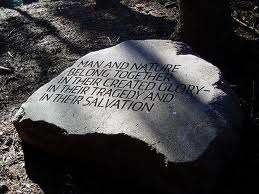
Paul Tillich quote in Tillich Park, New Harmony, IN: “Man and nature belong together in their created glory – in their tragedy and in their salvation.”
A spiritual reflection for the Second Sunday of Advent, December 7, 2014.
The beginning of the GOOD news is HARD news, according to John the Baptist, calling people out into the wilderness. “We must change,” he said. “Repent” by which the Judeo-Christian tradition means a 180 degree turn. “About face!” Only by turning will we be delivered from the consequences of the actions that have led us here.
For John the Baptist and the writer of the Gospel of Mark’s opening paragraph (Mark 1:1-8) the system at issue was Roman imperialism, an economic system centered in Rome, expanding out, and enforced by, military invasions, subjugation, religious tolerance (so long as the religious practice did not interfere with Roman prerogatives) and occupation.
One could repeat the sentence in 2014 with little change: “the system at issue [is [American] imperialism, an economic system centered in [Washington] expanding out, and enforced by, military invasions, subjugation, religious tolerance (so long as the local religious practice [does] not interfere with [American] prerogatives) and occupation.”
It is our spiritual, moral, economic, cultural and political captivity to a global system that cannot satisfy our real needs or the world’s that produces a longing in our hearts, a readiness to make the lonely trip to the wilderness.
We’re a weary people in 2014. Wearied and still disheartened 11 years after the “Shock and Awe” that took down Saddam Hussein on the pretense that he had weapons of mass destruction (WMDs) that threatened us, the Administration’s manufactured association of Saddam Hussein as the cause of 9/11. We’re wearied of lies and misrepresentations. Weary from budget fights that barely reference 10 years of un-budgeted military expenses, the loss of thousands of American soldiers’ lives and as many as 100,000 Iraqi civilians, a military venture undertaken on the assumption that the Iraqi people would welcome our presence as the beginning of democracy and a “free market” economy that would lift them all up.
That belief in the goodness of American intentions hit the rocks as quickly as Saddam’s statue hit the pavement in Baghdad. All the while we were wearied by the earlier invasion of Afghanistan, whose original justification was a quick elimination Osama bin Ladin and Al-Qaida untempered by realistic knowledge of the long history of the military interventions that mired the invaders in quagmires such as the Soviet Union found itself before leaving in defeat. To the Afghans it didn’t matter whether the troops were Soviet or American. They were the same. They were the occupation forces of an imperial power destined to fail.
In the midst of the weariness about what was happening abroad, the financial system at home took the American economy to the brink of disaster in 2008. Occupy Wall Street rose to the top of the news cycles. Although the movement fizzled over time, as such movements inevitably do, it caught the attention of television viewers, internet surfers, and newspaper and magazine readers. Occupy Wall Street and the spot light it placed on “crony capitalism” became a hot topic around water coolers at work and the table in the coffee shops.
For the first time in recent memory, capitalism was no longer sacred, no longer off limits. Time’s front cover asked the question whether Capitalism was dead. But, as with Occupy, public attention is short-lived. Amnesia sets in when people are weary. How soon we forget…until some new John the Baptist issues the cry for a 180 degree turn for the sake of something better.
Maybe Naomi Klein is edition of John the Baptist. This Changes Everything: Capitalism vs. the Climate, reviewed by the New York Times – places the over-riding systemic issue squarely before the general public again. Senator Bernie Sanders, America’s only socialist Senator who names climate action as among his four top priorities, is gaining attention as a possible presidential candidate. Elizabeth Warren, the Senate’s bulldog on holding Wall Street accountable is creating a wave of populist momentum. Put them with Bill McKibbon and 350.org and you begin to hear the echo of John’s all to the hard truth that is the beginning of the good news.
The hard truth that precedes good news is the discovery of the myth that has coupled democracy with capitalism in the American psyche, while demonizing socialism as democracy’s opposite. Ideological blinders are to nations and peoples what blinders are to horses on a race track: they limit vision to the straight-ahead narrow limits of the track. Ideological blinders prevent the owners’ horses from thoughts of anything but the track on which they’ve been placed to race each other.
But when the climate is changing our track in ways that compel our attention, and when we ask how we will make it through the changes together, the bigger question of the economic system – the race track itself – comes into view by virtue of necessity. It calls us off the track into the wilderness of Nature.
The words ‘economy’ and ‘economics’ derive from the Greek words for ‘house’ and ‘the management of the household’. Economics not about markets, free or otherwise, or about the technicians and pundits who monitor investments and predict quarterly outcomes. It is not an academic discipline, the exclusive province of experts on Wall Street or in university Economics departments who understand how the free market works.
Economics is a spiritual perspective like the one on Paul Tillich’s marker in Tillich Park in New Harmony, Indiana. “Man and nature,” he said, “belong together in their created glory – in their tragedy and in their salvation.” There is no humanity with nature; the human calling of our time is to reshape our lives for the wellbeing of the one house in which all life lives.
During this Advent season of longing expectation, John the Baptist with his axe aimed at the root of the tree reminds us that economics is the spiritual issue of the first order. The good news is what the Hebrew Bible calls “the Day of the Lord” and John the Baptist and Jesus of Nazareth called “The Kingdom [i.e. Society] of God”. The hard news is we’ve been running on the wrong track, or, you might say, barking up the wrong tree.
The planet – this home we call “nature”, without which no person, society or form of life exists – is an economy that requires different management. The economy for which our hearts long is the one house imagined by the psalmist and announced by John in the wilderness beyond the Pax Romana: the good news awaiting our longing hearts to embrace it, a planetary home where “righteousness and peace will kiss each other” (Psalm 85:10) and wars will be no more.
The beginning of the GOOD news is HARD news. “Repent, for the kingdom of heaven is at hand.”
– Gordon C. Stewart, Chaska, MN, December 7, 2014
The reference is to Carl Sandberg’s poem.
O, I got a zoo, I got a menagerie, inside my ribs, under my bony head, under my red-valve heart—and I got something else: it is a man-child heart, a woman-child heart: it is a father and mother and lover: it came from God-Knows-Where; it is going to God-Knows-Where—For I am the keeper of the zoo: I say yes and no: I sing and kill and work: I am a pal of the world: I came from the wilderness.
After 14 years of living at home, my cousin Alan was institutionalized. His Cerebral Palsy had finally come to the point of seizures at all hours of the day and night.
For 14 years Alan’s bed was just outside the open door between his room and his parents, my Aunt Gertrude and Uncle Bob in South Paris, Maine. His mother slept with an ear open for any change in Alan’s breathing pattern. She had come to learn the breathing changes that preceded a seizure. She would hear the change and rush to Alan’s side.
Alan required round-the-clock care. The years when my Aunt and Uncle felt secure in leaving him alone for shopping or running an errand had now become a wistful memory. My cousin Gwen remembers that their mother could no longer go outside to hang the laundry without calling a neighbor to stay with Alan for 10 minutes. Alan’s care became the all-consuming center of family life to the neglect of Alan’s younger siblings, Dennis (11) and Gwen (7) and the deteriorating health of Uncle Bob and Aunt Gertrude.
In the 14 year of Alan’s life, when things had gone beyond the point where they could care for him adequately, they made the hardest decision of their lives. They admitted him to the Pownal State School and Training Center in New Gloucester, Maine where he spent the last five years of his life with other severely disabled residents. Members of the family made the hour-and-a-half trip to New Gloucester twice a week to be with Alan at Pineland. During those next five years Alan’s friends at Pineland became friends to the entire Smith family.
My cousin Dennis describes the scene at Pownal in words of his own:
These were children with Downs Syndrome, dwarfs of all kinds, microcephalics, hydrocephalics, people we used to call morons, idiots, and imbeciles, and non-ambulatory people like Alan. All of natures mistakes in one big room.
When my mother and I would do concerts for them, they would bring Alan in on a gurney. They would sway to and fro to the music trying to sing or moan to the melody. At first their responses raised the hackles on the back of my neck. It was like a scene out of a Hollywood movie.
Some of the residents assisted in Alan’s care. In his room they would talk to him like dear friends and Alan would respond to them with his familiar ‘ah’s and laughter. I grew to understand he was in his element there with constant attention by those he knew and trusted…. I’m convinced he died a happy, contented young man who was free at last to be himself. Just another human being surrounded with friends who loved him.
The human species itself is what Carl Sandburg said each one of its members is: a menagerie. We are all in the menagerie, the most ‘abled’ and the least ‘abled’ of us. Every attempt to engineer a species without “mistakes” – a purified race, a super race, a genetically modified species – is a mistake doomed to fail. The wilderness always prevails.
Those who have met the zoo within themselves come to understand that we all come from the wilderness just outside the castle walls and moats of human pride and self-deception:
“…it [i.e., the zoo inside my ribs] came from God-Knows-Where; it is going to God-Knows-Where….I am a pal of the world: I came from the wilderness.”