God of the Profits or God of the Prophets?

October 14, 2012 at Shepherd of the Hill Presbyterian Church in Chaska

Text: Amos 5: 6-7, 10-15, 18-24

This morning I ask you which of the gods we will bow down and serve: the god of the profits, the organizing principle for those who were at ease in prophet Amos’ time, or the God of the Prophets who thundered against excessive profits in the marketplace?

Some will say that’s too simple.

Amos didn’t think so. Isaiah didn’t think so. Micah didn’t think so. Jeremiah didn’t think so. Jesus didn’t think so. Mohandas Gandhi didn’t think so.  We’ve heard from Amos and from Jesus.  Here’s what Gandhi called the Seven Deadly Sins of Society. The first sin on Gandhi’s list is

  • “Wealth without Work,” and the last is
  • “Worship without Sacrifice.”

Less than one month before we go to the polls to cast our votes for candidates for public office, I put before you from this pulpit the question of which God you will serve.

Will you commit yourself, or re-commit yourself, to the God of the biblical prophets, or will you line up your life and your values behind the god who thinks there’s no problem with wealth without work, worship without sacrifice?

I have never been more troubled in my life than I am today. It’s not because belong to a political party. It’s not that I want my team to win and the other team to lose. It’s because I believe in the God of the Prophets. I wake up every morning to scripture. And what do the scriptures say?

There were two sets of scripture that informed Jesus’ life. The Torah (also referred to as “The Law”) and the Hebrew prophets. “All the Law and the prophets are summed up in this: You shall love the Lord your God…and your neighbor as yourself.”

Jesus put the Voice of the prophets in the center of Jewish faith and life. Often he sounds like Amos.

We celebrate the Beatitudes of Jesus’ Sermon on the Mount or the Sermon on the Plain. We read in Luke’s Gospel:

“He lifted up his eyes on his disciples and said,

  • ‘Blessed are you poor, for yours is the kingdom of God.
  • ‘Blessed are you that hunger now, for you shall be satisfied.
  • ’Blessed are you that weep now, for you shall laugh.”

And our hearts rejoice. Because some of us, like Jesus’ first disciples, live in poverty; some of us know what it is to be hungry. Some of us are weeping now, wondering when we will laugh again.

Jesus consoles us. And these words of consolation are lifted up in the churches, as they should be.

But you can’t stop reading there if you want to follow Jesus. For in the very next lines of Jesus’ Sermon to his disciples, he echoes the thundering voice of the prophet Amos and his Woes:

  • “’But woe to you that are rich, for you have received your consolation.
  • “’Woe to you that are full now, for you shall hunger.
  • “’Woe to you that laugh now, for you shall mourn and weep.’”?

Jesus is calling it like it is. He is describing the revolution of economics, political power, and redistribution of wealth that is the Kingdom of God. The Kingdom of God is an economy – God’s economy. The economy preached by the biblical prophets and Jesus. The world of our best dreams where no stomach is empty, no one goes hungry; no one goes without health care. No one lives on the street under the viaduct, or in a car. No longer will those who have laugh at or pass by those who don’t.

The message of Jesus does console. It comforts the afflicted. But it also afflicts the comfortable. It causes trouble. It makes waves. It speaks the truth. It cuts through the lies that keep the privileged privileged.  It calls us to take responsibility in the here and now – to implement in the most practical ways the summary of the Law and Prophets. The over-riding question for the Christian is HOW to love my neighbor as myself? How to live now in the economy of God as the protest of hope and love within the economy of greed, disparity. How to live NOW as those whose worship DOES mean sacrifice.

A businessman notorious for his ruthless pursuit of profits once announced to Mark Twain that before he died, he meant to make a pilgrimage to the Holy Land. “I will climb Mount Sinai,” said the ruthless profiteer, “and I will read the Ten Commandments out loud from the top of Mount Sinai.”

“I have a better idea,” said Twain, with a twinkle in his eye. “You don’t have to go to the Holy Land. You could stay home in Boston and keep the commandments.”

Earlier in his life, Samuel Clemens (who became known as Mark Twin) had been a young reporter in Virginia City.  He was walking along the street one day with a cigar box under his arm when a wealthy lady acquaintance said to him scornfully, “You promised me that you would give up smoking.”

“Madam,” he said, “this box does not contain cigars. I’m just moving.

Today we are asked to make a decision of stewardship. In three weeks we will make other decisions in the voting booth. As we consider these decisions, remember Amos yourself which God of the Prophets/Profits your decisions will honor. Will your action bear witness to the economy of greed and extravagance, the world of Gandhi’s Seven Deadly Sins?

  • Wealth without Work
  • Pleasure without Conscience
  • Science without Humanity
  • Knowledge without Character
  • Politics without Principle
  • Commerce without Morality
  • Worship without Sacrifice

Or will your decisions proclaim with Jesus the different Kingdom for which every heart longs to celebrate?

In conclusion, a writer named Ted Kooser invites you to think of yourself as a Daddy Longlegs.  You know the Daddy Longlegs, those strange creatures with those tiny little brown bodies like a small brown pill, walking across the floor on those eight long legs.

“Here, on fine long legs springy as steel,

A life rides, sealed in a small brown pill

That skims along over the basement floor

Wrapped up in a single obsession.

Eight legs reach out like the master ribs

Of a web in which some thought is caught

Dead center in its own small world,

A thought so far from the touch of things

That we can only guess at it.

If mine, it would be the secret dream

Of walking alone across the floor of my life

With an easy grace, and love enough

To live on at the center of myself.

You don’t have to go to the Holy Land to read the commandments from Mt. Sinai. Walking on your eight long legs across the floor of your life, you can walk with an easy grace, and with love enough to live on at the center of yourself…You can make love real today right here in Minnesota.

The “Nones” at the coffee shop

The “Nones” are the fastest growing group in the United States religious landscape. Time publicized the story in its March 12, 2012 issue.

Last week Rose French, religion editor of the Star Tribune here in Minneapolis, personalized the Pew Forum research in  “Fastest growing group in religious circles? The ‘Nones’”  (10.15.12).

The story begins with Marz Haney, a young woman who grew up attending an evangelical Christian church every Sunday. But she had questions. And, it appears, the church she attended wasn’t big enough for her big questions.

Questions and doubts are not enemies of faith. They are the friends of faith. They refine, correct, expand, and reform faith. They challenge what Jean-Paul Sartre called “bad faith.”

Sartre, of course, thought that all religious faith was bad. Some of the “Nones” agree with Sartre. Others still profess faith or “spirituality” but live it outside the boundaries of the traditional institutions that no longer hold meaning for them.

“I had some doubts all along. I was sort of in continual doubt about my personal salvation,” says Marz Haney.

That Marz and others have concluded that spirituality/faith/religion is all about personal salvation brings me great sadness. That she would think so is a reflection of the right turn that began to dominate the American religious landscape beginning in the 1950s.

To many of the “Nones”, fear and hate have become the face of Christianity. Sometime in the late ’50s, the televangelists began to change the face of Christianity to the world. Those who tuned in watched and heard the voices of snake oil salesmen selling purple handkerchiefs that would heal, if only you purchased one and put the hanky on your television screen while the evangelist prayed for you. Intelligent faith was turned into an oxymoron. One either is intelligent and without faith, or full of faith and without intelligence.

At the coffee shop recently, the proprietor who greets me “Good Morning, Your Reverence” with a smile, invited me to join a conversation he was having with two other coffee drinkers. “You can help us here,” Mike said. His grin told me this was a set up. “If God created the world, who created God?”

“Hmmm. Interesting question. Really good question. Really, really, really good question. It assumes, of course, that everything is created. That’s the way we think. If something’s here, it has to have been created. But that begs the question endlessly. So….maybe some things are not created. Whatever that is ultimate reality. In theology, the word we use for the ultimately real is ‘God’.”

Several weeks later a young couple sat at the table at The School of the Wise, a coffee shop and wine bar humorously named after the euphemism for speakeasies during the era of Prohibition. The couple had sent a message through the church’s website inviting a conversation about their needs and whether Shepherd of the Hill Church might be a good fit.

They were “Nones”. I love this couple! They made my evening. So honest. So genuine. So open. Wondering and hoping that perhaps Shepherd of the Hill might be a place unlike that mega-church up the road whose very small print declares belief in “the intention, eternal punishment of the wicked”. They were cautious but feeling the need for a community that welcomes rather than scorns, unites rather than divides, thinks as well as feels, and moves them beyond self-absorption in the comfortable but confining precincts of economic privilege.Sitting in a coffee shop with The New York Times on Sunday Morning over a cup of coffee was no longer enough.

Which, of course, is what the gospel is about, as I understand it.

Jesus had one message: “the Kingdom of God/Heaven is at hand.”  A “Kingdom” is a society, a commonwealth. A society is people in relationship. “At hand” means “Now!” The kingdom of Heaven was something like the heaven the young couple and I were experiencing right there at the back table in The School for the Wise – real people in real relationships, exploring ultimate reality over delicious mocha-mint-lattes, looking beyond our privilege and celebrating the magnificence of a moment that is at the very heart of  creation as we know it.

Back To Top

A Back Porch Conversation on Human Needs Satisfaction

Today “In the company of hysterical women” referred to Abraham Maslow’s hierarchy of needs in the post “Living Below the Line – Day 2”. The reference to Maslow led to bringing this draft commentary out from the file drawer where it’s been gathering dust since early August.  Here’s the reflection

Defining Human Needs and Their Satisfaction

Terry Gips, Sustainability Associates

Terry Gips, President of Sustainability Associates (click HERE for description), introduced me to Chilean philosopher-economist Manfred Max- Neef’s ground-breaking re-conception of human needs and needs-satisfaction. Max-Neef’s framework offers a different view from Abraham Maslow’s pyramid-hierarchical model of self-actualization that prevails in the West. While the Maslow model is typically Western in centering on the individual, the Max-Neef paradigm looks at the larger culture and society in terms of needs and needs-satisfyers. It’s focus is the community.

The basic human needs are listed here, along with a rating scale to measure how we’re doing (a person, group, nation, world).

Needs satisfaction rating: scale of 1 to 5 (5 = fully satisfied)

Subsistence              1 2 3 4 5                                           

Protection                  1 2 3 4 5

Affection                     1 2 3 4 5

Understanding            1 2 3 4 5

Participation                1 2 3 4 5

Idleness/Leisure          1 2 3 4 5

Creation                       1 2 3 4 5

Identity                        1 2 3 4 5

Freedom                      1 2 3 4 5

–          Manfred Max-Neef – Matrix, Human Scale Development

According to this framework, food and shelter, for example, are not regarded as needs, but as satisfiers of the fundamental need fo subsist.

In much the same way, education (either formal or informal), study, investigation, early stimulation and meditation are satisfiers of the need for Understanding. Curative systems, preventive systems and health schemes in general are satisfiers of the need for Protection.

There is no one-to-one correspondence between needs and satisfiers. A satisfier may contribute simultaneously to the satisfaction of different needs or, conversely, a need may require various satisfiers in order to be met. Not even these relations are fixed. They may vary according to time, place and circumstance. For example, a mother breastfeeding her baby is simultaneously satisfying the infant’s needs for Subsistence, Protection, Affection and Identity.

Think now of “The American Dream” – a phrase coined 1931 by J.T. Adams (1878-1949), U.S. writer and historian, in Epic of America. Here are the words that introduced the aspiration of “the American Dream” to the U.S. national lexicon:

“The American Dream is that dream of a land in which life should be better and richer and fuller for everyone, with opportunity for each according to ability or achievement. It is a difficult dream for the European upper classes to interpret adequately, and too many of us ourselves have grown weary and mistrustful of it. It is not a dream of motor cars and high wages merely, but a dream of social order in which each man and each woman shall be able to attain to the fullest stature of which they are innately capable, and be recognized by others for what they are, regardless of the fortuitous circumstances of birth or position.”

Sipping coffee on Terry Gip’s porch with five seminary classmates, the discussion took a nose dive into theological and economic despair as the Christian pastors lamented the victory of environmental degradation, greed, concentration of wealth, militarism, and consumerism in American life. We were like the prophet Amos, or so we must have thought, thundering our cries of “Woe to you” when Terry, a person of deep and active Jewish faith, asked us to stop and think.

“We won’t get anywhere by negativity,” he said, or something like that. You guys are Christian pastors. People need good news. The old model is a model of scarcity; that’s not good news. We have to re-define abundance. Think about it. You can change the world if you take seriously what Jesus said by preaching a theology and ethic of abundance. We should be talking about a world of abundance, not scarcity.

Jesus: “I have come that you may have life, and have it abundantly.”

We left Terry’s porch wondering what it would look like to alter the approach to the proclamation of abundance re-defined in light of Jesus and Manfred Max-Neef’s human scale development. The “yoke” (responsibility) that brings satisfaction and rest, not only to the soul but to the body politic, is the shared yoke of humility and sharing.

The American Dream is again up for grabs on the road to the November election. I listen to every campaign ad asking which dream is being promoted, and the six Christian pastors go into the pulpit Sunday mornings chastened and deepened by a faithful Jewish brother who seemed to know our Lord, the Jewish rabbi, better than the Christian pastors on his back porch!

I Live with doubt

I live with doubt

A hymn by Steve Shoemaker, Urbana, IL, In honor of John Newton (1725-1807), author of “Amazing Grace.”

I live with doubt:  my faith is weak,
Dark clouds are what I see.
A God of love is all I seek,
Can such a good God be?

The world is full of greed and lies,
Of war and talk of war.
Can any savior hear my cries
And hope and peace restore?

When Jesus met the man born blind,
He touched his eyes with clay.
He bid him wash and he did find
His sight and a new day,

The sun breaks through, I see ahead
My task to feed the poor.
I still have doubts, but grace instead
Of fear I feel much more!

My thoughts and feelings come and go
Like sun dissolves the snow;
But God is firm, and now I see,
That God has faith in me.
Garrison Keillor’s “The Writer’s Almanac”posting on the anniversary of the birthday of John Newton, converted slave ship captain, prompted Steve to write these stanzas in honor of the author of “Amazing Grace.”  Steve’s hymn can be sung to the same tune. The meter is the same.

Why is pop culture fascinated with the end of the world?

Minnesota Public Radio’s Public Insight Journalism asked the question after release of the film Seeking a Friend for the End of the Earth. Here’s how I responded.

Ernest Becker’s The Denial of Death makes the case that our culture is death-denying.

One could argue that our fascination with end of the world films and stories is an entertaining and objectified way of dealing with one’s own personal destiny. Every death is “The end of the world.” The end of the world writ large on the planetary screen moves the issue into the world of fiction, fantasy and myth from which, like all cultures before ours, we create meaning in the midst of time.

There are other reasons for our fascination, of course. Supreme among them, in my view, is the dualism and the violence that saturate Western culture: God/Satan, Good/Evil, Moral/Immoral, Saved/Damned, Blessed/Cursed.

It is this misreading of ancient Jewish and Christian texts that makes the will to power the central theme of our time. The late Japanese Christian theologian Kosuke Koyama said that all “sin” has the same root. It is the claim of “exceptionalism.” Under the banner of nationalist exceptionalism’s shameless stealing of the metaphor of “the city set on a hill” away from its proper setting in Jesus’ nonviolent Sermon on the Mount, we assume Western Culture and the U.S.A. to be the Golden City and the agent of divine will. The exercise of that fallacious conviction results in wars of foreign intervention, occupation, and “pre-emptive strikes” in the name of national security.

We have become a national security state. The “end of the world” fascination in our time is heightened by the knowledge that global destruction – nuclear night – is entirely possible. We fear it. We know it. Yet we are also a culture addicted to entertainment where our worst nightmares get projected onto a movie or television screen where we know that what we’re watching is fiction. The fiction is almost always a high-tech version of the old racist and xenophobic dualism my generation grew up on: cowboys and Indians.

Beneath the question of why our culture is fascinated with end of the world is human nature itself. We human beings, like all other animals, are mortal. We may be exceptional in that we are (more) conscious and self-conscious, but first and last, we are animals. We are born. We live. We die.

As conscious animals, we are capable of great feats. We are also, so far as we know, the only animal capable of self-deception, denial, illusion, and species suicide. The denial of death is the great denial, and immortality is the human species’ great illusion.

The fact of death looms over life for each of us existentially and for the species itself from the beginning and in the middle, not just at the end.  Death is our shared destiny. Death is extinction. Our fascination with the end of the world is a strange Molotov cocktail comprised of all of the ingredients of the human condition, most especially the spiritual terror of annihilation, and the illusion of winning. It is the ongoing legacy of the biblical myth of Cain, humanity’s “first-born” who kills his brother Abel, the myth that describes our time and place in history.

If, like in the movie, you had only three weeks left before the end of the world… What would you do?

I’d do what I’m doing now only more consciously. I’d continue to write each morning. I’d do my best to live gratefully, attending to beauty in nature and in art (classical music and paintings) and to family and friends. I’d pray more thoughtfully. I’d walk my dogs more joyfully, stop yelling at them for barking, and find a place on the North Shore to look out to the horizon of Lake Superior. I’d eat lobster and Dungeness crab with lots of hot butter and salt, rib-eye steaks, garlic mashed potatoes. I would avoid Brussels sprouts! I’d end each meal with a Maine blueberry pie, flan, or Graeter’s ice cream, and a Makers Mark Manhattan.  Then I’d settle down on the couch next to the love of my life, Kay, by the fireplace, turn off the news, see if we can make a little fire of our own, get anchored again in the Sermon on the Mount, and return to sources of joy and laughter in the poems of Hafiz. I’d give up being intentional/purposive. I’d live in the moment.

Seeing with the Ears

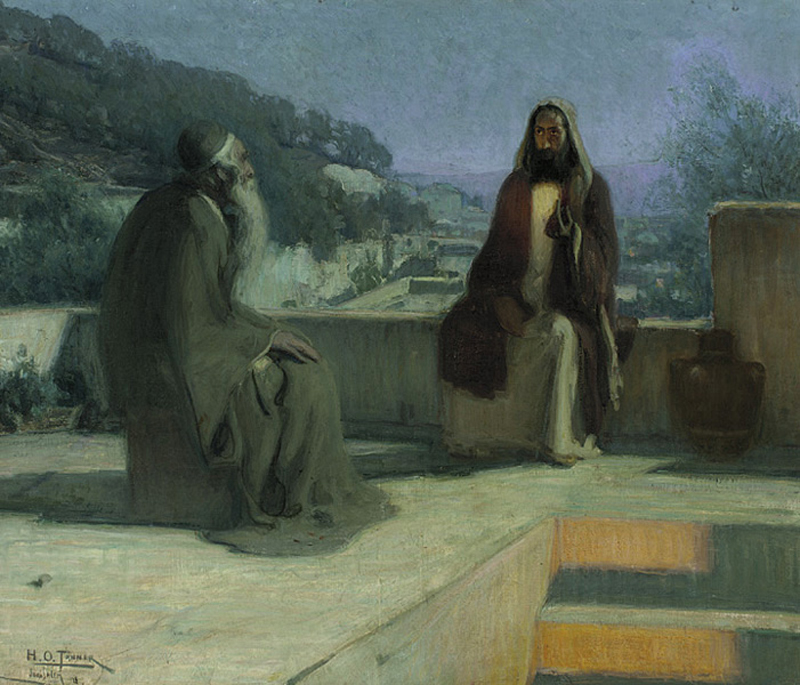
Nicodemus and Jesus on a rooftop, Tanner, Henry Ossawa, 1859-1937

Nicodemus and Jesus on a rooftop

He comes by night. He slips along the buildings of the city streets in hopes that no one will notice. He is a man of position and authority, a learned teacher with a Ph.D. in religion on his way to the kindergarten teacher. “Everything I need to know in life I learned in Kindergarten,” wrote Robert Fulghum. Nicodemus has a sense that he has lost a thing or two along the way, that he needs to start over again.

He’s sent a private message asking for a confidential meeting. The arrangements have been made for the time and place…under the cover of darkness… at Nicodemus’ request.

Dressed in a hooded sweatshirt pulled up around his face and wearing an old trench coat to blend in with displaced people who spend the night on the street, Nicodemus changes his normally stately gait on the way to his secret meeting.

Arriving at the appointed address at the appointed time, he ducks quickly to his left into the alley and darts up the stairs to the flat roof where the kindergarten teacher is waiting.

“Shalom!”

“Shalom aleikem!”

They kiss each other on the cheeks, the left and then the right, as is the custom among their people.

The teacher motions to the wood stool his hands have made for  occasions like this. The stool is well-worn by others who have come it at night, some by advance arrangement, others on the spur of the moment, when the darkness outside or within themselves has overwhelmed them and a hot cup of chamomile tea or warm milk won’t help them get back to sleep.

Nicodemus sits on the stool. But there is no second stool or chair. The teacher takes his customary place on the wall at the roof’s edge, his body and face partially lit by a full-moon, the city landscape and the whole world over the teacher’s shoulder, a strange kind of classroom. Nicodemus can see him – sitting calmly, erect, at full attention, his eyes fixed on his eyes, steady and searching and seeing, it seems, what even Nicodemus does not yet know about himself and the real reason he has come.

The man on the wall sits and waits for Nicodemus to break the silence. The wordlessness does not trouble him. He is at home with silence.

“You are a teacher who has come from God because no one can do what you do apart from the presence of God,” declares Nicodemus.

Nicodemus awaits a response to his declaration of honor, but there comes no response except for the eyes beholding him.

Nicodemus fidgets, uncomfortable with the silence. He repeats his declaration, increasing the decibels in case the teacher is hard of hearing, but not so loud as to wake the neighbors, the street people, or the police:

“You are a teacher who has come from God because no one can do what you do apart from the presence of God.”

Jesus gives a slight nod and looks at him from the wall.

“No one can see the kingdom of God unless he is born anew,” he says.

“So it’s about seeing?”

“Yes. It’s about seeing.”

Turning and pointing to the world over his shoulder, he asks Nicodemus, “Do you see this magnificent landscape behind me?… Look at it… Really look… What do you see?”

“I see a mess.”

“Ah, but look again, Nicodemus. You’re looking with the wrong eyes. It is a mess. Anyone can see the mess. If you look, you can see a different outline through the darkness. Maybe you need glasses. Maybe your ears will help you see.”

They fall again into the silence, but the words – “Maybe your ears will help you see” – speak to an inner darkness. Nicodemus looks with his ears at the night landscape and the distant horizon and the stars over the teacher’s shoulder, listening to the faintest sound of a familiar tune they both had learned in kindergarten at the synagogue.

Jesus, is humming.  Softly. Without thinking, Nicodemus joins in humming the tune, and then begins to mouth the words, the familiar words spoken quietly by every faithful Jew living under Roman occupation and in the dark nights of the soul, the words sung or spoken in silence by every Jew on the way home from synagogue, a kind of lullaby of faith, a way of seeing with the ears:

“Peace unto you, ministering angels, messengers of the Most High, of the supreme King of kings, the Holy One, blessed be He.” (repeat twice)

“May your coming be in peace angels of peace, messengers of the Most High, of the supreme King of kings, the Holy one, blessed be He. (repeat twice)

“Bless me with peace, angels of peace, messengers of the Most High, of the supreme King of kings, the Holy one, blessed be He.” (repeat twice)

“May your departure be in peace, angels of peace, messengers of the Most High, of the supreme King of kings, the Holy one, blessed be He.” (repeat twice)

“For He will instruct His angels in your behalf, to guard you in all your ways. The Lord will guard your going out and your coming in from now and for evermore.”

Pentecost Jazz

Whenever I hear Dave Brubeck, I think of Pentecost. Here’s a video of Brubeck and Al Jarreau that came to mind after reading my friend Steve’s poem (below) on Pentecost and jazz as the music of the Spirit.

PENTECOST (acrostic)

In Memory of Charles Reynolds*

(TO BE READ ALOUD )

Perhaps a jazz improvisation says

Exactly what is thinkable about

New life, fresh breath…the Holy Spirit.  Has

There ever been a music without doubt

Except jazz?  Faith, improvisation cause

Circles of sound to rise and fly throughout

Our cosmos.  Tongues of flame are seen on heads

Singing or playing solos.  Then without

Time passing–a new language:  Jesus!  Jazz!

*Charles Reynolds was Organist at the McKinley Church at the University of Illinois where Steve was the Senior Minister.

– Steve Shoemaker, Urbana, IL. Steve’s Sunday evening program “Keepin’ the Faith” can be heard anytime @ www.will.illinois.edu/keepinthefaith, including archive programs, “two of  which,” says Steve, “feature Gordon C. Stewart,my ‘publisher'”.

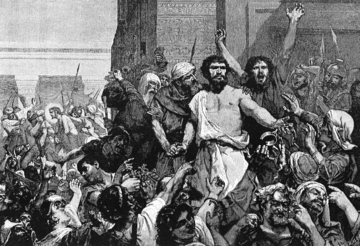
Jesus Barabbas

Give Us Barabbas

There are two Jesuses – two different Sons of the Father. One is executed; the other is released. Both are with us still.

Here’s the sermon at Shepherd of the Hill Presbyterian Church in Chaska, MN, a place for the mind and heart on YouTube:

YouTube: “” 

The Strangest of Gifts

Socrates is reported to have said that “the unexamined life is not worth living.”

Judas' conscience - G.E Nikolaj (1891)

Any honest self-examination knows that to be human is to experience betrayal. We betray and we are betrayed.

Would it help to think of God as being closer to our betrayals than we ever dare to be?

Would it help, perhaps, to see your betrayal of others and your self-betrayals, as scenes in a drama with many different scenes and acts, a drama bigger than betrayal?  A drama of One who knows our nature. Our fears. Our dashed hopes. Our un-trustworthiness. The side of us so ugly that we dare not look it in the eye – the side that, for thes moment, cannot imagine the larger dramatic piece and the hopeful theme we have forsaken: the persistence of love, of forgiveness, of life out of death, the resurrection of love itself…here and now…not just then and there.

There are two traditions about Judas, disciple of Jesus whose betrayal has been handed down across the ages, the scapegoat Betrayer we don’t want to be.

According to the first story In Matthew, “when Judas, [Jesus’]  betrayer, saw that [Jesus] was condemned, he repented and brought back the thirty pieces of silver…and throwing down the pieces of silver…he departed; and he went and hanged himself.”  The first story puts Judas at the end of his own noose. But there’s an altogether different tradition according to which Judas exploded from within while walking across a field. In this story, the Betrayer is a walking dead man, walking with such self-hatred – a self-loathing so profound – that he could not live with himself, and as he was walking, “all his bowels gushed out” (Acts of the Apostles 1:18).

A few of us have attempted suicide. Most of us have not  All of us, if we’re honest, know something of what it’s like to walk through life with unsettled stomachs and intestines. The prescriptions we take for upset stomachs or roiling bowels cannot touch the issue of betrayal when we have betrayed or have been betrayed.

But – stay with me a moment longer -here’s the thing I’ve come to see. The word for “gift” in New Testament Greek is didomi. The word most often translated “betrayal” is paradidomi – to give over –  para (over or across) and didomi (gift). Tradition is handing over the gift from one generation to the next.

Interesting…strange, even…that these words are so closely related. In Christian tradition, Jesus is the great Gift. Judas, the Betrayer, unwittingly passes on the gift, gives the gift over, hands the gift over… to the authorities…and to us…with a kiss.

With Judas’ kiss the story of Jesus the betrayed becomes OUR story: the story of the Betrayer and the Betrayed, the tradition handed over to us across the millenia.

Betrayal Steve Shoemaker, Urbana, IL, 2012

J. seemed a friend–he chose to join the group.

We trusted him.  We let him keep the purse

we held in common.  We would meet for supper

often–yes, our hands would touch, we’d curse

the same opponents, be amazed and shake

our heads at miracles.  We later learned

he stole, and made a secret deal to take

the silver from the Priests–from grace he turned

to greed.

Soon after,  he was overcome

with shame:  he threw the money at their feet.

J. left us then, he had himself to blame

and took his life:  Disciple of Defeat.

The greatest miracle of all he’d miss

because he betrayed Jesus with a kiss.

Betrayal is not the most importance scene in life. Stick around for the next scenes and acts that transform the laments of examined lives into anthems to the One who is closer to our betrayals than we ever dare to be. The examine life is worth living.

The foreign visitor

In this acrostic verse Steve Shoemaker imagined Simon of Cyrene, the innocent foreign (Libyan) bystander conscripted to help carry Jesus’s cross. Jesus of Nazareth was found guilty of “subverting the nation and refusing to pay tribute to Caesar.”

SIMON OF CYRENE 

Since I was in Jerusalem for Passover,

I  bought nice gifts both for my wife and the two boys.

Money I had, position in Cyrene, power…

Only meaning was missing, reason for my days.

Now my bags are knocked down and a Roman soldier

Orders me to carry a young condemned man’s cross.

From deep within his eyes I see a place of peace.

Crying women followed us all along the road.

Years later I could still recall, he turns and says,

Remove your tears for me, there are for you ahead

Even worse times to come:  no men,  no pregnancies,

No children, no city–for battles, sieges, war

End families, prosperity, leave just the poor.

  • – Acrostic Verse  – Steve Shoemaker – Urbana, IL, April 22, 2012

Steve (1943-2016) continued the work of Simon of Cyrene. He lived his life on behalf of the poor. We’re missing him today.

  • Gordon C. Stewart, Chaska, MN, March 28, 2017.