The President and Kosuke Koyama

“Our ideals and principles, as well as our national security, are at stake in Syria, along with our leadership of a world where we seek to ensure that the worst weapons will never be used. America is not the world’s policeman. Terrible things happen across the globe, and it is beyond our means to right every wrong. But when, with modest effort and risk, we can stop children from being gassed to death and thereby make our own children safer over the long run, I believe we should act. That’s what makes America different. That’s what makes us exceptional.”

Conclusion of President Obama’s Sept. 10 national address on Syria.

Kosuke Koyama

Kosuke Koyama

By the end of his life in 2009, Kosuke Koyama had concluded that there is only one sin: exceptionalism.

I wish President Obama had been able to consult with Kosuke Koyama (1929 – 2009) before delivering this speech. He might have chosen his words more carefully. Koyama was a world-renowned Japanese Christian theologian and leader in inter-religious dialogue, author of Waterbuffalo Theology, Mount Fuji and Mount Sinai: a Critique of Idols, among other books.

Koyama first heard the claim of national exceptionalism in the Japan of his childhood. Japan was exceptional. The best. Number one. The Empire of the Rising Sun. The Emperor, supported by the religion of the imperial cult, could do no wrong. He was divine. So was Japan.

Dr. Koyama and his wife Lois moved to Minneapolis following his retirement. He shared with his friends his deep sadness that the old Japanese imperial claim had become the American claim.

America’s “leadership of a world where we seek to ensure that the worst weapons will never be used” is at stake.

Fact: the worse weapons ever used (nuclear and chemical) have already been used. We used them. We are the only nation on the planet to have dropped the atomic bomb. We dropped on Hiroshima and Nagasaki, Japan. We used chemical weapons in Vietnam. Agent Orange is a chemical weapon. Napalm is a chemical weapon.

America is not the world’s policeman. Terrible things happen across the globe, and it is beyond our means to right every wrong.

We have thought of ourselves as the world’s policeman and we still do. A policeman insures that the law of the land is enforced. The law that causes such resentment in the Middle East is the law of American exceptionalism and prerogatives. For the Arab world, this is what makes America different: the presumption of American exceptionalism expressed by re-arranging the economic-political-cultural landscape to advance Western interests, as in the case of Saudi Arabia, or by imposing and disposing, as in the CIA assassination of the legitimate President of Iran and the installation of the Shah, or our support for Saddam Hussein and Iraq in the Iraq-Iran War.

Very clearly, the U.S. has not sought to right every wrong. Nor should we. But our language is hollow at best and jingoistic at worst when one surveys the history of American intervention into the internal affairs of other sovereign states as the heir of British colonialism. The arrangements in the Middle East have their genesis in deals made by wealthy British and American elites with elite Arab Sheiks and strong men like Hosni Mubarak and Muammar Gaddafi until they no longer were useful.

“But when, with modest effort and risk, we can stop children from being gassed to death and thereby make our own children safer over the long run, I believe we should act.”

International scenes of human suffering and terror abound. In some cases we have chosen to act. In others, like Darfur, we chose not to act based largely on the principle of American self-interest. If American national interests were not threatened or affected, we did not act militarily. We acted humanely with humanitarian aid, but we did not act militarily to stop the horror of genocide in Darfur.

The principle of American national security and self-interest is clear in the President’s speech where he ties together the long-term safety of American children here at home with the short-term safety of children being gassed in Syria. That is, arguably, the way it should be. The use of chemical weapons and the threat of them in the hands of those who hate us is an ominous prospect.

Whether we should act is not, however, the question. The question is how America should act? Furthermore, how we decide to act should be informed and guided by the lessons of our own historic use of weapons of mass destruction and our own involvement in the supply of chemical weapons to Saddam Hussein, used in the Iraq-Iran War and allegedly used against his own people in Iraq.

It is an essentially moral position to condemn the use of weapons of mass destruction (chemical, nuclear, or biological. It is immoral to use them –an offense against humanity, and offense against all nature, and, for religious people, an offense against God.

Unfortunately there is not an equivalent of confession for nation states when they themselves have acted against their own declared moral principles. President Obama did not drop the bombs on Japan. Nor did he or his Administration supply the chemical weapons that did in Iraq what has happened to the mothers and children in Damascus. He might wish he could wash the blood from America’s hands or erase these chapters of American history, but he cannot. He cannot because the facts are facts, and the rest of the world remembers.

<

em>“That’s what makes America different. That’s what makes us exceptional.”

“There is only one sin,” said Kosuke Koyama,.“Exceptionalism.”

The myth of American exceptionalism dates back to a great hope as the new nation was about to be born. It was spoken in a sermon by Puritan John Winthrop on the Arbella sailing the high seas from the Old World of England to the New World of America. The biblical text of John Winthrop’s sermon was the Sermon on the Mount in the Gospel of Matthew applied to the adventure of establishing an exceptional nation, “the city set upon a hill” (Matthew 5:14) to give light to the world.

Although the word ‘exceptionalism’ is foreign to most Americans except those in academia or those who are especially attuned to American politics, it is the controlling myth of American life and the ground to which succeeding American Administrations and Congresses have turned to justify American ventures – economic, spiritual, political, cultural, and military.

In some way or another it falls to each Administration to uphold the myth, even and perhaps especially, when the myth appears to be false. The aspiration of a city set upon a hill was etched in mind of the Church, not a nation-state. It was and is a call to a different way, and its original spokesman saw that city quite differently from the American military-industrial-technological-corporate complex. This Jesus, a Jewish rabbi living under the Roman occupation of the First Century C.E., was not a warrior or a policeman. He saw to the heart of the human condition and the tragedy of high moral claims that justify all forms of violence.

“Why do you see the speck in your neighbor’s eye, but do not notice the log in your own eye? Or how can you say to your neighbor, ‘Let me take the speck out of your eye’, while the log is in your own eye? You hypocrite, first take the log out of your own eye, and then you will see clearly to take the speck out of your neighbor’s eye” (Gospel of Matthew 7:3-5, NRSV).

There is only one sin.

Koyama’s last work was Theology and Violence: Towards a Theology of Nonviolent Love, published in Japanese in 2009 in Tokyo. There is, as yet, no American translation.


Sermon – The Divided House

A sermon at Shepherd of the Hill Presbyterian Church in Chaska, Minnesota. It could also be called “Take a Risk – Stand for Something!”

If only church leaders could speak like this …

New Zealander David Earle of “In the Company of Hysterical Women” published this today. It features actor Patrick Stewart addressing the issue of domestic violence. Click

If only church leaders could speak like this ….

to read David’s post.

Sermon: The Spirit’s Language

Apologies

apology letterThe above letter appeared publicly online today, Saturday, May 25 2013.

Usually our sins are less egregious and are such that we never do anything to make right our wrong. Which is what prompts this post.

Apologies to my friend Steve, the author of the poem in the Views from the Edge’s most recent post (“Beyond Fundamentalism”) for misprinting the title of his poem. Strange how our eyes are conditioned to see what we expect to read. Knowing Steve’s background, I didn’t expect to see the word ‘conversion’, so my eyes read it as ‘conversATion’. Here it is again under the correct title. And, Steve, this is the last I want to hear about this! 🙂 What are friends for if not to forgive by the wider, deeper, more than fact truth that knocked the Apostle Paul off his horse?

CONVERSION AT SEMINARY

Four years Wheaton College tried
to make a fundamentalist
Christianity the first
and last thought on my searching mind.
Then a liberal McCormick
Dean Filson took a chance on me–
I learned Bible truth could be
much wider, deeper, than mere fact:
changing this world was our call!
From civil rights to stopping war,
social justice cried for more
of faithful love, that holy force
learned by the Apostle Paul
when Jesus knocked him off his horse.

– Steve Shoemaker, Urbana, IL, May 25, 2013

Wilderness – Carl Sandburg, Jesus, and Us

Boundary Waters Canoe Areas Wilderness, Minnesota

Boundary Waters Canoe Area Wilderness, Minnesota

Once upon a time a pompous nobleman paid a call to the English Embassy in St. Petersburg, Russia. He walked into the office and demanded to see the ambassador immediately. “Pray, take a chair,” said the young attaché, “the ambassador will be here soon.”

The visitor took exception to the off-hand way he had been treated. “Young man, do you know who I am?” he demanded, and recited a list of his many titles and appointments.

The lowly attaché listened, paused and said, “Well then take two chairs.”

Pride, vanity, greed, self-deception, and illusions of grandiosity are part of the human condition.

We are creatures of the wilderness, wanderers and sojourners in time who have here no lasting city to dwell in. And so, as in the legend of the Tower of Babel in The Book of Genesis (chapter 11), we (humankind) come upon the Plain of Shinar . . . or some other version of it. . . and settle down to rid ourselves of anxiety . . . and we settle there as though we could build something permanent that would be a fortress against the uncertainties of the wilderness and the knowledge of ultimate vulnerability and ultimate dependence. We build our own societies and towers of Babel.

Yet there is something about us that still loves a wilderness. Something in us that knows that refusing the nomadic wilderness – “and as they journeyed, they came upon the Plain of Shinar, and settled there” – is fraught with greater danger and social peril. Something in us knows better than to settle down on the Plain of Shinar to build something impervious to the dangers of the wilderness and time. Something in us knows that the brick and mortar will crumble, that the projects of pride, vanity, and greed will fall of their own weight, and that the high towers we build with the little boxes at the top that presume to house and control Ultimate Reality (G-d) are little more than signs of a vast illusion, the vain act of species grandiosity. For in the Hebrew tale of the tower of Babel with its “top in the heavens,” the joke’s on us. The narrator speaks truth with humor: God has to come down to see this high tower.

Every society and culture has its own version of the city and the tower of Babel. Equally so, in every society there is at least the memory of the wilderness, a sense of call to recover our deeper selves as mortals whose destiny is only found by traveling beyond the politics and religiosity of pride, vanity, greed, self-deception, and grandiose illusions.

Perhaps that is why John the Baptist heads out to the wilderness – “the voice of one crying in the wilderness” – away from delusions and distractions of the city of Babel. Perhaps that is also why, as scripture tells it, the masses also went out to the wilderness and the Jordan River to go under the muddy Jordan waters to rise to the hope of a fresh beginning on the other side of the formative influences of Babel-ing nonsense.

After the authorities imprison John, Jesus asks the crowds what had drawn them to John in the wilderness. “What did you go out to see? A reed shaken by the wind? A man clothed in soft raiment? No. Those who wear soft clothing live in kings’ houses. What then, did you go out to see?”

Jesus begins his ministry in the wilderness. He partakes of John’s baptism, and when he did, the Spirit grasped him and called him further into the wilderness, “drove him into the wilderness” – away and apart from all distractions and illusion – back to the place where humankind lives before it “settles” to build the political-economic-religious tower, the impervious fortress and monuments to itself in the Plain of Shinar.

Those who would learn from the Genesis legend and those who wish to follow Jesus are called into the wilderness to restart the long spiritual journey that stopped too early.
For the fact we deny is that underneath all our steel, glass, and technology, we are still animals – mortals subject to the most primitive yearnings, vulnerable creatures who possess nothing.

In his poem “The Wilderness” American poet laureate Carl Sandberg realized a great truth long before it came into vogue.

There is a wolf in me . . . fangs pointed for tearing gashes . . . a red tongue for raw meat . . . and the hot lapping of blood—I keep this wolf because the wilderness gave it to me and the wilderness will not let it go.

There is a fox in me . . . a silver-gray fox . . . I sniff and guess . . . I pick things out of the wind and air . . . I nose in the dark night and take sleepers and eat them and hide the feathers . . . I circle and loop and double-cross.

There is a hog in me . . . a snout and a belly . . . a machinery for eating and grunting . . . a machinery for sleeping satisfied in the sun—I got this too from the wilderness and the wilderness will not let it go.

There is a fish in me . . . I know I came from salt-blue water-gates . . . I scurried with shoals of herring . . . I blew waterspouts with porpoises . . . before land was . . . before the water went down . . . before Noah . . . before the first chapter of Genesis.

There is a baboon in me . . . clambering-clawed . . . dog-faced . . . yawping a galoot’s hunger . . . hairy under the armpits . . . here are the hawk-eyed hankering men . . . here are the blonde and blue-eyed women . . . here they hide curled asleep waiting . . . ready to snarl and kill . . . ready to sing and give milk . . . waiting—I keep the baboon because the wilderness says so.

There is an eagle in me and a mockingbird . . . and the eagle flies among the Rocky Mountains of my dreams and fights among the Sierra crags of what I want . . . and the mockingbird warbles in the early forenoon before the dew is gone, warbles in the underbrush of my Chattanoogas of hope, gushes over the blue Ozark foothills of my wishes—And I got the eagle and the mockingbird from the wilderness.

O, I got a zoo, I got a menagerie, inside my ribs, under my bony head, under my red-valve heart—and I got something else: it is a man-child heart, a woman-child heart: it is a father and mother and lover: it came from God-Knows-Where: it is going to God-Knows-Where—For I am the keeper of the zoo: I say yes and no: I sing and kill and work: I am a pal of the world: I came from the wilderness.

Jesus of Nazareth, whom Christians call The Christ, walked in our wilderness to live authentically and faithfully as a human being among all the beasts of the menagerie that were part of his nature and are part of our nature. Immediately after he had gone down into the waters to die to the worlds that would fool and twist him, and just as quickly as the voice from heaven declared him “my beloved Son in whom I take pleasure,” the spirit immediately drove him into the wilderness. As the Gospel of Mark narrates the story, he was there for forty days among the wild beasts, and angels ministered to him.

By God’s grace and power, may it be so also with us.

Sermon preached by Gordon C. Stewart, Shepherd of the Hill Presbyterian Church in Chaska, MN.

Alt-Facts and the ‘Anti-Christ’

Talk radio host

Talk radio host

Views from the Edge re-publishes this piece on Maundy Thursday, 2017. It first appeared here on March 24, 2010. Sadly, nothing much has changed. The U.S. was sucker-punched by the apocalyptic spirituality of the alt-right politics of Rush Limbaugh and Steve Bannon.

Something from the Christian tradition – the idea of ‘the Anti-Christ’ – is lifting its ugly head, a word and concept that could trigger unthinkable tragedy unless we clean up our civil discourse.

According to Harris Interactive Poll taken between March 1 and 8, “more than 20% believe [President Obama] was not born in the United States, that he is ‘the domestic enemy the U.S. Constitution speaks of,’ that he is racist and anti-American, and that he ‘wants to use an economic collapse or terrorist attack as an excuse to take dictatorial powers.’ Fully 20% think he is ‘doing many of the things that Hitler did,’ while 14% believe ‘he may be the anti-Christ’ and 13% think ‘he wants the terrorists to win.”

The poll reflects what we all know: our civic health as a nation is being poisoned by inflammatory rhetoric from both sides of the political aisle. This toxic disregard for truth lies behind the results of the Harris Poll. Trigger words like ‘socialist,’ ‘communist,’ ‘terrorist,’ ‘anti-American,’ and ‘the Anti-Christ’ and the allegation that America’s first black president is the nation’s chief domestic enemy take us beyond the McCarthyism of the ‘50s. This cocktail is lethal.

As a Christian pastor I rue the use of Christian scripture to stoke the fires of fear and hate. The Christian life – or spiritual life of any sort, for that matter – is a life of discernment about the powers that shape ordinary life. It is not blind to evil. But loud spirituality is an oxymoron. We need to be reminded that all the great religions hold some version of the essential tenet expressed in the First Letter of John. “Whoever says he is in the light and hates his brother is in the darkness still” and “If any one says, ‘I love God,’ and hates his brother, he is a liar, for he who does not love his brother whom he has seen cannot love God whom he has not seen. And this commandment we have from him, that he who loves God should love his brother also.”

Labeling the President of the United States ‘the Anti-Christ” gives deranged minds a license to kill . . . in the name of the non-violent, crucified Jesus. If some deranged American patriot like the Marine who plotted to assassinate the President should succeed . . . God forbid! . . . the blood will be on the hands of all who remained silent when the hate speech was being poured into the public stream of consciousness. And if you claim to be a disciple of Jesus, get yourself to church Maundy Thursday and Good Friday to ground yourself again in the love that conquers hate and fear.

  • Gordon C. Stewart, Chaska, MN, Maundy Thursday morning, Chaska, MN.

The Way to Love Jesus

A sermon three years after Deep Water Horizon on love, freedom, and caring for each other, the oysters and the crabs in the Gulf of Mexico.

If only he’d had a gun!

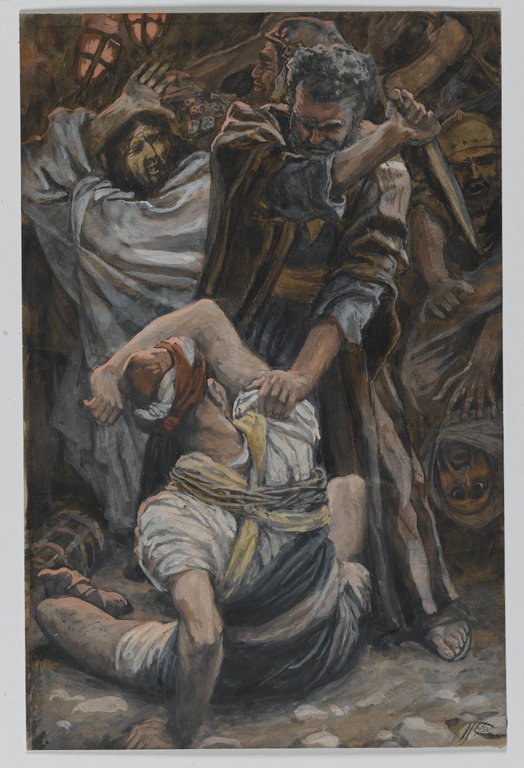
Peter cuts off the ear of Malchus - James Tissot

Peter cuts off the ear of Malchus – James Tissot

Jesus of Nazareth (ca. 30 CE): “Those who take up the sword will die by the sword.” (Matthew 26:52b)

American City Council (2013 CE): Mandatory Gun Ownership Law Passes in Georgia Town

Gun-buying after Newtown massacre (2013): : Customers pack Connecticut gun stores after deal on laws

George Carlin (ca. 2000 CE): “I’m not concerned about all hell breaking loose, but that a PART of hell will break loose… it’ll be much harder to detect.”

Good Friday 2013

Today is Good Friday.

Two pieces enriched the silence today. The first arrived early this morning.

Testimony

In Mark, the earliest account, the name
is given of the man who from the crowd
was forced to lift and carry the crude wood
cross that some carpenter had made the same
day. Simon of Cyrene is named, and then
the names of his two sons–as if they were
still living and could testify that their
father was one of the witnesses when
Jesus was crucified. Women were named
who saw the body buried in the grave,
and later returned to the empty cave
and found the heavy round stone had been rolled
away. Joseph of Arimathea
had given his own family tomb away.

But you are skeptical and full of doubt
that Christ is risen–you should check it out.
See that his followers who ran away
now risk their own lives when they sing and pray.
His students now have students. Many saw
him after death. They live and testify.
His movement grows, and some react with awe
and pass the story on, still testify…

– Steve Shoemaker, Urbana, IL, Good Friday, 2013

The second arrived this afternoon.

Click HERE to read Dr. Matthew Boulton’s Good Friday reflection in the Indianapolis Star. Matthew carries on the story as President of Christian Theological Seminary in Indianapolis, Indiana. Matt is the son of Wayne, my seminary roommate and best friend since 1964. “They live and testify. His movement grows, and some react with awe and pass the story on, still testify…”