2017 in the Cleft of the Rock

This 500th Anniversary of the 16th Century Reformation is also the onset of climate departure. Not just climate change, but climate departure, the tipping point beyond which there is no way back.

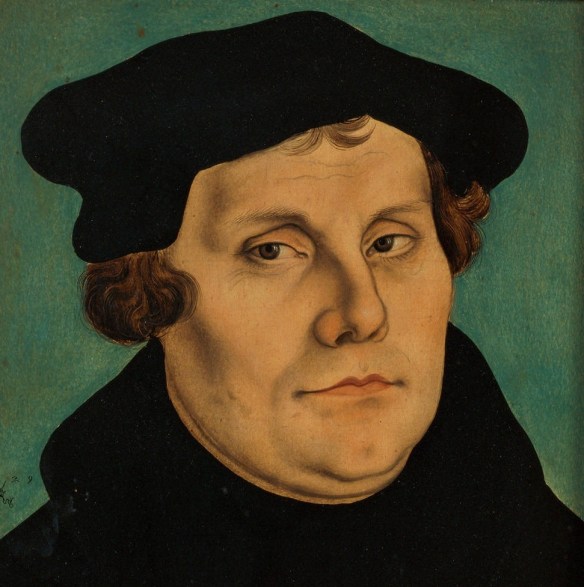
1529MartinLuther

Martin Luther (1483-1546)

Preparing to preach on Reformation Sunday at Central Presbyterian Church in St. Paul leads to reflection on a strange text and several great hymns.

The text (Exodus 33:12-23) pictures Moses in the cleft of the rock with God’s hand covering him while God passes by with the reminder that no mortal can see the face of God and live. The hymns that come to mind are “A Mighty Fortress Is Our God” and “Immortal, Invisible, God Only Wise.”

Perhaps, like Moses in the wilderness, we are in the cleft of the rock — between a rock and a hard place — and more than a little humbled as the Creator of all that is, Being-Itself, passes by while we are in the dark.

This moment of climate departure demands a new reformation, beginning with the recognition that we, homo sapiens, are mammals with the horses, cows, dogs, lions, cheetahs, and elephants — and that our future is imperiled by the gods of greed and prosperity our hearts have manufactured.

“Human nature is, so to speak, a perpetual factory of idols,” wrote the 16th Century Reformer John Calvin.

cd6353be60481a08737fdf1555f0973e--john-calvin-reformed-theology

2017 is a far cry from 1517, but it is, in this respect, the same.

A difference this year is that Martin Luther’s Ein feste Burg — “A Mighty Fortress” — will be sung in Catholic masses as well as protestant celebrations, bearing witness to the reconciling love of God over centuries of time.

Meanwhile the prosperity gospel — based on the idol of property — will go unchallenged in many churches, a departure from the truth that can only be found between a rock and a hard place: this cleft of the rock in 2017 while God passes by.

  • Gordon C. Stewart, Chaska, MN, October 27, 2017.


Elijah: Grandpa, what’s surreal mean?

The_Elephant_Celebes

The Elephant Celebes by Max Ernst. Oil on canvas. 125.4 x 107.9 cm. Tate Gallery, London.

Grandpa, what’s surreal?

Where’d you get that word? You’re only five months old!

I heard it on the news. Some flake from Arizona said it.

1200px-Jeff_Flake_official_Senate_photo_(cropped)

Senator Jeff Flake (R-AZ)

Well, it wasn’t “some flake,” Elijah! It was Senator Jeff Flake, and he’s not a flake. Flakes are like snowflakes. You haven’t seen snowflakes yet but it’s supposed to snow tomorrow. You’ll see. Snowflakes fall from the sky, turn everything white, and then they disappear.

Did Jeff Flake disappear? He’s white. Is he surreal?

No, Elijah, he hasn’t disappeared and he’s not about to disappear.

So…what are you talking about? You’re not making sense, Grandpa!

Well, Jeff Flake was saying what thinking people know: what’s happening in the world right now is surreal.

That’s what I asked you!!! What’s ‘surreal’?

Life is, Elijah! You’re only five months old.  You’ve never known anything but the surreal world. It’s the world that has “the disorienting, hallucinatory quality of dream; unreal; fantastic” (Dictionary.com). Life itself has become surreal.

Grandpa, are elephants real?

Yes, why?

‘Cause Marissa doesn’t’ like elephants. She says they’re mean and out of touch with reality. Are elephants like snowflakes?

No, Elijah. Elephants are real. But some elephants, like the one Marissa is talking about, are . . .  well . . .  surreal and deranged. They want the whole world to be white. They’re snowflakes.

Yeah, but not like Jeff Flake. Jeff Flake’s no flake!

Right, Elijah. He’s like Max Ernst and the Surrealists who exposed the underlying insanity by painting it. Jeff Flake painted it with words.

IMG_1779 E 5 monthsThanks, Grandpa. This whole conversation has been surreal. I love words!

  • Grandpa Gordon, Chaska, MN, Oct. 26, 2017.


Elijah and his sitter’s text

Grandpa, my babysitter was crying today.

IMG_1779 E 5 months

Elijah (five months old)

I’m sorry, Elijah. Why was she crying?

Marissa’s cousin in Puerto Rico sent a text five days ago but Marissa didn’t get it until this morning. She was crying hard, Grandpa! It was really sad.

What did the text say, Elijah?

I thought you’d ask, so I asked Marissa to print it out ’cause you’re old. You don’t text so good.

‘Well’, Elijah, I want you to learn to speak proper English. You should say, “You don’t text so well” — not “you don’t text so good.”

Yeah, well, you say ‘well’ a lot. That’s not good. Well, here’s what Marissa’s text from Puerto Rico said. It’s not good.

Month 2. Day 1.

No power

We have running water

Telecommunications are fair on the best of days. I consider it successful if I can consistently get 2mb down. Today it’s about 0.13mb.

Traffic is insane

Fuel lines are better

Shopping takes hours

We are the lucky ones, the privileged ones. It’s not better, progress is slow, medical care is impossible for many.

We are here. We need your help. Keep pressure on news organizations, on elected officials, and aid organizations. Use your voice for people who have been silenced.

Grandpa! We’re gonna help, right? Are we ‘privileged’?

  • Grandpa Gordon, Chaska, MN, October 24, 2017

“A Soulless Coward”

The President’s lies about former presidents Obama and Bush in reaction to criticism that he had not made presidential calls to the families of four soldiers killed in Niger struck me as just one more example of his unfitness for office.

Then The Nation exclusive interview — “‘A Soulless Coward’: Coach Gregg Popovich Responds to Trump” — popped into my inbox. “[T]o lie about how previous presidents responded to the deaths of soldiers—is as low as it gets. We have a pathological liar in the White House.”

Gregg Popovich, the United States Air Force Academy alumnus and head coach of the San Antonio Spurs, is affectionately called “Pop” but one has to wonder how long the affection will last after calling the president a soulless coward.

The interviewer, Dave Zirin, The Nation‘s sports writer, concludes the article: “Should be one hell of an NBA season.”

  • Gordon C. Stewart, Chaska, MN, October 17, 2017.


Open Letter to NFL Owners

To: Mark and Zygi Wilf, owners, Minnesota Vikings
Cc: NFL Commissioner Roger Goodell

October 17, 2017

Today’s NFL owners meeting is a watershed moment. The agenda item  that would change the NFL’s rules limiting player behavior during the national anthem requires a courage stance informed by history.

As the sons of parents who were survivors of the Holocaust in Nazi occupied Poland, you are in a unique position to lead this discussion as owners of the Minnesota Vikings.

I applaud your initial response to the issue of taking a knee during the national anthem. By linking arms with Vikings management and players, and by your official statement on the matter, you supported players’ First Amendment right to free speech. You refused to buckle to the White House demagoguery that confuses taking a knee on behalf of racial justice with disrespect for the country.

I was pleased that you and the NFL stood up for a bedrock American principle. Principle trumped profits . . . momentarily. Now filling pockets threatens to empty the initial commitment to the U.S. Constitution.

If the NFL owners today accede to the president’s bullying, I, for one, will take a knee. I will turn off the television Sundays, Mondays, and Thursdays . . . as a matter of principle . . . and will invite everyone I know to do the same. Some things are more important than football. They learned that in Germany. I thought we had, too.

Perish the thought, but . . . if the national anthem pre-game ritual requires the equivalent of a “Sieg Heil!” salute that abrogates the right to free speech, maybe it’s time to end the pre-game ritual and just play football.

I hope and pray this morning that our Jewish friends lead the way today to honor the dead from the history we dare not forget and to stand up for the principle of First Amendment rights to freedom of speech.

And, while you have the floor, I hope you will bring to the league’s attention the duplicity of having defended the league against the president’s criticism of taking the knee while, at the same time, the owners appear to collude to exclude the original kneeler, Colin Kaeppernick, from taking the practice field.

Sincerely,

Gordon C. Stewart
Chaska, Minnesota

Neighborly Economics

Mindfulness —the latest topic around the water coolers — helps in times like these. While some use Yoga or some other eastern meditation to become more mindful, my practice is to contemplate the poetry of the Book of Psalms. I open Psalm 146 in hopes of putting my anxious soul at ease from this moment of history.

Praise the LORD, O my soul,
I will praise the LORD as long as I live;
I will sing praises to my God as long as I have my being.

Put not your trust in rulers, nor in any child of earth,
for there is no help in them.

When they breathe their last, they return to the earth,
and in that day their thoughts perish. (Ps. 146:1-3)

The psalmist assures me that this moment will not last forever. The elevation of the rich and the assault on the poor, the game of matches lit near the fuses of nuclear devices on two sides of a vast ocean, the name calling between the two narcissists whose Echoes sound the same despite the differences in language, the scenes from Puerto Rico in the aftermath of Maria, the burned-out forests, homes, and vineyards in northern California, the undermining of the hope for universal health care, and the disregard for the Paris Accord addressing climate change have ground me down. There is no help in the White House or Capitol Hill. But, their time, the psalmist declares, is but a breath, a moment. Their thoughts will perish.

IMG_8484

cabin by the wetland

In the solace of the cabin by the wetland far from the news, I am breathing easier. Away from the rulers in whom the psalm urges me to place no trust, my mind is calmer. I am in need of no great thing.

But, after lighting the fire in the wood stove, it dawns on me that we’ve forgotten some supplies for the weekend. We have no bread. Or ice cream!

I remember a sign for “DON & DAVE’S: Groceries and Gas — 4 Miles.”

IMG_8514Don & Dave’s is a throw-back to the day Don founded it 70 years ago. From the looks of the exterior, although it is well-kept, I imagine little except for the “ATM Inside” sign has changed since 1947.

“You must be Don or Dave,” I say to the man inside. “I’m Dave,” he says with a smile. I’m Don’s son.” Dave is in his late ‘60s. Don was his father, killed in a car accident years ago. Dave joined his father in the business in 1977. I introduce myself as the owner of the A-frame by the wetland, but he already knows from Shirley, our only neighbor within a quarter of a mile of the cabin.

I take a look around the store, pick up a $1.59 loaf of locally made wheat bread, notice the ice cream freezer, pick up a large tub of Neopolitan ice cream, notice a Hershey milk chocolate with almonds bar, and take them to the check-out counter where Don meets me.

I take out my credit card. “We don’t take plastic,” says Don. “Just cash or check.” I tell him I don’t have either. “Well, we have an ATM,” he says. “I don’t do ATM’s,” I say. You need a PIN for that. I have no idea what the PIN is; Kay does that. I don’t have a clue.” He laughs and invites me to take the bread, ice cream, and Hershey bar without paying. “No problem. Please take it. You can pay me when you come back.”

He takes out a slip of scrap paper, writes down my name, the amount I owe, and the date, and wishes me a good weekend.

Four hours later I return with the cash just before 6:00 P.M., hoping Don and Dave’s is still open on a Saturday night. Turns out they open at 8:00 A.M. and closes at 10:00 P.M. seven day a week! I learn from the young woman who greets me that Don has left for the day, and explain that I’m here to pay my bill. She asks my name, and fetches the piece of paper from a shelf below the cash register. “What should I do with this? Tear it up?”

“No,” I say, “I want Don to know I came back and I want to say thanks. Just write ‘paid’ with today’s date and let me add a word of thanks.”

I had learned earlier from Don that there are four Walmarts with a 60 mile radius of Don & Dave’s. I wonder when the last time was Walmart sent an empty-handed customer away with so much as a loaf of bread, a tub of ice cream, and a candy bar.

I’m very mindful. In the moment. 1947 never looked better!

Values Worth Fighting For

John Buchanan’s “Values Worth Fighting For” articulates clearly so much of what my seminary classmates and I are thinking and feeling as we prepare for the 500th Anniversary of the Reformation in the midst of the era of Donald Trump.

Family of John M. Buchanan's avatarHold to the Good

Churches across the globe, Protestant but also Roman Catholic, will mark the 500th anniversary of the Reformation later this month. On October 31, 1517, Martin Luther, an Augustinian monk and theology professor, nailed 95 Theses to the door of the Castle Church in Wittenberg, Germany. The church door served as the community bulletin board and Luther’s Theses – or propositions- were in the form of an invitation to debate. There has always been some uncertainty about whether Luther actually nailed the document to the church door. What is not uncertain is the effect they had. The 95 Theses had to do with traditional church doctrine and practice that, in Luther’s mind, needed to be reexamined and reformed. The result was the Reformation, in Marilynne Robinson’s words, “a movement that touched or transformed thought and culture across the breadth of empire.” (The Givenness of Things, p.17). Before it was over…

View original post 1,036 more words

Between Here and There

A CNN report caught my attention this morning. Anticipating today’s Congressional vote on the president’s $36.5 billion disaster relief aid package, Rep. Tom Cole, R-Oklahoma, said the following.

“People want to be helpful here. They’ve turned on the television. They know these are awfully genuine needs,” he said, arguing that Republicans simply want to fund the measure in a “prudent” way.

Early this morning the president took to twitter with a series of tweets about Puerto Rico.

“Puerto Rico survived the Hurricanes, now a financial crisis looms largely of their own making.” says Sharyl Attkisson. A total lack of…..

..accountability say the Governor. Electric and all infrastructure was disaster before hurricanes. Congress to decide how much to spend….

We cannot keep FEMA, the Military & the First Responders, who have been amazing (under the most difficult circumstances) in P.R. forever!

Rep. Cole spoke truth that “people want to be helpful here. They’ve turned on the television. We  “know these are awfully genuine needs….” But the “here” is a question. Where is “here“? Is “here” Houston, northern California, Puerto Rico? All of them? Or only some of them?

Or is “here” Congress and the Oval Office, the seats of authority and power in a constitutional republic — the branches of government where the television-watching American public hopes against hope that those we elect to represent us get their information from something other than their televisions.

The Commonwealth of Puerto Rico, unlike Houston and the wine country of northern California, is poor. Its history is that of a pawn in the chess game of powerful nations.

The Smithsonian website article “Puerto Rico — History and Heritage” — offers a brief history of Puerto Rico.

Puerto Rico remained an overseas province of Spain until the Spanish-American war, when U.S. forces invaded the island with a landing at Guánica. Under the Treaty of Paris of 1898, Spain ceded Puerto Rico (along with Cuba, the Philippines and Guam) to the U.S.

As a result, the turn of the century saw Puerto Rico under United States sovereignty. At that time, Puerto Rico’s economy relied on its sugar crop, but by the middle of the century, an ambitious industrialization effort, called Operation Bootstrap, was underway. Cheap labor and attractive tax laws attracted American companies, and soon the Puerto Rican economy was firmly grounded in manufacturing and tourism. Today, Puerto Rico is a leading tourist destination and manufacturing center; the island produces high-tech equipment and many top-selling American pharmaceuticals.

Puerto Ricans received U.S. citizenship in 1917 and Puerto Rico officially became a U.S. Commonwealth in 1952. The issue of political status is one under constant debate, with some in favor statehood, others independence, and still others the continuation of commonwealth status.

During World War II, the U.S. Navy purchased two thirds of the island to use as a naval base. The Navy used the area for military exercises and bombing practice for nearly 60 years until a civilian was killed during a bombing exercise in the 1990s. This sparked a wave of protests that finally ended when the base closed in 2003. Since then, the Navy’s lands have become wildlife reserves.

Today Congress faces a moral issue that begins with the question of where “here” is and with a couple of early morning tweets that divide the world between here and there, and want to leave “there” behind, ignoring the wisdom of The Letter of James:

If anyone thinks he is religious and does not bridle his tongue but deceives his heart, this person’s religion is worthless. Religion that is pure and undefiled before God the Father is this: to visit orphans and widows in their affliction, and to keep oneself unstained from the world” [i.e., the world divided by here and there; us and them; rich and poor]. – James 1:26-27.

  • Gordon C. Stewart, Chaska, MN, October 12, 2017.


Liddle Elijah and Bumpa (Grandpa)

Bumpa, we’re supposed to respect people, right?

IMG_8373

Elijah asks about the president and senator corker

Yes, Elijah, that’s part of growing up.

Yeah, I’m not growed up yet. I’m liddle.

Well, yes, but it’s “grown” up, and you spell ‘little’ with two ‘t’s not two ‘d’s.

That’s not how the president spells it. Who am I supposed to respect more, you or the president?

Hmm. When it comes to spelling and not calling people names, I think Grandpa may deserve a little more respect. That’s just Grandpa’s opinion. But the president called Senator Bob Corker ‘liddle’ and meant it as an insult. Senator Corker is short; he’s little compared to the President. But a person’s physical stature shouldn’t matter to grown-ups. Do you understand?

And what about that IQ thing?  What’s an IQ?

Lots of people are asking that question these days.

Is having a higher IQ like being taller? I’m tall. Dr. Smith said I’m in the top 94 percentile of four-month-olds! What’s a percentile?

It’s a way of measuring, Elijah. It’s complicated. It’s just a statistic. But it gives me comfort that the percentage of people approving of the president seems to have become littler in all 50 states between last January and September.

We like little. Right Bumpa?

We do, Elijah. Sometimes we do.

“I look to a day when people will not be judged by [how tall they are]], but by the content of their character.” — Rev. Dr. Martin Luther King, Jr.

  • Grandpa Gordon, Chaska, MN, October 11, 2017.

The Planet and Puerto Rico: Unincorporated Territories

Much of Puerto Rico is still without power. But it may be that Puerto Rico will lead the way for the U.S. mainland by developing a renewable energy power grid that replaces its dependence on fossil fuels.

2120x1192-kiuc-powerpack-high-e1498010513769.png

While Elon Musk of Tesla proposes building a new renewable energy power grid to replace the destroyed carbon-producing fossil fuel-dependent grid, the Trump administration is shoring up the fossil fuel grid back on the U.S. mainland.

The Environmental Protection Agency administrator, Scott Pruitt, on Monday said he would sign a proposed rule Tuesday rescinding Obama’s Clean Power Plan, established in 2015 to reduce carbon-dioxide emissions.

Pruitt spoke at an event with Senate Majority Leader Mitch McConnell in Hazard, Kentucky — coal country.

“Here’s the president’s message: The war on coal is over,” Pruitt said. “Regulatory power should not be used by any regulatory body to pick winners and losers.” – Yahoo Finance, Oct. 9, 2017

Coal and oil are shipped at great expense to Puerto Rico from the mines of Hazard, Kentucky and the oil refineries of Houston. Puerto Rico, an unincorporated third world U.S. Territory, has been the loser. So have the people of Hazard who’ve been led to believe that winning the the war on coal will secure their future.

In the world of climate departure — not just climate change, but departure with no way back to what we considered normal — we’re all losers when the departure is denied.

elon-musk-rossello-400x240

Governor Ricardo Rosselló and Elon Musk

The sun, on the other hand, is indigenous to Puerto Rico.

Could it be that a poor unincorporated Territory in the dark without power would lead the world by building a new grid lit by a source that shines without discrimination on winners and losers in Puerto Rico and in Hazard?

Perhaps, if the Governor of Puerto Rico comes to an agreement with the Elon Musk and the Tesla Corporation, the light may yet go on across the world that the planet itself is an unincorporated territory.

  • Gordon C. Stewart, Chaska, MN, October 10, 2017.