
Father and Son – the Pasternaks

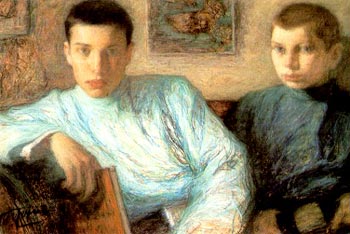
Leonid Pasternak painting of his sons Boris and Alex

Leonid Pasternak painting of his sons Boris and Alex

Thinking about father – son relationships led me to the Pasternaks, starting with the son, Boris.  Boris is seated to the left in this painting, done by his father. One wonders whether Boris and Alex were as angry as the father has painted them, or whether the father only imagined them to be resentful about sitting for the portrait. Father-son relationships are often hard to figure out. They’re about perceptions.

The name Boris Leonidovich Pasternak (1890-1960), the Nobel Laureate who declined the award in 1958, is etched in the annals of Russian literature.

So is the name of his father, Leonid (1865-1945), the revered Russian painter and illustrator, friend of Rainer Maria Rilke and Leo Tolstoy, among others. Leonid’s drawings illustrated Tolstoy’s War and Peace and Resurrection.  

Can you see the father in the sons, and the sons in the father who painted them?

Photo of Leonid Pasternak, Russian painter.

Photo of Leonid Pasternak, Russian painter.

Why, then, would the sons’ father leave them behind?

In 1921 when Leonid Pasternak left Russia for eye surgery in Berlin, he took his wife and two daughters, Lydia and Josephine, leaving Boris and Alex behind in Russia. He never returned. He, his wife, and the girls remained in Berlin until 1938 when he fled from the Nazis to England. The sons remained in Russia.

According to the Pasternak Trust, “Leonid Pasternak was the friend and illustrator of Tolstoy.
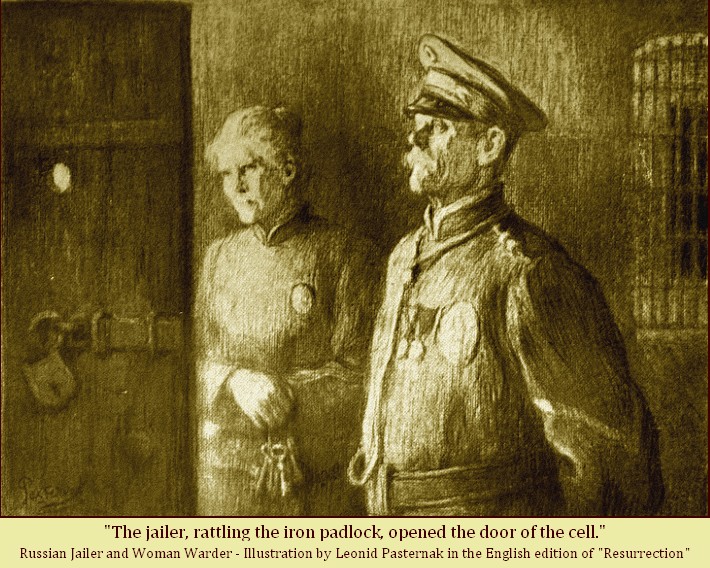
Leonid Pasternak illustration in Tolstoy's Resurrection.

Leonid Pasternak illustration in Tolstoy’s Resurrection.

His portraits include studies from life of writers (Tolstoy, Gorky, Rilke, Remizov, Hauptmann); musicians in performance (Scriabin, Chaliapin, Busoni, Rachmaninov); other distinguished contemporaries including Einstein, Hoffman, Gordon Craig and Lenin.

“Sketches of family scenes – his wife at the piano, and their four children reading and playing – are among his most intimate and charming works. His landscapes stretch from the Black Sea to the Bavarian Alps and Palestine.” – Excerpt from The Pasternak Trust.

Although Leonid never returned to Russia, it was his brush that painted Boris into life as a painter whose brush was words, and one can imagine it was his mother’s music that lulled him to sleep even as an adult His mother was a concert pianist.

“‘What is history?” wrote Boris in Doctor Zhivago.

“Its beginning is that of the centuries of systematic work devoted to the solution of the enigma of death, so that death itself may eventually be overcome. That is why people write symphonies, and why they discover mathematical infinity and electromagnetic waves.”


Boris Pasternak, Doctor Zhivago (English translation by Nikolay Nicholayevich, 1957), Chapter 1, Section 5.
On the Ship and on the Train

I was 18 months old when my father shipped out for Saipan in the Mariana Islands of the South Pacific in WW II.

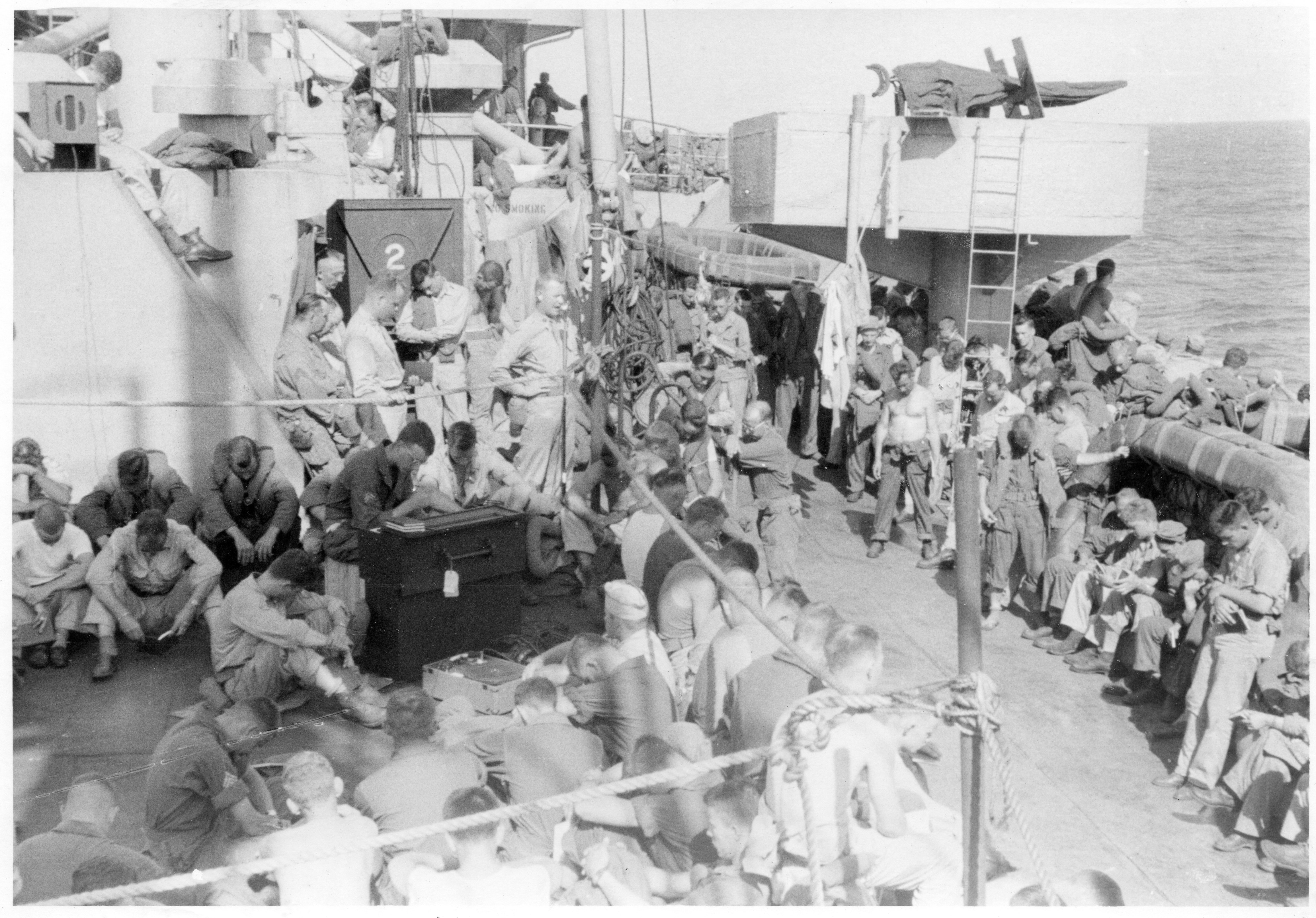
My father, the Chaplain, on board ship to Saipan, WW!!.

My father, the Chaplain, leading worship on board ship to Saipan, WW!!.

I don’t remember the ship. But I remember the emotional wake its departure left behind: the memory of my mother crying on a train. The sounds of the clicketty-clack of the wheels rolling down the track and the whistle blowing like a lost child in the night still plunge me into existential loneliness.

Late in her life, I shared with my mother the memory or her crying on the train.

Because I was so young when it happened, she was surprised that I remembered it, She confirmed it in great detail.

Dad felt “a call” to stand with the brave men who were risking their lives in the war against fascism and imperialism. With my mother’s blessing, he resigned his pastorate in Mechanicsburg, PA to enlist as an Army Air Force Chaplain. After six-months in the States, he left my mother and me behind.

While he was preaching on board ship, my mother and I were on a train from Los Angeles, his point of departure, to Boston, the home of my paternal grandparents.

I never saw the photo or thought of him aboard ship until a phone call and subsequent picture arrived by email from a researcher of my father’s unit on Saipan last month.  Dad was tending his “flock” on board ship. I never knew. Some things, like wine, take time.

Not everything is as it seems or feels. We do the best we can and pray it’s good enough.

The Reign of Christ

I’ve often wondered
why he included
me

in parables of goat
and sheep, of tare and
wheat

of a woman on a floor
to find her one
lost coin

of a manly crowd
with stones to throw at
“her”

of ramming rams and
bleating ewes and one
little lamb

of pride and loathing
of specks and logs in
eyes

of sight and light
of day and sleepless
nights

of father running to
greet his son from
empty sty

of water and wine
and miracles that healed
the sick and

called forth Lazarus
from the tomb, unwrapping
him and me

– GCS, Nov. 24, 2014 – early Monday morning the day following Christ the King (Reign of Christ) Sunday.

Sheep and Goats

Being without a pulpit doesn’t stop the yearning for study and communication. Today Dean Seal stood for the first time in the pulpit where I once stood. I rejoice with Dean and the dear people of Shepherd of the Hill as they begin this new ministry together.

But I also sense the loss of the community that has been Kay and my home for the past eight and a half years. So I do what I have always done. I look at the texts for the day, ponder their meaning, and write about them.

The Hebrew Bible text for today – the last Sunday in the Christian liturgical calendar, “the Reign of Christ” Sunday – is from Ezekiel 34. It reads, in part:

I myself  [i.e. God] will be the shepherd of my sheep, and I will make them lie down, says the Lord GOD.

I will seek the lost, and I will bring back the strayed, and I will bind up the injured, and I will strengthen the weak, but the fat and the strong I will destroy. I will feed them with justice.

Therefore, thus says the Lord GOD to them: I myself will judge between the fat sheep and the lean sheep.

Because you pushed with flank and shoulder, and butted at all the weak animals with your horns until you scattered them far and wide,

I will save my flock, and they shall no longer be ravaged; and I will judge between sheep and sheep.


– Ezekiel 34:15-22

Ezekiel is spoken to the exiles, the aliens in a strange land – you might call them “immigrants” or “exiles” or “refugees”. Or “undocumented workers” who labor for peanuts without the protection of the law.

Ezekiel’s 34th chapter looks to David, the leader of the nation, to be God’s agent to rescue them. Or maybe, in our time, a distant relative named Barack.

During the time I worked outside the church at the Legal Rights Center in Minneapolis, a group of undocumented workers came to the Center. The Hispanic/Latino Community Advocate had identified their need and had convinced them that the LRC was a safe place to bring their case.

Six Mexican “employees” of a cleaning service that sub-contracted for janitorial services at the Mall of America in Bloomington, Minnesota had not received their wages for the past six weeks. The company knew their workers had no recourse. The law was against them; deportation was always one step away. The employer was confident in its privileged position. Those who withheld their wages had not yet read Ezekiel’s proclamation: “I will seek the lost, and I will bring back the strayed, and I will bind up the injured, and I will strengthen the weak, but the fat and the strong I will destroy. I will feed them with justice.”

It took one phone call to the employer to get these men the wages they and their families had been wrongfully denied.

Let those who oppose Immigration reform legislation in the United States of America read Ezekiel, or sit in on the conversation at the Legal Rights Center. Then let them think again about President Obama’s compassionate speech on immigration policy reform and pass the bipartisan bill languishing the House of Representatives.


The Distant Murmurs of Prayer

“In our imaginations, we listen for the distant murmurs of prayer,” wrote Dennis Aubrey in his post “In Seclusio at Thines” posted on Via Lucis Photography.

Listening for the distant murmurs immediately brought to mind a hymn composed by Anne Quigley in 1992. The tune is LONGING. The textual refrain is:

“There is a longing in our hearts, O Lord, for you to reveal yourself to us. There is a longing in our hearts for love we only find in you, O God.”

It was the recollection of the text that drew me to LONGING. I searched YouTube for possible videos for this post but found that the lightness of the tune, like so much contemporary Christian music, left me longing for “the distant murmur of prayers” that echo down the ages in the Gregorian Chants once sung in the now empty or mostly empty monasteries and churches that inspired Dennis to conclude “In Seclusio in Thines”:

“[PJ and I] … hear the echoes of sandaled footsteps in lonely churches long deprived of their monastic communities. And in our imaginations, we listen for the distant murmurs of prayer.”

I long for gravitas awakened by the beauty of silence.

Two Presidents – November 22, 2014

Today is the anniversary of the assassination of President John Fitzgerald Kennedy (JFK), 35th President of the United States of America.

Who killed JFK remains a question for the ages. Someday, perhaps, we will learn the truth of why and by whom he died, but for now the story must be told again, remembered for what it was and for what might have been.

Some things are,
or, so it seems,
“not meant
to be”

Things like
Jack and us
that almost
were

Yet some things,
I repose,
never fade
or die away

Some things not
“meant to be”
like Jack and me,
live on

As things that are,
I surmise,
not meant
to die

For love is not
a thing,
an object that
can die

It hangs around,
like time,
in spaces all
its own

– GCS, Nov. 22, 2014


It must be remembered and mourned afresh today when hatred for his successor runs rampant and “lapses” in White House security inexplicably abound. One theory of President Kennedy’s assassination includes not only a rogue element of the CIA but also the Secret Service, charged to protect the President. Prayers are in order for the President who stood tall this week in his speech on immigration reform.

For our President, Barack, for the leaders of the nations, and for all in authority, let us pray to the Lord. Lord have mercy.

For the poor and the oppressed, for the unemployed and the destitute, for prisoners and captives, and for all who remember and care for them, let us pray to the Lord. Lord have mercy.

Defend us, deliver us, and in Thy compassion protect us, O Lord, by Thy grace. Lord have mercy.

[Excerpts from The Book of Common Prayer, Form I, 1979 Pew Edition, page 384.]

Verse – How and Why?

Some say “God has a
plan for you.” But I say,
“There is no plan. There is
no meaning we find;
only the meaning we make.”

But how do 12 Bald Eagles circle
overhead during simultaneous
memorial services for the slain
children of Red Lake – six over
Red Lake; six over Saint Paul?

Why does the Egret wading in
the pond suddenly stop its fishing
and fly across to the window on
the other side where a mother
grieves her daughter’s death?

Are you and I the only makers
of meaning or is there Another
outside or inside of nature,
a Meaning-Maker inside, between
and among everything that is?

– Gordon C. Stewart, November 22, 2014


The President’s Speech

President Obama rang the bell last night in his speech on immigration. The President is a Constitutional lawyer. He is also a man of faith, a thoughtful Christian who interprets the Bible the way Abraham Lincoln did, and, like Lincoln before him, the President preached to a divided nation from the White House.

He used the bully pulpit to stop the bullying.

“Scripture tells us, we shall not oppress a stranger, for we know the heart of a stranger — we were strangers once, too. My fellow Americans, we are and always will be a nation of immigrants. We were strangers once, too.”

This morning Speaker of the House John Boehner, who for the past year-and-a-half has personally blocked a vote in the House on the bipartisan Senate immigration reform bill, filed a lawsuit, alleging the President has exceeded his authority. Mr. Boehner and others also threaten impeachment.

Very few of us understand the Constitutional separation of powers well enough to assess knowledgeably whether the President has or has not exceeded his executive authority, but given similar actions by every recent President, both Democrat and Republican, the Las Vegas odds-makers would surely lay heavy odds in favor of the Constitutional lawyer in the White House.

Catholic, Protestant, Jewish, Muslim and secular humanist leaders have led the fight for immigration reform for many years. They have commended the President’s actions and have renewed the call for Congress to pass bipartisan reform.

Because they’re not bomb-throwing religious extremists, there likely will be little media coverage of these religious leaders support for the President’s speech and actions. Like Mr. Obama, their faith, and the faith of the people and congregations they represent, are thoughtful and fairly quiet in demeanor. They don’t make headlines. But once in a while, one of gets to preach from the White House.

In the habit of some preachers who invite response from the pews following prayers or a sermon, “Let all the people say ‘Amen!’

Idealism and Terror

When one thinks of idealism, Martin Luther King, Jr. or Gandhi comes to mind. Moral and spiritual giants who stand for ideals that make the world a better place. We think of Idealism as good in the face of evil, or of ideals lifting us up from the dirt of reality, purifying life from its toxins. Ah, but there lies the fatal flaw in idealism itself.

George Will’s Washington Post opinion piece “A Murderer’s Warped Idealism” looks afresh at idealism and evil, not just evil masquerading as idealism, but idealism as a source and form of evil itself.

Will’s commentary zooms in on Adolf Eichmann, executed at midnight 1961 for his role in the German State’s systematic extermination of 6,000,000 Jews. During the trial in Jerusalem Eichmann minimized his role in the Holocaust, presenting himself as a thoughtless functionary carrying out the orders of his superiors.

Referring to newly discovered writings by Eichmann which form the backbone of a new book by German philosopher Bettina Stangneth, Will writes:

Before he donned his miniaturizing mask in Jerusalem, Eichmann proclaimed that he did what he did in the service of idealism. This supposedly “thoughtless” man’s devotion to ideas was such that, Stangneth says, he “was still composing his last lines when they came to take him to the gallows.” (Bolding added by Views from the Edge)

Eichmann and Hitler were not without ideas or ideals. They were not thoughtless. Nor were they irrational, as those who believe that reason can sea us believe. They were idealists who sought to lift up a super race, burning away the world’s impurities as their deranged hearts conceived of them.

The late Dom Sebastian Moore, O.S.B. shone a different light on idealism and the remedy for human madness. He put it this way in The Crucified Jesus Is No Stranger:

“We have to think of a God closer to our evil than we ever dare to be. We have to think of [God] not as standing at the end of the we way take when we run away from our evil in the search for good, but as taking hold of us in our evil, at the sore point which the whole idealistic thrust of man is concerned to avoid.”

We are, says Moore, “conscious animals scared of our animality and seeking to ennoble ourselves.”

Eichmann, Himmler, and Hitler were idealists. Nationalist extremists are idealists. Racial and religious extremists are idealists. ISIL is idealist. American exceptionalism is idealist. Whether behind the banner of the State, or of religion, gender, ideology, scientism, or rationalism – idealistic terrorism lives to rid the world of evil as its adherents understand it, projecting evil as “the other” while fleeing “the sore point” that we conscious animals seek to avoid.

Only the God who meets us at the sore point of our shared animality can save us from fantasies. In his last book, Remembered Bliss ((Lapwing Publications: 2014), Dom Sebastian told the reader, “I’m ninety-six, and for most of my life I’ve been a monk. My life as a monk has been, for the most part, the search for God as real.” RIP.


Verse – Invitations

Invitations once came in the post,
Now emails & voicemails are lost
Amid FaceBook & Twitter,
In Texts & e-clutter:
I can’t RSVP the host!

– Steve Shoemaker, Urbana, IL, Nov. 20, 2014