Jesus in the Hospital

Jesus is in the hospital.

I had one of those nocturnal throw-back dreams retired people sometimes have.

It’s a Sunday morning. I’m the Senior Minister just returned from being out-of-town. The other ministerial staff and I are robing for worship. Though I’m the preacher for the morning, I am totally unprepared.  In addition, I remember that we are scheduled to receive new members from the new members class during worship. I ask Byron (a wonderful former colleague who shows up in the dream) for an update. He is clueless. He fears the members of the class haven’t been notified. Perhaps no one will be joining, though the reception of new members is clearly listed as part of the morning Order of Worship. We wonder how to handle an embarrassing situation.

Then Byron says, “Oh…and I just learned Jesus is in the hospital.”

“Which hospital?”

“I think it’s Star,” he says.

“What’s Star? I’ve never heard of it.”

“Oh,” says Byron, “it’s a private wing of Christ Hospital for public figures concerned about their privacy.”

“When was he admitted, and why? What’s the diagnosis?

“I don’t know; I just learned of it a moment ago from John (the custodian).”

“Well… what should we do?  The congregation’ll be shocked, but we should announce it. We should remember Jesus in the Prayers of Church, don’t you think?”

The idea of Jesus being in the hospital didn’t strike me as that strange in the dream, but it did pose its own kind of curious scenario. I’d never imagined Jesus sick. I wonder if Jesus was ever in the hospital? There was something strangely comforting about the thought of Jesus in the hospital, one of the flock for whom  we could pray.

Dreams, they say, are ways the subconscious works on things the conscious mind dares not address. What if Jesus had died in the hospital?

– Gordon C. Stewart, Chaska, MN, April 20, 2015.

The Punishment and Rescue of the Talkative

You’re reading a blog post. Blogging is talking. Sometimes it’s downright t-a-l-k-a-t-i-v-e. Chatty. Pointless. Silence is to be preferred to word pollution.

Two photographs in The Wood of Our Lady, Dennis Aubrey’s Via Lucis post, give reason to talk about talkativeness. Open the link and scroll down near the bottom to see two capitals: 1) two figures with their heads in their hands, weeping, and 2) what Dennis calls “The Punishment of the Talkative”.

The weeping figures of 12th century Église Notre-Dame-de-la-Nativité strike a chord of familiarity.  How many times a day does the news cause us to put our head in our hands in despair? But “the punishment of the talkative” capital evokes no such sympathy. It strikes us moderns as barbaric, the art of a Christian first-cousin of ISIL with grotesque figures excising the tongue of the talkative. Yet it served to remind the worshipers in the 12th century, as it still does in its startling way, that talkativeness is no virtue. Words are sacred. Dennis Aubrey puts it this way:

Perhaps the most famous capital represents the punishment of the talkative, presumably by excising the tongue with tongs. I don’t know if this condemns lying, calumny, or verbal abuse, or if it is a more generalized censure of chattiness or language in general. While this punishment somehow seems fitting for the slanderers who fill our public lives, I would prefer these thoughts of Voltaire, … les anges m’ont tué par leur silence. Le silence est le just chatiment des bavard. Je meurs, je suis mort. “The angels have killed me with their silence. Silence is the just punishment for the talkative. I’m dying. I’m dead.”

It was poet Kahlil Gibran, author of The Prophet, whose first published book (1918) was titled The Madman, who used words to say, “I have learned silence from the talkative, tolerative from the intolerant, and kindness from the unkind; yet strange, I am ungrateful to those teachers.”

Thank you, Dennis Aubrey and P.J. McKey for bringing the teachers to light.

– Gordon C. Stewart, Chaska, MN, April 20, 2015.

The Race to the White House 2016

Ted Cruz, Ron Paul, Marco Rubio, and Hillary Clinton are taking their places in the starting gates for the horse race to the White House in 2016. Smiles and frowns all around, emails asking “Are you IN?“with a request for money from the partisan Yea-Sayers and Nay-Sayers. But the fact is that every horse they ride – conservative and liberal – is owned by Wall Street.

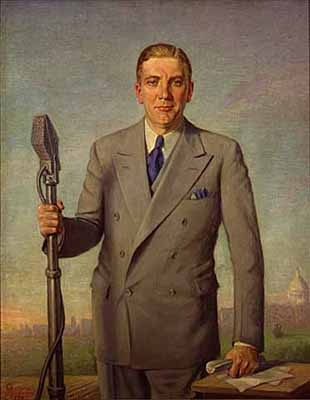
Painting of Governor Floyd B. Olson

Painting of Governor Floyd B. Olson

I’m not “IN” until a candidate rides a different horse into the starting gate. Until someone acts and sounds like Floyd B. Olson.

Click What would Floyd B. do? to find a candidate who puts them all the declared candidates to shame.

Floyd B. Olson was neither a Democrat nor a Republican. He was the first third party candidate elected Governor of Minnesota as the candidate of the progressive Farmer-Labor Party. Years later the Farmer-Labor Party joined with the Democratic Party to form the Democratic Farm-Labor Party (DFL).

I am not a liberal. I am what I want to be — a radical,” said Governor Olson to the 1934 Farmer-Labor party convention. A radical is not an ideologue. It’s a person who insists on going to the root of things. Olson was the nemesis of Wall Street, a champion of the people.

The Farmer-Labor party, a loose and, at times, tenuous coalition of farmers, workers, socialists, isolationists and progressives, coalesced around the idea that working together they would bring about a fairer distribution of income for themselves and increase social justice for the larger society. – Russell Fridley, Minnesota Law & Politics.

If and when someone like Floyd B. Olson rides a different horse into the starting gate for the 2016 White House horse race, I’ll be IN with both feet.  Until then, I’m not IN.

– Gordon C. Stewart, Chaska, MN, April 18, 2015.

Verse – House Concert

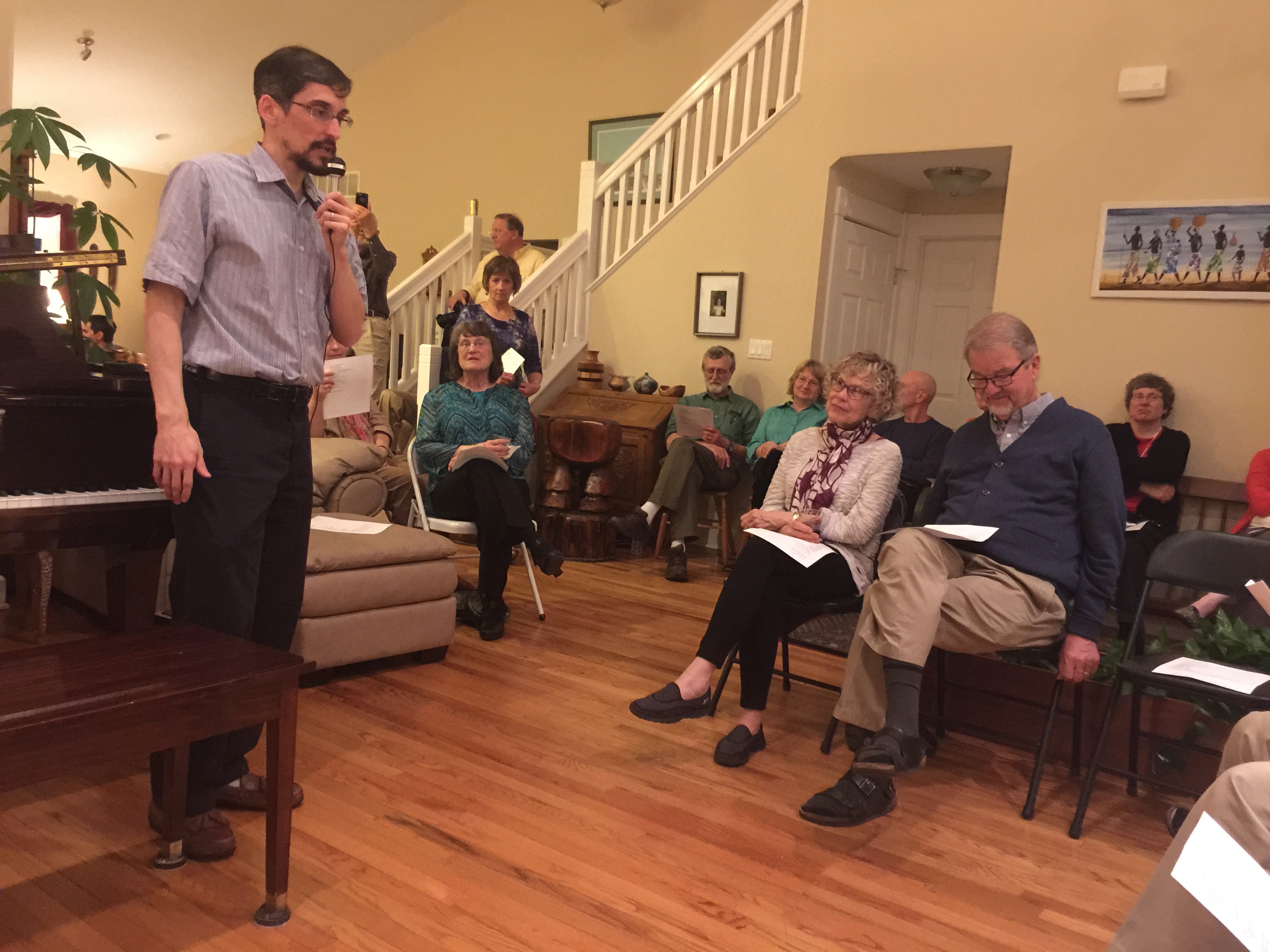
House concert(April 17, Michael Hammer
piano)

so many keys played carefully
one at a time or recklessly
in clumps in chords in runs in scales
hands bouncing fingers waggling trills
yet knowing each composer’s need
for a performer’s sloth or speed
for piano or fortissimo
to Hammer or to gently go

– Steve Shoemaker, Urbana, IL, April 18, 2015

Liberation Limerick

It’s sexist, demeaning, though hard to explain
That a positive adjective can be a pain:
The papers we scan
Don’t say Jane’s handsome man,
It’s always Joe Blow and his lovely wife, Jane.

– Steve Shoemaker, Urbana, IL, April 16, 2015

Verse – Annals of Aging, No. 14

On Snoring

I wake and my lips are all chapped,
My sinuses completely stopped.
Breath through my nose is what’s missing.
My biggest regret: no kissing.

– Steve Shoemaker, Urbana, IL, April 15, 2015

Verse – A Cliche Expanded

What I believe
and state firmly
does not matter
nearly as much
as my actions
in revealing my
character.

Who I am
can be seen:
much more clearly
by observers
than learned by
hearers or readers
of my words,
so carefully chosen.

– Steve Shoemaker, Urbana, IL, April 12, 2015

Verse – Buzzkill

Buzzkill

Five in a line in our family
(all of them females, of course),
have the name Bee in the middle
(between their last and their first.)

Half of the bees in our country
died over winter last year.
One out of three of our foodstuffs
need bees or will disappear.

Einstein may not be who said it
(no one has proved it was he),
that we will die, yes, each family
within two years of the bee.

We need more prairies and fruit trees,
(that are not sprayed from above.)
Honey from new hives can happen:
we need to give bees our love.

[written in 9 minutes early this morning after hearing a PechaKucha 20-slides-each-20 seconds talk last night by Urbana, Illinois, beekeeper Maggie Wachter at a Sola Gratia Farm dinner.]

– Steve Shoemaker, Urbana, IL, April 12, 2015

“Minnesota Nice” and Better – John Skogmo

Minnesotans are known for Minnesota Nice, a phrase that describes Minnesota’s Scandinavian culture of civility. Sometimes Minnesota Mean lies just below the surface. Other times civility and gentleness pervade a person’s character. John Skogmo was Minnesota Nice at its best. There was no meanness in him.

Minnesotans also don’t like fanfare. That Minneapolis is called “the little apple” refers not only to the city’s size compared to “the Big Apple” but also to Minnesotan’s disdain for big splashes, big stages, and floodlights. ‘Ego’ and ‘Minnesotan’ belong together in the Thesaurus as antonyms.

Working back stage behind-the-scenes is what Minnesotans are about at their best.  John Skogmo’s obituary, laced with subtle humor, is a great tribute. John was a man without guile; his faith was the foundation of the quiet stature universally recognized by his family, friends, church, and work colleagues.

Obituary, published April 12, 2015 [highlights added by VFTE]

John Gunderson Skogmo died April 4, 2015 of cancer. Born in Fergus Falls, MN, July 15, 1947, to James Bertram and Joyce Shirley Skogmo.

John found his calling at age nine, reading his father’s issues of Kiplinger’s financial magazine. He became fascinated with compounding interest and saw the benefits of delayed gratification. As a teenager he ran a concession that sold popcorn, cotton candy, and caramel apples at local events. At the end of the day he laundered money-at the kitchen sink, to get the sugar and grease off his cash intake. He used his earnings to buy shares in the Security State Bank of Fergus Falls and was frequently excused from school to attend shareholders’ meetings.

After graduation he left for the Cities to attend Macalester College, where he received a treasured liberal arts education. He earned a J. D. from the University of Minnesota Law School in 1972 and went to work immediately in the three-person legal department at Northwestern National Bank. Except for a summer at the Cornell University School of Business as a 1978 Bush Foundation Fellow and the bank’s temporary displacement by the 1982 fire, John spent his entire career at the corner of 7th and Marquette, as NWNB became Norwest and then Wells Fargo. He was fortunate to work in several departments before finding his true home in 1989 in Wealth Management, where he applied his stellar relationship skills to helping individuals and families. He was set to retire in June 2015 after 43 years with the bank.

John Skogmo’s volunteer work, much of it behind-the-scenes, helped assure the solvency and stability of some important organizations. As a trustee of Macalester College, he reinvigorated the Alumni Fund at a critical juncture. He worked with Artspace to maintain affordable housing and workspace in gentrifying neighborhoods and was instrumental in establishing the Cowles Center. He served as president of the Friends of the Minneapolis Public Library and was appointed by the city council to the Minneapolis Community Development Agency.

His proudest achievement was his long-term service to Westminster Presbyterian Church as a deacon, trustee, elder, and treasurer. John’s was the voice of prudence in many crucial financial decisions, and his steadfast leadership earned respect for Westminster’s endowment as one of the most wisely managed church funds in the country.

He was predeceased by his parents and a grandniece, Lily Irene Martyn, and is survived by Tom Morin, his partner of 32 years and husband of 1 year; his sister, Shirley Nelson; niece Sharri Martyn and her daughter Claire; nephew Trevor Steeves (Jana) and his children, Elizabeth (Kyle) and Joshua; half-brothers Phillip Skogmo (Yukiko) and David Skogmo (Linda); two aunts and many cousins. Memorial service on Friday, May 1, 2015, at 3:00 PM, at Westminster Presbyterian Church, 1200 Marquette, Minneapolis. Reception following at the Minneapolis Club. Memorials preferred to Westminster or donor’s choice. No Flowers Please. www.Washburn-McReavy.com Edina Chapel 952-920-3996.

– Gordon C. Stewart, Chaska, MN, April 13, 2015

Verse – Rising Early

Our April morning
sky, ribbed in violet,
now becomes

magenta fading into
dusty blue without
a single white cloud

to distract our horizon gaze
waiting for our spinning
globe to show the sun.

– Steve Shoemaker, Urbana, IL, April 12, 2015