
The Day the School Burned Down

“Where were you on April 9, 1956?” The answers are pouring in from the Class of 1960.
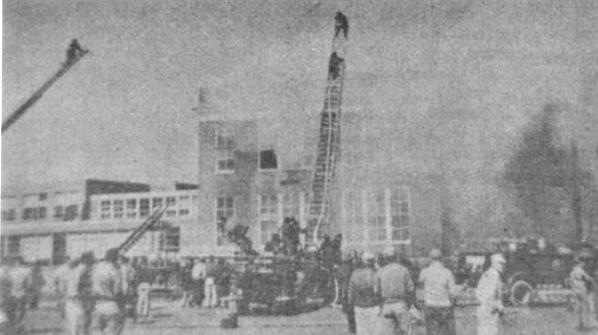
Marple-Newtown Junior High-Senior High School Fire, April 9, 1956

Marple-Newtown Junior High-Senior High School Fire, April 9, 1956

We were in the 8th grade of Marple-Newtown Junior-Senior High School. On that day we were eating lunch, getting ready for our next class when the fire alarm sounded. Must be a fire drill. We knew the drill. So did the teachers. The teachers led us outside, hand-in-hand in the continuous line processional we’d learned in those ridiculous fire drills. The school was going up in flames.

One of my classmates, Dave, remembers it this way:

The Boys’ Room was crowded with guys smoking cigarettes before class, the air was filled with a cloud of tobacco smoke and smells, so we didn’t have any indication that a fire was building below the first floor. Hearing the fire alarm, we stepped out into the hallway to see a trickle of smoke rising from each plank of the hardwood flooring. Seeing that smoke, we knew that the school and the students were facing a serious fire emergency. An orderly evacuation began and although it was a cold day, no one was permitted to go back to their homerooms for their coats.

To a chorus of cheers, we all stood outside shivering for what seemed to be a long time and watched the fire fully consume the building. To a chorus of boos, the fire trucks finally arrived and the volunteer firemen had trouble hooking up the hoses and getting water on the destructive blaze.

The school building was obviously a total loss and since I was cold, I decided to hitchhike home. It was about lunchtime, when I arrived home. My mother immediately descended on me, “…why are you home, are you playing hooky and where is your leather jacket?” “No,” I said. “It wasn’t my fault,” I blurted out, before feeling the back of her hand across my face. “Tell me the truth,” she demanded. I said,”the school burned down,” just before getting a fresh one on the other cheek.

One of the memories we share is the picture of Mr. Harvey, still inside the building, handing the typewriters out the upstairs window from his typing class to Seniors who were ascending and descending a firetruck ladder to save the typewriters until he had to come down himself to loud gasps and cheers.

Fred, remembers being “in typing class a year later using one of those ‘saved’ machines with melted keys.”

Ellie, who wasn’t in the building when the first started, adds something else:

I was approaching the school entrance after lunch at the pizza shop and was met by students rushing out to safety. Still remember that once we were all assembled by homerooms Mr. Rathey went tearfully from group to group checking whether we were all accounted for.

What a surreal day!

Mr. Rathey pointing

Mr. Rathey pointing

The miracle is that we all made it out safely. Before Mr. Rathey, shown here pointing to the school, could see his charges walk across the stage at graduation, he was diagnosed with cancer. The Class of 1960 presented him with a gold watch at his early retirement. Ellie reminded us today of Mr. Rathey’s tearful care on the day the school burned down and in the years that followed.

– Gordon C. Stewart, Chaska, MN, April 9, 2015.

When it rains…

… it sometimes pours.

News came today of the death of John, followed hours later by news of the death of Jerry, and the impending demise of two more friends. Life is like that, or so I tell myself. But it doesn’t help much, if at all, because grief has its own way. Grief wends its course through the soul the way a river eventually ignores the man-made routes and dams imposed to keep it in its place. Nature always wins.

Loss is always hard, even for those who believe, as the Creed does, “in the life everlasting.” I look to the presence of the Eternal in this life, this side of death, this side of my mortal end, as the heart of things, knowing that love continues, no matter how many deaths and sorrows it suffers.

On days like today when it pours, a familiar hymn often sings itself in me, and I am strangely comforted.

“Time, like an ever-rolling stream, soon bears us all away, we fly forgotten as a dream dies at the opening day.

“O God, our help in ages past, our hope for years to come; be Thou our Guide while life shall last, and our eternal Home.”

I pray the same comfort for John’s and Jerry’s spouses, relatives and friends, and for the readers of Views from the Edge, in whatever circumstance you find yourself tonight.

– Gordon C. Stewart, Chaska, MN, April 8, 2015.


Verse – My Familiar Voice

Her voice is low and very resonant,
but now, with age, I often cannot hear
each word. She rightly takes offense at that
and thinks me inattentive. If my ear
is turned away, or if I do not see
her moving lips, the sounds are often lost.
For other women there is jealousy
since I can hear them fine. It is not lust
for at the string trio tonight, the sound
of violin was clear, cello was round,
but viola was lost in the background…

– Steve Shoemaker, Urbana, IL April 8, 2015

The Choir – emblem of hope in a world at odds with itself

Listen in on John Rutter, one of the world’s great composers, discuss the choir as “a kind of emblem for what we need in this world, when so much of the world is at odds with itself….”

Verse – The Male

When I am mowing grass between
the growing Christmas trees,
I often see the red-winged bird
perched high observing me.

If I turn the loud mower off
I’ll hear his scolding cry
a Konk-la-ree, a Konk-la-ree,
and then away he’ll fly.

Is he critiquing how I mow?:
Hey you there! Watch-that-tree!
No, there’s a female nesting near,
Come-to-me, Come-to-me…

– Steve Shoemaker, Urbana, IL, April 6, 2015

The Tree of Life and the Other Tree

Something happened in church yesterday on Easter. Call it an “aha” moment.

Hidden away in the first reading of Easter is a curious reference that draws no attention: “They put him to death by hanging him on a tree; but God raised him…” [Acts of the Apostles 2:5]. Yesterday the “tree” shined like a diamond attracting full attention.

The reference to “a tree” seemed strange. This wasn’t a lynching in Mississippi – they hadn’t hanged him from a tree. It was a crucifixion. The Roman cross was made of wood, but why would Peter call it a tree? Unless, perhaps, the tree calls something else to mind, a reference point within Hebraic scripture and theology that puts the cross in the greater light of a tree. Like the stories of creation and fall in Genesis 1 and 2.

There are three references to a tree in the Genesis narrative.

The first is from the third day of creation:

“And the earth brought forth grass, and herb yielding seed after his kind, and the tree yielding fruit, whose seed was in itself, after his kind: and God saw that it was good. And the evening and the morning were the third day.” [Gen. 1:11-12]

The second reference juxtaposes two trees. One gives life. The other is the tree of death.

“And the Lord God planted a garden in Eden, in the east; and there he put the man whom he had formed. Out of the ground the Lord God made to grow every tree that is pleasant to the sight and good for food, the tree of life also in the midst of the garden, and the tree of the knowledge of good and evil.” [Gen. 2:8-9]

The third reference describes the tree of the knowledge of good and evil as the one tree that is forbidden in the garden:

“The Lord God took the man and put him in the garden of Eden to till it and keep it. And the Lord God commanded the man, “You may freely eat of every tree of the garden; but of the tree of the knowledge of good and evil you shall not eat, for in the day that you eat of it you shall die.” (Gen. 2:15)

It is always the fruit of the tree of the knowledge of good and evil that gets us into trouble. It is the tree of divine presumption. Hubris. The tree that produces not life but death. It destroys, almost always in the name of goodness, and what goodness seeks to kill is evil. The knowledge of good and evil is beyond human capacity.

The Jesus who is hanged from this killing tree exposes the folly of the tree on which he hangs. As foe to the global imperial claims of the Roman Empire, his killing tree becomes for one and all the tree of life.  On the forbidden tree of the knowledge of good and evil, the crucified-risen One becomes the tree of life, “yielding fruit, whose seed was in itself, after his kind; and God saw that it was good. And the evening and the morning were the third day.”

Perhaps that’s the rich history, the diamond, that shines like a diamond in the Easter text from The Book of Acts. No one would know the juxtaposition better than Peter, the only disciple to deny knowing Jesus, and the only disciple specifically named in the instructions to the three women at the empty tomb: “Go and tell the disciples and Peter that he is going before you to Galilee; there you will see him… [Gospel of Mark 16:7]

Christ “suffered under Pontius Pilate, was crucified, dead, and buried; he descended into hell; The third day he was raised again from the dead” [Apostles’ Creed]. And by this fruit of creation restored is all creation blessed.

– Gordon C. Stewart, Chaska, MN, April 6, 2015

A Verse for Easter

Readers unfamiliar with Christian scripture will find it helpful to learn that the original Gospel of Mark ended abruptly and curiously, not the way one would expect good news to end. Upon discovering the stone rolled away from the tomb and the tomb empty, Mark ends not with triumphal joy but with fear. “So they went out and fled from the tomb, for fear and amazement had seized them, and they said nothing to anyone, for they were afraid.” Here’s Steve’s verse for Easter:

The Short Ending of Mark

Most scholars think that first came Mark,
then Matthew, or perhaps St. Luke,
but Mark is shortest of the three
and it takes work for brevity.

The empty tomb is found in Mark,
but in the first draft of the book
no resurrected Christ appears–
his followers are left in fear.

The Gospels four all tell the tale
of thousands fed by miracle,
but only Mark will tell it twice–
this Jesus is the Bread of Life.

Young Mark assumes from Chapter One
that Jesus is the Son of God
the Christ-Messiah, Holy One.
His faith was fed by wine and bread.

Mark must believe that doubts and fears
can turn to trust when he appears.

[Mark 16:1-8]

– Steve Shoemaker, Urbana, IL, April 5, 2015

Do unto others…

It’s not often we follow up of Steve’s poems. But today’s post (“Verse – Indiana”) on Indiana’s Religious Freedom Restoration Act (RFRA) merits further comment on Holy Saturday.

some so-called Christians change the
Golden Rule:
Do unto others what hate did to you.

Steve and I are both Presbyterian ministers. We’re Protestants. We’re not proud of it; it’s just who we are. At this point in his life, Steve restricts his social commentary to poems and verses.

Here are the earlier stanzas of of “Indiana” that succinctly set the Indiana religious Freedom Restoration Act in its ironic historical context:

To America came the Protestants.
In England they could not live
as they would.
They were despised by ruling residents
and fled to freely worship their own God.

Conservatives want to preserve the past,
forgetting which side they were on…
They now
discriminate against those who resist
and say, “To your beliefs we will not bow.”

Tomorrow Steve will celebrate Easter in Illinois. I will celebrate Easter in Minnesota. The symbol of the stone rolled away will be front and center. There can be no hate at the empty tomb. Governor Pence and legislators, pay close attention. “Father, forgive them, for they know not what they do.” It’s hard to believe they didn’t know what they were doing, but in the sense in which the prayer from the cross was uttered, they really didn’t know`1.


Verse – Indiana

To America came the Protestants.
In England they could not live
as they would.
They were despised by ruling residents
and fled to freely worship their own God.

Conservatives want to preserve the past,
forgetting which side they were on…
They now
discriminate against those who resist
and say, “To your beliefs we will not bow.”

Instead of helping people to be free
to live and love as God made them to be,
some so-called Christians change the
Golden Rule:
“Do unto others what hate did to you.”

– Steve Shoemaker, Urbana, IL, April 4, 2015

A memory of Ken

The first Good Friday following retirement from active ministry is filled with the memory of a friend named Ken.

On Good Fridays from 2006 through 2013 Ken Beaufoy was the one member of the congregation I could count on to be with me in the Chapel from noon to 3:00 p.m. There were years when there were three or four. But most Good Fridays, it was just the two of us.

The pattern for the three-hours was very simple. Each half-hour began with a reading from the passion narratives of Gospels. A five minute silence followed, ending with a movement from Gabriel Faure’s Requiem. A brief prayer was spoken aloud. Another contemplative silence ended the half-hour segment.

There were times when I looked at Ken and felt as though I knew him the way his beloved wife, Ilse, had known him. Isle had been the third person in the pews before her death in 2007. Ken and Ilse were like no other couple I’d ever known and not only because theirs was the most unlikely of loves. Ken, a British soldier during the occupation of German following the end of World War II, and Ilse, a German soldier decorated with the German Silver Cross for bravery, fell in love during the occupation and made a life together against all odds. Their marriage was a sign of the power of reconciling forgiveness and love.

Two people never adored each other more than Ken and Ilse. During Ilse’s demise, when hope was scarce and hard decisions were made, I saw Ken’s faith up close and personal in his Good Friday moment of saying goodbye to his Ilse. As often happens between a pastor and a congregant, we became blood brothers until Ken died quietly in his sleep.

Today I’m remembering Ken and those six half-hour segments in the Chapel. I read the readings, listen to the movements of Faure’s Requiem – Introit et Kyrie, Offertory, Sanctus, Pie Jesu, Agnus Dei et Lux aeterna, Libera me, and In Paradisum – pray the prayers, and give thanks for a communion deeper than words. It still endures.