In the Footsteps of Mary

A sermonic reflection on America today, Dec. 14, 2014.

Today’s texts speak indirectly to the national outrage over the deaths in Ferguson, Cleveland, and Staten Island and to the larger context of the economic Law – Capitalism – under which they’ve taken place.

The Spirit falls upon Isaiah

…to provide for those who mourn in Zion– to give them a garland instead of ashes, the oil of gladness instead of mourning, the mantle of praise instead of a faint spirit….They shall build up the ancient ruins, they shall raise up the former devastations; they shall repair the ruined cities, the devastations of many generations. (Is. 61:2-4)

I am in mourning. Even in the midst of Zion. Though I already taste the fruit of the Kingdom of God which is yet to come in fullness, I am in mourning. In ashes. Faint in spirit. Living among the ancient ruins, the former devastations, the ruined cities, the devastations brought on by many generations including my own.

There is anger out there. Lots of it. There are calls for justice out there. There are “die-ins” on Interstate Highways blocking traffic, interrupting business as usual. And it’s good. It’s right. It’s an American thing to do.

But, like most movements, this one will pass in a few weeks or maybe months. It will go the way of Occupy Wall Street.

For while protesters were were being hand-cuffed for “die-ins”, Congress was taking the hand-cuffs off Wall Street and the “too-big-to-fail” banks. The Dodd-Frank restrictions enacted following the 2008 meltdown were being quietly removed by hidden-away paragraphs in the down-to-the-wire spending bill. There will be no more hand-cuffs. No more probation. No more accountability to the American people. The legal limits on dealing in the “derivatives” market were being deleted on Capitol Hill, and, perhaps worse, the Dodd-Frank provision prohibiting a second government bailout was replaced by a commitment to bail them out again.

While on Capitol Hill the Law was being re-written to deliver automatic bail to Wall Street, individuals protesting law enforcement tyranny on the streets were hauled off to jail hoping a friend would bail them out.

Only within the larger economic puzzle do the various pieces begin to make sense.

For all of America’s national wealth, we are among the poorest of nations. We are a classist society bordering on a caste society. Class has always been the issue in America. Race and class have always gone hand-in-hand, but classism has other hands as well.

The wider context surrounding the law enforcement racial divide is the classism embedded in a global capitalist economic structure.

We are living still amid the “ancient” devastations brought on by rich white slave traders who captured Africans like animals for a zoo to work their plantations for profit. Racism is a class issue, an ownership issue, an issue of economic privilege, before it is anything else. The coupling of race and class is as clear now as it ever was, despite the Civil Rights Movement and the election of America’s first African American president.

Capitalism is the issue. The accumulation of wealth. The increasing concentration of wealth. The hoarding of wealth. Wealth disparity, power disparity, racial disparity, electoral disparity, legal disparity; what’s enforced and what’s not; who’s in handcuffs and who’s not; who’s bailed out and who’s not; who’s charged and who isn’t; who’s in prison for what and who’s not; who’s on probation or parole and who’s not; who’s elected to Congress and who’s not; who owns what and who doesn’t; who can pay for an election and who can’t – are all about class, the control of the means of production and capital and the expropriation of cheap labor and natural resources that can’t talk back.

Enter now into this world the psalmist of today’s readings who dared to dream of a great reversal of fortunes:

When the LORD restored the fortunes of Zion, we were like those who dream.

Then our mouth was filled with laughter, and our tongue with shouts of joy; then it was said among the nations, “The LORD has done great things for them.”

“The LORD has done great things for us, and we rejoiced.

Restore our fortunes, O LORD, like the watercourses in the Negeb.

May those who sow in tears reap with shouts of joy.

Those who go out weeping, bearing the seed for sowing, shall come home with shouts of joy, carrying their sheaves.”[Psalm 126:1-6]

The tears of weeping bear the seeds for sowing and reaping of the sheaves of the new economic order. It is no accident that the psalmist mixes the metaphors of weeping, seeds, sowing, and shouts of joy, and sheaves. It is, as it were, a vision for the Earth itself. Honest weeping is the beginning – the sowing – that leads to earthly transformation and shouts of joy.

Mary, the newly pregnant peasant girl, becomes the representative, singing her song amid the ancient devastations, announcing the hope that will engage the powers of class “to provide for those who mourn” [Is.61:1]:

My soul magnifies the Lord, and my spirit rejoices in God my Savior, for he has looked with favor on the lowliness of his servant. Surely, from now on all generations will call me blessed; for the Mighty One has done great things for me, and holy is his name. His mercy is for those who fear him from generation to generation. He has shown strength with his arm; he has scattered the proud in the thoughts of their hearts. He has brought down the powerful from their thrones, and lifted up the lowly; he has filled the hungry with good things, and sent the rich away empty. He has helped his servant Israel, in remembrance of his mercy, according to the promise he made to our ancestors, to Abraham and to his descendants forever.” [Luke 1:46b-55]

Put differently by Philip Clayton, Ingraham Professor of Theology at Claremont School of Theology, we are living

“…at the dawn of a new form of human civilization. Individuals, societies, and nations are now deciding whether to keep fighting to preserve the dying order, or whether to take leadership in building the new. It’s not a matter of waiting for more data; we already know what the old practices are doing to our planet, and we know what it takes to build a global society that is socially, economically, and environmentally sustainable. The ones who make the greatest difference are those who work and live with wisdom, with diplomacy, and with restraint, placing the good of the whole planet first.” [Philip Clayton and Justin Heinzekehr, Organic Marxism: An Alternative to Capitalism and Ecological Catastrophe, Process Century Press, 2014]

I’m still mourning. But I feel better. I know that the mourning is a holy thing, the hint of a coming “garland instead of ashes, the oil of gladness instead of mourning, the mantle of praise instead of a faint spirit” and so, I write. I pray. I sing. I mourn to the tune of Isaiah. I march to the dream of the Psalmist. I walk in the footsteps of Mary.

– Rev. Gordon C. Stewart, Honorably Retired, Views from the Edge, Third Sunday of Advent, Dec. 14, 2014.

America Compromised: the Budget Bill of 2014

The Congressional omnibus budget bill is a compromise – a BIG compromise. It turns the clock back on regulations put in place after the financial market meltdown in 2008 had taken us to the brink of another Great Depression. It undoes the core provision of Dodd-Frank and increases the limit for wealthy giving to political campaigns.

Cover on John Irving's The Hotel New Hampshire in which "Sorrow" the family dog floats to the surface after the plane crash.

Cover on John Irving’s The Hotel New Hampshire in which “Sorrow” the family dog floats to the surface after the plane crash.

The dog we hoped we’d buried still floats, as Views from the Edge published on MinnPost a year after the 2008 crisis.

Click Sorrow Floats: the Healthy-Deregulated-Capitalism Myth Just Keeps Resurfacing.

Sorrowfully, memory is short, and, because the American electorate chooses amnesia to consciousness, the old dog still haunts us.


Voices

NOTE: This e-mail was shared among friends from my wife Kay’s high school days. When asked how best to introduce her, Kathy replied, “just another person seeking to understand how to respond.”

“It’s so hard to make sense sometimes of all the voices, the messages, that break into a usual day.

“Downtown, I heard the sound of a ragtag bunch of demonstrators on the next block, chanting in one voice, ‘Hands up, don’t shoot’, in solidarity with protesters all around the country. I saw an armored police vehicle, moving quietly, on the next block, seemingly trying to get ahead of where the protesters would be coming next. There was no sound at all coming from the twelve or fifteen police who were mounted around the outside of the vehicle, like so many tin soldiers, with protective gear and plexiglas shields. If they were speaking, it wasn’t for us to hear. On the next block, at least two dozen police on bicycles were making their way up a crowded sidewalk; probably more in total than the group of protesters.

“Somewhat shaken, and wondering, as I often do, whether I belong out there with the marchers, and where is my place in the confusing discussion. What does my own voice need to say? I made my way back home. After all, there was no place to leave my car in our crowded downtown if I wanted to join the marchers. I was not “dressed” for a protest. I said to myself, “a walk in the park is what I need, even though it is getting dark. It’s not raining, and it’s mild and not windy”.

“As I walked up the slope around the corner from our house, I heard chanting again, this time happy voices. I couldn’t quite make out the words at first, but soon I realized it was three girls singing “Come on down to our holiday sale, our holiday sale, our holiday sale”. Of course, that group was much easier for me to join, and there were most certainly no police in sight. The girls had hot cocoa, gingerbread cookies, and origami birds for sale. Conversation was easy. One girl told me she was raising money for ‘cancer’, the next for the ‘pet shelter,’ and the last for ‘homeless’.

“I had to offer a prayer of gratitude for everyone who is working to make this longing world a more just and welcome place.”

Kathy Elliott
Portland, Oregon
December 7, 2014

The Streets of Ferguson, Cleveland, NYC, Minneapolis

A 19 year-old African American walks into the Legal Rights Center (LRC). He insists on seeing the Executive Director.

He’s a large man, his speech is fast, his eyes are angry. He pulls up his shirt to show the swastika he alleges the police carved on his back while he lay on the street in North Minneapolis.

There are witnesses. Three women and a man who saw it happen  during another man’s arrest. “Raymond”, we’ll call him, was objecting to the arrest when two officers took him down to the pavement, face down, while one of the officers used his key to etch the Swastika into his flesh. He was not arrested.

Police abuse of power, racial profiling, the use of unreasonable force, shootings, and prosecutors and grand juries looking the other way always have been the way it is in America.  What’s new is the public outcry, the jarring of consciousness and conscience among those who do not live in places like North Minneapolis, Ferguson, or one of the poorer African-American neighborhoods in Cleveland or New York City.

After several years of the LRC Executive Director referring complainants to the Minneapolis Police Civilian Review Board without satisfaction of remedy, I proposed something out of the ordinary. We went directly to the commanding officer of the 4th Precinct of the Minneapolis Police Department.

The Commander’s attention seemed to wander as I introduced myself and Raymond until Raymond pulled up his shirt. The Commander asked if Raymond got the number of the squad car or remembered the badges of the officers. He didn’t. The Commander then, to my great surprise, named a number of officers, asking if Raymond recognized any of the names. Those officers were well-known for terrorizing the North Minneapolis African-American community.

“This is way beyond Internal Investigation,” he said. “You need to take this to the F.B.I.”

Raymond didn’t trust the F.B.I. any more than he trusted the Minneapolis Police Department. He decided to let it go.

Lots of people like Raymond have decided over the years to let it go. Until Michael Brown was shot and killed in Ferguson and a grand jury decided not to indict him. Until 12-year old Tamir Rice was killed by a police officer in Cleveland. Until Eric Garner died of a police officer’s choke hold saying, “I can’t breath!” The inferno of anger boiling over across the streets of America is new only in the breadth of consciousness and conscience.

It will take time. It will take a change of heart and mind. But, mostly, it will NOT change until America gets it straight that for most African-Americans being black is also an issue of class. Class is about power and powerlessness. Only when what we call “the middle class” understands that its interests lie with African-Americans in Ferguson, Cleveland, NYC, and Minneapolis will thing change in America.

Attorney General Eric Holder just released a Department of Justice Investigation report. Click HERE for the story.

It’s all about the economics: up or down. There really is no middle. “Hands up!” “I can’t breath!”

The Dancing Dog Eatery and Juicery

An Acrostic Tribute

The vegetarians love it!
How do omnivores love it too,
Even though all is vegan food?

Delicious, each bite of the pies!
Animal friends happy outside!
Nice, the waiters are always nice!
Chips and fish, the menu says,
Inside is plant-based tasty food,
Never cooked from any other!
Good! And never had a mother!

Delicious, I use the word twice!
Orange, apple, grape, amazing juice!
Good wine and beer, let’s give a cheer!

– Steve Shoemaker, Urbana, IL, Dec. 4, 2014. The Dancing Dog is in Urbana, IL. Here’s a link to the restaurant.

The Dancing Dog Eatery and Juicery

The Dancing Dog Eatery and Juicery

Keep Awake – Undelivered sermon #1

KEEP AWAKE!

First Sunday in Advent, 2014
Texts: Isaiah 64:1-9
Mark 13:24-37

“And what I say to you I say to all: Keep awake.” [attributed to Jesus, Gospel of Mark 13:37].

It’s hard to stay awake in times like these. To be conscious means grief, helplessness, anger at the state of the world.

“Heaven and earth will pass away, but my words will not pass away” is supposed to bring comfort but it doesn’t, unless the heaven and earth of which Jesus speaks are the ones our pride has created. The imaginary ones. The heavenly and earthly projects that rise out of human insecurity as in the Genesis story of Babel, the story of what never was but always is, according to which the building of the ideal city is interrupted and the tower “with its top in the heavens” is “left off”.

But the word – the story about it – has not passed away. It endures. As fresh today as it was when first shared around a campfire as a way of telling each generation the respective places of God and man (humankind).

The Tower of Babel by Pieter Bruegel.

The Tower of Babel by Pieter Bruegel.

Fourteen years after the World Trade Towers collapsed in NYC, a new tower, “One World Trade Center” – taller, stronger, bolder – stands where the old towers fell on 9/11.

One World Trade Center, symbolizes a resurrection of the crashed myth. Standing a few blocks from Wall Street, where the global economy is reconstructed every day, One World Trade Center re-erects the myth of national supremacy, benign goodness, and the virtue of the American economic system. Which is different from a resurrection.

We could have left Ground Zero empty, void of monoliths and phallic symbols. We could have turned it into a plaza, a memorial to the error of pride, a turning away from global arrogance. A repentance from the economic-military-religious complex that expropriated the oil fields in the Middle East, assassinated the elected President of Iran in 1958, installed the Shah in his place, ignored the human rights of Palestinians, supported and installed western-friendly oligarchies and strong men in Saudi Arabia, Iraq (Saddam Hussein), Libya (Muammar Gaddafi), and Egypt (Hosni Mubarak) until, except for Saudi Arabia, they turned against us.

Instead of listening to the word that does not pass away, we Americans, to the sorrow of New Yorkers like Michael Kimmelman (” A Soaring Emblem of New York, and Its Upside-Down Priorities, NY Times, Nov. 29, 2014), opted for the old words and worn-out scripts that have failed us.

The Arab Spring in Libya, Egypt, and Tunisia did not do what the NeoCon exporters of Western democracy had imagined. It unleashed a seething volcano of anti-American resentment. Meanwhile, Afghanistan, Iraq, and now Syria, have become desert quagmires – Vietnams without jungles.

One World Trade Center

One World Trade Center

Eisenhower’s last speech to the nation warning of an emerging military-industrial complex is all but forgotten as One World Trade Center stands like a phoenix raised up…and up…and up from the ashes, the world’s tallest building, symbol of global dominance re-erected from the horrifying deadly collapse of 9/11.

Words and symbols are everything in this world.

As Mr. Kimmelman put,

“…[The World Trade Center Twin Towers] never really connected with the rest of Lower Manhattan. There had been talk after Sept. 11 about the World Trade Center re-development including housing, culture and retail, capitalizing on urban trends and the growing desire for a truer neighborhood, at a human scale, where the windswept plaza at the foot of the twin towers had been.”

It’s all about human scale. A plaza. Not a tower with its top in the heavens.

Staying awake is hard. Being attuned to what is not passing away takes faith. It takes hope. I takes courage. Maybe even love.

“From the fig tree learn its lesson: as soon as its branch becomes tender and puts forth its leaves, you know that summer is near.” [Mark 13:28]

Jesus often seems to have said that the word we need to hear is spoken by nature. Learn from the fig tree. It waits through the dormant season to become tender again, to put forth its leaves toward summer when it produces its sweet figs.

Nature is calling. Nature is our home. Nature is what is – the real heaven and earth – the word that will not pass away, the word that will survive when we are gone. We need to love nature again. Awaken to nature. Re-imagine ourselves as part of nature, “creatures” like all the other creatures. Our words will pass away, even the best of them. Our Creator’s word will not.

During Advent – this most puzzling of seasons, the season of wakeful, wait-ful anticipation of a Coming in fullness – I find myself crying out like Isaiah. “You have hidden your face from us, and have delivered us into the hand of our iniquity.” [Isaiah 64:7]

“O that you would tear open the heavens and come down, so that the mountains would quake at your presence—as when fire kindles brushwood and the fire causes water to boil– to make your name known to your adversaries, so that the nations [the ‘ethnoi’ in New Testament Greek, i.e.” the peoples”] might tremble at your presence!” [Isaiah 64:1-2]

The “nations” have always been God’s adversaries, closed in on themselves, puffed up, defensive against intruders foreign and domestic, plunderers of nature and other nations, hostile to the foreigner, both human and Divine.

In this season of “economic recovery” when the poor continue to get poorer, the rich get richer, and the middle class shrinks, I pray “Good Lord, deliver us, from ‘the hand of our own iniquity’. Remember, ‘O LORD, you are our Father; we are the clay, and you are our potter; we are all the work of your hand.’ [Isaiah 64:8]”

This word is the only word that lasts.

Stay awake, my soul. Stay awake to the whole of it, all of it – the sorrow and the grief of it, the loneliness of it, the anger in it, the guilt of it, the finger pointing out and away and the finger pointing back at me, a nation to myself, and the presence of the Potter – and my soul will be well.

Father and Son – the Pasternaks

Leonid Pasternak painting of his sons Boris and Alex

Leonid Pasternak painting of his sons Boris and Alex

Thinking about father – son relationships led me to the Pasternaks, starting with the son, Boris.  Boris is seated to the left in this painting, done by his father. One wonders whether Boris and Alex were as angry as the father has painted them, or whether the father only imagined them to be resentful about sitting for the portrait. Father-son relationships are often hard to figure out. They’re about perceptions.

The name Boris Leonidovich Pasternak (1890-1960), the Nobel Laureate who declined the award in 1958, is etched in the annals of Russian literature.

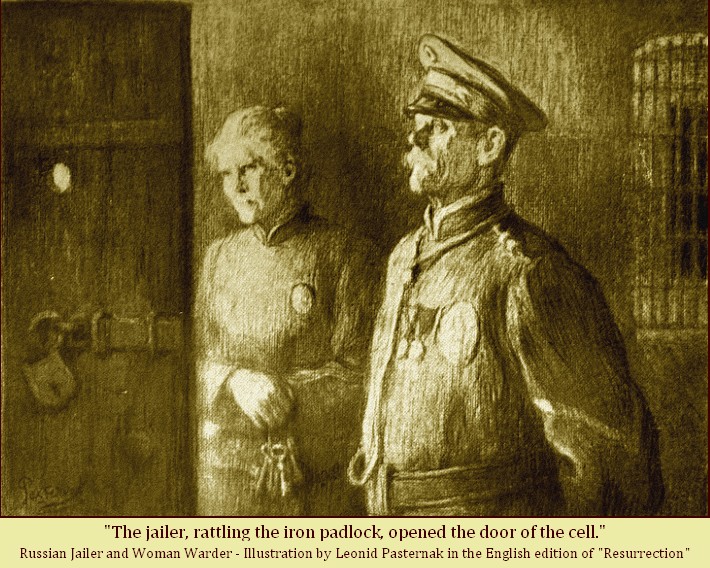
So is the name of his father, Leonid (1865-1945), the revered Russian painter and illustrator, friend of Rainer Maria Rilke and Leo Tolstoy, among others. Leonid’s drawings illustrated Tolstoy’s War and Peace and Resurrection.  

Can you see the father in the sons, and the sons in the father who painted them?

Photo of Leonid Pasternak, Russian painter.

Photo of Leonid Pasternak, Russian painter.

Why, then, would the sons’ father leave them behind?

In 1921 when Leonid Pasternak left Russia for eye surgery in Berlin, he took his wife and two daughters, Lydia and Josephine, leaving Boris and Alex behind in Russia. He never returned. He, his wife, and the girls remained in Berlin until 1938 when he fled from the Nazis to England. The sons remained in Russia.

According to the Pasternak Trust, “Leonid Pasternak was the friend and illustrator of Tolstoy.

Leonid Pasternak illustration in Tolstoy's Resurrection.

Leonid Pasternak illustration in Tolstoy’s Resurrection.

His portraits include studies from life of writers (Tolstoy, Gorky, Rilke, Remizov, Hauptmann); musicians in performance (Scriabin, Chaliapin, Busoni, Rachmaninov); other distinguished contemporaries including Einstein, Hoffman, Gordon Craig and Lenin.

“Sketches of family scenes – his wife at the piano, and their four children reading and playing – are among his most intimate and charming works. His landscapes stretch from the Black Sea to the Bavarian Alps and Palestine.” – Excerpt from The Pasternak Trust.

Although Leonid never returned to Russia, it was his brush that painted Boris into life as a painter whose brush was words, and one can imagine it was his mother’s music that lulled him to sleep even as an adult His mother was a concert pianist.

“‘What is history?” wrote Boris in Doctor Zhivago.

“Its beginning is that of the centuries of systematic work devoted to the solution of the enigma of death, so that death itself may eventually be overcome. That is why people write symphonies, and why they discover mathematical infinity and electromagnetic waves.”


Boris Pasternak, Doctor Zhivago (English translation by Nikolay Nicholayevich, 1957), Chapter 1, Section 5.

Sheep and Goats

Being without a pulpit doesn’t stop the yearning for study and communication. Today Dean Seal stood for the first time in the pulpit where I once stood. I rejoice with Dean and the dear people of Shepherd of the Hill as they begin this new ministry together.

But I also sense the loss of the community that has been Kay and my home for the past eight and a half years. So I do what I have always done. I look at the texts for the day, ponder their meaning, and write about them.

The Hebrew Bible text for today – the last Sunday in the Christian liturgical calendar, “the Reign of Christ” Sunday – is from Ezekiel 34. It reads, in part:

I myself  [i.e. God] will be the shepherd of my sheep, and I will make them lie down, says the Lord GOD.

I will seek the lost, and I will bring back the strayed, and I will bind up the injured, and I will strengthen the weak, but the fat and the strong I will destroy. I will feed them with justice.

Therefore, thus says the Lord GOD to them: I myself will judge between the fat sheep and the lean sheep.

Because you pushed with flank and shoulder, and butted at all the weak animals with your horns until you scattered them far and wide,

I will save my flock, and they shall no longer be ravaged; and I will judge between sheep and sheep.


– Ezekiel 34:15-22

Ezekiel is spoken to the exiles, the aliens in a strange land – you might call them “immigrants” or “exiles” or “refugees”. Or “undocumented workers” who labor for peanuts without the protection of the law.

Ezekiel’s 34th chapter looks to David, the leader of the nation, to be God’s agent to rescue them. Or maybe, in our time, a distant relative named Barack.

During the time I worked outside the church at the Legal Rights Center in Minneapolis, a group of undocumented workers came to the Center. The Hispanic/Latino Community Advocate had identified their need and had convinced them that the LRC was a safe place to bring their case.

Six Mexican “employees” of a cleaning service that sub-contracted for janitorial services at the Mall of America in Bloomington, Minnesota had not received their wages for the past six weeks. The company knew their workers had no recourse. The law was against them; deportation was always one step away. The employer was confident in its privileged position. Those who withheld their wages had not yet read Ezekiel’s proclamation: “I will seek the lost, and I will bring back the strayed, and I will bind up the injured, and I will strengthen the weak, but the fat and the strong I will destroy. I will feed them with justice.”

It took one phone call to the employer to get these men the wages they and their families had been wrongfully denied.

Let those who oppose Immigration reform legislation in the United States of America read Ezekiel, or sit in on the conversation at the Legal Rights Center. Then let them think again about President Obama’s compassionate speech on immigration policy reform and pass the bipartisan bill languishing the House of Representatives.


The Distant Murmurs of Prayer

“In our imaginations, we listen for the distant murmurs of prayer,” wrote Dennis Aubrey in his post “In Seclusio at Thines” posted on Via Lucis Photography.

Listening for the distant murmurs immediately brought to mind a hymn composed by Anne Quigley in 1992. The tune is LONGING. The textual refrain is:

“There is a longing in our hearts, O Lord, for you to reveal yourself to us. There is a longing in our hearts for love we only find in you, O God.”

It was the recollection of the text that drew me to LONGING. I searched YouTube for possible videos for this post but found that the lightness of the tune, like so much contemporary Christian music, left me longing for “the distant murmur of prayers” that echo down the ages in the Gregorian Chants once sung in the now empty or mostly empty monasteries and churches that inspired Dennis to conclude “In Seclusio in Thines”:

“[PJ and I] … hear the echoes of sandaled footsteps in lonely churches long deprived of their monastic communities. And in our imaginations, we listen for the distant murmurs of prayer.”

I long for gravitas awakened by the beauty of silence.

Two Presidents – November 22, 2014

Today is the anniversary of the assassination of President John Fitzgerald Kennedy (JFK), 35th President of the United States of America.

Who killed JFK remains a question for the ages. Someday, perhaps, we will learn the truth of why and by whom he died, but for now the story must be told again, remembered for what it was and for what might have been.

Some things are,
or, so it seems,
“not meant
to be”

Things like
Jack and us
that almost
were

Yet some things,
I repose,
never fade
or die away

Some things not
“meant to be”
like Jack and me,
live on

As things that are,
I surmise,
not meant
to die

For love is not
a thing,
an object that
can die

It hangs around,
like time,
in spaces all
its own

– GCS, Nov. 22, 2014


It must be remembered and mourned afresh today when hatred for his successor runs rampant and “lapses” in White House security inexplicably abound. One theory of President Kennedy’s assassination includes not only a rogue element of the CIA but also the Secret Service, charged to protect the President. Prayers are in order for the President who stood tall this week in his speech on immigration reform.

For our President, Barack, for the leaders of the nations, and for all in authority, let us pray to the Lord. Lord have mercy.

For the poor and the oppressed, for the unemployed and the destitute, for prisoners and captives, and for all who remember and care for them, let us pray to the Lord. Lord have mercy.

Defend us, deliver us, and in Thy compassion protect us, O Lord, by Thy grace. Lord have mercy.

[Excerpts from The Book of Common Prayer, Form I, 1979 Pew Edition, page 384.]