The Fanatical Situation

Under the Fence: Everything Is Shaking

Everything is shaking. And it’s not because of the fence that now divides us. No matter how high the fence between Trump-ers and Never-Tump-ers, the earth shakes under the fence and on both sides of the fence. The ground itself is quivering, seizing, lurching, caving in on itself, like a sinkhole that stops traffic on a street we assumed to be secure. Everything is up-for-grabs.

Deeper and Wider than Politics

What haunts us across America is not primarily political. All politics rise from something deeper. Like oak trees and poison ivy, the shape and substance of what we see spring from depths we cannot see.

Photograph of Willem Zuurdeeg.

Dutch philosopher Willem Zuurdeeg, author of Man Before Chaos: Philosophy Is Born of a Cry, and An Analytical Philosophy of Religion (APR), uses a phrase that may seem strange.

Until we pause to think about it.

Search for solid ground

”The establishment of one’s existence is the background against which imperialistic and fanatical claims have to be understood.”

Zuurdeeg, An Analytical philosophy of religion, p. 89

To ‘establish’ one’s existence is to ‘secure’ it, to keep it from blowing away. We become fanatical and aggressive because we are insecure. We grab for something solid. When we feel the ground shaking, anxiety grabs for something solid. Something that will stay still. Everything is soul-sized. Something in us gasps at the knowledge of human frailty, our mortality, the inevitability of death. The gasps turn into grasps for a secure foothold.

Fanatical Zeal from Hidden Anxieties and Insecurity

Professor Zuurdeeg proposes that we speak of “fanatical claims” rather than “fanatics.” Like most books published in 1958, An Analytical Philosophy of Religion‘s speaks in the gender specific male pronouns. We cite the following paragraphs from page 81:

We have to say: The 'fanatical claimer' sees his own group as more than just a group. It is a fanum. The word "fanatic" is derived from the Latin fanaticus, and this word is related to fanum, a temple, a sanctuary. Fanaticus meant: first, pertaining to a temple; second, inspired by a divinity, especially with the meaning of a frantic zeal for such a divinity. We can say that for the fanatical claimer his group is such a fanum, a sanctuary, a privileged domain which relieves him of his hidden anxieties and insecurity. 

The fanatical Nazi is "the victorious German nation" (his fanum); the Orthodox Dutch Calvinist of the war against Spain (1568-1648) is the Chosen Nation, and is his God of Old Testament wrath. The fanatical claimer cannot permit his basic presuppositions to be questioned because such questioning would imply a doubting not only of these convictions but of the whole structure (his own person, his fanum, his God) cemented together by the process of identification.

-- An Analytical Philosophy of Religion, p.81

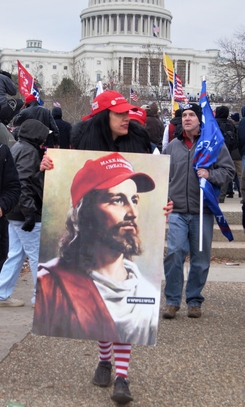
It is through the lens crafted in Zuurdeeg’s workshop that I have come to see the world. In the days following the 2020 election, stunned by the “alternative fact” alleging that the election was rigged and stolen, watching the mob storm the Capitol January 6, and hearing the deadly silence of the President of the United States of America betraying his oath of office to enjoy the show, I saw the frantic zeal of a fanum.

The Focus

But there is more. Drawing from French existentialist philosopher-playwright Gabriel Marcel‘s Man Against Mass Society (1952), Zuurdeeg expanded his analysis:

“Marcel justly points out that there is still another element in the convictional situation of the fanatical claimer, the focus. Marcel suggests that such a focus is an individual; and that is sometimes the case, as with Hitler or Stalin.” (APR, p. 81-2)

Photo of Gabriel Marcel (c. 1951)

America 2021

Everything is up-for grabs. The ground is shaking under our feet. We look for someplace solid, a sure foothold against the chaos. I see the world — or try to — in these terms. But the wise professor and the playwright-philosopher urge us to go deeper than what can be seen and managed, for we are “complex and ambiguous being(s)” who only know ourselves partially. “We are therefore not allowed to speak of a non-fanatical person.” (APR, 84). Although I think I know what Zuurdeeg and Marcel would say if they could see us now, they caution me that only a “fanatical claimer” is without doubt.

Gordon C. Stewart, public theologian, author of Be Still! Departure from Collective Madness (2017 Wipf and Stock), 49 brief commentaries on faith and public life, Brooklyn Park, MN, October 20, 2021.

The Barbed-Wire Fence

A Childhood Memory: Buddy and I

No fence divided the neighboring properties on Church Lane the day my family arrived in Broomall. The little girl next door and I quickly became playmates. We went back-and-forth with no thought of things like property lines. My yard was her yard; her yard was mine. Until the day the Singletons bought the property and she was gone.

Buddy Singleton was five years-old. So was I. Buddy and I soon became playmates. We played freely in each other’s yards. No one owns a tree. Buddy climbed our Red Maple, I climbed Buddy’s old Oak tree. Until the day the fence went up. Buddy could no longer get to me; I could not get to him. The gate locked Buddy in and kept me out.

Every day we talked through the chain link fence with the barbed wire at the top. “C’mon over,” said Buddy. The only way to “come over” was to climb the fence. So I did! Until my foot slipped near the top. The barbed wire punctured my left hand and left me hanging like a banana nor yet ripe for falling. My mother heard the screaming and lifted me from the fence. I still have the scar to prove it happened.

Photo by Kaique Rocha on Pexels.com

Then and Now

The fence that separates neighbors is higher now. Rarely do we we talk through the fence that separates us. We’ve learned to stay on our side of the fence. I no longer climb your Oak tree. You no longer climb my Red Maple. Neither of us invites the other to “c’mon over” and, if they do, we decline. Once you’ve hung from the barbed wire, you learn not to try it again. But the fence is not all barbed wire. It’s a chain-link fence. We can talk with each other through the fence without impaling ourselves, if we have the will to engage with the other. “The time for talking is past,” said an old friend. “I’m done! The time for thinking is over. You can’t talk to these people. It’s time for the barricades.”

The Barricades?

I know the feeling. But the time for talking is never over. The time for thinking is never over. However strongly I disagree with or despise the neighbor on the other side of the fence, however deeply I agree with Eugene Robinson’s question — “How dumb can a nation get and still survive?”(Washington Post, October 7, 2021) — as much as I want to back away from the fence to the club house in my Maple tree, something nags me to remember the commandment I prefer to ignore: to love my neighbor as myself. If I dare to look, I will find the enemy I despise inside myself.

Talking through the Chain-Links of the Barbed-Wire Fence

The time for contemplation and self-criticism is always now. It’s always time for thinking. It’s still the time for talking through the fence and trying to understand how and why people on opposite sides of the fence think, feel, and act as we do. Barbed-wire fences do not make good neighbors! “Something there is that doesn’t love a [fence].”

Brian Maclaren offers a way to talk through the openings if the chain-links fence.

People can’t see what they can’t see. Their biases get in the way, surrounding them like a high wall, trapping them in ignorance, deception, and illusion. No amount of reasoning and argument will get through to them, unless we first learn how to break down the walls of bias. . . .

Brian Mclaren, Why Don’t They Get It? Overcoming Bias in Others (and Yourself)
(Self-published: 2019), e-book.

To be continued with a look at Brian McLaren’s 13 walls of bias that shape how and why we see ourselves, each other, and the world at the barbed-wire fence.

Gordon C. Stewart, author of Be Still! Departure from Collective Madness (2017 Wipf and Stock), Brooklyn Park, MN, October 18, 2021.

Elijah asks Grandpa about facts

This “conversation” between Grandpa (Bumpa) and Elijah took place during the Senate’s first impeachment trial. It’s been buried in the draft file. Elijah was two-and-a-half at the time. But some things are still true when Elijah is four.

Elijah and Bumpa (Grandpa) in Elijah’s room

Elijah: I don’t get it, Bumpa! I have questions.

Grandpa: What questions, Elijah? Shoot!

I don’t want to! We don’t like guns at daycare!

I’m sorry, Elijah. I don’t mean shoot. I meant it as a “figure of speech”.

Yeah! We like figures. One, two, free, four, . . . l, m, n, o, p. . .

I’m so proud of you!, Elijah! You know your numbers and your ABCs! But “a figure of speech” is different, it’s an idiom.

Like what?

Like . . . you might say that somebody “lies like a rug.” So what are your question?

We hate lying, We like facts, right Bumpa?

Yes. We do, Elijah.

So we don’t like the Publicans. They lie like rugs, right?

Publicans?

Yeah, Publicans, like the ones on TV who hate facts and get all angry on TV.

I see.

We’re not Publicans! We like Jesus, right?

Well, yes, sort of. You’ll come to your own faith as you grow older. The Publicans collected taxes for the Romans. It would be like Americans working for a foreign government.

Okay. But we’re not publicans. We don’t like craters and creezin, right?

Creezin? Are you sure you have the right words?

Geez, Bumpa! Don’t ya know? C r e e z i n ! Like you and Grandma have for breakfast every morning.

Ah, now I get it. We eat Raisin Bran. R a i s i n B r a n. You mean treason! T r e a s o n.

Yeah! Are they going to de-peach you? Did you commit creezin? Are you and Gamma craters who should be de-peached? Publicancraters?

Those are big words you’ll learn about in school. No, we can’t be impeached, and we’re not Publicans. We try to stick with the facts, not lie like a rug. Any other questions?

Yeah. Ucranes. We have Ucranes at the cabin. Do Ucranes whistle?

  • Grandpa and Elijah, Dec. 4, 2019.

America at the Precipice

Two American Founders

The Founders Archives of the National Archives preserves a letter to Ben Franklin eighteen months before the Declaration of Independence was issued. Ben Franklin, the Philadelphia “Quaker,” became a household name. Charles Thomson (1729-1824), the Philadelphia Presbyterian, did not, and that’s a shame.

Charles Thomson was the Secretary of the First and Second Continental Congress, a quiet Founder on the road from colonial rule to an independent democratic republic. The official Declaration of Independence had only two signatures, the President and the Secretary of First Continental Congress: John Witherspoon and Charles Thomson.

He held the office of Secretary from 1774 throughout the American Revolution until the adoption of the Constitution. Thomson’s correspondence with his friend Benjamin Franklin is learned and passionate. His translation of the Bible and the Septuagint from Greek into English is the first English Bible published in America. Thomson’s love of language and range of literature is evident in his letter to Franklin.

Charles Thomson Letter to Benjamin Franklin

“When I look back,” wrote Thomson to Franklin in London, “and consider the warm affection which the colonists had for Great Britain till the present reign, the untainted loyalty unshaken fidelity and cheerful confidence that universally prevailed till that time, and then view the present heartburnings, Jealousies, gloom and despair, I am ready to ask, with the poet, ‘Are there not some chosen thunders in the stores of heaven armed with uncommon wrath to blast those Men,’ who by their cursed schemes of policy are dragging friends and brothers into the horrors of civil War and involving their country in ruin?”
Thomson Letter to Franklin, Nov. 1, 1774

Charles Thomson and Cato, A Tragedy


The poet whose words Thomson cited were from James Addison, the anti-royalist English poet-playwright, whose play, “Cato, a Tragedy” was widely read and often quoted by the Founders of the new nation. Whether intentionally or inadvertently, Thomson changed the “Cato” text from singular to plural to suit the circumstances that enraged him. “Blast the Man” (the king) became “Blast those Men” (i.e. Parliament) who had violated the rights and freedoms of the American colonies’ rights and freedoms under British law.

Dragging their Country into Ruin

The circumstances of November 1, 1774 have changed, but Charles Thomson’s unusual outburst is as fresh today as the day he wrote to Franklin. The longing for a king exceeds the bounds of time. The anxiety that hangs over us makes our heads spin; we long for solid ground, something solid that does not change. So it is that a political party and a portion of the American public have come to mistake treason for patriotism, a bully with a savior, a quack with a swan, and have followed the strong man’s quackery into the halls and offices of the Congress that makes America a democratic republic. When we confuse patriotism with terrorism, Charles Thomson’s letter from the Founders Archives is more than archival.

Teetering on the Edge of the Precipice

When a hollow man and hollow party hollow out the core of what we have thought we valued, the question from Cato’s tragedy rumbles like thunder from the heavens. Charles Thomson’s renderings from Cato fit the eve of a threatened sequel to January 6, when the democratic republic once again “teeters on the very edge of the precipice.”

Toward Healing the Wounds

Will we in 2022 share the hope and prayer with which Charles Thomson ended his letter of November 1, 1774: “Even yet,” he wrote, “the wounds may be healed and peace and love restored; But we are on the very edge of the precipice. I am sir your affectionate Friend and humble Servant.– Chas Thomson”

--Gordon C. Stewart, Public theologian, author of Be Still! Departure from Collective Madness (2017, Wipf and Stock), September 17, 2021.

I wish I were a lily pad

Early morning reflection from the dirt road by the wetland pond

Walking the off the map dirt road where nothing much happens, it’s quiet. The only sounds are bird songs; the only things that lie here are the lily pads lying on the shrinking wetland pond bordered by the cattails and wild flowers between the pond and the unpaved road. Nothing toils or spins. Nothing is anxious here. Not this morning.

Lily pads on a wetland pond

“Consider the lilies of the field, how they grow; they neither toil nor spin; yet, I tell [all of] you [human beings], even Solomon in all his glory was not arrayed like one of these.” (Jesus of Nazareth, Sermon on the Mount, Matthew 6:28b-29.)

There are no Solomons here. No kings. No countries. No states. Nothing seduced by the will-to-power. No illusions of sovereignty. No delusions of grandeur or control. No toiling and spinning like the mind observing it all from the dirt road. Everything is what it is: Yellow Goat’s-Beard, Yarrow, and Golden Clubs; Sweetflag, White Sweet Clover, and Butterfly-Weed; Bugle-Weed, Cuckoo-Flowers that aren’t cuckoo, and Bullhead-Lilies that don’t bully; pink Storkbills, Wild Sorels, Common Milkweeds, and blue-violet Pickerelweed.

Water lily –Photo by Hiu1ebfu Hou00e0ng on Pexels.com

Only the hunting-blind on the distant hill gives evidence of other spinning heads that toil for the mastery we cannot have. The hunting-blind on stilts high about the pasture waits for trigger fingers. Soon buckshots from the tower will fire babel that breaks the silence of this place. The flowers of the field — the Butterfly-Weed, the Bugle-Weed, and the Cuckoo-Flowers, the Lilies, and the lily pads — are not anxious. They are what they are. What is is what is. What will be will be. They neither toil nor spin.

— Gordon C. Stewart, from the wetland, August 3, 2021

Insurrection and Faith (Part 4)

A State of Mind: Patriots and Traitors

The maximum capacity crowd at the First Tuesday Dialogue did not have a crystal ball. It was February 1, 2013, eight years before the insurrection that would come eight years later. QAnon, the Proud Boys, the Boogaloo Bois, Wolverine Watchmen, Oath Keepers, and other White nationalist militias that traveled to Washington, D.C. to “Stop the Steal!” were unknown, but the mindset was already there.

Some Mindsets Never Really Die

Some states of mind are like toxic waste. They have long shelf lives. Before two people in the crowd took the floor to read aloud from the John Birch Society Blue Book and newsletter, it had been years since I last thought of the John Birch Society (JBS). What we thought had ended with the public shaming of Sen. Joe McCarthy and McCarthyism had not died. Like a baton that changes hand in a mile relay race, the mindset of McCarthyism was passed into the hand of the John Birch Society.

Like McCarthy’s search for traitors hiding in government and the entertainment industry the Birch Society’s conspiratorial mindset was ludicrous. The JBS had alleged that President Dwight Eisenhower (“Ike”) was not to like. Ike, his brother, Milton, and Allen Dulles, director of the CIA were closet Communists or Communist sympathizers.

When the John Birch Society Blue Book and newsletter were quoted on February 1, 2013, those who knew their history recognized the old voice we thought had died in the mid-1960s.

The Jack Ash Society lyrics (Mary Brooks)

A bunch of jack ashes at large in this land
 Have suffered a terrible fright
 They looked under their beds and discovered such reds
 As Allen and Milton and Dwight
 

 If more you would know of this Jack-Ash credo
 See the blue book, the black book, the white
 If you do you will find we're all Reds of some kind,
 Like Allen and Milton and Dwight.
 

 Joe McCarthy is dead, so Jack Ash instead
 Leads the anti-Communist fight;
 U. S. Reds he has found swarming all around.
 (179 million so far)
 Including Allen and Milton and Dwight.
 

 If you believe in more hospitals, housing, and schools,
 New highways and civil rights,
 The Ashites will add you to the un-American list,
 Along with Allen and Milton and Dwight
 

 Social security's a Bolshevik plot
 Cooked up by some shrewd Muscovite.
 So go naked you must or be security risk
 Like Allen and Milton and Dwight.
 

 Beware of good pay and the minimum wage,
 It's part of the Socialist blight;
 Created by conspirators bold,
 Like Allen and Milton and Dwight.

Pete Seeger and the “Jack Ash Society”

Pete Seeger performing The Jack Ash Society

The Berkeley Pit

Photo by William Rosmus uploaded from Wikipedia. Shot of telephone poles used to show scale of the flooded Berkeley Open Pit mine site, with respect to the photo ‘Composite fish eye view of the Berkeley Pit in Butte, Montana’ (Butte_MT_Berkeley_Pit_April_2005_Composite_Fisheye_View.jpg). The poles are just slightly right of centre in the larger composite fish eye picture of this flooded open pit mine.

Long Shelf Lives

An uninformed passer-by may assume the Berkeley Pit is a swimming hole, a place to swim and fish. It’s not. Nothing lives there. The Berkeley Pit is a pool of deadly toxins left behind by the Atlantic Richfield Company which bought the site from Anaconda Copper. Anaconda Copper left long ago, but the Berkeley Pit is still there. The Pit is not managed by the Department of Parks and Recreation. It’s an U.S. Environmental Protection Agency Superfund site, one of the largest, if not the largest in the land of the free.

The Call for Patriots

By 2013 the John Birch Society’s had made a quiet comeback in American political-cultural. It had not perished. The toxins from its Superfund clean-up site had seeped into the stream of American consciousness. It has never been cleaned up.

Now, more than ever, your patriotic leadership is needed. Is this the America our Founders envisioned? Their principles, and the Constitution itself, are under attack by forces that include socialists, Marxists, globalists, and the Deep State. We’ve created some great resources for you to educate Americans and stand for freedom. May we count on your help? We, as Americans, cherish our God-given liberties. We stand for a free and independent nation that fully abides by the Constitution and the Founding Fathers’ values. The John Birch Society provides a national program designed to counter the Deep State/Big Government agenda and to restore our rights.

John Birch Society website

The Birther Movement and “Stop the Steal!” Call for Patriots

2010 billboard displayed in South Gate, California, questioning the validity of Barack Obama’s birth certificate and by extension his eligibility to serve as President of the U.S. The billboard was part of an advertising campaign by WorldNetDaily.

The “Birther” and “Stop the Steal!” movements repeat the Birch Society call for real patriots to fight against “socialists, Marxists, globalists, and the Deep State.”

During Barack Obama’s campaign for president in 2008, throughout his presidency, and afterwards, “there was extensive news coverage of Obama’s religious preference, birthplace, and of the individuals questioning his religious belief and citizenship—efforts eventually known as the ‘birther movement‘”, by which name it is widely referred to across media. The movement falsely asserted Obama was ineligible to be President of the United States because he was not a natural-born citizen of the U.S. as required by Article Two of the Constitution. Birther conspiracy theories were predominantly held by conservatives and Republicans, as well as individuals with anti-black attitudes.

“Barack Obama citizenship conspiracy theories,” Wikipedia

The Pit of American Toxic Waste

Donald Trump tapped into that toxic stream in which right is wrong and wrong is right, truth is wrong and falsehood is right, information is wrong and disinformation is right, reality is wrong and fantasy is right, science is wrong and ignorance is right, confession is wrong and denial is right, Howdy Doody is wrong and Mr. Bluster is right.

But some things stay the same. White is still right and Black is still wrong. Barack Obama had no birth certificate. He had been elected, but his presidency was illegitimate. So was the election of 2020. Donald Trump is legitimate. Real patriots know they wish to believe. Real patriots stand back and stand by until the time is right to fight.

The toxins in American culture reach far back into our history, and the Pit is deep. The prevailing myths of White supremacy and national exceptionalism were here from the start. The Founding Fathers’ and Mothers’ values are both healthy and toxic.

Cleaning Up the Superfund Site

Only we can clean up the mess. The toxins in the Berkeley Pit still poison the American mind and turn hearts to stone. American culture and politics will be clean when we embrace our history as the continuing struggle between truth and falsehood, reality and fantasy, and all the hard truths we prefer not to see.

Bob Dylan, like Mary Brooks and Pete Seeger, may have thought the Birch Society was terminal. Or perhaps Bob, like Mary and Pete, knew that some toxins continue to make us blue.

John Birch Paranoid Blues — Bob Dylan

Gordon C. Stewart, author of Be Still! Departure from Collective Madness (2017 Wipf and Stock) — 49 two-four page social commentaries on faith and life — Chaska, MN, Feb. 24, 2021.

Ashes, ashes . . . we all fall down

Ring-a-round the Rosie

No one really knows the origins of “Ring-a-round the Rosie.” Some say the nursery rhyme sprang from the Black Plague, the epidemic that took children as well as adults, kings as well as paupers. Others say it has different origins, but I don’t care. This is my blog, and I’ll cry if I want to, cry if I want to! “We all fall down.”

It’s Ash Wednesday, the first day of Lent in a QAnon world when reality doesn’t mean much anymore. Truth is a fiction. Choose your fantasy. It doesn’t matter anymore. We may fall down, but, like corks thrown into the sea, we bob up again. Or so some think. We never really fall down. Yet something in us knows that how Narcissus dies bowing to his own reflection, and that the flower only blooms when he and his loyal Echo return to dust.

What stories shall we tell ourselves in a time when the pond we thought was ours is drying up, when there is no up or down on a spinning Big Blue Ball floating in space that feels upside-down and falling back to dust and ashes? 

The Parable of the Madman

When the madman in Friedrich Nietzsche’s The Gay Science parable steps into the marketplace with his lantern lit on a bright morning seeking God, and later announces, “God is dead! God is dead. And we have killed him, you and I,” those who view God as a phantasm laugh in derision. You can’t kill what never was. The believers don’t laugh. They throw him out when he enters the church to sing his requiem for God, leaving him to ask, “What are these churches but the sepulchres of God?”

“How shall we comfort ourselves, the murderers of all murderers?” asks the madman. “What was holiest and mightiest of all that the world has yet owned has bled to death under our knives: who will wipe this blood off us? What water is there for us to clean ourselves? What festivals of atonement, what sacred games shall we have to invent? Is not the greatness of this deed too great for us? Must we ourselves not become gods simply to appear worthy of it? There has never been a greater deed; and whoever is born after us — for the sake of this deed he will belong to a higher history than all history hitherto.” — The Gay Science, Book 2 (1882)

What stories do we tell ourselves?

Ash Wednesday brings every fantasy to a halt. There is no higher history than all history before us. There is life and there is death. Both are real. Where do we find a footing? What stories do we tell ourselves? What does a disciple of Jesus do when the Jesus hanging on a cross crying out that the horror of god-forsakenness has been re-shaped into a positive thinker, a White supremacist, a Christian nationalist? What to do in a reality denying QAnon world in the aftermath of January 6, 2021?

Where your treasure is

“Whenever you pray, go into your room and shut the door and pray to your Father who is in secret; and your Father who sees in secret will reward you” (Matthew 6:6). “Do not store up for yourselves treasures on earth, where moth and rust consume and where thieves break in and steal; but store up for yourselves treasures in heaven, where neither moth nor rust consumes and where thieves do not break in and steal. For where your treasure is, there your heart will be also” (Mt. 6:19-21).

The imposition of ashes

Ring-a-round the Rosie seems different this Ash Wednesday, but it’s not. It’s always the same. Going forward for the imposition of ashes I acknowledge the reality I flounder to avoid. “Dust to dust; ashes to ashes.” The ashes that smudge my forehead always have to be imposed. We all fall down.

Gordon C. Stewart, author of Be Still! Departure from Collective Madness (2017 Wipf and Stock), 49 short commentaries on faith and life; Chaska, Minnesota, February 17, 2021.

Insurrection and Faith (Part 2)

Flashback and Portent — The Epidemic of Gun Violence

Flashing back to February 1, 2013 feels like a flash forward to America in 2021. An evening in a small church in Chaska, Minnesota on gun violence gave hints of what was coming in eight years later. It was a glimpse into the apocalyptic mind and heart that led to the insurrection of January 6.

February 1, 2013 Opening of First Tuesday Dialogues’ series on gun violence

The parking lot was full. Until that night, First Tuesday Dialogues’ attendance had ranged between 35-75 people. Attendance that night was 138.

The threat of disruption and violence did not materialize. Everyone entered respectfully. But there was a storm cloud hovering over the room. I wondered when the thunder and lightning would come.

I welcomed the crowd, laid out Dialogues’ simple practices and ground rules — respectful listening and speaking with no interruption, no cheering, no booing, no clapping.

The evening began with a half-hour exchange between the city’s Chief of Police and the Carver County Sheriff expressing different views on the increase of massacres like the one at Sandy Hill in Newtown.

The tone was set for a respectful conversation.

The Invisible Guest named John

A Q&A with the chief and sheriff was allotted 20 minutes. A woman in the last row was the first to raise a hand. She was handed the microphone and began by expressing anger that we were having such a discussion. The Second Amendment was the Second Amendment. No government was going to take away her guns. She then began reading from a John Birch Society manuscript. Lots of people clapped and shouted their approval.

A woman a across the aisle was in tears. I gave her the microphone. She stood to ask a question. “Has anyone here lost a loved one to gun violence?”

Four or five hands went up, but before she could tell her story, the first speaker shouted at her, “That has nothing to do with the Second Amendment!” Shouts again rang out. I reminded everyone of the Dialogues’ expectations. If you are holding the microphone, the floor is yours. When you are not holding the microphone, you listen. No rebuttals. No clapping. No shouting. No us versus them.

The woman who’d been crying answered her own question. “I have,” she said, and told the wrenching story story from her childhood. Her story was chilling. The wounds were still fresh. The room was quiet.

The Coming Apocalypse

Two voices later voices foreshadowed America eight years later. The first spoke with passion. Obama and the feds were coming to take his guns. The government is going down. The economy will collapse. The dollar won’t have any value. Grocery store shelves would be empty. Those who are not prepared would have no food to feed their families. We need to get ready for the chaos that’s coming.

The man who next held the microphone agreed. The economy is built on sand. It will collapse. It will be “every man for himself.” If you don’t have a secure bunker full of food to last you a year, you’re in trouble. If you don’t have a secure bunker, build one. Now! When your neighbor comes asking for food, too bad. Have your guns ready.

Like the person who had turned the Q&A into a time for monologues, this speaker had a manuscript from which he quoted. His apocalyptic tone and message felt like the street corner preacher’s citing The Revelation to Saint John, the last book of the Christian Bible, shouting about the end of the world, but this apocalypse was different. Real god-fearing patriots don’t rant on street corners. They don’t preach, and they don’t kneel. They rise up to expose and overthrow the communists, socialists and other collectivists who control of the world. Real patriots stand and fight He was reading from the John Birch Society manual.

The evening ended peacefully. There was no physical violence. Gun rights advocates were thankful and looking forward to the next event. Others participants expressed fear of violence or discomfort with the rudeness. They would not be back for the next event in the series.

A Dilemma

If Dialogue’s programs success were measured by attendance, the first evening had exceeded expectations. If drawing people of opposing views were the measure, the evening had been a success. Although there had been raw moments that tested the Dialogues norms, the expressions of opinion had been honest. Nothing was left on the table or kept under the table.

During the days that followed, we learned that an estimated 180 people had chosen to attend a public hearing on gun control at the state Capitol. There would be hearing to keep them away from the Feb. 19 program focusing on the Second Amendment. Those who had been at the Capitol were reported to be less respectful and more extreme. We should expect the crowd to double on the 19th.

Stay tuned for “Insurrection and Faith (Part 3).

Gordon C. Stewart, author of Be Still! Departure from Collective Madness (2017 Wipf and Stock), 49 short (2-4 pages) social commentaries on public life. Chaska, Minnesota, February 13, 2021

I know an Old Party that swallowed a lie … I guess she’ll die.

“All parties die at last of swallowing their own lies” — John Arbuthnot

Dr. John Arbuthnot (1667-1735) became a household name in Great Britain for writing The History of John Bull. John Bull soon became the British equivalent of America’s Uncle Sam.

Although John Arbuthnot was the ground-breaking mathematician said to have inspired Jonathan Swift’s Gulliver’s Travels and Alexander Pope’s Peri Bathous, Or the Art of Sinking in Poetry, John Arbuthnot was a biographer’s nightmare.

“Dr. Arbuthnot,” as he was known with great affection, left behind little information for a biographer who might praise him. So deep was his humility that, according to Alexander Pope, Arbuthnot allowed his children to play with and burn his manuscripts. He didn’t toot his own horn.

Dr. Arbuthnot may seem irrelevant in 2021. He knew nothing of The Apprentice, the Birther Movement, the Grand Old Party (GOP), or Donald J. Trump. Nothing of COVID-19, fake news, stolen elections, the Deep State, Q, or QAnon. He couldn’t imagine watching from Cambridge the live coverage of a mob insurrection in Washington, D.C. He knew nothing of the Proud Boys, the Boogaloo Boys, Wolverine Watchmen, Roger Stone, Marjorie Taylor Greene, or the GOP’s duplicitous response to Rep. Greene’s endorsements of domestic terrorism to save America from Satan and from Jews sending laser beams down from outer space to light the fires in California.

The creator of John Bull didn’t need to know our particulars to understand what is happening to Uncle Sam’s country in 2021.

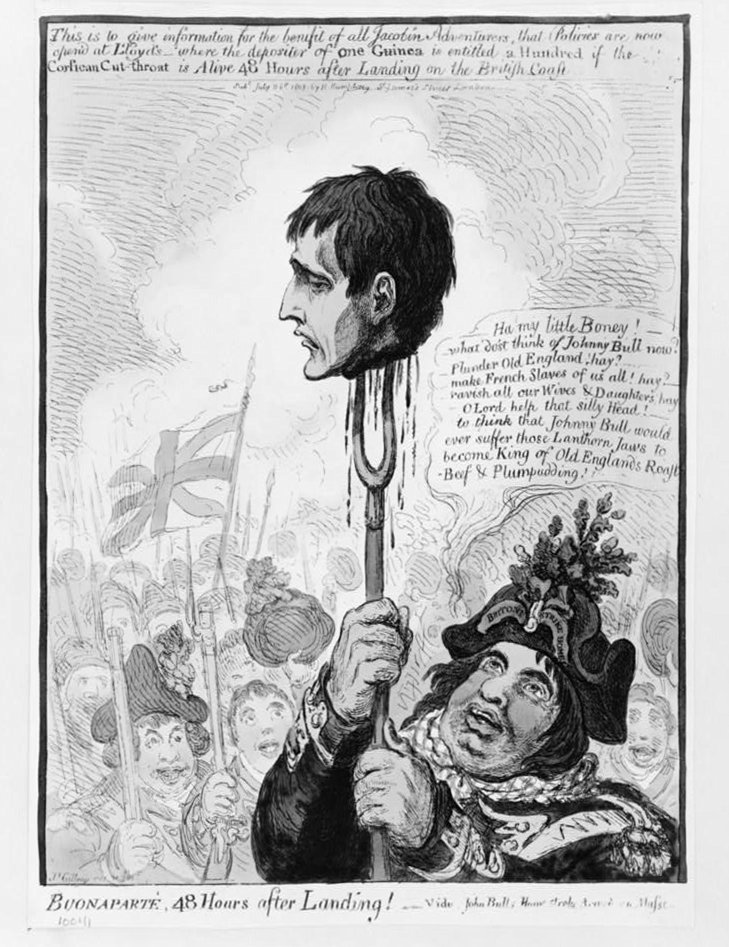
Like the cartoonist of the garish satirical cartoon of “John Bull” with the head of Napoleon held high on a pitch fork, he didn’t need to sit in on the second impeachment trial to read the fear on the faces of GOP senators. He knew that every political party dies swallowing its own lies.

Two days before U.S. Senators become jurors, one can only hope! “Come, John Arbuthnot, Come!” “Come, Lord Jesus!, Come!” “Come, Sojourner Truth, Come!”

John Arbuthnot’s choice of a text from which to speak during a time of deep division reveals what he considered most important in life. The Elizabethan language is no longer ours, and its spirit is at risk, but its truth and wisdom abide. So does courage, if only the Senate Jurors and we, the people, seek it.

Better is he that laboureth, and aboundeth in all things, than he that boasteth himself, and wanteth bread. My son, glorify thy soul in meekness, and give it honour according to the dignity thereof. Who will justify him that sinneth against his own soul? and who will honour him that dishonoureth his own life? The poor man is honoured for his skill, and the rich man is honoured for his riches. He that is honoured in poverty, how much more in riches? and he that is dishonourable in riches, how much more in poverty?” –Ecclesiasticus 10:27-31.

A sermon preach’d to the people at the Mercat Cross of Edinborough on the subject of the union. Ecclesiastes, Chapter 10, verse 27 (King James Version)

Gordon C. Stewart, author of Be Still! Departure from Collective Madness (2017 Wipf and Stock), Chaska, MN, January 7, 2021

Things Fall Apart; the Centre Cannot Hold — a Sermon

Friend and ministerial colleague John M. Miller spoke these words following the January 6 siege of the U.S. Capitol.

A sermon by John Miller, Chapel Without Walls, Hilton Head Island, SC – January 10, 2021

Text – “Immediately after the tribulation of those days the sun will be darkened, and the moon will not give its light, and the stars will fall from heaven, and the powers of the heavens will be shaken.” – Matthew 24:29 (RSV)

Things Fall Apart; the Centre Cannot Hold

    January 6, 2021, like December 7, 1941, is a date that shall live in infamy. Four days ago  American democracy was shaken to its very foundations. It happened in the United States Capitol building, the seat of government of a nation which proudly proclaims itself the strongest democracy in the history of the world. But on January 6, our democracy endured its most damaging test since April 12 of 1861, and it was prompted by the nation’s president.

    In 1919, after the War to End All Wars had finally ended, and the foolhardy Treaty of Versailles was being thrust upon the barely-defeated nations of World War I, William Butler Yeats wrote what is perhaps his most famous poem. It is called The Second Coming. For his whole lifetime, the Irish poet had lived through injustices forced upon his fellow countrymen by the English. The people of the Emerald Isle had been kept in British bondage for centuries. In 1919 the world was in the grip of a major pandemic, the worst one in six centuries. Life could have not been more bleak for a brilliant, sensitive, and mystical bard.

    The Second Coming is a dark and ambiguous poem. Nonetheless several lines from it have been used to describe events around the world ever since Yeats wrote the poem. “Turning and turning in the widening gyre/ The falcon cannot hear the falconer.” We feel ourselves being drawn into a metaphorical swirling whirlpool or tornado, and we become severely disoriented.

    “Things fall apart; the centre cannot hold;/ Mere anarchy is loosed upon the world,/ The blood-dimmed tide is loosed, and everywhere/ The ceremony of innocence is drowned.”

    In the late morning of January 6 the head of state of the American government addressed several thousand of his most avid supporters near the White House. He had been carefully cultivating his cult for more than four years. (The two words are linguistically yoked.) Since November 3, 2020, he had been telling them that the election had been stolen, and he instructed them that they must try to stop Congress from counting and affirming the votes of the Electoral College. Taking him at his word, they began their march to the capitol as both Houses of Congress were in session, doing what the Constitution requires after every presidential election.

    “The best lack conviction, while the worst/ Are full of passionate intensity.” Most of the people then meeting in the Senate and House of Representatives intended to approve the electoral count that would affirm Joseph Biden, Jr. as the next President of the United States. However, ten Republican Senators and a hundred and thirty-nine Representatives objected to the tallies sent to Congress from a few states whose citizens had chosen Mr. Biden. These were politicians who by now should clearly have known that Donald Trump would stop at nothing to avoid having to leave the presidency. Shortly after the process was begun, the capitol was breached by force, and the excited hordes stormed into it, streaming out in every direction. The Members of Congress were told to shelter in place, a new phrase in our ever-changing lexicon, usually reserved for another matter altogether. Most of them quickly went to their offices and locked the doors.

    Those of us who saw these events live on television watched the beginning of the formalities in the two chambers. But soon the networks were displaying videos from outside the capitol building, with growing crowds pressing forward, then breaking through the barriers and rushing into the capitol. “Things fall apart; the centre cannot hold;/ …The ceremony of innocence is drowned;/ …The best lack all conviction, and the worst are full of passionate intensity.” Though the electoral numbers were unassailable, the congressional objectors stood ready to make their case, until the mobs appeared at the doors of the House and Senate. We looked on with increasing dread, fearful of where the chaos was leading.

    Three or four days before Jesus was crucified, Matthew tells us he gave a lengthy monologue to his disciples. In it he very obliquely focused on what he perceived would be his imminent death and its aftermath. Matthew, chapter 24, is highly apocalyptic. The Greek word apocalypsos means “to uncover.” The meaning of an important future event is inevitably hidden, and the cryptic apocalyptic words are supposed to uncover their meaning to those who have eyes and ears to understand them. Apocalypticism was familiar to the people who wrote and who were the first readers of the Bible. Unfortunately, most of us find such words merely bewildering.

    “So when you see the desolating sacrilege spoken by the prophet Daniel, standing in the holy place (let the reader understand)” [except most of us who read this don’t understand much at all of what Jesus was saying] “then let those who are in Judea flee to the mountains” (Mt. 24:15-16).

The problem for us is that we are far too removed from first-century Judea, and we don’t understand. In several places in the Gospels, Jesus spoke of what would precede his Second Coming after he had died. Matthew 24 is an example of that. For us 20 centuries later it may be too cryptic, too veiled. Furthermore, Jesus likely didn’t say everything Matthew said he said.

    Jesus hinted in several places in the Gospels that he would return again to the earth after he had died. Yeats took that imagery and wrote a very ambiguous and foreboding poem, but with no religious meaning at all. I am using both the Yeats poem and the apocalyptic teachings of Jesus as the basis for this sermon. No Christians can be absolutely certain about what Jesus meant by the Second Coming, but millions have been drawn to it like moths to a flame, with a great variety of interpretations regarding this phenomenon. “And if those days had not been shortened, no human being would be saved, but for the sake of the elect those days will be shortened” (Mt. 24:22). (Calvinists love that and all other verses which contain the word “elect.”)

    Did Jesus actually say all these things? I am convinced  he said some of them. Whatever else he was (and he was many other things), he was surely a first-century Jewish apocalyptic preacher.

    Jesus told his disciples, “Immediately after the tribulation of those days the sun will be darkened, and the moon will not give its light, and the stars will fall from heaven, and the powers of the heavens will be shaken” (Mt. 24:19). When Jesus said that, was he predicting January 6, 2021, or Dec, 7, 1941, or April 12, 1861? Absolutely not. But he was predicting that things like that would occur. If we live, we will all experience wars and riots and plagues. It cannot be otherwise. Apocalyptic teachings proclaim that truth in their own uniquely strange manner.

    It is a certainty that millions of supporters of the president, as well as many Members of Congress, will not change their minds one scintilla about the best direction for this nation to follow as a result of what happened on January 6th. Fierce opinions don’t change readily.     

Many of the talking heads on television were aghast that there were not more police to prevent the mob from breaking into the capitol building. In the providence of God, we can be very grateful it was mainly the Capitol Police who were there to try to stop them. Had it been the DC police or the DC National Guard, it might have been a disastrously different story.  The capitol police are more like guides than they are like guards. They are not trained to quell riots, and fortunately, they didn’t stop the invasion. Put lots of guns into the hands of lots of males, and you’ll get lots of people shot. Had the capitol police fired many guns, instead of five deaths (only two caused by firearms), there could have been hundreds  injured and scores killed if armed police and National Guardsmen and armed demonstrators had  started blazing away at each other. The best lack all conviction, while the worst are full of passionate Second Amendment intensity. As awful as it was, it is amazing there was not far more bloodshed and vandalism within the nation’s seat of government. Most of the people on both sides of the conflict were relatively peaceful, considering how volatile the situation actually was, and who the assailants were.

Elections may be mocked, voters may be mocked, and democracy may be mocked. All of that happened on January 6. A tragically lifelong narcissistic president cannot do what our president did without severely damaging the body politic. For six years (two years of campaigning, nearly four years of being in office, and two months of incessant attempts to undermine the validity of a properly conducted election), he did what was natural to him. He attempted to expand his political base to support his “governance,” such as it is. That is all this tragic man knows how to do. He has shown himself incapable of being presidential, but he is extremely capable of being Donald J. Trump. Now he is being widely discredited, but most of all he should be pitied. He is not the worst person in history by any means, but he is obviously full of passionate intensity.

Though elections might be mocked, God is not mocked, even though on January 6 God and Jesus appeared to be mocked. One demonstrator carried a hand-written sign saying, “Jesus Saves.” Another carried a flag which said “Jesus 2020.” You may not have realized it, but Jesus also apparently was up for election in 2020, and in the Capitol Assault of January 6. Many of these people truly believe they represented Jesus in their actions. That is as sad as it is dangerous.

In my opinion, most in the mob were not intentional terrorists. They didn’t mean to terrorize Congress as such. They were simply duped by their leader into thinking their unruly presence would somehow nullify the Electoral College vote. That tells you how well the leader understands and respects the Constitution. But it also shows how brilliant he is at duping people.

Millions of Americans and thousands of Republicans elected to various offices throughout America, plus many Democrats as well, have doggedly supported President Trump up to and beyond January 6. When upcoming elections occur, remember the names of any such people. “Fool me once, and shame on you. Fool me twice, or indefinitely, and shame on me.” Donald Trump is not a monster, although he is a man with a severe personality disorder and/or mental illness. All of us should have realized and admitted that before now. The man should have been convicted of the articles of impeachment by an overwhelming vote in Congress last February, but it didn’t happen. Shame on the members of the party which kept him in office. As it was, January 6 turned out to be Three Cheers for the Democrats Day because of the president’s failed attempt to sway the voters of Georgia. He didn’t; it backfired. If Mike Pence had been the President for the past ten months, the Grand Old Party might have averted a very slim Democratic majority in both houses of Congress. A Republican president still in office became the Republican downfall.

However, the Democrats have little to crow about. Both parties have rendered it almost impossible to work with the other party amicably, and they are equally guilty of allowing this deadly impasse to have evolved. Democrats may think they stand on the moral high ground, but they have an uncanny knack of regularly cutting the ground out beneath their clay feet. Bernie Sanders and the now-famous AOC are examples of how they allow that to happen. Joe Biden and Kamala Harris have an immense job on their hands, though they may be the two Democrats most capable of uniting us once again. Let us hope and pray it may come to pass.

Does January 6 represent the end of the world and the Second Coming of Christ? Certainly not, although probably many fundamentalist Christians think so. But it will go down as one of the darkest days in American history. An assault on the nation’s capitol building was incited by a president who imagined a mob somehow could overturn an election whose results he refused to accept. Had he succeeded in his ploy, democracy would have failed, with incalculable chaos. 

However, that surely was not what Jesus was talking about on a spring day in the first third of the first century of the Common Era. Apocalyptic words can be interpreted in a wide fashion, but January 6 was not apocalyptic, either via Jesus or William Butler Yeats.

Nonetheless, Jesus does return to us in a continual Second Coming. We encounter him in the form of exhausted health care workers toiling on behalf of people dying from COVID-19. He is a poverty-stricken mother feeding her children all the food she has, saving none for herself. He is a demonstrator for the civil rights of oppressed people, and a policeman trying to maintain order among the demonstrators. Jesus comes back as a bricklayer, a minimum-wage child care worker, a fast-food worker, and a street sweeper. He can be seen in Members of Congress from both parties, carefully striving to do the nation’s business, clearly knowing that they can never achieve widespread acclaim among all the people.  

A chastened nation needs to emerge from January 6.The best lacked conviction on what to do when it should have been done five years or ten months earlier. Those who were the worst-equipped to do anything positive seized the January 6 headlines. The Georgia special election should have made January 6 a totally different kind of news day, but an out-of-control president and an uncontrolled throng of his supporters prevented that from happening.

A great American once said, “It’s never over till it’s over.” January 6 is not over. It will take years before it’s over. Even after order was restored in Congress and the Electoral College tallies were approved, there were still one hundred and forty-nine Republicans who voted against doing what Congress was required to do. This isn’t over. The Trump Phenomenon existed long before Donald Trump existed. It was there is the Whiskey Rebellion in Western Massachusetts during the Articles of Confederation period. It was there at Fort Sumter in 1861. It was there is the obliteration of Reconstruction in the truly rigged election of Rutherford B. Hayes in 1876. It was there is the Tea Party movement of the 1990s onward, and it may even have been the precipitating factor in the Boston Tea Party of 1773. It will require all the wisdom, courage, perseverance, and forgiveness the American people and their elected representatives can muster for one another if we are to emerge from the political nightmare we have endured for the past four years. As Lincoln said, “with malice toward none, with charity for all”, we must move beyond the partisanship we have so perversely allowed not only to exist but to cultivate among ourselves. 

America has become two giant tribes with two very different concepts on how to govern the third most populous nation on earth. There shall be no earthly messiahs to bring us together. But we must hope and pray that Joe Biden and Kamala Harris will be the two ordinary humans who become the greatest unifiers we have available to us. That, after all, is what elections are about. 

“Then will appear the sign of the Son of man in heaven, and then all the tribes of the earth will mourn, and they will see the Son of man coming on the clouds of heaven with power and great glory” (Mt. 24:20). Not literally, not visibly, but metaphorically, poetically, yet visible to the eyes of faith. Maranatha; come swiftly, Lord Jesus. Amen.