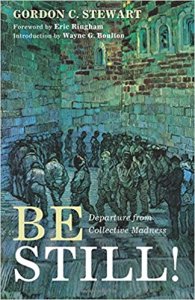
Announcing “Be Still!” Program

Be Still“BE STILL! To See More Clearly

This six-session program for churches invites you to re-examine the faith perspective (“lens”) through which you have come to “see” yourself and the world with brief selected readings from Be Still! Departure from Collective Madness.

“To see clearly, to see clearly, to see clearly–such is the great impulse and drive you meet on every page.” – Introduction to Be Still!  by Wayne. G. Boulton, Ph.D., former president of the Presbyterian School of Christian Education.

“Such essays are an eloquent rebuke to the prejudice that theological writing is abstraction from the concretions of life. I think of Stewart as an incarnational theologian like Bonhoeffer, who insisted that we pay attention to God’s presence in the concretions of our history.” – Donald Shriver, Ph.D., President Emeritus, Union Theological Seminary (NYC).

SIX One-1.5 hour SESSIONS using Be Still! Departure from Collective Madness

ONE—What is “public theology? Read and discuss the “Foreword” (ix-x), “Introduction” (xv-xviii), and Psalm 46.

TWO—The Author’s Lens. Read and discuss “The Preface (xi-xii), and the last paragraph of the “Acknowledgements” (xiv) about the Brothers of Opal Street.

THREE—Exceptionalism as Sin. Read and discuss “Only One Sin: Exceptionalism” (110-113) and “Memorial Day and the Soldier’s Helmet “ (10-12).

FOUR—Toward an Incarnational Theology. Read and discuss “Stillness at Blue Spring” (3-5) and “A Joyful Resting Place in Time” (5-7).

FIVE—No Gospel without the Blues. Read and discuss “The Forlorn Children of the Mayflower” (66-70) and “My Soul Waits in Silence” (98-100).

SIX—The Economy of God. Read “The Economy: Only One House” (114-115), “The World in an Oyster” (94-97), and “The Bristlecone Pines” (143-145).

ENDORSERS of Be Still! Departure from Collective Madness

Lucy A. Forster-Smith, Sedgwick Chaplain, Senior Minister in the Memorial Church, Harvard University:

”As a person who navigates the pleasures and perils of the twenty-first-century campus, having Be Still! at my fingertips will be like having a counselor, a guide, a very present help in these times. This volume touches the pulse of our times with the rare combination of unwavering candor and tender mercy.”

Walter Brueggemann, Columbia Theological Seminary:

”This wondrous collection of rich snippets would be of interest and value if only for the rich source material that Gordon Stewart quotes from, as it must be an inexhaustible memory and/or file. But the many words he quotes are no more than launching pads for Stewart’s expansive imagination and agile mind that take us, over and over, into fresh discernment, new territory, unanticipated demands, and open-ended opportunity. All of that adds up to grace, and Stewart is a daring witness to grace that occupies all of our territory.’’

Barrie Shepherd, author of Between Mirage and Miracle:

“Gordon Stewart has a way with words, a clean, clear, concise, and yet still creative way with words, a way that can set the reader almost simultaneously at the blood-stained center of the timely–the urgent issues of our day–and also at the deep heart of the timeless, those eternal questions that have forever challenged the human mind. Stewart looks at terror, Isis, and all their kin, from the perspective of Paul Tillich and, yes, John Lennon. He moves from Paris, Maine, by way of the town drunk, toward the City of God. This is strong medicine, to be taken in small, but serious doses. Wear a crash helmet!”

 Michael McNally, Professor of Religion, Carleton College; Author of Honoring Elders:

”Be Still! is needed at this American moment of collective madness even more than the moments that occasioned many of the essays originally airing on public radio and other venues. With a keen eye and a knack for telling the right story at the right time, Rev. Stewart speaks to the pressing issues in our politics, economy, and culture, and consistently, often poignantly, puts them in ethical and theological perspective that clarifies what too often mystifies. Great bedside reading for those of us who stay up at night concerned about where our world is heading!”

Frank M. Yamada, President, American Theological Society, former President, McCormick Theological Seminary:

”In Be Still! Stewart masterfully spins a counter-narrative to the collective madness that is gripping our world. Like the psalmist, Stewart prays thoughtfully through metaphors and religious tradition, meshing theologians with news headlines to lead the reader to a deeper, more sustained truth. Be Still! reads like part op-ed and part parable. In these troubling and anxious times, may we, who have ears to hear, listen!”

Joyce Sutphen, Minnesota Poet Laureate; Professor in English, Gustavus Adolphus College:

“Be Still!: Departure from Collective Madness, is exactly what its title proclaims: a departure from the frenzy and folly of our times. Each essay offers the reader an opportunity to breathe deep, to fall into the story or idea and consider what it means to be a citizen, a friend, a human being. The topics covered are both particular and universal (usually both at the same time), and the writing is wonderfully concise and open—much like poetry! This is a book you will want to open again and again; it’s what the world needs now, more than ever.”

ORDERING THE BOOK, INQUIRIES & SPEAKING ENGAGEMENTS

Be Still! Departure from Collective Madness is available from Amazon (paperback @$21 [shipping included w/Amazon Prime] or kindle @ $9.99), and from Wipf and Stock Publishers (paperback @$16.80 + shipping, or E-Book @$16.80). Churches and groups within 50 miles of Chaska, MN may order the book from the author @ a reduced rate.  A Study Guide is available at no cost.

Contact Gordon C. Stewart @ gordoncstewart@comast.net for speaking engagements, questions, or requests for more information.


DIDN’T A MAJORITY OF AMERICANS HAVE MEDICAL COVERAGE BEFORE OBAMACARE?

Marilyn Armstrong’s highly personal revelation connects the dots with the call for universal health care.

Marilyn Armstrong's avatarSerendipity - Seeking Intelligent Life on Earth

The question on Quora was “didn’t a majority of Americans have medical coverage before Obamacare”?


I thought about the answer. This is one of those issues in which I had — still have — a gigantic personal stake. I’m one of those people who would never get insurance without laws forcing them to give it to me. Maybe a majority of working adults had medical coverage, but among those who were not — for whatever reason — working, mostly, they had nothing. This includes disabled people, old people, people injured and unable to return to work. And, of course, children.

We were among the group who no longer had medical insurance, although we’d had it before.

I was desperately ill. Massachusetts had not gotten its own medical care system yet and the U.S. had nothing, the situation to which it seems we will shortly return. I could be fixed, but no…

View original post 830 more words

Intoxicated with Success

“[People] are undoubtedly more in danger from prosperity than from adversity, for when matters go smoothly, they flatter themselves, and are intoxicated by their success.”

This bit of wisdom from what many will consider an unlikely source invites reflection in these days when one of America’s most successful has met adversity from his peers at the G-20 meeting in Hamburg, Germany.

421DA3B800000578-4674150-image-a-95_1499432704494He sits by himself at the table while others mingle. The chairs of China and the United Kingdom, whose leaders he has scorned, stay empty until they will be filled, begrudgingly, at the very last minute. One may hope it is a sobering moment of adversity.


“As Gregor Samsa awoke one morning from uneasy dreams he found himself transformed in his bed into a gigantic insect. He was laying on his hard, as it were armor-plated, back . . . ” – Franz Kafka, The Metamorphosis.

As an infant, Donald Trump was baptized by a Presbyterian church in Queens, New York in the tradition of the controversial 16th century theologian John Calvin. Perhaps all these years later, after all the success, but suddenly regarded as a cockroach, feeling like Gregor Samsa, he’s reading the passage from John Calvin and remembering who he really is.

  • Gordon C. Stewart, Chaska, MN, July 9, 2017.


When Hope Wavers

“We should ask God to increase our hope when it is small, awaken it when it is dormant, confirm it when it is wavering, strengthen it when it is weak, and raise it up when it is overthrown.”

Plugging the ears, closing the eyes, looking away have become standard practice in response to the growing sense of despair provoked by the bellicose behavior of current occupant of the Oval Office. Each day further chips away the objective grounds for hope that the insanity and inanity will stop. Hope grows smaller, wavers, goes into hiding, becomes weak, and, on the worst of days, feels overthrown.

Is it surprising that a word from the 16th Century serves to encourage the weary?

CalvinInstitutio

Institutes of the Christian Religion

Is it surprising that it comes from the pen of Jean  Calvin, the lawyer-theologian of the Genevan branch of the protestant reformation, the author of the The Institutes of the Christian Religion who had more than his fair share of days when hope was small, and whose little hope was shrunk by the many haughty, small-minded people who claimed to follow him?

I was always exceedingly delighted with that saying of Chrysostom, “The foundation of our philosophy is humility”; and yet more pleased with that of Augustine: “As the orator, when asked, What is the first precept in eloquence? answered, Delivery: What is the second? Delivery: What is the third? Delivery: so if you ask me concerning the precepts of the Christian religion, I will answer, first, second, and third, Humility.

There is no inconsistency when God raises up those who have fallen prostrate.[John Calvin, Institutes of the Christian Religion]

Holy One, increase our hope when it is small, awaken it when it is dormant, confirm it when it is wavering, strengthen it when it is weak, and raise it up when it is overthrown. Amen.

Elijah’s Joy: Life is beautiful!

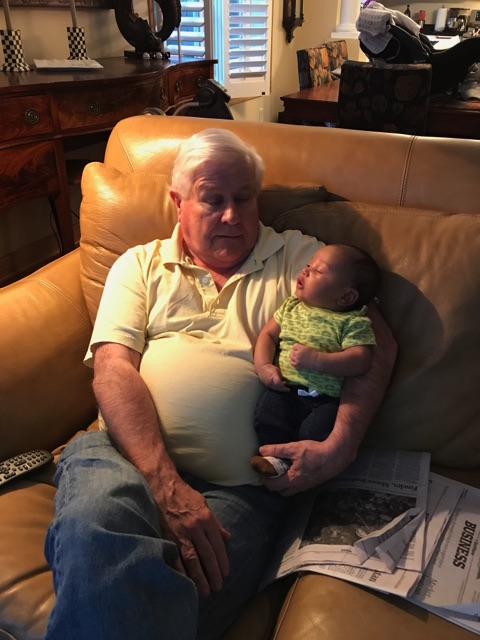
Elijah no longer watches CNN or any other news channels. He’s become a Gopher — a Minnesota Gopher fan, but he doesn’t care about sports or any kind of competition. He’s all smiles watching his mobile characters stroll across his crib, enjoying the music and his mother’s and grandmother’s voices.

We should all be so happy!

  • Grandpa Gordon, Chaska, MN, July 6, 2017

Double Vision

Thomas and Peter are this writer’s favorite apostles. Thomas because he refused to believe unless he saw with his own eyes and confirmed “an idle tale” with his own hand; Peter because he was impetuous, quickly stepping onto the sea at Christ’s invitation only to plunge like a stone when his faith failed him.

It was through these two very different eyes — one of Thomas, the other of Peter — that we viewed Dennis Aubrey and PJ McKey’s Two Churches in the Cliffs on Via Lucis this morning.

The two churches on the cliffs appeared differently to these different eyes of faith.

3L1A5132

Apse, Église Notre-Dame-de-l’Assomption (Alpes-de-Haute-Provence) Photo by PJ McKey

The apse of Église Notre-Dame-de-l’Assomption with its narrow vertical window immediately elicited a Petrine sense of immediate belief. It held Peter’s eye for a long time.

Perhaps it was held by the yearning for the vertical, that which transcends the horizontal banality to which a mass culture has shrunk everything not of its own making. Perhaps it is the delight of hope from above that trembles the spine of the despairing. Or perhaps it’s the beauty of the apse’s proportionality, the genius of the central Christian symbol: the intersection of the horizontal by the more gracious vertical — the horror of human cruelty interrupted and transformed by the unexpected shaft of light and the still small Voice heard by Elijah in his cave.  Or all of the above and more.

But Thomas is never far beyond Peter. It is the Thomas in us that asks the hard questions, insists on separating fact from fiction, reality from illusion, good faith from what Sartre called bad faith. It is Thomas whose faith couldn’t make itself piggy-back on the shoulders of the other apostles’ story of having met the risen Christ. It was Thomas who insisted that he see for himself the evidence for “seeing” or believing in hope beyond the horror of the suffering, cruelty, and death his eyes had seen days before on the Hill of Skulls.

800px-Chapelle_Notre-Dame_de_Beauvoir

Chapelle Notre Dame de Beauvoir, Moustiers-Sainte-Marie (Alpes-de-Haute-Provence ) Photo by ICE-Marseille, courtesy of Wikipedia Commons


Which brings us to the second church on the cliff — the story of the stillborn in Via Lucis‘ post that awakens Thomas’ skepticism.

“Notre Dame de Beauvoir was known for its suscitations – stillborn children were carried up and baptised there, at which time they would immediately come to life and would be granted a place in heaven. This was a well-known phenomenon in the region and also known at two neighboring churches.”

While the thought of stillborn children immediately coming back to life appeals to Peter, it offends Thomas as an idle tale for the feeble of heart and mind. It’s either true or it’s not. And, if it’s true, what kind of cruel God would deny the same to the stillborn children and grieving parents who have not carried them up the steps to Notre Dame de Beauvoir for suscitations? Or is the tradition of Notre Dame de Beauvoir a sacred story of love and hope beyond what the empiricist eye of Thomas can see?

We have a left brain and a right brain, and sometimes it is true that never the twain shall meet. Likewise, faith has two eyes: Peter the believer, and Thomas the doubter — its own kind of double vision — looking out and up from one small brain.

  • Gordon C. Stewart, Chaska, MN, July 6, 2017.


An Echo from Lockerbie

Pan_Am_Flight_103._Crashed_Lockerbie,_Scotland,_21_December_1988With the explosion of Pan Am Flight 103 over Lockerbie, Scotland in the news yesterday, we share this excerpt from James Whyte’s sermon for the mourners at the Lockerbie Memorial Service 1988.
41+xpkf2RxL._SX347_BO1,204,203,200_

That such carnage of the young and of the innocent should have been willed by men in cold and calculated evil, is horror upon horror. What is our response to that?

The desire, the determination, that those who did this should be detected and, if possible, brought to justice, is natural and is right. The uncovering of the truth will not be easy, and evidence that would stand up in a court of law may be hard to obtain.

Justice is one thing. But already one hears in the media the word ‘retaliation’. As far as I know, no responsible politician has used that word, and I hope none ever will, except to disown it. For that way lies the endless cycle of violence upon violence, horror upon horror. And we may be tempted, indeed urged by some, to flex our muscles in response, to show that we are men. To show that we are what? To show that we are prepared to let more young and more innocent die, to let more rescue workers labour in more wreckage to find the grisly proof, not of our virility, but of our inhumanity. That is what retaliation means.

The  Right Rev. James Whyte was the Moderator of the Church of Scotland, still suffering from grief and physical fatigue following his wife’s death. He had recently retired as Principal and Professor of Practical Theology at the University of St. Andrews’ divinity school, St. Mary’s. The full text of the Lockerbie Memorial  sermon was published in Laughter and Tears: Thoughs on Faith (Reflections), pp. 92–5.

Every Thursday afternoon in the summer of 1991 the Right Rev. Professor James (“Jim”) Whyte brewed a pot of tea and served scones to the complete stranger he’d welcomed to St. Andrews, an American Presbyterian minister seeking his tutelage in practical theology during a sabbatical from pastoral duties at Knox Presbyterian Church in Cincinnati. His hand-written prayers delivered at Hope Park Church in St. Andrews remain a priceless treasure.

  • Gordon C. Stewart, Chaska, MN, July 5, 2017.


Elijah’s hunger strike!

carseatFullSizeRenderElijah is not happy when he arrives at Grandpa’s and Grandma’s at dinner time.  Adult dinner-time, not his! Elijah still eats every two hours, all day, all night.

He hates his car seat.

He yells and screams at Mom for the 20-minute drive from Mom’s to his Grandparents’ home in Chaska.

The conversation begins while removing the straps of his straitjacket.

“Elijah, Mom needs you to be quiet when she’s driving. You need to be more respectful. Mom has needs, too.”

“No she doesn’t! Mom’s a warden! I hate that cell!!!”

“No, Mom loves you! She’s not a warden; the car is not a prison; and your car seat is nothing like a prison cell.”

“Uh-huh!!! I thought you were my friend! You’re just like Mom! You don’t care about me. You think I’m just a thing, like my car seat. I’m not coming here anymore.”

“I’m sorry you feel that way. Do you want me to get you out of your car seat or not?”

carseatNo! I’m staying here just like Martin Sostre did in solitary confinement because he refused to submit to the warden’s rules.”
“Well, Martin’s case was altogether different. Martin was a political prisoner at Clinton Correctional Facility in Dannemora, New York. Chaska’s a long way from Dannemora.”

“You loved Martin more than you love me, and Martin wasn’t even your grandson!”

“Well, there’s a big difference between you and Martin. Martin was a man of courage. He didn’t scream and yell. He didn’t cry. Martin didn’t terrorize his mother.”

“You care more about people who aren’t members of the family than you do about me! That’s not right! Martin was a criminal. I’m a prisoner, but I’m no criminal.”

“Elijah, there’s a big difference. Martin was an adult. He wasn’t in solitary for his own safety. He was put there to humiliate him. Mom puts you in your car seat to keep you safe.”

“Uh-huh! And because she’s enforcing the law! Mom’s a warden and you’re a guard! How come you won’t help me! I’m your grandson! I’m gonna go on a hunger strike!”

“Well, okay. But remember. If you go on a hunger strike, you’ll still get strapped in your car seat. The only things a hunger strike would change are you’ll make Mom happy ’cause she doesn’t have to feed you every two hours . . . and you’re going to starve.”

“That’s not fair!””

“No, it’s not, Elijah. Life’s not fair. As my old football coach used to say, ‘Life is tough! You must learn to adjust.”

“Not in my car seat!”

  • Gordon C. Stewart, Chaska, MN, July 1, 2017.


With Patience and Courage

Family of John M. Buchanan's avatarHold to the Good

I had a good idea recently. Stop hyperventilating about Donald Trump and focus instead on American history; really focus. It is helping me and I highly recommend it. There is, of course, so much to hyperventilate and worry about, something new every day: Russian interference in the election and the President’s obvious unconcern, his rejection of the high moral vision expressed in American foreign policy for two and a half centuries and replacing it with a starkly different vision articulated by two top presidential advisers, H.R. McMaster and Gary Cohn in the Wall Street Journal: “The President embarked on his first foreign trip with a clear-eyed outlook that the world is not a ‘global community’ but an arena where nations, nongovernmental actors and businesses engage and compete for advantage.” That is a very different and harsh vision which David Brooks described as “moral decoupling…morality has nothing to do with anything…

View original post 677 more words

Grandpa, we’re with Mika, right?

Eli and baseball IMG_5753Elijah and Grandpa had just read the President’s tweet about Mika Brzezinski when Elijah said a bad word.

“You need to be more respectful of the President!”

“Why?” asked Elijah. “He’s not my President! Look what he just did to Mika! What’s he have to do that for! He’s mean, Grandpa!”

“I wish I knew, Elijah. Most of his tweets happen when he wakes up early in the morning.”

“Maybe he needs to be nursed as soon as he wakes up. That always calms me down.”

170629123255-trump-tweets-assualt-on-brzezinski-1024x576.jpg“Well, I’m afraid Donald Trump’s mother is way beyond being able to nurse him. She’s really old, way older than Grandpa, Elijah.”

“Then you should call the White House. They should give him a bottle as soon as he wakes up before he attacks another mother! When he stops tweeting insults at women like Mika, I’ll stop calling him a mother.”

  • Gordon C. Stewart, Chaska, MN, June 30, 2017.