“Child Again”

Picture of classmates with Harry Strong to the right

Picture of classmates - Harry Strong on the far right

Yesterday classmate Harry Strong,sent this by email in response to Steve and my reflection “Words from childhood” posted on Views from the Edge. I asked Harry for permission to publish part of his email here. Harry’s reflection ends with questions for your reflection.

–  by Harry Lee Strong, San Juan Mountains, Colorado, sent April 28, 2012

While teaching adult classes at the Church of the Wildwood in Green Mountain Falls, I led a course called: “Could I Sing That Song and Mean It?”  We sang and listened to a number of sacred and secular pieces on various topics. This was one of them.

“Child Again” (Beth Nielsen Chapman) 

She’s wheeled into the hallway
Till the sun moves down the floor
Little squares of daylight
Like a hundred times before
She’s taken to the garden
For the later afternoon
Just before her dinner
They return her to her room

And inside her mind
She is running
She is running in the summer wind
Inside her mind
She is running in the summer wind
Like a child again

The family comes on Sunday
And they hover for a while
They fill her room with chatter
And they form a line of smiles
Children of her children
Bringing babies of their own
Sometimes she remembers
Then her mama calls her home … CHORUS

Playmate, come out and play with me
(It’s raining, it’s pouring, the old man is snoring)
And bring your dollies three
(Bumped his head on the edge of the bed)
Climb up my apple tree
(Never got up in the morning)
Slide down my rain barrel
(Rain, rain, go away)
Into my cellar door
(Come again another day)
And we’ll be jolly friends
(Little Johnny wants to play)
Forevermore
(Some more) … CHORUS

  1. Do you have family members or friends who are suffering from Alzheimer’s or dementia? 
  2. What counsel, wisdom, or inspiration do you have to offer  to caregivers and loved ones who are trying to be helpful companions  to those whose mind is not what it used to be?

Ephemera (Dennis Aubrey)

Profound and humorous personal story by Dennis Aubrey of Via Lucis.. “…And so I read these books in the library, but I carried them around the school halls in order that young women would be impressed.”  Lessons from Bertrand Russell, Alfred North Whitehead, Das Capital, libraries, books, and the raging hormones of  “the juvenile medieval monks who worked diligently in the scriptorium.”

Click Ephemera (Dennis Aubrey) for the photos and the story. Well worth the read.

Bishop in dreadlocks – Hallelujah!

Click Bishop in dreadlocks – Hallelujah!.

“In the Company of Hysterical Women”  sent this today – the appointment of a bishop with dreadlocks in New Zealand.  Read the story and watch the video interview with the pastor whose ministry has stood with the homeless and marginalized people.

Indeed. Hallelujah! It’s a good day.

Gordon

Still Waters

Pond photo - Shoreview, MN

Pond photo - gcs - Shoreview, MN

Story by friend and classmate Harry Lee Strong, San Juan Community Church, CO, sent by email today following “The Words of Childhood” – April 28, 2012

Yesterday I visited 94-year old Angie again.

Her daughter had called Thursday and said:

“Hospice gives Mom two weeks – could you please try to see her soon.”

In my five months with Angie, I’d never gotten more than a smile.

As I was preparing to leave yesterday, I said,

“I’m preaching on the Shepherd Psalm Sunday – you remember it, right?

‘The Lord is my shepherd …’

Precious Angie’s lips began to move …

She stayed with me all the way through the green pastures and the still waters.

(You ALL know the story line – I went to minister to her – & Angie turned the tables …)

Words from Childhood

Personal reflection – a Visit with Red – written April 28, 2012

I walk through the door to his room…quietly. He is lying on his left side, his back to the door, his body turned toward the windows, in a fetal position.

His wife of 50 years had put him there. Couldn’t care for him anymore at home. That was a year ago.

Now he didn’t know her name or recognize her face.

The usual visits are the theater of the absurd. Becket’s’ Waiting for Godot. Blank stairs. Monologues. Boredom. Wondering why I go…except…he’s there. I could be too.

I tiptoe around the foot of the bed. I hear his voice. His eyes are closed. His lips are moving. “Now I lay me down to sleep, I pray the Lord my soul to keep. If I should die before I wake, I pray the Lord my soul to take” – the prayer he committed to memory as a child.

Slow - Children

Slow - Children

He finishes and seems at peace. I pause…quietly speak his name…and place my hand gently on his shoulder. He opens his eyes.

“Good morning, Red. It’s Gordon.”

Blank stare.

“Your pastor…from Knox Church.”

His eyes grow wide. He smiles. He reaches out his hand…and looks me in the eye – a memory unlocked from deep within his soul…beyond the reach of Alzheimer’s.

“The Church Choir” –  Steve Shoemaker, Urbana, IL, April 28, 2012

Words sung can be remembered long

after words said.  A person with

Alzheimer’s still may sing a song

recalled from church or school.  The myth

that music is a gift for few

blessed with a perfect pitch is just

malicious:  any in a pew

who talk can sing!  Of course, they must

speak S-L-O-W-L-Y and (the hardest thing

of all) must listen to others

around them–and follow the fingers

or baton of conductors

who beg and plead, talk loud or soft

to lure folks into the choir loft

All these years later…I wish I’d sung with Red  that day. “Jesus loves me; this I know…” S-L0-W-L-Y… from the choir loft… in the nursing home.

The Man Who Loved Graves

My great-great-great-grandfather Isaac Andrews founded the Andrews Casket Company and Funeral Home next to the trout stream in Woodstock, Maine more than 250 years ago. Isaac was a minister.Because there was no carpenter in town, he not only stood at the graves. He built pine boxes for those he buried.

Over the course of time, the simple boxes became the caskets of the Andrews Casket Company and Funeral Home. You might say Isaac had a monopoly in those Maine woods.

Only recently did the Andrews property leave the family when Pete Andrews, my late mother’s favorite cousin, sold it to some whippersnapper who just wanted to make a buck.

My mother used to chuckle as she recalled playing hide-and-seek with her siblings in and among the caskets at the casket factory. The land, the mill, the old homestead,the funeral home and the trout stream that had belonged to the family all those years belongs to someone new…which means that it, like Garrison Keillor’s fictional “Lake Woebegone,” never really did belong to us and does not belong to them. It does not belong to time.

Last October my brother Bob and I stood with my cousins at the open grave of my 99 year-old Aunt Gertrude – our one remaining Andrews elders. I recited from The Book of Common Worship the prayer I have prayed a thousand times at the open grave, the one my classmate Steve and I learned as young, naive pastors, a prayer for the living that feeds me day and nigh until the lights go out. I wonder if Isaac Andrews did the same way back when.

“O Lord, support us all the day long until the shadows lengthen, and the evening comes, and the busy world is hushed, and the fever of life is over, and our work is done. Then, in your mercy, grant us a safe lodging and peace at the last.”

Book of Common Worship

Here’s the poem from Steve from a few days ago that inspired the above reflection.

When I was just a young and naive pastor,
an old man in the congregation
would always arrive long before the rest
of the people at the grave site. He’d shun
the funeral, but haunt the cemetery…
Standing by the open grave, he’d state
his opinion of the deceased and share
with me the type, style and brand of casket
he’d told his wife he wanted when he died.
As the morticians say, he “predeceased”
his spouse, and when we met to plan, she tried
to grant his wishes to the very last
She blessed their common gravestone with her tears,
but smiled through life for many happy years.

“The Man Who Loved Graves” – Steve Shoemaker, April 24, 2012

Like the widow of the man who loved graves, I smile through tears for all the years, and I take ancestral solace in knowing that I don’t really “own” a thing.

Gordon C. Stewart, the not-so-great great-great-great grandson of Isaac Andrews

Sojourners publishes again today

Sojourners today re-published “A Song for Each Kind of Day” on their blog – “God’s Politics: a blog with Jim Wallis and friends.” Click HERE to see it on their blog.

Yesterday they picked up “I Wish We Were All that Crazy.”  Click HERE to see it.

Thank you, Sojourners – and thank you Steve Shoemaker for the heart of the piece.

Drug Wars

“Drug Wars”

Steve Shoemaker, Urbana, IL, April 26, 2012

The prisons are full and profit only

the investors in the rich companies

that plan, build and manage the “Custody

Industry.”  All that the prisoner sees

is injustice:  blacks serve more time than whites,

the rich with high-priced lawyers pay a fine,

the poor endure the filth, the rapes, the fights,

and learn to do sophisticated crime.

Released with prison records few can find

a decent job, or a safe place to live.

Back on the streets often their only friend

is the one who had sold them drugs, who give

them yet another chance to forget pain.

Their land will never let them forget shame.

Homeless men on Corinthian Aveune in Philadelphia

Homeless men on Corinthian Avenue in Philadlephia

Returning last year to the street where I once worked with homeless men and youth gangs in North Philadelphia, I took this shot from the car window. The scene was all too familiar.

Custody Wars

“Custody Wars” 

Steve Shoemaker, Urbana, IL April 26, 2012


“Come to me,” I taught him when he was

just a puppy–now he lives with her.


I will never say her name, I choose

to call her “The Plaintiff.”  She is sure

both the kids love her the most, but they

tell me that they hate her new husband,

and they live for days the decree says

they can be with me.


The hours and

days that they are gone stretch out to be

years.  They change and grow mature unseen,

independent now–austerity

on my part absolutely unknown,

unacknowledged.


When they marry, I

pray they will have love until they die.


The Estate Sale and a Thousand Years

Last Saturday I bit my tongue and went to an estate sale in hopes of buying a patio set. It was sold by the time I got there. Here and gone in a heartbeat.The rest of the stuff, except for the men’s suits (wrong size) was junk.

The memory that lasts is the house itself. Highland Park is a lovely neighborhood in Saint Paul. Beautifully constructed old Tudor homes on a tree-lined street…except for…the house with the estate sale…a lavishly done white retro Art Deco house…plopped down like a fly on top of a French Soufflé.
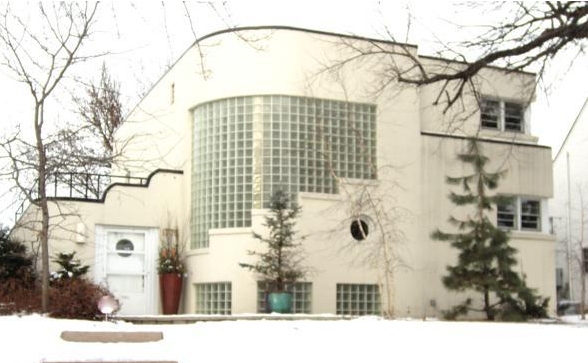
I blurted out to another shopper, “This place is really strange.”  “Yes!” she said. “What were they thinking?”

Right then I thought of the ongoing conversation with Dennis Aubrey of Via Lucis Photography about the Romanesque and Gothic churches that still inspire reverence and awe eight centuries after they were built.

Dennis: “One of the wonderful things about these [Gothic and Romanesque] churches was that they took so long to construct and design that the intellectual currents that drove the builders were deep and powerful, not short, erratic eddies of fashion.”

Dennis had posted a question about a contemporary artistic installation at the Church of Saint Hilaire in France.  Would the newly created installation at the Church of St. Hilaire stand the test of  time. Might it also come from sources that are “deep and powerful, not short, erratic eddies of fashion”? Would it stand the test of time as compared with Gothic and Romanesque structures with their high vault ceilings that lift our eyes and hearts to something else for which we human beings long?  I had shared with Dennis that I find most contemporary church architecture banal and uninspiring.

I wrote to Dennis: “The culture of individualism is NOT Romanesque or Gothic where the glory is directed away from the individual, where the individual gets to feel…well…very small, humble, rather insignificant in the best way. I, too, see wonderful works of contemporary architecture, and I hope I’m not just being a cranky old man here. The comment about banality is not about those magnificent creations but rather about what I believe is the prevailing dumbing down of our time that leaves us bereft of awe, the sense of grandeur, wonder, or humility [one feels in Gothic and Romanesque spaces]. There’s a flattening, a leveling of existence itself to human proportions. The belief in species superiority displaces everything that suggests otherwise. My comments, I think you know, are not so much about the new installation at St. Hilaire – which, in and of itself, strikes me as quite lovely – but more about the age in which we live where nothing much seems to be of lasting value.”

Dennis: “Gordon, I think it was a form of this ‘prevailing dumbing down’ that inspired us to these churches in the first place. I became increasingly disturbed by rampant      commercialism, when the point of commerce is to create obsolescence so that goods can be replaced whether necessary or not. Fashion and styling is substituted for value. PJ and I wanted to concentrate on something that had intrinsic value, and when we began exploring these churches in  2006, we found that something.

“One of my favorite books of all time is Raymond Chandler’s The Long Goodbye [published in 1953]. In it, there is a speech by the wealthy Harlan Potter:

“’You can’t expect quality from people whose lives are a subjection to a lack of quality. You can’t have quality with mass production. You don’t want it because it lasts too long. So you substitute styling, which is a commercial swindle intended to produce artificial obsolescence. Mass production couldn’t sell its goods next year unless it made what it sold this year look unfashionable a year from now. We have the whitest kitchens and the most shining bathrooms in the world. But in the lovely white kitchen the average American housewife can’t produce a meal fit to eat, and the lovely shining bathroom is mostly a receptacle for deodorants, laxatives, sleeping pills, and the products of that confidence racket called the cosmetic industry. We make the finest packages in the world, Mr. Marlowe. The stuff inside is mostly junk.’”

Well, the kitchens today aren’t just for the “housewives,” thank goodness, but the rest hit too close to home.

I think of the height of the Gothic arches and the things that will last when someone says at my departure “Dust to dust, ashes to ashes” and holds an estate sale.

I sit down with the Scriptures for something longer lasting than deodorants, laxatives, sleeping pills, or a plastic patio set.  I want something like the lasting value of the Gothic and Romanesque architecture “took so long to construct and design,” where “the intellectual currents that drove the builders were deep and powerful, not short, erratic eddies of fashion.”

I’m drawn to the English translation that preserves the clear distinction between the Divine and the human – the use of the archaic word “thou” for God. Like the vaults of St. Hilaire, the language lifts up my heart from the flat banality of our self-preoccupations and species grandiosity.
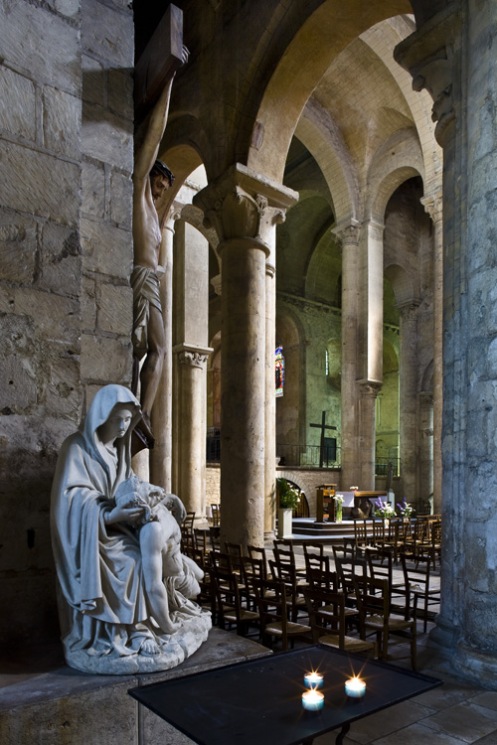
Basilique Saint Hilaire, Poitiers (Vienne) Photo by PJ McKey

“O Lord, how majestic is thy name in all the earth!

When I look at the work of thy heavens, the work of thy fingers,

The moon and the stars which thou hast established;

What is man that thou art mindful of him…?


O Lord, our Lord, how majestic is thy name in all the earth!” (Psalm 8)


“Lord, thou hast been our dwelling place in all generations.

Before the mountains were brought forth, or ever thou hadst formed the earth and the world,

From everlasting to everlasting thou art God.

Thou turnest man back to the dust, and sayest, ‘Turn back, O children of men!’

For a thousand years in thy sight are but as yesterday when it is past, or as a watch in the night.” (Psalm 90:1-4)