Simply Being Kind

If you’re not big on churches, read to the end of Hold to the Good‘s post re-blogged here on Views from the Edge. The author, John Buchanan, is Pastor-Emeritus of Fourth Presbyterian Church – Chicago, former Moderator of the Presbyterian Church (U.S.A.), and recently retired Publisher of The Christian Century.

Family of John M. Buchanan's avatarHold to the Good

One of the occupational hazards of the preaching vocation is that not everyone likes, or agrees with, what we say – particularly when we push on beyond the words of scripture to the behavioral and social ramifications. On occasion, rare to be sure, listeners tell us, in no uncertain terms that they did not like what we said at all. Sometimes it happens during that hoary church custom of greeting the preacher after the worship service, standing in line, shaking hands and saying, “Good morning, Reverend. I enjoyed your sermon.” It is heartfelt sometimes and sometimes it is simply a rote part of the greeting ritual but the sad fact is that we preachers become addicted to compliments however and whenever they come. When someone chooses the occasion to let us know they didn’t like the sermon at all, it hits us like a physical blow and we think about…

View original post 610 more words

Sermon – In the Desert

Devon AndersonFirst Sunday in Lent – February 14, 2016
The Rev. Devon Anderson, Rector, Trinity Episcopal Church, Excelsior, MN

The season always begins with the story of Jesus in the wilderness being tempted by the devil. The Gospel tells us that no sooner is Jesus baptized in the River Jordan than he is led away into the desert. Led away from the crowds, with his hair still damp, with the words of God still ringing in his ears, “This is my Son, the Beloved, with whom I am well pleased.”

Jesus’ forty days in the desert is a time unlike any other in his life. It is a time in between his anointing by God and the start of his ministry. Before he could start the work he had been given to do, a few things needed to be sorted out. In the words of Frederick Buechner “Jesus went off alone into the wilderness where he spent forty days asking himself the question what it meant to be Jesus.”

It is only after the forty days are up, only after Jesus is good and parched, good and exhausted, good and depleted that the devil shows up. The devil wasn’t stupid. He allowed Jesus some time wear down, time to exhaust his own resources. Maybe then, the devil thought, Jesus might be open to accepting a little help.

Years ago I spent some time in a desert like the one Jesus struggled in for 40 days. It was during a summer study course at St. George’s Anglican College in Jerusalem. Part of that program included a week in the Sinai desert exploring sacred sites and camping. As we crossed the border into Egypt, our Bedouin guides met us. Strapped to the top of each of their jeeps were the week “supplies” – a few dusty sleeping bags, some kerosene burners, gallon containers of water, and a small cage of live chickens, one that would be, each night for dinner, killed, plucked, gutted, and roasted. We loaded the jeeps and were off. In no time at all we were deep in the Sinai desert driving over sand and more sand, having left the one-lane highway and all civilization almost immediately.

After several days exploring and camping, we came to a mountainside, and our guides told us that the time had come when we would go our separate ways for awhile. We were to walk no more than 5-10 minutes in any direction by ourselves and spend an hour and a half in silence. At this point, the strident introvert in me leapt for joy – this was going to be awesome. Finally, what I had come for – some uninterrupted, focused, time to breathe and be with God.

I walked out into the craggy desert, found myself a shady rock to sit on and began to pray. I noticed at once was how silent it was. Obviously there were no planes overhead, or cars driving by with their stereo bass level turned up. My classmates had all but disappeared. There was also no wind, or birds or voices. It was so deafening quiet that I thought I could even hear the blood rushing through my body like a hum.

The second thing I noticed was the flies. How could I not? Here I was trying to commune with Jesus, all the while this annoying insect insisted on circling my head,

1

buzzing my ears, and trying with all its might to fly up my nose. The Gospel narratives never mention flies, but after my experience I am convinced they were Jesus’ fourth temptation. “You think you’re so holy? You think you’re the Son of Man? Try this little bugger on for size!”

The third and most important thing I noticed was how quickly I became lonely. Once I found a comfortable place to sit, I cleared my mind, sang all the songs I knew, drank water, fixed my hat, prayed all the prayers I could remember, I listened, I said more prayers, I listened. And after awhile the time was up. I stood up, stretched, and began to make my descent from the craggy rock upon which I had had quite a nice meditation.
But on the way down, I happened to glance at my watch and, good God, only 25 minutes had gone by. What was I going to do now??? How would I fill the next 65 minutes? I began to feel nervous.

Those of you who have spent time in a desert know: there is something about them that have the power to suck out your self-confidence. They are so big, so quiet and empty that one in comparison feels inconsequential and perishable. I was shocked and ashamed by how I had so quickly come to the end of what I could do myself to fill the space and quiet. I had run out of things to say and think and do, and all that remained was kind of an empty, low-grade panic. I did slog it out, and gratefully returned to our camp, live chickens and my annoying classmates never looking so good.

In hindsight, that experience was a bit of an epiphany. For I realized for the first time how I had, up to that point, done my best to avoid coming in contact with that empty, carved out space inside me. I had confused quiet and silence. I had avoided, at all costs, an awareness of where what I can do for myself ends and where my dependence upon God’s grace begins.

There Jesus was, in a desert not that far from the Sinai peninsula. He had just come from his glorious baptism, surrounded by crowds, affirmed and crowned by God – only to be led into a long, lonely time in the desert. During that time, God makes no appearance – there are no voices, descending doves, no reassurance. Only silence and that carved out empty space inside. Over forty days, Jesus gets to the bottom of his own reserves. It is precisely into this empty, hollowed-out place that the devil makes his appearance.

What is important about the devil’s temptations is the theme that ties them together. How the devil tempts Jesus, in three different ways, is with the provocation that Jesus deserves better than what God is giving him. That he, Jesus, has the power to provide for himself what he needs. That he doesn’t, ultimately, need God. Listen to the devil’s taunts: “Command this stone to become a loaf of bread.” Feed yourself. “See the kingdoms of the world. If you worship me, it will all be yours.” Make your own power, authority. Fashion your own worth. “Throw yourself down from the temple.” Protect yourself. With each taunt the devil dares Jesus to prove who he is by acting with the ultimate power of a god instead of a man. And with each taunt, Jesus resists, replies with an emphatic “no.” “I will not assume to provide what only God can give.”

2

Lent is a time unlike any other set aside for us to wrestle with the very same temptations set before Jesus. We are all vulnerable to the viral illusion that we can, ultimately, provide for ourselves. We are vulnerable to the idea that if we make enough money and invest wisely, we will be able to feed ourselves – provide all the sustenance and nourishment we will ever need. That we can, through our sheer determination, obtain what we need to fill ourselves in every way, buy what we need to make ourselves whole. We are vulnerable to the temptation that if we advance and distinguish ourselves in our professions, speak articulately, exhibit learnedness and intellectual capacity that we can win for ourselves authority and respect. That it is entirely up to us to create our own value and worthiness. We are vulnerable to the idea that if we buy the right car or car seat, install a home security system, live in the nice neighborhoods, put our kids in the right schools, if we keep our cholesterol down and choose the best health plan and doctors that we have the power to inoculate ourselves from the sadness and pain that are part of being human.

In her book, Things Seen and Unseen: A Year Lived in Faith, Nora Gallagher equates these temptations to fantasies, illusions that suck out our vitality, that keep us from discovering God’s rich reality. “To come to terms with illusion,” she writes, “is one of the great jobs of our lives: to discern what is fantasy and what is reality, what is dead and what is alive, what is a narcotic and what is food. It is dangerous, wrenching, and unavoidable. The seductive call of the Sirens was so compelling Odysseus lashed himself to his mast. In the desert, Jesus fought for his life. What is asked of Jesus is what is asked of us: that we give up illusion – its false promises and its addicting inertia – and come to our senses. That we, as Vaclav Havel would say, ‘live within the truth.’”

The devil’s agenda is to convince us that we can go it alone, that God is to us a pleasurable elective – something interesting and provocative to ponder, a presence that offers solicit in time of need. But Lent challenges us, right off the bat, to question ourselves. It is, after all, the season that derives its name from the old English word, lenten, meaning “spring.” It is not only a reference to the season before Easter, but also an invitation to a springtime of the soul. Forty days to cleanse our system of the illusion that we are in control, that what we ultimately need – to nourish our souls, prove our inherent worth, guard our lives — we can provide for ourselves. Forty days to open our eyes to the one holy and gracious God, by whose mercy alone we live and move and have our being. AMEN.


3

A Reflection on Terrorism

mccrackin_376x500

Copyright 1996 The Cincinnati Enquirer

A sermonic reflection on Luke 13:1-9

Ordinary citizens are not terrorists, are we?  We didn’t bring down the World Trade Center, kill and maim marathon runners and spectators at the Boston Marathon, or kill innocent co-workers in San Bernadino. The Rev. Maurice McCrackin answered that we are and we have, for reasons we’ll explain later.

Mac was informed by today’s Gospel reading (Luke 13:1-9) where Jesus addresses terrorism and urges his hearers to turn. “Unless you all repent, you will all … perish.”

It happens when some people inform Jesus “about the Galileans whose blood Pilate has mingled with their sacrifices.” The speakers seem to be contrasting the Galileans – known for their armed resistance to Roman rule, i.e. guerilla warfare – and the Jerusalemites.
Remember, Jesus himself is a Galilean!

The non-Galileans are putting him to the test. As he so often does so ably, Jesus, the Galilean Jewish rabbi, begins strangely by appearing to agree with their anti-Galilean prejudice. He asks whether these violent Galileans were any different from the rest of the Galileans. One can almost hear the applause from the more sophisticated, non-terroristic Jerusalemites.

Then he quickly shifts their attention to a scene in Jerusalem. He asks them if the eighteen saboteurs “upon whom the tower of Siloam fell, and slew them, do you think they were worse sinners than all others in Jerusalem?”

“No,” he says, “but unless you (plural) repent, you will all likewise perish.”

Sometimes reading a familiar text in a form much closer to the original context of Jesus’ linguistic-religious-cultural-political-economic context serves to awaken us to hear it differently.

Now … there were some present reporting to Rebbe, Melech HaMoshiach about the men of the Galil whose blood Pilate mixed with their zevakhim (sacrifices).

And, in reply, Moshiach said, Do you think that these men of the Galil were greater chote’im (sinners) than all others of the Galil, because they suffered this shud (misfortune)?

Lo (no), I say, but unless you make teshuva, you will all likewise perish.
Or do you think that those shmonah asar (eighteen) upon whom the migdal (tower) in Shiloach fell and killed them, do you think that they were greater chote’im (sinners) than all the Bnei Adam living in Yerushalayim?

Lo (no), I tell you, but unless you make teshuva, you will all likewise perish.
And Rebbe, Melech HaMoshiach was speaking this mashal. A certain man had an etz te’enah (fig tree) which had been planted in his kerem, and he came seeking pri (fruit) on it, and he did not find any. [YESHAYAH 5:2; YIRMEYAH 8:13]

So he said to the keeper of the kerem, Hinei shalosh shanim (three years) I come seeking pri on this etz te’enah (fig tree) and I do not find any. Therefore, cut it down! Why is it even using up the adamah (ground)?

But in reply he says to him, Adoni, leave it also this year, until I may dig around it and may throw fertilizer [dung] on it,

And if indeed it produces pri in the future, tov me’od (very well); otherwise, you will cut down it [Ro 11:23].

The Orthodox Jewish Bible (OJB) Copyright © 2002, 2003, 2008, 2010, 2011 by Artists for Israel International.

The ‘mashal’ (a familiar proverb or parable) he re-interprets is already part of his and his hearers’ self-understanding from Isaiah 5:2 and Jeremiah 8:13:

Jesus is speaking about collective social life – politics, economics, religion, resistance, keeping the faith – a whole society, a culture, a nation. He is calling for thorough-going societal transformation – turning from blaming others (the Galileans) to looking in the mirror to see the log that is in every eye: the underlying pervasive violence in our way of being in the world, taking up “ground” on this beautiful planet.

In Hebrew Scripture the human species, Adam, is derived from Adamah – earth, soil, dirt, ground. Humans, created in the image of God,  are to produce sweet figs. But the Owner of the vineyard with the barren fig tree shows two traits: deep disappointment – “Why is it even using up the ground?” – and an over-riding patience that allows it more time to produce the sweet figs it was intended to bring forth from the dirt (adamah).

As I look out the window this morning to the world outside, I feel a tiny shiver of God’s frustration and long-suffering. I read the paper, read my emails, look in the mirror, and take my morning shower wondering what it will take before we see the violence of terrorists in ourselves.

The Rev. Maurice McCrackin is the one soul I know who really dared to live what Rabbi Jesus preached about teshuvah (repentance).  Mac was Pastor of St. Barnabas Presbyterian Church, by far the poorest church in the poorest section of Cincinnati, until he was removed. But it wasn’t his daily work among the poor that brought him attention. Mac was a war tax resister. He refused to pay federal taxes -not because he didn’t believe in taxes. He did! In the name of crucified Jesus, the Prince of Peace, Mac refused to join in funding a “defense” budget that was, in fact, a war budget that supported state-sponsored international terrorism. “Ordinary citizens aren’t terrorists, are we?” Mac said we are, and, in the name of Jesus, the Prince of Peace,  and he was carried off to jail again and again and again. “To give financial support to war while at the same time preaching against it is, to me, no longer a tenable position.” His spirit was as free as anyone I’ve ever known.

Now … there were some present reporting to Rebbe, Melech HaMoshiach about the men of the Galil whose blood Pilate mixed with their zevakhim (sacrifices).

And, in reply, Moshiach said, Do you think that these men of the Galil were greater chote’im (sinners) than all others of the Galil, because they suffered this shud (misfortune)?

Lo (no), I say, but unless you make teshuva, you will all likewise perish.

How shall we make teshuvah?

  • Gordon C. Stewart, Chaska, MN, Feb. 27, 2016

The Prayer to the Right Hand of God

“And as they were stoning Stephen, he prayed, ‘Lord Jesus, receive my spirit.’ And he knelt down and cried with a loud voice, ‘Lord, do not hold this sin against them.’ And when he said this, he died.” [Acts 7:59-60]

Flesh and blood is weak and frail,” wrote T.S.Eliot in his poem “The Hippopotamus,” “While the True Church can never fail/ For it is based upon a rock.

We don’t know for sure whether Stephen, the martyr, was murdered by a mob or was executed with government sanction. We do know that he didn’t lose his life;  it was taken.  Yet he did not let the terror of “nervous shock” strip him of his faith or his humanity. Like Jesus, Stephen did the unthinkable as he died. “He knelt down and cried out with a loud voice, ‘Lord, do not hold this sin against them” [Acts 7:60].

The back story for Stephen’s death is a squabble between Greek-speaking Jewish Christians and Aramaic-speaking Jewish Christians about the fair distribution of the early church’s common wealth. To resolve the matter, the Apostles invited the people to choose seven men to be a kind of leadership council that would see to the needs of the community’s members. They chose Stephen, “a man full of faith and of the Holy Spirit, and Philip, and Prochorus, and Nicanor, and Timon, and Parmenas, and Nicolas a proselyte from Antioch… And when they had prayed, they laid their hands on them.”

Not long after that, false charges were made against Stephen from a few disgruntled factions.  Stephen, though flesh and blood and, like all flesh and blood, susceptible to nervous shock, was not deterred. He responded by reciting Israel’s history, but in doing so also pointed to their collective and habitual disobedience, particularly in the form of idolatry. He went so far as to call them “stiff-necked,” meaning hardheaded or stubborn. Not a good way to make friends or to influence your accusers.

Stephen was a bold witness who lost his life for the Lord’s sake only to find it. He paid the ultimate price and his testimony lives on even today, as in persecution the Church has spread across the world. There are others, too, however, who have testimonies in this story. The hands of those who participated in the murder and who stood by doing nothing are left with the crimson stain of innocent people. It is the German liberation theologian Dorothee Sölle who wrote in her book Suffering, “In the face of suffering you are either with the victim or the executioner–there is no other option.” Whether for good or evil, love or hate, health or dysfunction, protection or exploitation, we all have a testimony.

One of the lasting testimonies comes from a man named ‘Saul’, whom the Church remembers as ‘Paul’, who was there at the stoning of Stephen.

While Scripture doesn’t say that Paul hurled any stones, if you peek over to chapter eight, you will discover that Saul approved of Stephen’s murder. The fraudulent witnesses took off their coats and “laid them down at Saul’s feet”, improving the range of motion of their throwing arms like pitchers warming up in the bullpen. This same Saul was on a crusade to crush the Jesus movement until the heavens opened, struck him blind with overwhelming light, and spoke his name: “Saul, Saul, why are you persecuting me?”

It’s easy to judge those who laid down their coats at Saul’s feet, and to judge the young persecutor who was there at the stoning of Stephen. But we, too, throw our stones from a distance – not only the distance of time but at a fearful distance from the shock of our own flesh and blood reality and the shock of who we are.

Rembrandt's_Stoning_of_Saint_Stephen_(detail)Rembrandt’s first painting was of the Stoning of Stephen. A close look at the faces of the crowd reveals at least three self-portraits of Rembrandt peering out from the crowd, just behind a prominent executioner with a large rock ready to pummel the praying Stephen’s head. Rembrandt saw himself there, close up and aghast, among the stoners but sympathizing, it seems, with the one being executed.

Rembrandt_Harmensz._van_Rijn_150

You and I are also there in the story. Check the echoes of the “stoning of Stephen” in your own life. Perhaps you have participated in your own stoning through some debilitating sense of perfectionism and self-hate. In the courtroom of your own deepest self,  you have testified on behalf of the prosecuting attorney who calls you loathesome. Perhaps you have borne witness against yourself, not only unable to forgive the sins of others but standing as your harshest, most unforgiving, critic – serving as prosecutor, judge, and jury against yourself.

“And as they were stoning Stephen, he prayed, ‘Lord Jesus, receive my spirit.’ And he knelt down and cried with a loud voice, ‘Lord, do not hold this sin against them.’ And when he said this, he died.”

Like the Amish who tipped their hats as they passed by the home and the family of the man who had murdered their children in the West Nickel Mines Amish school house shooting 10 years ago, Stephen could only do this with divine help infusing his weak and frail flesh and blood susceptible to nervous shock.

What informed Stephen and what can direct us is Stephen’s vision of the crucified Jesus as the one who sits at the right hand of God. For the right hand of God is the hand of God’s power. But, according to Stephen’s testimony, God’s power is not like human power. God’s power is not the power of might or revenge. It is exercised in weakness. God’s power is exercised is long-suffering patience with the creatures God hands have formed.

Stephen accused his accusers of being “stiff-necked people” who broker no criticism, perhaps because they had mistaken the Holy One as the sternest of judges. With stones in hands, executing Stephen, or peering out as silent observers, like Rembrandt, they were stoning themselves.

The stoning scene in The Book of the Acts of the Apostles reads:

“[W]hen they heard (Stephen’s words), they were enraged and ground their teeth against him.”

“But Stephen, full of the Holy Spirit, gazed into heaven and saw the glory of God, and Jesus standing at the right hand of God; and he said, ‘Behold, I see the heavens opened and the Son of Man standing at the right hand of God.”

While his accusers and executioners picked up their stones, Stephen stood upon the Rock of his salvation: the faith that his future and the future of his killers lay in the hands of the One who sits at the right hand of God the Father Almighty, the Crucified Human One, our judge and our redeemer. It was this crucified Jesus, now seated at God’s right hand, who on the cross had become humanity’s defense attorney – “Father, forgive them, for they know not what they do” – whose cry inspired Stephen to breath his last in peace rather than in spite.

While we never hear again of Prochorus, Nicanor, Timon, Parmenas or Nicolas – the fellow first deacons chosen with Stephen – Saul, the participant in Stephen’s stoning, bore the fruit from which the gospel was carried into the world. Over time, Stephen’s vision and prayer to the right hand of God ate away at the heart and mind of the young man Saul who’d been entrusted with the coats of Stephen’s killers, and he, Saul, became Paul who, by grace, became the supreme witness to the defense, and opponent of all heartless prosecution.

The Church was built upon this rock amidst the mud of the hippopotamus and human flesh and blood. We proclaim with Stephen and with Paul that it is the crucified-risen Christ who sits at the right hand of God, and that because he does, there is hope for us and for the world.

  • Gordon C. Stewart, Chaska, MN.

Living Among the Wild Beasts

Samuel Clemons (“Mark Twain”) wrote in his autobiography words akin to the Gospel of Mark’s briefest description of Jesus’s 40 days and nights in the wilderness:

“With the going down of the sun my faith failed and the clammy fears gathered about my heart. Those were awful nights, nights of despair, nights charged with the bitterness of death. In my age as in my youth, night brings me many a deep remorse.

None of us is ever quite sane in the night. Our faith fails. The clammy fears gather in our hearts. Despair descends. It is into this primitive night of the soul that Jesus enters when Mark describes Jesus’s wilderness temptation with one line:

“He was with the wild beasts, and angels ministered to him.”

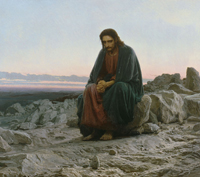
Christ in the Wilderness -Kramskoi

Christ in the Wilderness -Kramskoi

In Mark’s Gospel there is none of the later Gospel’s three temptations. Jesus simply enters that frightening solitude Gerard Manley Hopkins described as a miserable soul “gnawing and feeding on its own miserable self.”

The wild beasts of Mark and of the Hebrew Scripture are symbols representing the violence and arrogance of nations and empires: the lion that threatened David’s sheep; the lion with wings and a bear gnawing insanely on its own ribs in Daniel’s dream; a leopard and a dragon with great iron teeth destroying everything in its way. The beasts of Daniel and the Hebrew Scripture symbolize the deepest threats, threats to human wellbeing and existence itself. In Daniel’s dream, when the Ancient of Days takes his judgment seat and gathers the nations (wild beasts), they are as nothing before him, but “of his kingdom there shall be no end.”

Like Samuel Clemons, with the going down of the sun [our] faith fails and the clammy fears gather about my heart.

In his book Man Before Chaos Dutch philosopher-theologian Willem Zuurdeeg argues that all philosophy and religion is born in a cry. Whether the great philosophies of Plato or Aristotle or Hegel, whether Buddhism, Judaism, Islam, Christianity or what we arrogantly describe as ‘primitive’ religions; whether the political philosophy of Western democracy or Islamic theocracy or one or another economic theory – capitalist, socialist, communist, or communitarian – all philosophy and religion is born in a cry for help. It is the primal cry of human vulnerability, our  contingency, our finitude, our mortality. It is the cry for order, protection and meaning in the face of the chaos without and within.

Separated from all social structure and from all the answers that express or muffle the cry, removed from civilization and all distraction – no computers, no video games, no reading material, no play stations, no TV, no artificial noise, nothing unreal to distract him – in the wilderness of time, “he was with the wild beasts.”

“He was with the wild beasts” is a kind of cliff notes for Jesus’ entire life and ministry. He would dwell among the wild beasts – the unruly principalities and powers that defy the ways of justice, love and peace.  He lived and died among the wild beasts that mocked him at his trial – “Hail, King of the Jews!” – stripped him of his clothing, plaited a crown of thorns believing they had seen the end of him. But after the beasts of empire had torn him to shreds, he become for us the crucified-risen King whose love would tame us all.

There are times for each of us when the beasts are all too real, moments when faith falters, nights in the darkness when despair gnaws and paws at us, and hope has all but disappeared.

A young woman sits in the Atlanta airport. She is returning home from a year of study abroad. All flights have been delayed because of a storm. She is anxiously awaiting the final leg of her journey home. But home as she had known it no longer exits. Her mother and father have separated. Her father has entered treatment for alcoholism. She has entered a wilderness not of her own choosing. The beasts are tearing her apart. Her ordered universe has fallen apart.

She goes to the smoking lounge to catch a smoke. A stranger, her father’s age, sits down. He jolts her out of her fog. “Do you have the time?” he asks. As strangers are sometimes wont to do, they begin to talk. Unaware of her circumstances, he tells her that he is a recovering alcoholic, a former heavy drinker whose drinking was destroying his marriage until his wife became pregnant. The impending birth of his daughter snapped him into treatment and sobriety. “I thought I was going to die,” he says, “but it was the beginning of a resurrection, a whole new life.”

The young woman begins to feel a burden lifting. The stranger finishes his cigarette and disappears. She never gets his name.

The loudspeaker announces her flight’s departure. She boards her flight, and as the plane rises through the clouds, she finds herself momentarily sandwiched between two sets of clouds – one below, one above – and the space between is filled with rainbow light, a world whose grandeur and grace exceed all reasons for despair. She is strangely calm in the face of what lies ahead. A sense of peace descends. She is sure that the man has been given to her as a gift. She has been with the wild beasts. An angel has ministered to her.

During these 40 days and nights of Lent we live more consciously with the wild beasts, praying that the angels of our better nature will minister to us in the wilderness of time, dreaming with Daniel and Jesus of the Ancient of Days taking his judgment seat and gathering the nations. They are as nothing before him, but of his kingdom there shall be no end.

  • Gordon C. Stewart, Chaska, MN, Feb. 14, 2016.

Sermon on most divisive Christian claim

“I am the way, the truth, and the life; no one comes to the Father but through me [Jesus]” is sometimes used as a billy club, as in, “if you believe, you’re ‘in’ – if you don’t, you’re ‘out’.” According to Matthew Myer Boulton, the statement has nothing to do with belief. Read in context, this line in the Gospel According to John is the opposite: an assurance of divine comfort and inclusion.

Matthew (“Matt”) Myer Boulton, President of Christian Theological Seminary in Indianapolis, is the son of Wayne and Vicki Boulton, friends of Gordon and Steve for 51 years. Matthew’s leadership is a source of great joy. He is the author of God Against Religion and Life in God.

In Defense of Darkness

INTRODUCTION: Every few years a sermon knocks my socks off. This unusual sermon by The Rev. Devon Anderson was heard last Sunday at Trinity Episcopal Church in Excelsior, Minnesota. The text is Luke 3:1-6. Disclaimer: the sources for the sermon are listed at the end; the text itself does not include footnotes and does not always include quotation marks.

___________________

A few weeks ago I was in Baltimore at a church meeting held at the Maritime Institute of Technology’s conference center. The institute teaches how to pilot everything from a tugboat to the biggest of seafaring barge. During our meeting my friend Ernesto discovered that the Maritime Institute boasts two “full mission, ship handling” simulators. With a bit of sweet talk, he finagled a tour.

The simulators are housed inside huge 80X30 feet curved projection screens (kind of like an iMax theater). Inside is constructed an actual bridge – the literal steering wheel, radar, and control panels that any barge of that magnitude would have. We stepped onto the bridge in darkness. But after our guide punched some buttons and threw a few switches, the lights came on and we were – in an instant – ship captains, navigating an industrial barge through Baltimore harbor. Ernesto and I took turns serving as captain and first mate.

At some point our tour guide started to mess with us. “Hmmm…,” he said, “it looks like it’s about to rain.” A few buttons, a few switches, and the sky began to darken, as virtual raindrops misted the windows. “Hmmmm…,” he said again, “I think we’re heading for a bit of a hurricane,” and all of a sudden we were in the open sea gazing back at the Maryland coastline, as the waves swelled, and the barge dipped and rocked deeper and deeper. “Oh no,” said our host, clearly enjoying himself in the face of our growing panic, “it looks like the hurricane knocked out power in Baltimore.” As he said it, the control panel, too, flashed and went cold as the sound of the engines cut out. In an instant everything went black. I mean, really black. Out of the darkness came the voice of our guide, “Hmmm…what are you going to do now?” We drove the barge around in the dark for a while – which was terrifying — as the hurricane subsided. Eventually the click click click of buttons and switches cleared the night sky, and from the darkness emerged a million sparkling stars. “When everything goes dark,” our guide told us, “a good pilot slows down and watches for what can help him.”

Hmmm….I’ve been thinking about that virtual darkness out on the virtual sea these past weeks. Advent always happens in the darkest of days, as our little place on the planet moves further and further away from the sun. This time of year, we know a lot about darkness. Our Advent scriptures reflect that. So much of what we read in Advent is about darkness and our thirst for light. “The Lord is my light and my salvation…(Ps 27:1)” writes the psalmist, “the fountain of life in whose light we see light (Ps 36.9). “The people who walked in darkness have seen a great light; those who lived in a land of deep darkness – on them light has shined.” (Is 9:2). And even today John the Baptist calls the people out into the cold, dark, desert night so they are ready for the light that will save them all. In so many of our Advent stories, the message is the same: the light of the world has come to put an end to darkness, to be a lamp in the hands of those who believe. Like myself, I know so many people whose lives depend on that promise – when we can’t see where we are going; when the bottom drops out; when our prayers go unanswered and we’re marooned in the kind of darkness that makes us afraid to move – we cling to the promise that if we can just keep our minds focused on the light of the world then sooner or later God will send us some bright angels to lead us out.

And yet – deep in our holy scriptures there lives an equal and opposite truth that almost never comes up in church: that God dwells in deep darkness. God comes to the people in dark clouds, dark nights, dark dreams and dark strangers in ways that sometimes scare them half to death but almost always for their good, or at least, for their transformation. God does some of God’s best work in the dark.

We have been conditioned to view darkness as a negative, symbolizing what’s sinister, or dismal, or tragic or wrong. It was a really dark film. We’re in a really dark place right now. He’s gone to the dark side. No one ever asks God for more darkness, please. Please God, come to me in a dark cloud. Give me a dark vision. Please eclipse the sun and throw life as I know it into complete shadow. Put out my lights so I can see what I need to see. Then, send me a dark angel on the worst night of my life, please.

And no one asks for darkness in the Bible, either, but it happens. Once you start noticing how many things happen at night in the Bible, the list grows fast. God comes to Abraham in the dark, instructing a series of desired sacrifices then sealing the covenant with the people Israel forever. God comes to Jacob in the dark not once, but twice – the first in a dream at the foot of a heavenly ladder, and the second on a riverbank where an angel wrestles him all night long. The exodus from Egypt happens at night; God parts the Red Sea at night; manna falls from the sky in the wilderness at night – and that’s just the beginning.

The cloud and the glory always seem to go together – not just in the Hebrew Scriptures, but in our Gospels, too. Ask Jesus’ disciples Peter, James, and John who entered another cloud on another mountain where they too were overshadowed by the glorious, terrifying darkness of God. Ask Saul the ferocious who was blinded on the road so he could be led by the hand to a hard bed in a rented room, where he finally became soft enough to welcome a dark angel named Ananias. Ask Mary how her life – and the life of the whole world – changed when the savior of the world was born in that scary, darkest hour just before dawn. Ask Mary Magdalene who, in her insurmountable grief, discovers the risen Christ. “Early on the first day of the week, while it was still dark…” the discovery of resurrection begins.

It’s not a popular truth, but there it is: God dwells in deep darkness. When we cannot see – when we are not sure where we are going and all our old landmarks have vanished inside the storm – then plenty of us can believe we are lost and forgotten. But what I am asking you to consider is an additional theology – that when we find ourselves in darkness, we may be the exact opposite of lost and forgotten. Based on the witness of those who have gone before, we know that darkness is where God most often restores us when our lives have broken apart. It is the cloud of unknowing where nothing we thought we knew about God can prepare us to meet the God who is. It is in darkness where new life, no matter how shattered, is born.

There are real benefits to this kind of faith, though they may not appeal to those for whom God can only be light (and in whom there is no darkness at all). The first benefit is that we have to slow way, way down when we find ourselves in the dark. When the kids were little we took them to visit Crystal Cave in western Wisconsin, right off I-94. It’s campy as all get-out, but it’s been around as a tourist attraction for a long time, first discovered in 1881. Just like any cave or mine tour, visitors must walk down flight after flight of industrial stairs, down, down, down – 70 feet in this case — into the damp, drippy earth. At some point the guide flips off the lights so everyone can get a feel for how dark the dark can be – like, can’t see your hand in front of your face dark. Anyone that’s been on one of these tours knows – the minute those lights go out, everyone freezes. There’s just no running around in dark like that. All the things we pride ourselves on in the light outside – our speed, our agility, our ability to talk fast and get things done – they don’t help us one single bit in that kind of darkness. Darkness forces us to slow down and use senses we don’t use when our eyes are working in the light of day. Darkness like that sharpens our senses, hones our awareness, makes us hyper-sensitive to God’s light touch.

Another benefit of faith in darkness is teaches that none of our outside navigational tools can, in the end, really help us. Just like when the power went out in the virtual Baltimore harbor – when we hit real darkness, external things we depend upon in the light of our normal lives to keep us safe and secure, no longer work. If it’s not already inside us, then it’s of limited use to us in the dark places. Once we enter darkness we find out what our primary resources are: love, hope, vulnerability, openness, and what insistent, sacred whisper we can learn to trust when we’re navigating by faith and not by sight. We learn in that place to trust more supremely what only God can do for us, over what we think we can do for ourselves.

And finally, inside darkness with everything slooooowed waaaay doooowwn, depending on what’s inside ourselves to feel our way forward, the good news is that God has room and time and enough of our attention to bring forth new life – an entirely new thing that didn’t exist before dark descended. One of my favorite paintings of all time is from Van Gogh’s olive tree series, housed in the permanent collection of the Minnesota Institute of Arts. A light, lavender punctuates the painting in rows between trees and in the background mountain scape. Apparently Van Gogh considered the lavender a color of “consolation” (his word) in that he felt the color was not its own entity, but created by the stormy confrontation of darkness weakened by light. The new creation only possible because of darkness.

I know my defense of darkness will never, ultimately, sell. Endarkenment is never going to appeal to anyone the way enlightenment does. But for those who are already sitting in the dark, and for those of us who know that at some point we’ll be there, too, to consider the possibility that God dwells there with us is Gospel Good News indeed. And, in the end, I do know this: the thing about the cloud of unknowing, which even the saints take on trust is that it’s not there to get through like a test or a fever. It is God’s home. It is the place where God dwells. To be invited in is a great honor, and to stay awhile? Better yet. When sitting in darkness, we never feel that it’s a great honor – it’s the last place any of us want to be. But I do know this: that for those who make it out the other side, while they may not have a lot of words to describe where they have been, and they’ll tell us they never would have chosen it in a million years – they do have a great story to tell and more than not it’s a story that includes redemption and healing, regeneration and a new wisdom. They might just tell us that now that it has happened they would never give it back. AMEN.

Sources:

The brilliant idea and direct quotes about God doing God’s best work in the dark are excerpted from Barbara Brown Taylor’s Learning to Walk in the Dark (2014), an excellent read that I highly recommend.

The Maritime Institute of Technology’s website (click HERE) has interesting information about its simulator-based training programs.

Van Gogh’s approach to the cover lavender is commented upon by Goethe in the book Goethe’s Way of Science by David Seamon: “…this reciprocity between darkness and light points to the ur-phenomenon of color: Color is the resolution of the tension between darkness and light. Thus darkness weakened by light leads to the darker colors of blue, indigo, and violet, while light dimmed by darkness creates the lighter colors of yellow, organize, and red. Unlike Newton, who theorized that colors are entities that have merely arisen out of light (as, for example, through refraction in a prism), Goethe came to believe that colors are new formations that develop through the dialectical action between darkness and light. Darkness is not a total, passive absence of light as Newton had suggested, but, rather, an active presence, opposing itself to light and interacting with it. Theory of Color presents a way to demonstrate firsthand this dialectical relationship and color as its result.”

Sermon: Testify to the Truth

Yesterday’s Christ the King Sunday sermon by Rev. Anne Miner-Pearson on John 18:33-37 at Trinity Episcopal Church in Excelsior deserves a greater audience. We’re pleased to publish it on Views from the Edge.

“Testify to the Truth”

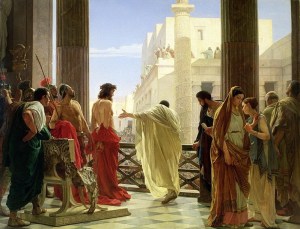
Pontius Pilate with his Prisoner - Antonio Ciseri

Ecce homo – “Here is the man”

Pilate and Jesus are an odd couple. We usually meet them in Holy Week when their conversation is part of Jesus’ journey to his crucifixion. Because Good Friday and the cross are looming closer and larger, we pause only briefly in Pilate’s headquarters. But today is Christ the King Sunday and we encounter this odd couple under different circumstances. We are on the cusp of the Church year – the end of 52 Sundays facing into Sunday, Advent I, awaiting God’s move to enter human flesh as Jesus, beginning his life in birth like us, and ending his life in death like us.

Yet, before our church year begins, tradition asks us to pause and hold on to the bigger story of Jesus. There is a larger and more eternal back-story to the one that opens with shepherds, a star, some straw in a manger and even Mary. There is another birth story in John’s gospel and we enter toward the end as Pilate and Jesus talk. What an unlikely conversation it is. Pilate, Pontius Pilate, the 5th prefect of the Roman province of Judaea calls – no, “summons” – an accused religious heretic to his headquarters. Pilate has already questioned the Jewish leaders and could be done with the matter. Undoubtedly, he has more important issues awaiting his attention than dealing with the process leading to a crucifixion. They happen all the time and aren’t on his radar.

So, they are an odd couple. A man with impeccable Roman familial and political credentials, Pilate stands in expensive robes, perfumed and fresh from his morning bath. Jesus’ home address is Nazareth. His profession listed as carpenter. His clothing hardly deserve the name – practically rags after the torture and stripping, smelly from sweat and blood. But Jesus is no country bumpkin. He knows at least 4 languages – Aramaic, Hebrew, Greek and the Latin he uses with Pilate. However, Jesus’ linguistic skills don’t make him a king. Yet, that is the direction the conversation goes.

“Are you the king of the Jews?”, Pilate begins, a question Jesus later returns to. “My kingdom is not from this world.”, Jesus answers. “So you are a king?”, Pilate inquires. With that question, Pilate introduces what makes him and Jesus the oddest pair. They are both “kings”, but the descriptions are polar opposites: Power-Love, Higher-Lower, Divided-One, Hold on-Give away, Boundaried-Open, Petty-Generous, Unjust-Just, Manipulating- Embracing, Triumphant-Humble.

Yet, Jesus, without actually answering, takes the title of “king” in a whole different direction. “For this I was born, and for this I came into the world, to testify to the truth.” Here Jesus tells his own “nativity” story, but remember, this is John’s gospel. To understand what Jesus is saying to Pilate as his earthly life is about to end, we have to go back to the beginning, way back to the beginning to understand Jesus’ kind of king.

“In the beginning was the Word and the Word was with God, and the Word was God. He was in the beginning with God. All things came into being through him, and without him, not one thing came into being. What has come into being in him was life, and the life was the light of all people….. And the Word became flesh and lived among us…”

Jesus understands himself as king and where his kingdom is from radically different. Pilate doesn’t get it. The crowds don’t get it. Even Jesus’ close disciples haven’t gotten it yet. In that humble peasant, from the virgin womb of Mary, God entered the world, breaking through all categories, possibilities and imaginings. The Word of God who first spoke all creation and universes into being now has spoken again. A second holy Word took form but this time the birth came as God was and is willing to become empty. The apostle Paul captures it in the mystical hymn in Philippians: “…thought he was in the form of God, did not regard equality with God… but emptied himself, … being born in human likeness.” Jesus’ kingdom is not from this world, but in this world, grounded in and flowing from the eternal God, what we now call the Trinity: God, Creator, God, Christ, and God, Spirit.

It’s like when God birthed the created worlds, God already had another birth in mind. God’s Word would speak another creation. The Spirit Breath who give human life and form from the dust was not finished. The Trinity was not complete until the human experience could join in the circle, the abundant, ever-flowing Love. And now God’s experience in human form nears the end, the pain and suffering of crucifixion.

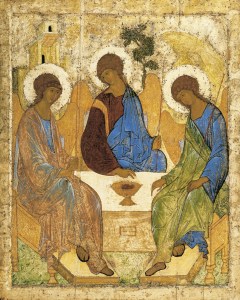
But, ponder this thought by a contemporary mystic, Bernadette Roberts. Maybe the hardest thing for Jesus was not the crucifixion, but the incarnation – to leave the circle and connection of Love to learn and teach how to hold on to and live in that flow of Love caught in bodily form. And we can picture that Circle, can’t we, the world of Christ the King, the kingdom Jesus is from. It’s the picture we see on the icon of the Trinity by Rublev.

Angels at Mamre Trinity, Rublev

Angels at Mamre Trinity, Rublev

We all know it – the beloved the one we take with us on vacation and hold up for photos on Facebook. I brought my personal one this morning and it’s on the altar. It was “written” in 2000, (the verb used when making an icon) by Eugenia. At that time, she was imprisoned in the largest women’s prison in Europe, outside of St Petersburg, Russia. Her crime was counterfeiting. However, Father Nicolai, pastor to the prison, thought her counterfeiting skills could be redeemed. Released under Father Nicolai’s watch, Eugenia was taught icon “writing” to help support her 3 daughters. Before she paints the copy of an icon, Eugenia goes through all the traditional rituals, including prayer and fasting.

Through the vision of a monk on Mount Athos, Greece, around 1260, and the hand and heart of an alcoholic felon, we see the “dance of the Trinity” – gathering in communion, gazing in a circle of love, pouring out within and beyond that Love to all creation. Given the three figures dominating the scene in their bright robes and adoring gazes, perhaps you have missed a small detail in the icon. I have. It was just pointed out to me recently. It’s under the table, a small brown box.

An ancient story about the the Rublev icon is that originally there was a mirror on top of the box. So, as one sits in front the icon and ponders the kingdom of God, the Trinity, one is able to see oneself as the fourth figure in the circle, at the table, in the flowing love always moving, expanding, tumbling out to all creation, in all time. From the beginning, God envisioned a fourth place in the Love.

Jesus said, “For this I was born, and for this I came into the world, to testify to the truth.” “Pilate asked him, ‘What is truth?'” Jesus spoke no answer that day. His life was and is the answer. The truth Jesus lived and died is that each of us, Eugenia, Pilate, all people have a place at God’s Table, in God’s heart, in Christ the King’s kingdom. Our response is to see ourselves in the mirror and claim our place. Amen.

The Movement Made the Man (MLK)

Martin Luther King, Jr. did not make the civil rights movement. As Elizabeth Myer Boulton reminds us, it was the movement that made the man. Without the movement there would have been no “I Have a Dream Speech”.

Elizabeth (Liz) Myer Boulton’s spouse, Matthew Myer Boulton, President of Christian Theological Seminary, hosted five McCormick Theological Seminary classmates this past week, including Steve Shoemaker and me.

I returned from Indianapolis and found Liz’s powerful sermon. It reminded me of Kay and my month in Saint Augustine.  It was the unsung local heroes who built the movement, paid the price, and drove the buses to the Poor People’s March on Washington. Martin represented them all.

– Gordon C. Stewart, Chaska, MN, May 23, 2015.

Warning: Danger Ahead

If you’re interested in a homiletic case consistent with Bernie Sanders, check out the Rev. Ed Martin’s sermon at Shepherd of the Hill Church in Chaska, MN. It’s superb.