GUEST POST: I went to Gordon College and My Roommate was Gay

Haddayr Copley-Woods posted this on her blog. Haddayr is a writer published by many venues, including aired commentaries on Minnesota Public Radio’s “All Things Considered” program. In light of Views from the Edge’s recent posts on the topic of religion and sexuality, we’re glad to share this first-person story of a student’s dilemma at Gordon College.

American Religion and LGBT Rights

Common Good News, an online publication of Faith in Public Life  and Convergence, re-published and interesting piece today from ThinkProgress. Click The Rise of LGBT Rights is an Existential Threat to Conservative Religious Groups for a thoughtful read following the Presbyterian Church (U.S.A.)’s re-definiton of marriage and news of the election of a Lesbian Rabbi to lead the Central Conference of American Rabbis.


Church approves gay marriage

Yesterday the Presbyterian Church (U.S.A.) approved an amendment to its Constitution that re-defines marriage as a covenant between two people.

As a Presbyterian pastor since 1967, this debate has been a matter of long-suffering disappointment, prayer, and hope. At long last, the church opened its heart to all of its members. Questions of how to move forward in ways that do not disparage the conscience of dissenters and how to prevent further withdrawal of dissenting PC(USA) congregations provide no ready answers. Perhaps the fifth of the PC(USA)’s Historic Principles of Church Order (approved at the founding General Assembly of the Presbyterian Church in 1789) may yet guide the church today and in days to come.

…[W]e… believe that there are truths and forms with respect to which people of good characters and principles may differ. And, in all these we think it the duty both of private Christians and societies to exercise mutual forbearance towards each other. [Book of Order, Presbyterian Church (U.S.A.)

Forbearance is an increasingly foreign attribute in the church, the nation, and the world.  One prays and hopes that forbearance would prevail as we work our way through the thistles and nettles of the spiritual, ethical, national, and geopolitical issues of conscience that trouble and divide us.

– Gordon C. Stewart, Chaska, MN, March 18, 2015

Marriage – a covenant between…

Yesterday the Presbyterian Church (U.S.A.) – PC(USA) – approved amending its constitution to define marriage as “a covenant between two people.

Click THIS LINK for the New York Times story, “Largest Presbyterian Denomination Gives Final Approval for Same-Sex Marriage”.

Many, such as I, welcome this change after many years spent in local and national discussion and debate over the nature of biblical authority, biblical interpretation, and the nature of human sexuality.  This morning passersby on State Highway 41 and Engler Boulevard in Chaska, MN will see two flags flying high at Shepherd of the Hill Presbyterian Church: the Presbyterian Church (U.S.A.) flag and, beneath it, a rainbow flag signifying God’s welcome of all.

The church’s re-definition of marriage adds one more enlarging freedom to the Apostle Paul’s list in the Epistle to the Galatians:

“There is no longer Jew or Greek, there is no longer slave or free, there is no longer male and female, [gay or straight]; for all of you are one in Christ Jesus.“- Galatians 3:8 {NRSV].

Thanks be to God.

– Rev. Mr. Gordon C. Stewart, Honorably Retired, Presbyterian Church (U.S.A.), Chaska, MN; March 17, 2015.

Our Lady of the Crusades Redux


Crusader Madonna and Child courtesy of Via Lucis Photography (Dennis Aubrey and P.J. McKey)

Crusader Madonna and Child courtesy of Via Lucis Photography (Dennis Aubrey and P.J. McKey)How differently people of different times view life is masterfully illustrated by Dennis Aubrey’s post . .Dennis Aubrey’s post .

Dennis Aubrey’s post The Throne of Wisdom demonstrates how peoples’ views of life are shaped by their times in history.

During the Crusades, Mary and the Jesus of the Gospels become the authorization for killing Muslims. The executed Jesus of Nazareth becomes the Knight Templar, angrily taking up the sword against the unbelievers. Mary, the iconic “Mother of God” of Catholic and Orthodox Christian veneration, is turned into the Mother of Christian Jihad.

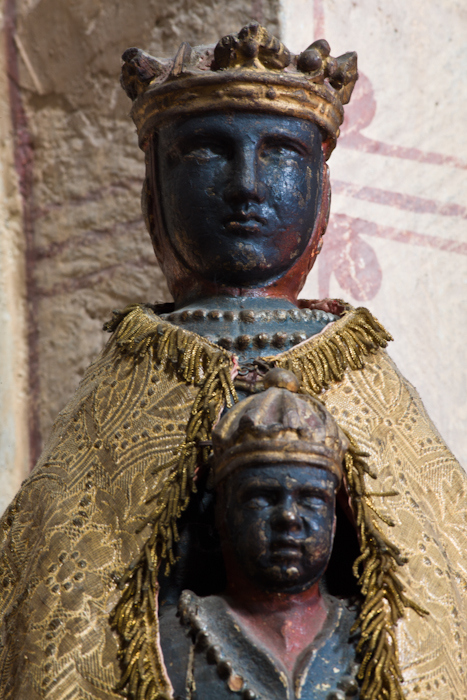
Pictured below is an altogether different Madonna  (12th Century from Notre Dame de Vauclair, Église de Molompize, Molompize [Cantal] Photo by Dennis Aubrey) who seems to be looking with horror at what is happening.

Notre Dame de Vauclair, Église de Molompize, Molompize (Cantal) Photo by Dennis Aubrey

Notre Dame de Vauclair, Église de Molompize, Molompize (Cantal) Photo by Dennis Aubrey

There is a great struggle today over which Madonna to enthrone.  Our Lady of the Crusades is back. For example, click HERE for Sen. Tom Cotton, author of the letter to Iran signed by 47 U.S. Senators, interviewed by CBS host Bob Schieffer on Face the Nation.

Thanks to Dennis and P.J. for prompting this post. When we look carefully at where we come from, we sometimes see the darkness today in the clearer light.


Barack Obama after the Presidency?

Quote

Ever wondered what President Barack Obama will do after he leaves office? 

The President’s 50th Anniversary of “Bloody Sunday” speech in Selma, Alabama is a masterpiece in the tradition of the Church of the Bridge (see earlier post “The Church as Bridge” on Views from the Edge). Think of the President as pastor-preacher in the prophetic preaching tradition that speaks truth to power, celebrates hope, honors courage, and preaches a gospel that calls us all to cross the Pettus Bridge toward the world for which our hearts yearn.  The President’s speech was, in fact, a sermon rooted in Hebrew and Christian Scripture, freely quoted from memory.

Click HERE to hear the President on the Edmund Pettus Bridge in Selma, Alabama.

“Wait a minute!” – Tributes to Fred Craddock

Fred Craddock

Fred Craddock

Fred Craddock, one of America’s great preachers who died last Friday, was honored Sunday by CNN. Click HERE to see the CNN video and written tribute.

In this post on Views from the edge, two other preachers influenced by Fred Craddock share their stories.  The first came by email from McCormick Theological Seminary classmates and friend Harry Strong, recently retired, in Prescott, Arizona:

Fred may have been small in stature, but he was truly a homiletical giant! I still remember sitting with him and Barbara Brown Taylor in a preaching seminar back in 1985 at Kirkridge in eastern Pennsylvania. Fred was talking about the texts in Mark that made you want to interrupt Mark’s narrative and say, “Wait a minute … wait a minute! Mark, you can’t drop that sentence to the middle of the story and then move on!” One I especially remember was Mark 6:48  — “When (Jesus) saw that they were straining at the oars against an adverse wind, he came towards them early in the morning, walking on the sea. He intended to pass them by …” And Fred interjected: “Mark! Wait a minute! Wait a minute! ‘He saw them straining at oars … he came towards them, walking on the sea – and HE INTENDED TO PASS THEM BY???’  Where the heck was he GOING??!!

A second email arrived from Bob Young who once served as Pastor First Presbyterian Church in Enid, Oklahoma. Bob is no retired in Corsicana, Texas:

Fred Craddock lived a block away from me in Enid. I chaired the Fall Festival of Faith for the Council of Churches one year. Fred was our preacher. It was a treat to work with him. We met several times to prepare the liturgy for the services. He often preached at the chapel services of Phillips Theological Seminary where I was an adjunct. He ALWAYS — and I mean ALWAYS — left us as people who knew we had overheard the Gospel again. We laughed and cried and listened with wrapt attention. I hate to admit this, but one time, as he began to preach, I said to myself “I will not let him hook me today. I will just sit here and be stoic.” By the end of the sermon I had tears in my eyes. In my experience he simply could not be ignored. When he preached, barely visible behind a pulpit in that squeaky little voice, everyone listened. Amazing just amazing.

I was at the funeral he preached for a Phillips faculty member who had battled cancer for years. Still gives me goose bumps. A very fine, humble, amazingly gifted and faith-filled gentle man. I have been rereading Cherry Log Sermons and the book of his “parables.” Whew!

Quite independently of each other, Harry and Bob each ended his email by calling attention to Fred Craddock’s Cherry Log Sermons.

Thank you, Fred, for your long ministry of thoughtful humor and tears. “Well done, good and faithful servant….Enter into the joy of your Lord” [Matthew 25:23].

– Gordon C. Stewart, Chaska, MN, March 11, 2015.

The Church on the Bridge

Pettus Bridge, Selma to Montgomery

Pettus Bridge, Selma to Montgomery

If some churches are like opium dens, others are like Pettus Bridge, the bridge over the Alabama River you must cross to get from Selma to Montgomery, Alabama.

In the history of America’s civil rights movement, Pettus Bridge and the events of “Bloody Saturday” represent a crossing over from the society addicted to violence, hatred, and war to “the peaceable kingdom” of Isaiah. Think Jesus. Think Martin Luther King, Jr. Think Congressman John Lewis. Think all the anonymous souls who dared to cross the bridge from here to there.

“Have we not come to such an impasse in the modern world that we must love our enemies — or else? The chain reaction of evil — hate begetting hate, wars producing more wars – must be broken, or else we shall be plunged into the dark abyss of annihilation.” [The Rev. Dr. Martin Luther King, Jr.]

I suspect Karl Marx never knew a church like that. What he saw was religion as a tool of the powerful, an ideological overlay on reality to keep their subjects compliant with the existing social order.

The church of the bridge is no opium den. No one is doped up. No one is in a stupor. People don’t go there to hide. It is by nature a place that calls for commitment and action. The Church as Pettus Bridge is spiritually, economically, politically, and culturally revolutionary. It requires far-reaching transformation of people, structures, and systems. It’s a risky place. The church on the bridge requires you to put your whole body, mind, and soul on the line – on the  bridge – fully conscious that the troops the old social order will come after you. It is the church of Jesus and the prophets, and of Paul at his best:

I appeal to you therefore, brothers and sisters, by the mercies of God, to present your bodies as a living sacrifice, holy and acceptable to God, which is your spiritual worship. Do not be conformed to this world, but be transformed by the renewing of your minds, so that you may discern what is the will of God—what is good and acceptable and perfect. [Epistle to the Romans 12: 1-2, NRSV]

Every time the Church of the Bridge gathers for worship, the pews are filled with people wearing crash helmets. They expect something real to happen. They expect to make it happen. When they gather around the Lord’s Table for Eucharist, they know what they are celebrating: “the peaceable kingdom”, the City of God on the other side of violence, hatred, and war that puts them on the bridge.


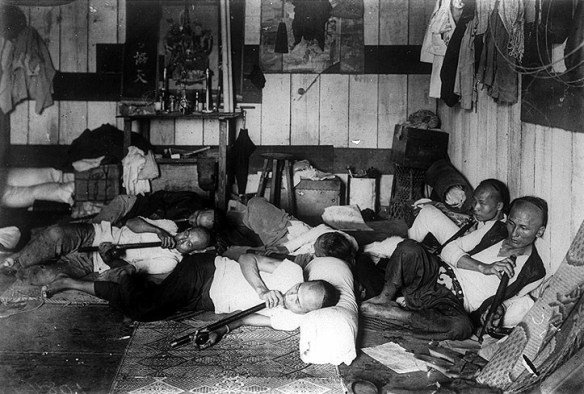
The Church as Opium Den

Opium Den, Manila, Philippines

Opium Den, Manila, Philippines

In our previous post “Just a Bunch of Hypocrites” we promised further commentary on the American religious landscape. Randy Beckum’s sermon — posted earlier today as “American Sniper, Selma, and Jesus” — followed the courageous preaching examples of William Sloane Coffin and Martin Luther King, Jr. He turned the Chapel of MidAmerica Nazarene University into Annie Dillard’s kind of place where worshipers are learning they’d better bring their crash helmets to church.

Chaplain Beckum’s body language communicates that he knew his sermon wasn’t meeting the standard expectations of the worshipers. There are moments where his hands take the lapel of his sport coat to draw his coat like a shield around him against the arrows coming his way. “He will cover you with His pinions, And under His wings you may seek refuge; His faithfulness is a shield and bulwark. You will not be afraid of the terror by night, Or of the arrow that flies by day.” [Psalm 91:5]

So, one wonders, what might they, or other chapels and churches where a certain kind of American-Christian gospel, expect when they gather?

Imagine the Opium Den

The real world is hard. It’s disturbing, if you pay attention to all the bad news, and it’s often personally painful. Sorrowful. We need to be lifted up. Given a reprieve. Assured that all is as it should be, that “God’s in his heaven and all’s right with the world.”

In many evangelical Protestant churches the messages from the pulpit, the music, and the prayers put people into a Christian nationalist stupor. God, America, Christianity, and Capitalism are like strands of a ball of yarn, indivisibly entangled.

These are the forms of religion the exemplify Karl Marx description of religion as “the opiate of the people.” The opium dens are places folks went to smoke themselves into another world, the temporary illusory high manufactured by the human mind under the influence of opium. The Opium Den – the flights into another world – are escapes from real life that allow the systems and sources of human suffering to continue without conscious criticism and the actions necessary to overcome them.

Religious suffering is, at one and the same time, the expression of real suffering and a protest against real suffering. Religion is the sigh of the oppressed creature, the heart of a heartless world, and the soul of soulless conditions. It is the opium of the people.

The abolition of religion as the illusory happiness of the people is the demand for their real happiness. To call on them to give up their illusions about their condition is to call on them to give up a condition that requires illusions. The criticism of religion is, therefore, in embryo, the criticism of that vale of tears of which religion is the halo.

Criticism has plucked the imaginary flowers on the chain not in order that man shall continue to bear that chain without fantasy or consolation, but so that he shall throw off the chain and pluck the living flower. The criticism of religion disillusions man, so that he will think, act, and fashion his reality like a man who has discarded his illusions and regained his senses, so that he will move around himself as his own true Sun. Religion is only the illusory Sun which revolves around man as long as he does not revolve around himself.

It is, therefore, the task of history, once the other-world of truth has vanished, to establish the truth of this world. It is the immediate task of philosophy, which is in the service of history, to unmask self-estrangement in its unholy forms once the holy form of human self-estrangement has been unmasked. Thus, the criticism of Heaven turns into the criticism of Earth, the criticism of religion into the criticism of law, and the criticism of theology into the criticism of politics.

– Karl Marx, 1843, A Contribution to the Critique of Hegel’s Philosophy of Right

To the extent that a church serves as a relief valve for the suffering of its adherents and substitutes the amelioration of suffering through charitable programs for addressing the root causes of social suffering, it qualifies for Marx’s critique. Jesus and the Hebrew prophets didn’t fall for the opium den. They turned  to the criticism of Earth, of law, snd of politics…in the name of the God Who is beyond religion itself.  Like the psalmist,they rose above the fear of the terror of the night and the arrow that flies by day. They sound more like Marx than the sermons in the opium den, and they expect the same of their followers.

American Sniper, Selma, and Jesus

Sometimes, as the saying goes, a preacher goes from preaching to “meddling”. The sermon disturbs the listeners. Chaplain Randy Beckum preached a sermon like that in the Chapel of MidAmerica Nazarene University, a conservative evangelical college in Kansas. Focusing on the way of Jesus and American culture’s addiction to violence, Beckum’s sermon included comparison of the exceeding popularity, according to box office receipts, of American Sniper compared with Selma, the story of the Rev.Dr. Martin Luther King and the non-violent way of Jesus.

Views from the Edge had never heard of Randy Beckum or MidAmerica Nazarene University until this sermon went viral after the university president relieved the preacher of his additional role as Vice President of the MNU Foundation. Some sermons are hard to give and, apparently, they’re even harder to hear. That’s when you know a preacher’s worth his/her salt.