This Is Home!

“An ancient gift to you this morning,” read the email from my friend Wayne with a link to Gaelic Psalm-singing.

You can be pretty sure someone with the name Gordon Campbell Stewart is a Scot, or, at least, has a Scottish heritage. Three clans – and not all of them friendly to each other – combined in one name, is perhaps its own kind of DNA symbol of worldly reconciliation.

Seeing the YouTube of the Gaelic Psalm-singing that lives in my DNA brings tears to my eyes. Watching the faces, hearing the voices, longing for the simplicity of the Psalm-singing takes me to another place. This is home!

While visiting a church like this on the Isle of Skye, the faces and voices were much the same. Before the Presenter began the congregational singing, you could hear a pin drop. The worshipers observed a sacred silence. The singing voiced a Word that speaks to a noisy world out of a Deep Silence. This is home!

  • Gordon C. Stewart, Chaska, MN, July 20, 2017.

Announcing “Be Still!” Program

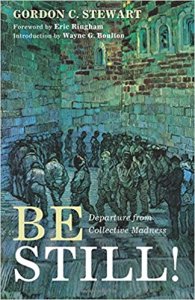
Be Still“BE STILL! To See More Clearly

This six-session program for churches invites you to re-examine the faith perspective (“lens”) through which you have come to “see” yourself and the world with brief selected readings from Be Still! Departure from Collective Madness.

“To see clearly, to see clearly, to see clearly–such is the great impulse and drive you meet on every page.” – Introduction to Be Still!  by Wayne. G. Boulton, Ph.D., former president of the Presbyterian School of Christian Education.

“Such essays are an eloquent rebuke to the prejudice that theological writing is abstraction from the concretions of life. I think of Stewart as an incarnational theologian like Bonhoeffer, who insisted that we pay attention to God’s presence in the concretions of our history.” – Donald Shriver, Ph.D., President Emeritus, Union Theological Seminary (NYC).

SIX One-1.5 hour SESSIONS using Be Still! Departure from Collective Madness

ONE—What is “public theology? Read and discuss the “Foreword” (ix-x), “Introduction” (xv-xviii), and Psalm 46.

TWO—The Author’s Lens. Read and discuss “The Preface (xi-xii), and the last paragraph of the “Acknowledgements” (xiv) about the Brothers of Opal Street.

THREE—Exceptionalism as Sin. Read and discuss “Only One Sin: Exceptionalism” (110-113) and “Memorial Day and the Soldier’s Helmet “ (10-12).

FOUR—Toward an Incarnational Theology. Read and discuss “Stillness at Blue Spring” (3-5) and “A Joyful Resting Place in Time” (5-7).

FIVE—No Gospel without the Blues. Read and discuss “The Forlorn Children of the Mayflower” (66-70) and “My Soul Waits in Silence” (98-100).

SIX—The Economy of God. Read “The Economy: Only One House” (114-115), “The World in an Oyster” (94-97), and “The Bristlecone Pines” (143-145).

ENDORSERS of Be Still! Departure from Collective Madness

Lucy A. Forster-Smith, Sedgwick Chaplain, Senior Minister in the Memorial Church, Harvard University:

”As a person who navigates the pleasures and perils of the twenty-first-century campus, having Be Still! at my fingertips will be like having a counselor, a guide, a very present help in these times. This volume touches the pulse of our times with the rare combination of unwavering candor and tender mercy.”

Walter Brueggemann, Columbia Theological Seminary:

”This wondrous collection of rich snippets would be of interest and value if only for the rich source material that Gordon Stewart quotes from, as it must be an inexhaustible memory and/or file. But the many words he quotes are no more than launching pads for Stewart’s expansive imagination and agile mind that take us, over and over, into fresh discernment, new territory, unanticipated demands, and open-ended opportunity. All of that adds up to grace, and Stewart is a daring witness to grace that occupies all of our territory.’’

Barrie Shepherd, author of Between Mirage and Miracle:

“Gordon Stewart has a way with words, a clean, clear, concise, and yet still creative way with words, a way that can set the reader almost simultaneously at the blood-stained center of the timely–the urgent issues of our day–and also at the deep heart of the timeless, those eternal questions that have forever challenged the human mind. Stewart looks at terror, Isis, and all their kin, from the perspective of Paul Tillich and, yes, John Lennon. He moves from Paris, Maine, by way of the town drunk, toward the City of God. This is strong medicine, to be taken in small, but serious doses. Wear a crash helmet!”

 Michael McNally, Professor of Religion, Carleton College; Author of Honoring Elders:

”Be Still! is needed at this American moment of collective madness even more than the moments that occasioned many of the essays originally airing on public radio and other venues. With a keen eye and a knack for telling the right story at the right time, Rev. Stewart speaks to the pressing issues in our politics, economy, and culture, and consistently, often poignantly, puts them in ethical and theological perspective that clarifies what too often mystifies. Great bedside reading for those of us who stay up at night concerned about where our world is heading!”

Frank M. Yamada, President, American Theological Society, former President, McCormick Theological Seminary:

”In Be Still! Stewart masterfully spins a counter-narrative to the collective madness that is gripping our world. Like the psalmist, Stewart prays thoughtfully through metaphors and religious tradition, meshing theologians with news headlines to lead the reader to a deeper, more sustained truth. Be Still! reads like part op-ed and part parable. In these troubling and anxious times, may we, who have ears to hear, listen!”

Joyce Sutphen, Minnesota Poet Laureate; Professor in English, Gustavus Adolphus College:

“Be Still!: Departure from Collective Madness, is exactly what its title proclaims: a departure from the frenzy and folly of our times. Each essay offers the reader an opportunity to breathe deep, to fall into the story or idea and consider what it means to be a citizen, a friend, a human being. The topics covered are both particular and universal (usually both at the same time), and the writing is wonderfully concise and open—much like poetry! This is a book you will want to open again and again; it’s what the world needs now, more than ever.”

ORDERING THE BOOK, INQUIRIES & SPEAKING ENGAGEMENTS

Be Still! Departure from Collective Madness is available from Amazon (paperback @$21 [shipping included w/Amazon Prime] or kindle @ $9.99), and from Wipf and Stock Publishers (paperback @$16.80 + shipping, or E-Book @$16.80). Churches and groups within 50 miles of Chaska, MN may order the book from the author @ a reduced rate.  A Study Guide is available at no cost.

Contact Gordon C. Stewart @ gordoncstewart@comast.net for speaking engagements, questions, or requests for more information.

The Hiding Place

Visiting St. John’s Abbey for the first time years ago just before noon, one of the Benedictine monks invited the guest to join the monks for mid-day prayer.

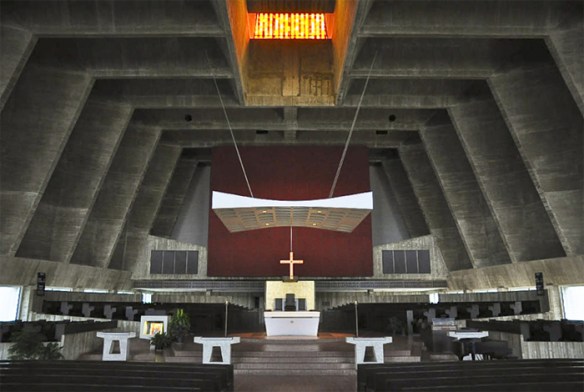
Abbey Church, St. John's University | Collegeville, MN | Marcel

St. John’s Abbey Church, Collegeville, Minnesota

Moments after declining the offer, I changed my mind. Risking the embarrassment of unfamiliarity with the Benedictine rite, I quietly made my way up the right side aisle toward the Chancel choir loft where the monks were gathering.

St John's Abbey hurch

Interior of St. John’s Abbey Church, Collegeville, Minnesota

Anxious and wanting to be as invisible as possible, I slid up the steps of the choir loft like a cockroach and found a suitable hiding place, the seat in the far corner of the top row (far right in the photograph).

I felt a tug on my left shirt sleeve. “I don’t think you want to sit there,” said the kindly Benedictine Brother with a twinkling eye, “unless you want to be the Abbot!”

Any early childhood protestant prejudice that monasteries are places where people of lesser faith go to hide came tumbling down! There is no hiding place in a Benedictine monastery. No one is a cockroach.

During a crisis years later, I returned to St. john’s for spiritual guidance and took a more lowly place in the choir loft.

  • Gordon C. Stewart, Chaska, MN, July 12, 2017.


Intoxicated with Success

“[People] are undoubtedly more in danger from prosperity than from adversity, for when matters go smoothly, they flatter themselves, and are intoxicated by their success.”

This bit of wisdom from what many will consider an unlikely source invites reflection in these days when one of America’s most successful has met adversity from his peers at the G-20 meeting in Hamburg, Germany.

421DA3B800000578-4674150-image-a-95_1499432704494He sits by himself at the table while others mingle. The chairs of China and the United Kingdom, whose leaders he has scorned, stay empty until they will be filled, begrudgingly, at the very last minute. One may hope it is a sobering moment of adversity.
“As Gregor Samsa awoke one morning from uneasy dreams he found himself transformed in his bed into a gigantic insect. He was laying on his hard, as it were armor-plated, back . . . ” – Franz Kafka, The Metamorphosis.

As an infant, Donald Trump was baptized by a Presbyterian church in Queens, New York in the tradition of the controversial 16th century theologian John Calvin. Perhaps all these years later, after all the success, but suddenly regarded as a cockroach, feeling like Gregor Samsa, he’s reading the passage from John Calvin and remembering who he really is.

  • Gordon C. Stewart, Chaska, MN, July 9, 2017.


Double Vision

Thomas and Peter are this writer’s favorite apostles. Thomas because he refused to believe unless he saw with his own eyes and confirmed “an idle tale” with his own hand; Peter because he was impetuous, quickly stepping onto the sea at Christ’s invitation only to plunge like a stone when his faith failed him.

It was through these two very different eyes — one of Thomas, the other of Peter — that we viewed Dennis Aubrey and PJ McKey’s Two Churches in the Cliffs on Via Lucis this morning.

The two churches on the cliffs appeared differently to these different eyes of faith.

3L1A5132

Apse, Église Notre-Dame-de-l’Assomption (Alpes-de-Haute-Provence) Photo by PJ McKey

The apse of Église Notre-Dame-de-l’Assomption with its narrow vertical window immediately elicited a Petrine sense of immediate belief. It held Peter’s eye for a long time.

Perhaps it was held by the yearning for the vertical, that which transcends the horizontal banality to which a mass culture has shrunk everything not of its own making. Perhaps it is the delight of hope from above that trembles the spine of the despairing. Or perhaps it’s the beauty of the apse’s proportionality, the genius of the central Christian symbol: the intersection of the horizontal by the more gracious vertical — the horror of human cruelty interrupted and transformed by the unexpected shaft of light and the still small Voice heard by Elijah in his cave.  Or all of the above and more.

But Thomas is never far beyond Peter. It is the Thomas in us that asks the hard questions, insists on separating fact from fiction, reality from illusion, good faith from what Sartre called bad faith. It is Thomas whose faith couldn’t make itself piggy-back on the shoulders of the other apostles’ story of having met the risen Christ. It was Thomas who insisted that he see for himself the evidence for “seeing” or believing in hope beyond the horror of the suffering, cruelty, and death his eyes had seen days before on the Hill of Skulls.

800px-Chapelle_Notre-Dame_de_Beauvoir

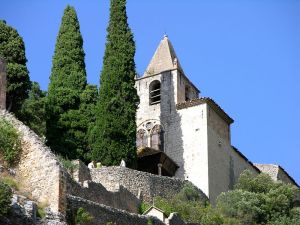
Chapelle Notre Dame de Beauvoir, Moustiers-Sainte-Marie (Alpes-de-Haute-Provence ) Photo by ICE-Marseille, courtesy of Wikipedia Commons


Which brings us to the second church on the cliff — the story of the stillborn in Via Lucis‘ post that awakens Thomas’ skepticism.

“Notre Dame de Beauvoir was known for its suscitations – stillborn children were carried up and baptised there, at which time they would immediately come to life and would be granted a place in heaven. This was a well-known phenomenon in the region and also known at two neighboring churches.”

While the thought of stillborn children immediately coming back to life appeals to Peter, it offends Thomas as an idle tale for the feeble of heart and mind. It’s either true or it’s not. And, if it’s true, what kind of cruel God would deny the same to the stillborn children and grieving parents who have not carried them up the steps to Notre Dame de Beauvoir for suscitations? Or is the tradition of Notre Dame de Beauvoir a sacred story of love and hope beyond what the empiricist eye of Thomas can see?

We have a left brain and a right brain, and sometimes it is true that never the twain shall meet. Likewise, faith has two eyes: Peter the believer, and Thomas the doubter — its own kind of double vision — looking out and up from one small brain.

  • Gordon C. Stewart, Chaska, MN, July 6, 2017.


An Echo from Lockerbie

Pan_Am_Flight_103._Crashed_Lockerbie,_Scotland,_21_December_1988With the explosion of Pan Am Flight 103 over Lockerbie, Scotland in the news yesterday, we share this excerpt from James Whyte’s sermon for the mourners at the Lockerbie Memorial Service 1988.
41+xpkf2RxL._SX347_BO1,204,203,200_

That such carnage of the young and of the innocent should have been willed by men in cold and calculated evil, is horror upon horror. What is our response to that?

The desire, the determination, that those who did this should be detected and, if possible, brought to justice, is natural and is right. The uncovering of the truth will not be easy, and evidence that would stand up in a court of law may be hard to obtain.

Justice is one thing. But already one hears in the media the word ‘retaliation’. As far as I know, no responsible politician has used that word, and I hope none ever will, except to disown it. For that way lies the endless cycle of violence upon violence, horror upon horror. And we may be tempted, indeed urged by some, to flex our muscles in response, to show that we are men. To show that we are what? To show that we are prepared to let more young and more innocent die, to let more rescue workers labour in more wreckage to find the grisly proof, not of our virility, but of our inhumanity. That is what retaliation means.

The  Right Rev. James Whyte was the Moderator of the Church of Scotland, still suffering from grief and physical fatigue following his wife’s death. He had recently retired as Principal and Professor of Practical Theology at the University of St. Andrews’ divinity school, St. Mary’s. The full text of the Lockerbie Memorial  sermon was published in Laughter and Tears: Thoughs on Faith (Reflections), pp. 92–5.

Every Thursday afternoon in the summer of 1991 the Right Rev. Professor James (“Jim”) Whyte brewed a pot of tea and served scones to the complete stranger he’d welcomed to St. Andrews, an American Presbyterian minister seeking his tutelage in practical theology during a sabbatical from pastoral duties at Knox Presbyterian Church in Cincinnati. His hand-written prayers delivered at Hope Park Church in St. Andrews remain a priceless treasure.

  • Gordon C. Stewart, Chaska, MN, July 5, 2017.


Geoengineering and Nature Itself

John Hopkins paintingThis morning John Lince-Hopkins of Lynx North Studio brought to our attention Technological Fixes for Climate Change.

We share below one theologian’s response to Technological Fixes for Climate Change.

Regarding “geoengineering”, maybe it’s just my depression, but I think not. The Tower of Babel has always been one of my go-to texts because it holds the paradox of the human condition. All attempts at “engineering” our way to security will fail.

There is an architecture that eludes our engineering when it comes to the planet. It’s called Nature. We are living in the time of what Bill McKibben calls “the end of Nature”. To what extend the end of Nature is the result of human disruption conceived in Western terms as “man over nature,” and to what extend climate change is attributable to non-human factors makes little difference IMHO to the call of the human species within Nature.

The Human Vocation

There are two very different creation stories in the Book of Genesis. Chapter one comes from the priestly (P) tradition.

It was the genius of the Priestly tradition’s creation story (Genesis 1) that they saw the balance of Nature as “Good”  (“and God saw…and it was good!”). The artchitecture of creation is a beautiful piece of art that inspires praise and awe. To imagine something else would be to fall from praise. You might say the P writers were more like scientists who beheld and marveled at the intricate web of natural life.

No sooner do we read Chapter One that we come to the second very different creation story from the perspective of what biblical scholars call “J”,  so called because of the use of the writer’s Name for God.

Genesis two and three read more like novels, expressing in very earthy terms the earth-bound character of human nature and human creature’s resistance to creaturely life — the inexplicable choice of the archetypal “earthlings” to eat the fruit of the ONLY tree among all the trees of the garden based in humankind’s tragic urge of to become “like God, knowing good and evil.”

Only when they fail to stand in awe and thanksgiving in the midst of the Good (a good which includes nature’s “limits” on their behavior) do they invoke the curse that renders them shamefully conscious of their nakedness (their naturalness) and sends them into a hiding from their Creator. Fratricide (Cain’s slaying of Abel) quickly follows their expulsion from Eden.

The continuing human calling is to see Earth itself as the theater of a glory not of our own making and to resist the illusion of the serpent: “if you eat of the one tree which is forbidden, you will become like God.” It’s the second part of that statement that is the temptation – refusing to live with the limits of Nature itself. One might even say “the Fall” is an attempt at geoengineering.

Genesis 1-11 is called the Primeval History — a history that never was but always is. The Primeval History concludes with the story of Tower of Babel — human engineering for the purpose of “making a name for ourselves”, i.e., establishing and securing our existence in time in the face of chaos.

Now it’s “GEO-engineering” – the illusion that we can fix this, that we can “engineer” our way out of the mess our geoengineering on behalf of a more perfect world has created. There’s a HUGE difference between geoengineering and being responsible. The former disturbs Nature. The latter works collaboratively with Nature…or whatever is left of her. Anything else is Babel. It is doomed to fail.

John captures in paint what his word say of his intention.

jr-3“Environmentally focused paintings and other art forms from the early 21st century build a foundational historic context for future generations.  They are documents of the time of ‘the first awareness’ by the human species about the course and implications of climate disruption. As this awareness settles in, climate disruption in the form of weather (as it affects biodiversity, human society and the physical planet) has become, for me, a main topic of my work.”

Perhaps it’s not too much of a stretch to say that John Lince-Hopkins, the scientist and the painter, combines in the 21st Century the ancient wisdoms of the P writer and the J writer — the awe of Genesis 1 and the earthy calling and tragedy of Genesis 2, 3, and 11. Would that we might all do the same.

Click Art Wander for more on how John views his work as a climate change scientist and artist.

Thankful for the friendship,

  • Gordon C. Stewart, Chaska, MN, June 29, 2017.


Acquittal of Jeronimo Yanez – a Response

The following letter from Presbyterian Church (USA) leaders in Minnesota arrived this morning in response to the acquittal of police officer Jeronimo Yanez in the shooting death of Philando Castile.

“Nearly a year ago, in a community overwhelmed with anger, grief, frustration, and despair at the shocking video images of the shooting death of Philando Castile, and then at the roiling protests that have followed, we—the Presbytery of the Twin Cities Area—joined our voices together with each other and with many others in a cry for comfort, for equality, for justice.

“We committed ourselves to prayer for the family of Philando Castile, that they would know our God’s deep and abiding presence, and for the many others so deeply grieved by these events. We prayed for our community,that amidst its deep divides and fractured relationships, amidst the fear and anger especially of our black community, we in the church might find words of comfort and challenge to speak into the yawning chasm of societal fractures and divides. We prayed for our police officers and all who daily place themselves in potential harm’s way in order to protect us. And we said, firmly and unequivocally, that Black Lives Matter, and we committed ourselves as a Presbytery to the work of understanding white privilege and to anti-racism.

“That work is not done. Today, we are compelled to revisit those prayers and commitments in the aftermath of the acquittal of police officer Jeronimo Yanez, a verdict that ripped open a family’s overwhelming grief and further caused our African-American brothers and sisters to fear anew that their lives indeed do not matter in this country.

“As followers of Jesus, our task is to listen, to hear, to act, in response to the call of God and the voices of the people. And so we again join our voices in prayer for the family of Mr. Castile. But we must not stop there. We must commit ourselves anew to work for end the perpetual sense of fear and suspicion under which our African American brothers and sisters constantly live. Whetherwe live in a community with very few people of color or with many, no one of us has the luxury of being detached and unaffected. Those of our society who feel suspect and vulnerable are our very sisters and brothers in Christ. As Christians, we must stand with them.

“We are challengedto look anew into the imperfect structures of our society; and to speak our belief that every person is created in the image of God, even as we confess our denial of that very belief in the sin of institutional racism. We must speak our belief that “Christ’s work of reconciliation is made manifest in the church,” knowing that, too often, we have allowed our ideological differences to fracture our unity in the One Body. We must challenge ourselves anew to proclaim Christ’s words, “that they may all be one,” knowing the essential need for all Christians of privilege to seek deeper understanding when so many of our brothers and sisters cry out for a justice they do not know.

“Our African American brothers and sisters have implored us to raise our voices on their behalf. Together, we in the Presbytery of the Twin Cities Area re-commit our voices and our actions to better seek justice and work for the good of all of our brothers and sisters in Christ.Give us the determination to build new or deeper relationships, as together we seek new ways to partner in work for a just society. Give us courage, in all that we do, to be not simply speakers of peace, but peacemakers.”

The Presbytery Leadership Team, Sue Rutford, chair
The Executive Presbyter, Jeffrey Japinga

The Shooter


the-latest-pence-speaks-with-victims-of-ballpark-shooting“Fools rush in where angels fear to tread.” Yet tread we must the day after the shooter aimed his rifle through the ballpark’s chain-linked fence at members of the U.S. Congress and their staff.

It’s a temptation to tread heavily, claiming only shock when, in fact, we all heard verbal shots before we heard the the gun shots from Alexandria, VA. Moral righteousness doesn’t help on a day like this because it is moral righteousness that pointed the rifle at the Congressional Representatives the shooter regarded as the unrighteous.

2631978_ThumbOne man decided to defend the American republic with a rifle, a horrendous offense that points the finger back at the rest of us who have tread heavily against the evils we deplore or who have tread less heavily in a seething wordless silence.

There is, of course, a huge difference between a rifle and a sentence. We have spoken out here about that difference. We proudly use words, not guns.

Yet, we must confess that, in the interest of defending the America we love, Views from the Edge has fired its own shots in the appalling era yesterday’s shooter sought to end with his rifle. As a follower of Christ immersed in scripture, we have known but have sometimes failed to heed the wise caution of the Letter of James (“How great a forest is set ablaze by a small fire! And “tongue is a fire” [Js. 3:5-6]) or the counsel of the Hebrew proverb (“The words of the reckless pierce like swords, but the tongue of the wise brings healing”[Proverbs 12:18]).

Moral righteousness wears a multiplicity of masks and uses many vocal disguises that hide its ugliness. Today we step back a few paces to ponder the question:

“How do we speak and act responsibly in ways that bear witness to what we believe in this time that puts our better angels to the test?”

We have no answers. Only a question.

Maybe today’s Congressional baseball game will speak louder than rifles or words.

Grace and Peace,

Gordon C. Stewart, Chaska, MN, June 15, 2017.


Ever wonder about your DNA?

How much of you is written already by the latest rendition of the old doctrine of predestination? Not so much by religious predestination as by your DNA? Or are predestination and DNA the same?

Reconnecting with the second cousin from the Andrews family raises the questions. I’d only met her once sixty years ago, yet, like twins separated by distance and circumstance, the parallels of perception, pencraft, and psyche are unmistakable.

Mr. Rogers assured the children that each of them was special. I like the sentiment but have preferred the word ‘unique’. None of us is nearly as ‘special’ as we’re prone to think we are, but, come to think of it, neither is any of us quite as unique as ego might lead us to think.

As Carl Sandburg reminded me, “O, I got a zoo, I got a menagerie inside my ribs!” Many of the creatures in my zoo were not of my choosing. They were, you might say, predestined. They predetermined me. Some of them date back to the Andrews family in Andrews Hollow, Maine, and as farther back into time than memory can follow.

  • Gordon C. Stewart, Chaska, MN, June 12, 2017