Harvey, Houston, and the Holy

The urgency of a rescue operation is not the time for anything but compassion.

Timing and perception are everything in this startling time of Hurricane Harvey, 500-year floods, and the chemical plant explosions now taking place in Houston. Watching a helicopter rescue the elderly and disabled from the rising waters of a flood that has put people at risk is not the time to say I told you so.

But sooner or later it is time to speak about the unnatural crisis hidden behind the crisis of nature. In times like this, everyone becomes a socialist, and, if we’re seeing straight, no one stays a climate change-denier in the city big oil built.

150814201758-texas-chemical-plant-fire-aerials-vo-00002322-exlarge-169

Chemical plant explosions are the latest horrific news that graphically illustrate a national crisis that is more than ‘natural’. The crisis is anthropological and theological.

“Man over nature” was always an illusion. A hoax. A faux understanding of the human species’ relationship with the rest of nature — “man (sic.) over nature,” as though the first were separate from the latter — that leads to destruction and self-destruction.

The chemicals are exploding because the plants that make them cannot keep them cool. Keeping them cool requires an operative electrical grid, or, when the grid goes down, an emergency generator that isn’t vulnerable to flooding. When the grid and backup generators fail, the chemicals heat and explode.

Timing and perception are everything.

14353975_1473359308.1101

Not much more than a year ago Standing Rock was being touted as the emerging symbol of the revised understanding, the shift in consciousness, and the new behavior required of humankind in the age of climate departure. The oil pipeline from Canada to Texas refineries was stopped in the name of nature itself.

f7WX3K4OV6amH3_ORNVUDgCWLmwZicPzOSbGvdcoCAY1Vse2qbjIWF_nCQgAavToiW0PU-sxqw9UosshC70VmVMv-Mi8s4hw5Uzq5FS_wgzShx8Uu32eAwz0rJt2pyVHoNQAAeEX

That was before the 2016 election, and the 2017 appointment of a climate change-denier to gut the EPA, presidential executive orders stripping away regulations on the fossil fuel industry, and America’s spiritual retreat from the Paris Accord on Climate Change. Texas, not Standing Rock, was in charge again. Or so it seemed until Harvey came ashore to wash away the illusion of “man over nature.”

It’s time now for a clearer perception. Time to hold next to each other a picture of flooded Texas chemical plant explosions and the peaceful protest of Standing Rock,  and ask ourselves which picture is truer than the other. Or perhaps the truth is better seen when both are held together side-by-side: two anthropologies and two theologies. According to the one, humankind and the human city are the measure of reality itself. According to the other, God (i.e. the Eternal, Being-Itself) is the “natural” context — the mysterium tremendum et fascinans* — in which we live, and move, and have our being.

Today is, and tomorrow will still be, time for compassion and help for the people of Houston. It is also time to perceive something much deeper and wider. The rescued people of Houston, southeast Texas, and Louisiana are but the latest victims of the tragedy of the human mind and spirit: the fanciful illusion and creation of an alt-world of species superiority to nature.

Could the trembling of this horrific moment lead us to a holier fascination with reality itself?

iottoru001p1

Rudolf Otto (1869-1937)

The people of Standing Rock and Rudolf Otto are watching.

*Rudolf Otto‘s Latin term for the human experience with the Mystery beyond all taming that both fascinates and causes us mortals to tremble. (Rudolf Otto (1869–1937), The Idea of the Holy: An Inquiry into the Non-Rational Factor in the Idea of the Divine and its Relation to the Rational.)

  • Gordon C. Stewart, Chaska, MN, August 31, 2017


A Hymn for Houston

Watching rescue workers, the Red Cross, FEMA workers, and volunteers serving in Houston brings to mind a rare hymn that focuses on the city in a time of despair.

Click HERE for the lyrics.

Erik Routley’s rendering of Charleston, an American folk tune, honors all who love and serve the city, all who bear its daily stress.

Across America — from tiny churches in Appalachia, the bayous of Louisiana, and Sitka, Alaska to Memorial Church at Harvard — prayers are lifted and hymns are being sung in thanks for all who love and serve the city.

  • Gordon C. Stewart, Chaska, MN, August 30, 2017.


A Moment of National Decision

Pastors sometimes view the world differently. Pondering the President’s visit to Houston today, the lines from three hymns come to mind.

“In an age of twisted values we have lost the truth we need. In sophisticated language we have justified our greed.”

“We have built discrimination on our prejudices and fear. Hatred swiftly turns to cruelty if we hold resentments dear.”

And these lines from James Russell Lowell‘s old chestnut, “Once to Every Man and Nation”:

“Once to every man and nation/ Comes the moment to decide/ In the strife of truth with falsehood/ For the good or evil side;/ Some great cause, some great decision/ Offering each the bloom or blight,/ And the choice goes by forever/ ‘Twixt that darkness and that light.”

If John Newton, the former slave ship captain, could be turned into an abolitionist by the amazing grace “that saved a wretch like me,” who’s to say amazing things can’t happen on August 29, 2017?

  • Gordon C. Stewart, Chaska, MN, August 29, 2017.

Singing through the storm?

Watching the floods in Texas, I don’t feel like singing. But, while weeping for the people of south Texas, I hear the song of Pete Seeger wading through the storms and lamentations.

When Robert Lowry (1826-1899) wrote “How Can I Keep from Singing,” Pete Seeger (1919-2014) hadn’t been born, but Lowry’s music found a voice in Pete and others who listen amid life’s storms and lamentations.

Robert_Lowry

Rev’d Robert Lowry, preacher and hymn writer

A reporter once asked him what was his method of composition— “Do you write the words to fit the music, or the music to fit the words?” His reply was:

“I have no method. Sometimes the music comes and the words follow, fitted insensibly to the melody. I watch my moods, and when anything good strikes me, whether words or music, and no matter where I am, at home or on the street, I jot it down. Often the margin of a newspaper or the back of an envelope serves as a notebook. My brain is a sort of spinning machine, I think, for there is music running through it all the time. I do not pick out my music on the keys of an instrument. The tunes of nearly all the hymns I have written have been completed on paper before I tried them on the organ. Frequently the words of the hymn and the music have been written at the same time.”

Robert Lowry regarded “Weeping Will Not Save Me” as the best hymn he ever wrote.

  • Gordon C. Stewart, Chaska, MN, August 29, 2017.


All us bastards

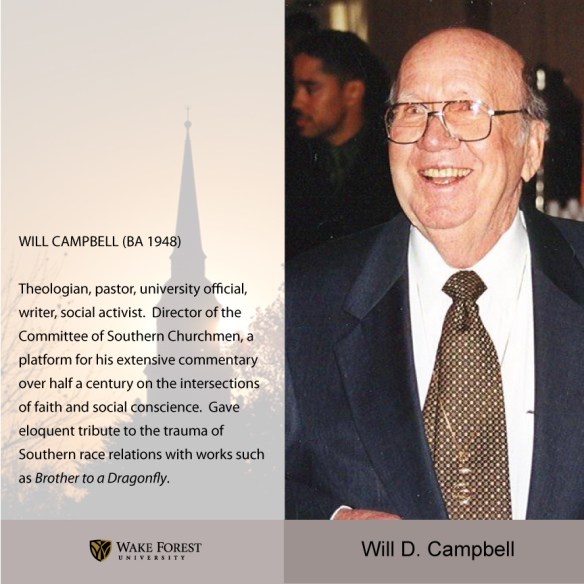
“Rev. Will D. Campbell, Maverick Minister in Civil Rights Era, Dies at 88” read the New York Times obituary. Will Campbell (1924-2013) was more than unusual. He was idiosyncratic.

willcampbellHOF

When the nine black school children walked through the hostile crowds attempting to integrate Little Rock’s Central High School, Will Campbell was one of four adults at their side. A civil rights leader, his life was threatened repeatedly over the years.

But there was something unusual about him. Will Campbell was “a good ol’ boy” from the white backwaters of Mississippi who became one of Martin Luther King’s closest confidants, the ONLY white person present at the founding of the Southern Christian Leadership Conference that led the charge for Civil Rights in America.

In 1964 Will founded the Committee of Southern Churchmen, the successor to the all but defunct Fellowship of Southern Churchmen that had been created in the 1930’s to combat injustices in labor, politics, and race relations.

The Committee of Southern Churchmen created a new journal Katallagate — Greek New Testament for “Be reconciled!”) — which reached a national audience in the conviction that the underlying issues were beyond regional.

With the passage of the Civil Right Act, Will did something few but his friend Martin Luther King, Jr. could have imagined. He re-directed his ministry to the newly defeated hooded enemies of all things good, the Ku Klux Klan.

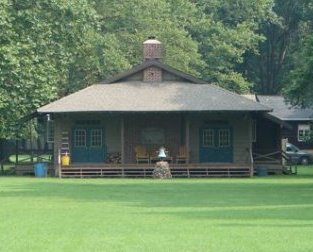
fc68a5171519678c41618146c96931a9--rustic-porches-country-porchesNo one but Will Campbell seemed to consider such a thing, let alone do it. But he did. Will headed for the rocking chairs on the front porches of the Klan to sip some moonshine and sit a spell. He became the civil rights chaplain to the KKK, returning to his roots as poor white trash raised in the backwaters of Mississippi.
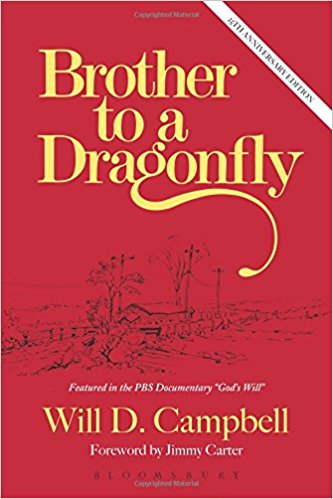
51ZqWjXVehL._SX331_BO1,204,203,200_Looking back on his life and ministry, he wrote in Brother to a Dragonfly, after the tragedy of his brother’s death:

“I had become a doctrinaire social activist without consciously choosing to be. And I would continue to be some kind of social activist. But there was a decided difference. Because from that point on I came to understand the nature of tragedy. And one who understands the nature of tragedy can never take sides.”

He confused his critics equally – first the Right and then the Left – insisting that his soul did not belong to anyone’s team – racial, political, religious, cultural, national. There was only one team:  humankind standin’ in the need of prayer. There is only one rightful place for a soul: the Kingdom of God.

“We’re all bastards,” he was often heard to say, “but God loves us anyway.”

He meant both things.

The belief “but God loves us anyway” reorganized his hierarchy of values around a non-elitist, non-righteous compassion. It was that compassion that had led him to campaign for racial equality in the Civil Rights Movement, and it was compassion that later led him to sip whiskey with the cross-burners in the rocking chairs on their front porches. His was a ministry of reconciliation, a living, idiosyncratic example of the good news that God was in Christ reconciling the world to God’s own Self: katallagete!

contentWhile Will continued to drink whiskey on the porches of America’s new legal bastards, Katallagete reached a wider national audience with a “who’s who” of religious, academic, political, and cultural luminaries: Thomas Merton, William Stringfellow, Daniel and Philip Berrigan, Vernard Eller, Jacques Ellul, W.H. Ferry, Duncan Gray, John Howard Griffin, Fannie Lou Hamer, Joe Hendricks, Jim Herndon, Christopher Lasch, Julius Lester, John Lewis, J. Louis Martyn, Reinhold Neibuhr, Walker Percy, and Robert Penn Warren.

Although I never met Will Campbell, Katallagete was must reading until it ceased publication, and I’ve been thinking more lately about what Will would say today.  His memory reminds me all these years later how hard it is to be a disciple of Jesus, how hard it is not to hate in 2017. How hard it is to love my neighbor as myself. How hard it is to love the enemies, especially when the neighbor and the enemy is the illegitimate bastard self on the rocking chair of my front porch.

Would that all us bastards were as idiosyncratic as Will.


  • Gordon C. Stewart, Chaska, MN, August 27, 2017.

The Scapegoat

screen-shot-2014-10-14-at-8-04-13-am

Sometimes a line leaps from the page to arrest me.

“Living among us, Jesus loved us. He broke bread with outcasts and sinners, healed the sick, and proclaimed good news to the poor.”

Sitting in the pew the week following the horrors of Charlottesville, this line from the Great Prayer of Thanksgiving of the sacrament of holy communion begged for deeper reflection.

Who were the outcasts, sinners, and sick people on the streets of Charlottesville? Who were the outcasts, sinners, and sick watching the news, tweeting, texting, yelling, screaming, retreating, turning off, tuning out? Who were the poor waiting good news?

Surely, I’m not poor. Am I? I love the outcasts, the sinners, the sick, don’t I, Jesus? I am among the counter-demonstrators, the despisers of white supremacy, the champions of racial equality, the scorners of the KKK and their white supremacist and white nationalist cousins. My anger boils over watching these sick people turning back the clock.

Preparing for the bread and cup, I am aware of my poverty, my thirst for good news. Failing, or refusing, to see the faces and listen more carefully to the shouting of the white supremacists in Charlottesville, I have cast them out as hopeless sinners: the outrageously sick representatives of white supremacy, America’s original sin.

christ-of-saint-john-of-the-cross

“Christ of St. John of the Cross” – 1951, Salvador Dali 

I consider not receiving communion today.

Then I recall René Girard‘s work on the crucified Jesus as the scapegoat whose life, death, and resurrection dismantles the scapegoat mechanism of religion and society.

“Everywhere and always, when human beings either cannot or dare not take their anger out on the thing that has caused it, they unconsciously search for substitutes, and more often than not they find them.”
René Girard, The One by Whom Scandal Comes

I ponder the ways capitalism turns us against each other: privileged and poor, insiders and outcasts, scapegoaters and scapegoats, sheep and goats — the company of sinners in need of the better news that there is, in reality, no division among us.

I remember Salvador Dali’s painting of the cosmic Christ and read again the lines of the Great Prayer of Thanksgiving:

“Living among us, Jesus loved us. He broke bread with outcasts and sinners, healed the sick, and proclaimed good news to the poor.

“He [the Scapegoat] yearned to draw all the world to himself, yet were heedless  of his call to walk in love.”

  • Gordon C. Stewart, Chaska, MN, August 23, 2017

Getting smart with sick people

https---blueprint-api-production.s3.amazonaws.com-uploads-card-image-567195-92342710-0d5c-4235-a14a-8c7f1b862648

Pictures like this from Charlottesville, Virginia send chills down the spine. White supremacy, white nationalism, the KKK, and the Neo-Nazis sometimes evoke a reptilian response in me. I hate the haters.

I am like the psalmist in the psalm I learned as a child.

Surely thou wilt slay the wicked, O God: depart from me therefore, ye bloody men.

For they speak against thee wickedly, and thine enemies take thy name in vain.

Do not I hate them, O Lord, that hate thee? and am not I grieved with those that rise up against thee?

I hate them with perfect hatred: I count them mine enemies. [Psalm 139:19-22 KJV].

They are evil, pure and simple! I hate them with a perfect hatred.

Then I remember the conclusion of the psalmist’s reflection immediately that strangely comes on the heels of hating God’s enemies with a perfect hatred. These last lines of Psalm 139 come only after the psalmist takes a very deep breath — a more contemplative introspective pause.

Search me, O God, and know my heart: try me, and know my thoughts:

And see if there be any wicked way in me, and lead me in the way everlasting. [Psalm 139:23-24 KJV]

Evil is not only out there. It’s also in here. In me. It’s like an infection. It’s pandemic. Comparing myself with the most egregious white supremacists leaves me among the righteous, but, as an old professor observed, comparison is the Devil’s work.

andrew-young

Andrew Young and Martin Luther King, Jr.

“I grew up in New Orleans, La., 50 yards from the headquarters of the Nazi party. Before I went to kindergarten, I was having to look in the window on Saturdays, and watch all these folks [shout] “Heil, Hitler!”

“In 1936.

“And my daddy said, those are sick people. They’re white supremacists, and white supremacy is a sickness. You don’t get mad, you get smart. You never get angry with sick people, because you’ll catch their sickness. That’s what I worry about with our young people. Anger and this emotional militancy will give you ulcers, give you heart attacks.

“Don’t get mad, get smart. Your brain is the most important thing you have.”

Andrew Young, August 16, 2017.

reptilian brain

The reptilian brain uploaded from http://www.collectiveevolution.com

Click How to By-Pass Your Reptilian Brain and Restore Your Creative Powers, or Controlling Anger Before It Controls You on the American Psychological Association web site, and remember Andrew young. “Don’t get mad, get smart. Your brain is the most important thing you have.”

Or just remember the psalmist in light of the snake’s deception in the biblical myth of the Garden of Eden: “You will be like God, knowing good and evil!”

  • Gordon C. Stewart, Chaska, MN, August 17, 2017.

Sinner, do you have my groceries?

I’d never thought about groceries back in Broomall. We’d drive to the Acme, fill the grocery cart, and bring the bags home. It was just part of daily life. Or so I thought.

groceriesI was 17 the day I learned about groceries in America.
Tony and I had become friends at Pennington Island, the church camp in the Delaware River, after meeting each other on the Saturday several years before when the junior-high youth groups from Marple Presbyterian Church and Berean Presbyterian Church had met during a service project at the Green Street Settlement House.

NLIOn Pennington Island the kids from Philadelphia and the Philadelphia suburbs spent nights together in the same cabins, rose early for “morning watch”, played games, ate the same food at the same tables in the mess hall, swam in the same swimming pool, and sang hymns and spirituals like Jacob’s Ladder. We were living in the same economy while climbing somewhere together.

After the week or two on Pennington Island, the members of his ideal economy would say good-bye and return to the disparate circumstances whose differences we preferred not to know.

Ignorance was bliss. Until the day Tony visited our home in Broomall, 15 miles west of Philadelphia, and watched my mother pull into the driveway with the groceries. My mother spoke of it years later as one of those moments that opened her eyes.

7769907-1955-buick-special-std-cAs we began to unload the groceries from the ’55 Buick, Tony’s eyes grew bigger. There was more than one bag. Never had he seen multiple grocery bags. When the Lewises had a little money, they’d bring home what they needed for the day…or maybe two, on a good day. There were never five, six, seven bags of groceries.

“Sinner, do you love my Jesus,” we had sung in the egalitarian economy of Pennington Island where we were climbing higher together. But unloading the grocery bags that day in Broomall, the difference in groceries seemed more like a symptom of sin – the gulf of separation between two worlds. One home was much “higher” than the other — one white, one black; one privileged, one not — in a black and white economy.

  • Gordon C. Stewart, Chaska, MN, August 14, 2017.


Into a dense fog: Sinner, do you love my Jesus?

The descent from my suburban home in Broomall to serve the “less fortunate” on Green Street sent me home looking into a dense fog.

The Wanderer

Wanderer Above the Sea of Fog –  Caspar David Friedrich, c.1818

I had given up a Saturday as a youthful answer to the song I learned has a child. “If you love him, why not serve him?”  Serving Jesus meant serving those who were less fortunate than we, as we used to describe the difference.

The kids from Marple Presbyterian Church in Broomall were aware that Jacob’s Ladder and the other spirituals we sang rose from the slave fields of the white Southern plantations, but the plantations were in the south. We were northerners. We were the abolitionists. We were part of the solution, not the problem.

The day on Green Street knocked me off my ladder. Those few hours on the calendar time of Chronos were a pivotal Kairos moment that placed me before a dense fog searching for answers to how and why life was so different for the two junior high youth groups from Marple Presbyterian Church in Broomall and Berean Presbyterian Church in north Philadelphia.

How and why was it that Tony was born into poverty while I was born into relative economic wellbeing in a suburb became a daunting question. I was looking into a dense fog.

Prior to the plunge to Green Street I hadn’t paid much attention to the first word of the stanza about loving Jesus: “Sinner… do you love my Jesus?” Although I knew myself to be a sinner — I had told a lie or two and not been kind to my younger brothers — I was no Judas! I was a soldier of the cross. “If you love him, why not serve him, soldier of the cross?”

Suddenly, the fog was not just outside of me. It was inside me, a jarring sense that I and “my people” were self-deceived sinners.

But what is sin and what is a sinner? Institutional slavery was sinful.  The slaveowners were sinners. I knew that. The slaveowners were white. The slaves were black. I knew that. The slaveowners were Christians. I knew that. The slaves were Christians. I knew that — or thought I knew it.

I didn’t learn until much later that the slaves were forced into the Christian faith no less than they had been herded like cattle onto slave ships, or that the difference in the churches was as different as it had been on the slave ships. The difference was that on board the slave ships, the slaves were chained together in the hold while the slave traders were up above; in the churches, the slaves were up above in the rear balcony, looking down on the sea of whiteness on the main floor. Until Richard Allen led the revolt from the balcony to form the African Methodist Episcopal Church.

But the kids from Berean Presbyterian Church were not African Methodist Episcopalians. They were Presbyterians in the theological tradition of the Protestant Reformation, John Calvin’s Institutes of the Christian Religion, and the doctrine of predestination.

Was Tony predestined to poverty in north Philadelphia? Was I predestined to white privilege in Broomall? Or was predestination a hoax, the idea of sinners washing their hands like Pilate that had nothing to do with the will of God?

Caspar_David_Friedrich_018

Frau am Fenster
Caspar David Friedrich, 1818–1822
Öl auf Leinwand
44,0 × 37,0 cm
Alte Nationalgalerie Berlin

I was no longer standing on the heights of innocence overlooking the landscape. I was a child of privilege, confined and alone, looking through a very small window at the world beyond what had belonged to “my Jesus”. I was pondering the ships of past and future and the dense fog that went on as far as my eye could see. It has lasted my whole lifetime.

  • Gordon C. Stewart, Chaska, MN, August 11, 2017.


My lifelong Quest

Some things take a lifetime. More or less.

It took until a few days before my 75th birthday to become clear about my lifelong quest. Some would call it my “vocation” in life, my “calling” as we say. Others might call it an obsession. In either case, it’s taken this long to say a word about it.
In a nutshell, my life’s occupation has been, and still is — are you ready? — theological anthropology.
EliIMG_6311
“Whoah! What’s that?” my 11-week-old grandson Elijah is asking.
Theological anthropology, like all anthropology, is the search for understanding of the human species. The term  ‘anthropology’ is the combination of the Greek words  anthropos (human) and logos (word). Anthropo-logy is ‘the word’ about ‘humankind’.
Theological anthropology is the study of humankind in the context of ‘theos’, i.e. ‘G-d’ — which Paul Tillich translated as Being-Itself, the Ground of Being, that which is ultimately Real.
Anthropos is contingent; Being-Itself is not. Like all species, ours has a very short lifespan in the aeons of eternity. We are a small part of the All or the Whole (Friedrich Schleiermacher), creatures of time with the rest of moral nature who can be understood, if at all, only in light of this larger timeless Whole.
The Psalmist question –“What is man that Thou art mindful of him?” (Ps. 8:4 KJV) — is my life-long question.
Who are we as a species? Who am I as a member of it? Who are the Andrews, the Tituses, the Campbells, the Stewarts among the vast assortment of homo sapiens? Who am I in relation to Barclay, my Cavalier King Charles Spaniel friend, the forests, the flowers, the birds, and the rest of the species of dust and ashes holding our breath before the majesty of life itself?
Why theological anthropology?
You can take the human species out of the universe and the universe will go on as it did aeons before anthropos came along. We can’t say the opposite. Essential to the human experience is the terror of contingency and the wonder of of it all, what Rudolf Otto called “mysterium tremendous et fascinans”.
The idea of “man (the human species) over nature” is a deadly illusion, a flight from reality itself, an escape from the trembling that comes with our vulnerability, our transience, our mortality, the final limit of all human creativity (the “image of God”).
After only one cup of coffee on my 75th birthday, that’s the best I can do.
Mom

Muriel Titus Stewart

This afternoon I’ll be in the Philosophy Lounge at Macalester College in Saint Paul, MN at the invitation of a philosophy professor, a long way away from the delivery room and the loving, laboring mother who pushed me into the world (the philosopher’s lounge) back in Mechanicsburg, Pennsylvania. Thanks, Mom!
– Gordon C. Stewart, Chaska, MN, August 10, 2017.