Singularity and SALT — a short film

Video

Matthew and Elizabeth Myer Boulton of The SALT Project granted permission to share this short (4:29 min.) animated production.

Produced by the SALT Project.

Click HERE to learn more about SALT.

Matthew Myer-Boulton is the son of long-time friends Wayne (RIP) and Vicki Boulton.

Grace and Peace,

Gordon C. Stewart, Chaska, MN, May 26, 2020.

Where the Wounds Are

Memorial Day is different today

At Indian Town Gap National Cemetery, where my mother and father are buried, “Taps” from a single bugle will ring over the silence of the fallen. That is as it should be. No band. No orchestra. No choir. No parades. No “bombs bursting in air.” Just a single bugler breaking the silence “in the dawn’s early light.”

Other tears will fall today for those who did not die or serve in war — 98,035 and still climbing here in the U.S.A. ( ); 345,000+ and climbing worldwide. They were sent to their graves by a deadly virus that knows nothing about wars and borders between nations. You can’t shoot or bomb a virus. Calling the new coronavirus an ‘enemy’ may strike up the band to rally the troops for a crusade, but it’s easily misused to divide the living and the dead. This is a time for Taps, not “”Reveille.”

You will find me where the wounds are

The lock-down to protect ourselves from exposure to COVID-19 led me to the strange encounter between the Crucified-Risen Christ and Thomas — and for all who come to faith in future time: “Blessed are those who have not seen but believe.” The following interpretation is original and speaks for no one else.

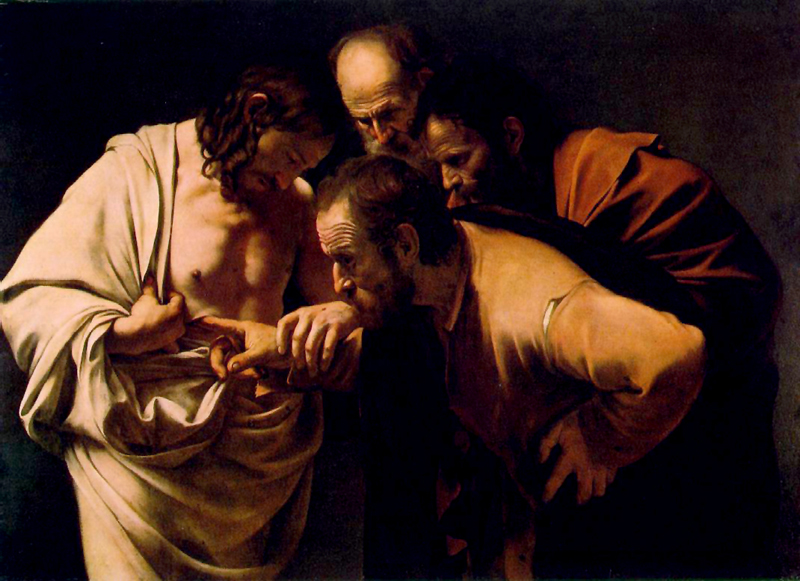
The Incredulity of Saint Thomas 
Caravaggio, Michelangelo Merisi da, 1573-1610 
Record number: [54170] 

Faith: throwing ourselves into the wounds

Caravaggio’s painting of Thomas putting his finger in the wound in the Risen Christ’s side is exquisite, but no painting can capture the strangeness of the invitation to Thomas in The Gospel of John (Jn. 20:26-29).

Translating New Testament Greek texts into English often involves a translator’s decision as to the meaning of a word. The story of Thomas is one such text. Most often βάλε in English becomes ‘place’ or ‘put — a rendering that paints a beautiful word picture of a unique moment of tenderness with Thomas. But “put your hand in my side” avoids the jarring sense of the Greek text — “Bring your hand and βάλε (thrust/throw [it] into) my side.”

The Wounds, the Marks, and the Type

“See the τυπος (marks) in my hands.” τυπος can mean ‘wound’ or ‘mark’ but it has another meaning – ‘type’. A τυπος originally meant a mark created by a blow or impression. Eventually it came to mean a mold or form into which something is shaped. Those who are being molded into the life of the Crucified-Risen Christ are called to behold the marks and throw themselves into the enduring gaping wound in Christ’s side.

The Jesus of Locked Doors

John tells the story found in no other Gospel. He tells it in the present tense, drawing the reader into the scene as it is happening. It is not an event happening only then. It is happening now. “Jesus έρχεται (is coming). Th syntax raises the question of how to render the placement of the word κεκλισμενων (‘locked’). Does the text describe the physical circumstances of an unrepeatable moment? Or does ‘locked’ modify Jesus? “Jesus of locked doors/gates έρχεταιs (is-coming) into the midst of them.” and us?

Becoming Faithful: Encountering God in the Wounds

“Do not γίνου (be becoming) faithless (ἄπιστος) but πιστός (faithful),” Jesus is saying to Thomas, and to all who will never see the historical Jesus directly, that faith and faithfulness are more than mental constructs and belief systems. To follow Christ is to throw ourselves into the gaping wound in Christ’s side all around us. He will meet us there.

The story of Thomas is the final word in the original of the most metaphorical Gospel. It is as though John is leaving us with another way of telling the Parable of the Last Judgment, turning our lives from distant observation and hiding ourselves from the wounds to throw ourselves into the place where we come to faith and faithfulness. “I was hungry and you gave me food. I was thirsty and you gave me drink. I was in prison and you visited me. I was a stranger and you welcomed me. I was naked and you clothed me. I was sick and you looked after me. I was in prison and you came to visit me”. (Gospel according to Matthew 25:25-26)

The Life of Compassion

Dietrich Bonhoeffer described the Christian life as an ongoing conformation into the pattern of Christ, “the Man for Others.” Writing from prison cell #6 of Tegel Prison where he awaiting state execution two days before the defeat of the German Third Reich, Bonhoeffer wrote the poem that addressed the question of where Christ is today. The three stanzas move from crying out from distress (“when we are sore bested”) to “standing with God in God’s hour of grieving” to God “hanging dead for Christians, pagans alike . . . and both alike forgiving.”

Men go to God when they are sore bestead,
Pray to him for succour, for his peace, for bread,
For mercy for them sick, sinning, or dead;
All men do so, Christian and unbelieving.

Men go to God when he is sore bestead,
Find him poor and scorned, without shelter or bread,
Whelmed under weight of the wicked, the weak, the dead;
Christians stand by God in his hour of grieving.

God goes to every man when sore bestead,
Feeds body and spirit with his bread;
For Christians, pagan alike he hangs dead,
And both alike forgiving.

There is no life inside locked doors, and if we lock them out of fear or for protection, the Jesus of the Locked Doors will find us and break us free.

Grace and Peace,

Gordon C.Stewart, Memorial Day 2020, Chaska, MN.

The Presence in Solitary Confinement

Years before the coronavirus pandemic put us in lock down, Tennessee Williams observed that each of us is condemned to solitary confinement for life, and, long before Tennessee Williams the Gospel of Luke spoke of the surprising presence of the risen Christ at the breaking of the bread.

Sermon “The Presence” — Tennessee Williams and the breaking of the bread.

Grace and Peace,

Gordon (May 24, 2020)

About Gordon

Rev. Gordon C. Stewart is a public theologian, author, Be Still! Departure from Collective Madness (2017, Wipf and Stock), former Pastor of Shepherd of the Hill Presbyterian Church in Chaska; guest commentator on “All Things Considered” (MPR), MinnPost, Presbyterian Outlook, Star Tribune, Sojourners’ “Blogging with Jim Wallace and Friend” and Day1.org.

Faith, Patriotism, and the Administered Consciousness

Working all week to complete a Views from the Edge autobiographical reflection on faith as I understand it, I laid it aside. This 2014 sermon on faith and patriotism is the best I can do during the the coronavirus pandemic and getting back to Americans’ favorite activity: shopping.

Sermon on radical imagination beyond the administered consciousness

Thanks for dropping by Views from the Edge: To See More Clearly. Grace and peace to you, Gordon C. Stewart, Be Still! Departure from Collective Madness (2017, Wipf and Stock), writing from home in Chaska, Minnesota.

Like a Lamp Shining in a Dark Place

Video

In spite of the deepening chasm that divides us, the American people on both sides of the abyss might agree that we are living in a dark night.

This sermon was preached on the Sunday of the Transfiguration. A friend suggested posting it Sunday morning.

  • Gordon C. Stewart, author, Be Still! Departure from Collective Madness (2017, Wipf and Stock), available in paperback or kindle from the publisher and through Amazon and Goodreads.

Continuing through the Disruptive Conjunction

The gift of Psalm 31 and Walter Brueggemann

During this strange time, I’d been engaged with Psalm 31. Before posting the reflection on Psalm 31, I checked to see what Walter Brueggemann might have written about it. This sermon from the pulpit of Duke University Chapel fits our experience in 2020 as much as it did in 2009. Here are the opening words:

The young woman who sits across from me at Church is there every Sunday. She sits in a wheelchair close to the pulpit. She cannot control the movement of her legs, and mostly not her arms either. She groans and occasionally shrieks. My priest tells me she is fed only with a feeding tube. One of her parents must sleep on the floor of her room every night. She takes a fragment of the Eucharist every Sunday. Her mother said, reported my priest, “Do you think I am bad person if sometimes I wish this were all over?” The priest answered, “You would be a pitiful person if you did not think that sometimes.”

I do not know what the young woman is thinking when she communes. But I have thought, perhaps, that she is reciting Psalm 31 . . . ,a complaint to God about the experience of unbearable suffering and a sense of social isolation . . . . 

Walter Brueggemann, Sermon "Continuing through the Disruptive Conjunctive" - Duke University Chapel, Palm/Passion Sunday, 2009.  
Walter Brueggemann sermon “Continuing though the Disruptive Conjunction,”Duke University Chapel

About Walter Brueggemann & most recently published Books

The Rev. Dr. Walter Brueggemann is William Marcellus McPheeters Professor of Old Testament Emeritus at Columbia Theological Seminary. Click HERE for more information on the official website of Walter Brueggemann, or click the following titles titles for his latest publications.

Grace and Peace to all,

Gordon C. Stewart, host of Views from the Edge, author of Be Still! Departure from Collective Madness ((2007, Wipf and Stock.), available through Amazon, April 27, 2020.


The School of Misery

Home-schooled in misery — Oh, for the wisdom of Aeschylus

Photo of Roman bust of Aeschylus after Greek bronze hermaphroditism (340-320 BCE).

I, schooled in misery, know many purifying rites, and I know where speech is proper and where silence.”

Aeschylus, Greek playwright known as the Father of Tragedy (c. 525/524 – c. 456/455 BCE)

In the school of misery, we know to wash our hands. Knowing when and where to speak one’s minds or hold one’s tongue is harder. In Aeschylus’ time, it required the wisdom of the gods or the wisdom of Solomon.

The Intelligence Test

“COVID-9 is not just a disease. It’s an intelligence test,” wrote sportswriter Jim Souhan in response to Major League Baseball’s idea of bringing all 32 MLB teams to Phoenix where they could play out the 2020 season. The teams would be quarantined at night in area hotels; the stadium seats would be empty to keep the players safe. “COVID-19 is not just a disease. It’s an intelligence test.”

Easy speech is not only pointless in 2020. It is dangerous. But so is silence. In the school of misery more than one kind of intelligence is required. Maintaining emotional balance in a time of plague is a test of courage and compassion. Albert Camus’s The Plague, whose heroic character is not the priest, but the doctor serving among the sick and the dying, comes quickly to mind. So does the crucified-resurrected Jesus’s strange encounter with Thomas.

The Courage of Compassion Test

The Incredulity of Thomas — Caravaggio, Michelangelo Merisi da, 1573-1610

Caravaggio paints what readers unschooled in misery are not likely to see in the text –the continuing presence and voice of the crucified-risen Christ in the Gospel of John 20:27: “Thereafter he is saying to Thomas . . . .”

Known for his gritty realism, Caravaggio has Jesus grasping the hand of the apostle Thomas and thrusting it deep within the wound at his side, powerfully aligning Jesus’ and St. Thomas’ hands to form a lance. St. Thomas’ face expresses profound surprise as his finger thrusts deep into Jesus’ wound. Perhaps, the surprise has to do with his unbelief. It could also be surprise at the realization that he, too, is pierced. Indeed, St. Thomas appears to clutch his side as if he becomes aware of a wound at his side as well. And we who wince at this gritty depiction feel a wound at our side as well.” — Edwin David Aponte, Handbook of Latina/o Theologies, Chalice Press, 2007.

“I will meet you there — wherever the wounds are.” “My Lord, and my God!”

Gordon C. Stewart, author of Be Still! Departure from Collective Madness (2017, Wipf and Stock), Chaska, MN, April 21, 2020.

Easter Morning

The painter’s brush, the poet’s pen, and the musician’s composing take the heart and mind into the space of wonder and joy that is Easter.

Easter Morning verse

EASTER MORNING
a double acrostic 


Either Jesus really did rise or
All his followers made up the worst
Series of lies in history... Poor
Thomas certainly was right to doubt
Even after hearing tales: what four
Reached the tomb (or five?) Who saw him first

Matthew says two women; Mark says three
Or was it just one, as said by John?
Reports of what eye-witnesses can see
Or was it just one, as said by John?
Never can be trusted. Luke said one
In the road joined two who could not see --
Not until he broke the bread...No one 
Got the story straight! Conspiracy?

Even grade school kids could do as well.
And Luke throws in Peter saw him too --
Somewhere unreported... Who could tell
That this jumble of accounts could do
Enough to give faith and hope to all.
Resurrection? Who could think it true?

Maybe just the simple: those whose eyes
Open to the light through grief, through tears…
Reminded of love, of truth, of grace…
Needing to be fed, hands out for bread ...
Inspired by the scriptures, in whose head
Grow visions: life can come from the dead.

- Steve Shoemaker, Urbana, IL, 2012 

Text set to music by Palestrina (1591)

“The strife is o’er, the battle won; the victory of life is won . . . . The powers of death have done their worst, but Christ their legions hath dispersed: let loud shouts of holy joy outburst.

[“The Strife is o’er” is often sung to the tune Victory, adapted from a 1591 setting of the Gloria Patri by Giovanni Pierluigi da Palestrina from a Magnificat tertii toni. An additional Alleluya refrain was set to music by William Henry Monk.”

Grace and Peace to you this Easter in the midst of the COVID-19 pandemic. “Life can come from the dead!”

  • Gordon C. Stewart, Chaska, MN, April 11, 2020, Easter morning.

Black Saturday, Blackmail, and Andrew Cuomo

Black Saturday — a deafening Silence

Black Saturday isn’t part of everyone’s experience; even many Christians don’t know it by that name. They know it as Holy Saturday, the day of dreadful silence that follows Good Friday. Jesus is dead. “It is finished.” It’s dark. There is not yet a resurrection. Jesus’s words of horror hurt our ears. Not the consoling words: “Father, forgive them, for they don’t know what they’re doing.” Nor his reply to the penitent hanging to his right, “Today, you will be with me in paradise.” Nor his care for his mother: “Woman, behold your son.” and to the un-named apostle, “Behold your mother.”

On Black Saturday we remember what we easily forget on other days: Jesus’s wrenching cry of god-forsakenness. Eloi, Eloi! Lema sebachtani? “My God, my God, why have you forsaken me?”; the thrust of the centurion’s spear opening a gash his side. “It is finished.”

Black Saturday and Shouts of Blackmail

Black Saturday feels darker this year by the ascendancy of the scapegoat mechanism at work in the trial and execution of Jesus, i.e. the consolidation of power by creating the scapegoat which must be sacrificed/killed to save the nation. But as the Alleluias will remind us tomorrow, you cannot kill love. You cannot kill goodness. You cannot kill the truth. Today’s White House “Resolute Reads” repeats the scapegoating with this quote from The New York Post:

“These left-leaning outlets don’t even care that their covering for Dems is so blatant. The Times took heat just this month for changing a headline, “Democrats Block Action” on the $2.2 trillion rescue plan, to “Partisan Divide Threatens Deal.” Yet that didn’t stop Thursday’s changeroo.

“No wonder Dems are so willing to resort to blackmail: They can count on their puppets in the press to never report it that way.”

New York Post April 9 editorial quoted in the White House daily update.

Black Saturday and Easter Sunday — Ego cannot defeat Soul

Into this Black Saturday reflection a stranger’s post arrives with a positive note that strikes a chord with me. Perhaps it will with you.

Andrew Cuomo’s Faith for All

Andrew Cuomo today is a phenomenon. He speaks every day about the coronavirus and his press conferences have become must-see tv. Why? Many reasons, but at heart he speaks to spiritual yearning in all people, a yearning that focuses not on religion and/or God, but on the truth and depth of our common humanity.

The Governor of New York State has become the voice of leadership and compassion during the coronavirus pandemic. His daily talks have become a time to hear the facts, face the reality, and listen to a calm voice of reason, hope and challenge. Beyond the arena of New York politics, about which most Americans know nothing, he has been received by the nation as a man to whom we can relate. He helps us transcend political divisiveness and helps us realize that we are all human beings.

He is a Roman Catholic, but one that many in his church would choose to excommunicate. Under his guidance, New York recognizes gay marriage and has the most humane abortion law to be found in America. It is clear from his presence that he is a man of deep faith, but also one whose faith is not determined by institutional religious authority. One might argue that his ability to speak to everyone is a result of decades of honing his political acumen, but that would be a shallow understanding. At least in these press conferences, Cuomo strikes a deep spiritual chord that resonates with most people.

To begin with, he respects everyone, whatever their religion or lack thereof, whether they celebrate Passover, Easter, Christmas, Ramadan or Kwanza, and you cannot help but feel that his respect is genuine. For public safety, however, public gatherings are prohibited. There is no exception for religious services, weddings or funerals. The kind of flagrant violation of stay-at-home policy exhibited by arrogant ministers in other states is strictly forbidden by Cuomo in NY.

Along with his acceptance of respectful others is a self-confidence that enables honest straight talk, incorporating a stature that can empathize with those who are hurting, both emotionally and physically. Essential to this data-driven attitude is a refusal to speculate, whether about the future of the pandemic or indeed about anything that might be called mysterious or mystical. His boldest statement about mystery asserted that although we are socially distanced we are spiritually connected, but he didn’t know how.

The only use of the word “God” is in the context of describing someone who risks their life for others. “God bless them”. God is also intimated in the phrase “keeping them in our thoughts and prayers”. But in both instances, the phrase seems to be more a term of popular culture than an actual assertion of faith. The closest Cuomo gets to a confession of faith is in his assertion that love wins. Love wins out over fear and anger. It also wins out over economic considerations. And to the calls by right wing voices to let the old and infirm die because they contribute nothing to society anyway, Cuomo responds with scorn and utter disbelief. No one is expendable. Loving and caring for one another is the essence of our humanity. Life is not reducible to numbers. This holds true not only for the elderly and infirm, but also for the outcast of society, the poor and the weak, those who labor for naught and strive in vain. If there is any refrain in his speaking, it is Cuomo’s prophetic insistence that no one will be left behind, that love reaches out to all and compels us to create a just society.
This is a moment, he says, for the world, for our country and state, for us as individuals. “Moment” is a word that he uses often, referring to a time in our lives when great change becomes possible. Stripped of diversions and escapes, we are free to explore our inner angels, to learn, to read, to listen in silence to the silence. The great danger, Cuomo believes, is giving in to the fear of the unknown that awaits us vis a vis both the virus as well as our own future. Too easily reason succumbs to fear and is overtaken by irrationality and panic. It is at this point that he says that this not the NY way, by which he means that this is not the human way, the way of strength, smartness, unity, and…love.

This is a message that reverberates across the country and probably around the world. It does not say, hey look at me and my needs. It says we are all in this together. And it does not say: learn how to do yoga, or meditate, or pray, or become a mystic. It simply says, appreciate the moment, accept the pain, do good, look ahead and celebrate the time when you can be together again with friends and loved ones, and, most importantly, share your love with all.

Many Americans, it seems, hear and understand. 

Carl E. Krieg, Ph.D, University of Chicago is a retired United Church of Christ pastor and professor with living in Ridgway, CO; author of The Void and the Vision: The New Matrix (2007, Wipf and Stock) and host of Carl E. Krieg’s Blog: Just Wondering.

Easter Sunday Worship Recommendations

If you’d welcome a live-streamed Easter celebration, click HERE for the 10:30 a.m. CT service of Westminster Presbyterian Church in downtown Minneapolis, or HERE for The House of Hope Presbyterian Church in Saint Paul, MN.

  • Gordon C. Stewart, Chaska, MN, Black Saturday, April 11, 7:30 p.m. CST.


Reflections for Good Friday

The sounds from the cross are too hard to hear. They still echo down the years to this moment when COVID-19 has locked us in our homes . . . if we have a home. Poetry not only echoes the sounds we do not wish to hear; it helps us to hear a Deeper Voice, the divine whisper beneath the clamor. What follows are the Stations of the Cross, courtesy of poet Malcolm Guite.

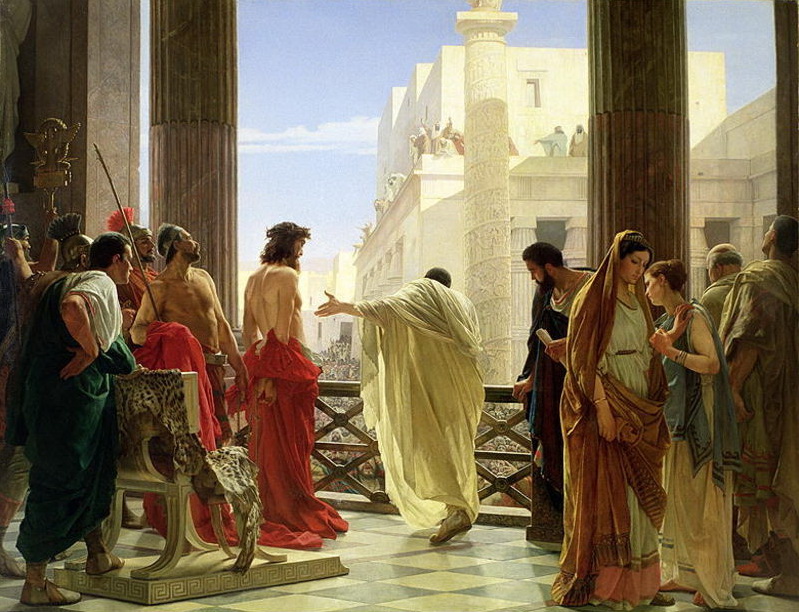
!I. Jesus is condemned to death

The very air that Pilate breathes, the voice
With which he speaks in judgment, all his powers
Of perception and discrimination, choice,
Decision, all his years, his days and hours,
His consciousness of self, his every sense,
Are given by this prisoner, freely given.
The man who stands there making no defence,
Is God. His hands are tied, His heart is open.
And he bears Pilate’s heart in his and feels
That crushing weight of wasted life. He lifts
It up in silent love. He lifts and heals.
He gives himself again with all his gifts
Into our hands. As Pilate turns away
A door swings open. This is judgment day.
Painting of Pontius Pilate with his Prisoner by Antonio Ciseri (1760-1828)
Pontius Pilate with his Prisoner – Antonio Ciseri (1760-1828)

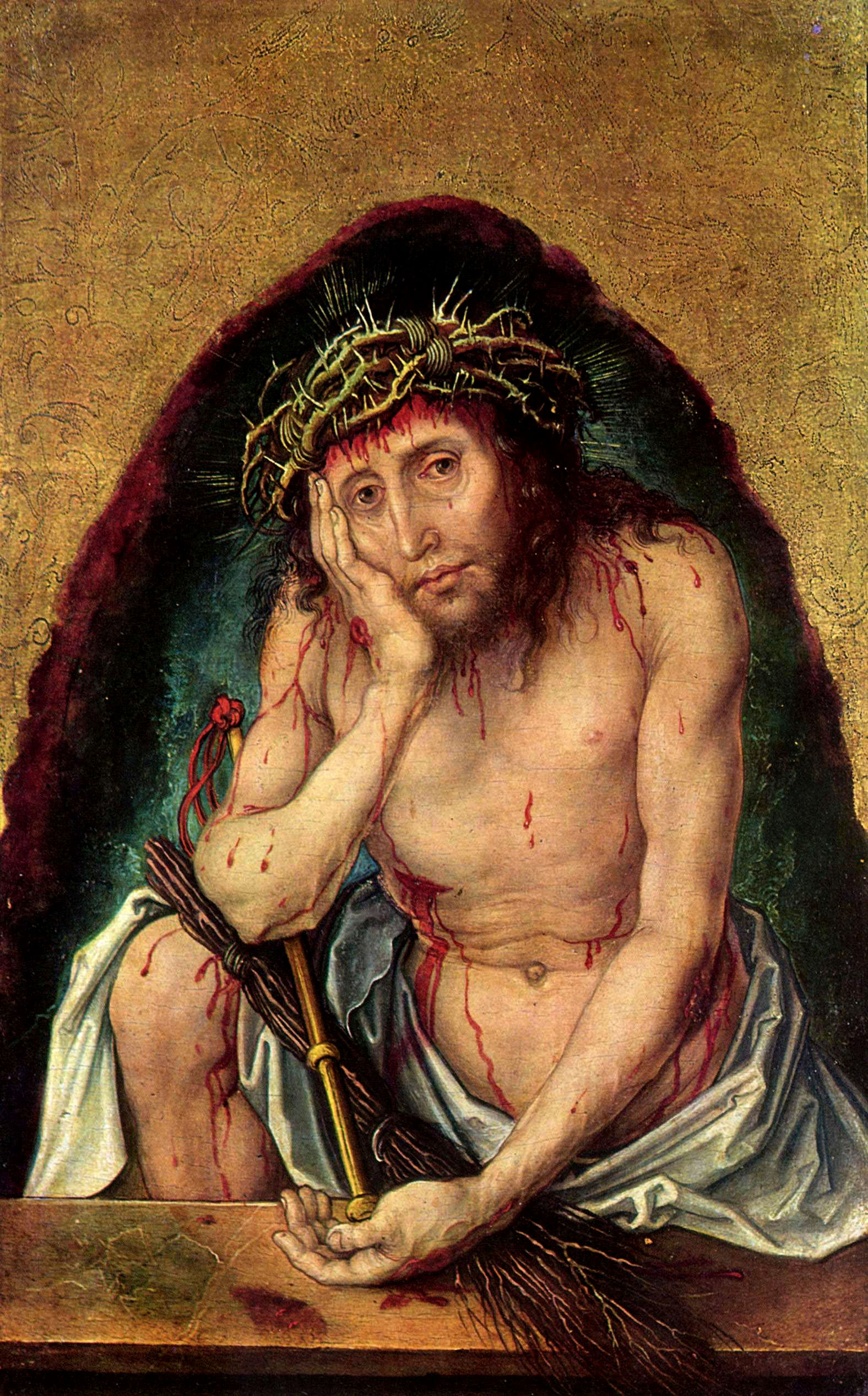
II. Jesus is given his cross

He gives himself again with all his gifts
And now we give him something in return.
He gave the earth that bears, the air that lifts,
Water to cleanse and cool, fire to burn,
And from these elements he forged the iron,
From strands of life he wove the growing wood,
He made the stones that pave the roads of Zion
He saw it all and saw that it is good.
We took his iron to edge an axe's blade,
We took the axe and laid it to the tree,
We made a cross of all that he has made,
And laid it on the one who made us free.
Now he receives again and lifts on high
The gifts he gave and we have turned awry.
Ecce Homo - "Here is the Man" Albrecht Durer
“Ecce Homo” Albrecht Durer

Click HERE for the rest of Malcolm Guite’s Stations of the Cross, or HERE for Malcolm’s book Sounding the Seasons.

  • Gordon C. Stewart, Chaska, MN, April 10, 2020 — Good Friday.