Church approves gay marriage

Yesterday the Presbyterian Church (U.S.A.) approved an amendment to its Constitution that re-defines marriage as a covenant between two people.

As a Presbyterian pastor since 1967, this debate has been a matter of long-suffering disappointment, prayer, and hope. At long last, the church opened its heart to all of its members. Questions of how to move forward in ways that do not disparage the conscience of dissenters and how to prevent further withdrawal of dissenting PC(USA) congregations provide no ready answers. Perhaps the fifth of the PC(USA)’s Historic Principles of Church Order (approved at the founding General Assembly of the Presbyterian Church in 1789) may yet guide the church today and in days to come.

…[W]e… believe that there are truths and forms with respect to which people of good characters and principles may differ. And, in all these we think it the duty both of private Christians and societies to exercise mutual forbearance towards each other. [Book of Order, Presbyterian Church (U.S.A.)

Forbearance is an increasingly foreign attribute in the church, the nation, and the world.  One prays and hopes that forbearance would prevail as we work our way through the thistles and nettles of the spiritual, ethical, national, and geopolitical issues of conscience that trouble and divide us.

– Gordon C. Stewart, Chaska, MN, March 18, 2015

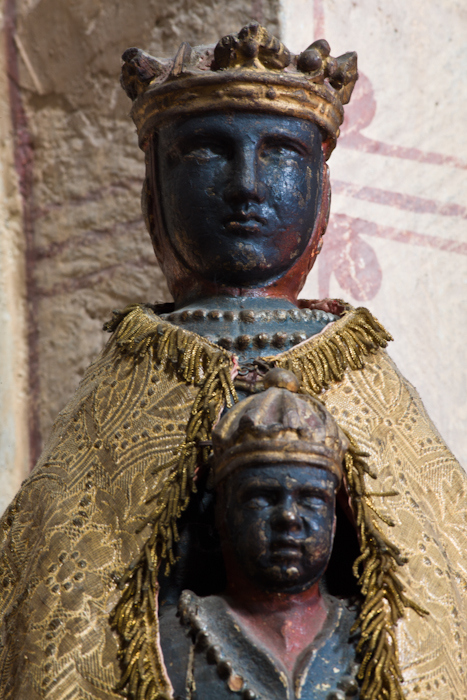
Our Lady of the Crusades Redux


Crusader Madonna and Child courtesy of Via Lucis Photography (Dennis Aubrey and P.J. McKey)

Crusader Madonna and Child courtesy of Via Lucis Photography (Dennis Aubrey and P.J. McKey)How differently people of different times view life is masterfully illustrated by Dennis Aubrey’s post . .Dennis Aubrey’s post .

Dennis Aubrey’s post The Throne of Wisdom demonstrates how peoples’ views of life are shaped by their times in history.

During the Crusades, Mary and the Jesus of the Gospels become the authorization for killing Muslims. The executed Jesus of Nazareth becomes the Knight Templar, angrily taking up the sword against the unbelievers. Mary, the iconic “Mother of God” of Catholic and Orthodox Christian veneration, is turned into the Mother of Christian Jihad.

Pictured below is an altogether different Madonna  (12th Century from Notre Dame de Vauclair, Église de Molompize, Molompize [Cantal] Photo by Dennis Aubrey) who seems to be looking with horror at what is happening.

Notre Dame de Vauclair, Église de Molompize, Molompize (Cantal) Photo by Dennis Aubrey

Notre Dame de Vauclair, Église de Molompize, Molompize (Cantal) Photo by Dennis Aubrey

There is a great struggle today over which Madonna to enthrone.  Our Lady of the Crusades is back. For example, click HERE for Sen. Tom Cotton, author of the letter to Iran signed by 47 U.S. Senators, interviewed by CBS host Bob Schieffer on Face the Nation.

Thanks to Dennis and P.J. for prompting this post. When we look carefully at where we come from, we sometimes see the darkness today in the clearer light.


Barack Obama after the Presidency?

Quote

Ever wondered what President Barack Obama will do after he leaves office? 

The President’s 50th Anniversary of “Bloody Sunday” speech in Selma, Alabama is a masterpiece in the tradition of the Church of the Bridge (see earlier post “The Church as Bridge” on Views from the Edge). Think of the President as pastor-preacher in the prophetic preaching tradition that speaks truth to power, celebrates hope, honors courage, and preaches a gospel that calls us all to cross the Pettus Bridge toward the world for which our hearts yearn.  The President’s speech was, in fact, a sermon rooted in Hebrew and Christian Scripture, freely quoted from memory.

Click HERE to hear the President on the Edmund Pettus Bridge in Selma, Alabama.

The Church on the Bridge

Pettus Bridge, Selma to Montgomery

Pettus Bridge, Selma to Montgomery

If some churches are like opium dens, others are like Pettus Bridge, the bridge over the Alabama River you must cross to get from Selma to Montgomery, Alabama.

In the history of America’s civil rights movement, Pettus Bridge and the events of “Bloody Saturday” represent a crossing over from the society addicted to violence, hatred, and war to “the peaceable kingdom” of Isaiah. Think Jesus. Think Martin Luther King, Jr. Think Congressman John Lewis. Think all the anonymous souls who dared to cross the bridge from here to there.

“Have we not come to such an impasse in the modern world that we must love our enemies — or else? The chain reaction of evil — hate begetting hate, wars producing more wars – must be broken, or else we shall be plunged into the dark abyss of annihilation.” [The Rev. Dr. Martin Luther King, Jr.]

I suspect Karl Marx never knew a church like that. What he saw was religion as a tool of the powerful, an ideological overlay on reality to keep their subjects compliant with the existing social order.

The church of the bridge is no opium den. No one is doped up. No one is in a stupor. People don’t go there to hide. It is by nature a place that calls for commitment and action. The Church as Pettus Bridge is spiritually, economically, politically, and culturally revolutionary. It requires far-reaching transformation of people, structures, and systems. It’s a risky place. The church on the bridge requires you to put your whole body, mind, and soul on the line – on the  bridge – fully conscious that the troops the old social order will come after you. It is the church of Jesus and the prophets, and of Paul at his best:

I appeal to you therefore, brothers and sisters, by the mercies of God, to present your bodies as a living sacrifice, holy and acceptable to God, which is your spiritual worship. Do not be conformed to this world, but be transformed by the renewing of your minds, so that you may discern what is the will of God—what is good and acceptable and perfect. [Epistle to the Romans 12: 1-2, NRSV]

Every time the Church of the Bridge gathers for worship, the pews are filled with people wearing crash helmets. They expect something real to happen. They expect to make it happen. When they gather around the Lord’s Table for Eucharist, they know what they are celebrating: “the peaceable kingdom”, the City of God on the other side of violence, hatred, and war that puts them on the bridge.


American Sniper, Selma, and Jesus

Sometimes, as the saying goes, a preacher goes from preaching to “meddling”. The sermon disturbs the listeners. Chaplain Randy Beckum preached a sermon like that in the Chapel of MidAmerica Nazarene University, a conservative evangelical college in Kansas. Focusing on the way of Jesus and American culture’s addiction to violence, Beckum’s sermon included comparison of the exceeding popularity, according to box office receipts, of American Sniper compared with Selma, the story of the Rev.Dr. Martin Luther King and the non-violent way of Jesus.

Views from the Edge had never heard of Randy Beckum or MidAmerica Nazarene University until this sermon went viral after the university president relieved the preacher of his additional role as Vice President of the MNU Foundation. Some sermons are hard to give and, apparently, they’re even harder to hear. That’s when you know a preacher’s worth his/her salt.


Magic Wars

There’s no record the wars of the Bible
Found in Exodus are that reliable
Historically.
Fortunately
Hebrews found Holy Land bloodlessly…

(This written as a FaceBook comment in response to a comment protesting a post by the brilliant & perverse Nina Paley about her newest feature length animated movie, “Seder Masochism“–retelling the Exodus story, like she retold the Hindu tales in “Sita Sings the Blues”, portions of the latest, and all of the former can be seen FREE many places on line!)

– Steve Shoemaker,  Urbana, IL, Feb. 22, 2015

Twins

We know that seeing never can
be believing. We fool the eye
of all who look at us and see
the other. Mother left the band
upon our wrist that gave our name
for weeks after our birth, but then
began always to dress Brian
in blue. One day we switched–I came
out in his shirt–she called him Chris!
St. Thomas was a twin and so
when he heard that his friends were sure
they’d seen the risen Lord, of course
he doubted that was true. But then
he heard the word…although a twin.

Steven Shoemaker
Urbana, Illinois, Feb. 21, 2015

[These poems may be used, copied, or published as you will. It would be nice
if you included my name, city, and State]

NOTE: Readers unfamiliar with Christian Scripture will find it helpful to know the biblical text behind Steve’s poem. Click Jesus and Thomas, the Twin for the story in the Gospel of John.

Life begins on the other side of despair

It was Jean-Paul Sartre, the French existentialist novelist, philosopher, and playwright, who declined the Nobel Peace Price for Literature in 1964, who said it. “Life begins on the other side of despair.”

Sartre’s statement resonates with those who have stood at the edge of the abyss of the loss of life’s meaning. Some don’t make it to the other side. Some move to the other side of the abyss with no faith but faith in themselves to create meaning they once ascribed to God or some objective moral order. Others arrive on the other side with their inherited faith not only deconstructed, but re-constructed. I am one of the latter.

Reading of the shooting suicide of a 27-year-old Iraq War veteran philosophy student in the library at Mankato State University takes me back to Sartre’s statement about life and despair. Timothy Lee Anderson was an honorably discharged U.S. Army gunner in Iraq. His picture in The Daily Mail shows him in an Iraqi combat zone with his weapon. In the background of the photo, Iraqi women in traditional Muslim dress appear to be crossing the street. How, I ask, does a guy who served as a gunner in the Iraq War choose philosophy as his major when he comes home to the U.S.A.?

Philosophy is not a popular choice these days. Unlike computer science, it’s not job- related. The word ‘philosophy’ derives from two Greek words meaning love (philo) and wisdom (sophia). Philosophy is the love of, and the search for, wisdom.

Wisdom is born of experience, not inheritance. It’s not hard to imagine the dashed, unexamined, inherited convictions of a young Army recruit: a world dependent on American goodness and might; an America with a manifest destiny in the global order; an exceptional nation privileged and responsible, whether by religious or political creed, to bring its blessings to the rest of an ignorant, unenlightened, uncivilized, and sometimes terroristic and defiant world.

Nor is it hard to imagine a soldier’s despair upon return, reflecting on his experience in search of greater wisdom among the philosophers. The early reports of Timothy Lee Anderson’s life experience point to a less than comfortable homecoming with arrests for marijuana and violation of an order for protection. The gun shot he fired at himself on the second floor of the Mankato State University library was a shot of despair, whatever the immediate reasons or circumstances.

The great sorrow is a life that ended too early on the despair side of the yawning abyss of collapsed meaning. It remains to the survivors and the rest of us who look with sadness on Timothy’s tragic departure to learn that claims to religious-national exceptionalism and wisdom go together about as well as bombs and day-care, guns and libraries.

– Gordon C. Stewart, February 3, 2015.


In Memoriam: the MSU Philosophy Student

“The life of the dead is placed in the memory of the living.” – Cicero

The philosophy student who shot himself in the library at Mankato State University yesterday could have been me many years ago. Or is it “could have been ‘I’”? I or me is a question of grammar without much consequence. Philosophy is a question of meaning. Grammarians don’t shoot themselves. Some philosophers do.

I know nothing about the 27-year-old philosophy major at MSU. I don’t need to know more for tears to fall while reading the Star Tribune news report over morning coffee.

A Minnesota State University Mankato student shot and killed himself Monday afternoon in the campus library.

Police were called about 4 p.m. to the library after receiving a report of a suicidal man. After searching Memorial Library, police found the 27-year-old man, a junior philosophy student, on the second floor. Police said he turned the gun on himself and shot.

Police said no one else was in any danger during the incident.

The library was open Monday evening but with access only to the lower level, first and third floors.

I feel sick. It’s sad enough when anyone takes his or her life. It’s sadder still, at least for me, to learn that he was studying philosophy and that he appears to have found a solitary place on the second floor, perhaps among the stacks in the philosophy section of the library, as I imagine it.

He was a junior, as I was when the course in contemporary philosophy plunged me into deep despair. Psychology majors might have called it depression because it looked like that on my face. But there’s a difference between depression and existential despair.

Jean-Paul Sartre’s Being and Nothingness, No Exit and The Flies, and Franz Kafka’s Metamorphosis and The Trial were like nothing I had ever read or heard. They blew my mind to smithereens, leaving me very much alone with the sense of nothingness.

By the time I hit the books in the library that junior year, I ate, drank, and slept philosophy. Of the 18 hours of courses I had decided to carry, only the philosophy course seemed important. Raised in a Christian home, I had always prayed, more or less, giving thanks and asking for blessings on those I loved and the less fortunate. But now prayer seemed a cruel hoax, “bad faith” as Jean-Paul Sartre put it. Why I would return from class and kneel down beside my bed not for “now I lay me down to sleep” but to tell God to go to hell is one of the great ironies, a question grammarians cannot answer.  Had I had a gun that afternoon, my roommate might have found me on the floor in Room 301 of Carnegie Hall.

I know nothing of the circumstances or state of mind of the 27-year-old MSU philosophy student. Perhaps no one will ever know for sure. It may be that his experience bears little or no resemblance to mine all those years ago. It’s not for me to know.

I don’t even know your name, but I sure do feel you! And I feel for those who mourn your loss. “That God does not exist, I cannot deny,” wrote Sartre, “That my whole being cries out for God, I cannot forget” – Jean-Paul Sartre.

Almighty God, Father of mercies and giver of comfort: deal graciously, we pray, with all who mourn; that, casting all their care on You, they may know the consolation of Your love. [The Book of Common Prayer]

Rest in Peace

– Rev. Gordon C. Stewart, Chaska, Minnesota (an hour from Mankato), Feb. 3, 2015.

The Man who Knew

He knows who he is! He is not ignorant; he’s smart. He knows the visiting rabbi is both “the Holy One of God” and the one who has “come to destroy us”.

It is because he knows this that he ends up shrieking. He knows better than those around him, all the others who have come at sundown to observe the Friday Shabbat and Torah study.

He takes his customary place among his neighbors in the Capernaum synogogue. He does not expect much to happen. Everyone, including he, knows that he’s a little strange. Off balance, as the kinder of them say.  Not the norm. Both they and he know his place. None of them yet knows Annie Dillard’s advice that worshipers “should wear crash helmets. Ushers should issue life preservers and signal flares; they should lash us to our pews. For the sleeping god may wake some day and take offense, or the waking god may draw us out to where we can never return.” [Teaching a Stone to Talk, Harper and Row, 1982, quoted here from Wikiquote.]

They have no need for crash helmets, life preservers, or signal flares. Like the ones who are better balanced, he likes his safety. He is safe in his customary place among the customary people expecting a customary teaching from a customary teacher who teaches like a copy-editor (a scribe). He expects to leave the same way he has come: bored and boring in the daily-ness of it all.

They look at him. He looks at them. They all yawn.  Until the guest rabbi takes his seat to teach and says nothing. Jesus just looks at them, reading their faces, reading their minds, looking into their hearts. They are uncomfortable with the long silence. He is reading them like a book he’s read too many times.

When finally the rabbi speaks, he astounds them. He reads the Torah and the prophets as living texts, not history. He is alive and expectant. He is not bored or boring. He teaches with authority. He commands the attention of everyone in the room. They want him, but do not want him. They haven’t brought crash helmets. They’ve come for safety.

He catches the eye of the man who’s a little off balance whose frequent uninvited outbursts   long ago placed him in the back row of the assigned seating.  Although the rabbi’s eyes are working the room from left to right and back again, seeing all the faces there, it is as though he is staring at him alone. They are all a bit on edge now, drawn to his voice and the content of his teaching, his unparalleled authority, but they are also becoming nervous that he is messing with them in ways they had not expected.

The man in the back senses this. He knows this, and he begins to twitch and make strange sounds. He is agitated, disturbed, out of his comfort zone, like everyone else.

His face twitching with the familiar tic, he struggles to his feet from his back row seat, shoving from his shoulders the hands of the ushers stationed on either side of him to prevent the man with Tourettes Syndrome from disturbing them and making a fool of himself.

He points at the rabbi and shrieks at him: “What have you to do with us, Jesus of Nazareth? Have you come to destroy us? I know who you are, the Holy One of God.”

Jesus moves from the center to the back row. He tells the body guards to leave him alone. He stands eye-to-eye with him. “Be silent,” he says, “Come out of him” as though speaking not to the man himself but to others who torment him from the inside.

The whole synagogue is on their feet watching. They know that the Tourettes man with the tic and uncontrollable speech has spoken for all of the normal ones as well. “Have you come to destroy us?”

The man screams and convulses, but it is not the man who is convulsing; it is the hostage-takers whose powers are being broken that are convulsing: the fear of losing one’s assigned place, the customary despair and despairing comfort that robs him and all of them of the joy of the extraordinary in ordinary life.

Perhaps the story of “the man with the evil spirit” comes so early in the Gospel of Mark because it is the story of us all. The Holy One of God does come to destroy us as well as heal us. The next time you go to the synagogue for Sabbath rest or to church on a Sunday morning, take a crash helmet and expect something great to happen!

Click Gospel of Mark 1:21-28 for the story on which this sermonic reflection is based.

– Gordon C. Stewart, St. Augustine, FL, February 2, 2015.