Solitude and Society Sermon
Reply

Gordon C. Stewart, August 8, 2013 copyright.
I have always been bemused by time . . . and place. I am on a train listening in the night to the eerie sound of the train whistle and the constant click-clacking of the wheels. Where were we? Where are we going – and why, just my mother and I?
We were between times and places. My father had shipped out for war in the South Pacific. Hewas somewhere on a ship and might not return. My mother and I were on our way from LA to Boston. Two different places: one hours behind, one many hours ahead. But for the time being, there was only the now of the train, the whistle, and the steady clickety-clack from the track carrying us from there to here to there, from then to now to then. Perplexity with time and place is my earliest memory.
We are all in transit. But from where to where and from when to when have become less and less my questions.
I do not share the popular view that time is an illusion or that the material world is the prison from which we will be released at death. Time and place are gifts of creaturely existence, boundaries within which we live our lives appreciatively or scornfully in the midst of the Eternal. To scorn them is to deprecate existence itself in the Promethean hope that we can steal fire from the gods to become what we are not: timeless and placeless.
Time and place are set within the larger Mystery that Rudolph Otto called the Mysterium tremendum et fascinans – the Mystery that makes us mortals tremble and fascinates us at the same time, the Mystery of the Eternal without which we are nothing that draws us to itself like iron to a magnet. Time and place – birth, finite life, death – exist within the Mystery of that which does not die: Eternity.
I am not amused by the denial of death that is so rampant in our culture. Surveys show that roughly 90% of Americans, regardless of religious affiliation, believe in life after death, by which they do not mean that life will go on without them, but that they themselves will never die.
I have come to believe that the denial of death and the fear of death lie close to the core of American culture at its worst. Ernest Becker’s The Denial of Death informs how I see the world and myself; Becker sits beside me as I turn to the Scriptures in the morning.
Psalm 90:1-5, paraphrased by Isaac Watts (1719) and sung as the hymn “O God, Our Help in Ages Past” is as much in my early memory bank as the train whistle on the ride to Boston. It has always represented a mature faith that takes seriously Otto’s Mysterium:
Before the hills in order stood,
Or earth received its frame,
From everlasting Thou art God,
To endless years the same.A thousand ages in Thy sight
Are like an evening gone;
Short as the watch that ends the night
Before the rising sun.Time, like an every rolling stream
Bears all its sons away;
They fly forgotten, as a dream
dies at the opening day.O God, our help in ages past,
Our hope for years to come,
Be Thou our guard while life shall last
And our eternal home.
Standing at the gravesites over the years, I have prayed the same prayer so many times that it has become an essential part of me. I confess that I don’t know what it means exactly but it expresses the sentiment of good faith as I have come to understand it for myself.
O Lord, support us all the day long,
until the shadows lengthen,
and the evening comes,
and busy world is hushed,
and the fever of life is over,
and our work is done.
Then, in Your mercy,
grant us a safe lodging,
a holy rest,
and peace at the last.
The shadows have grown longer since the trip to Boston and the first time I sang the hymn. Evening is closer now. The sense of the Mysterium tremendum et fascinans is different but no less real now than it was on the train to Boston. The hush of the busy world will come soon enough. Between now and the day my work is done, I want to listen more attentively for the Hush in the midst of time, and give thanks that the Silence is not empty. It is full of Eternity. I am bemused by time.
Click O God, Our Help in Ages Past for a video that captures the spirit of the hymn and the prayer.
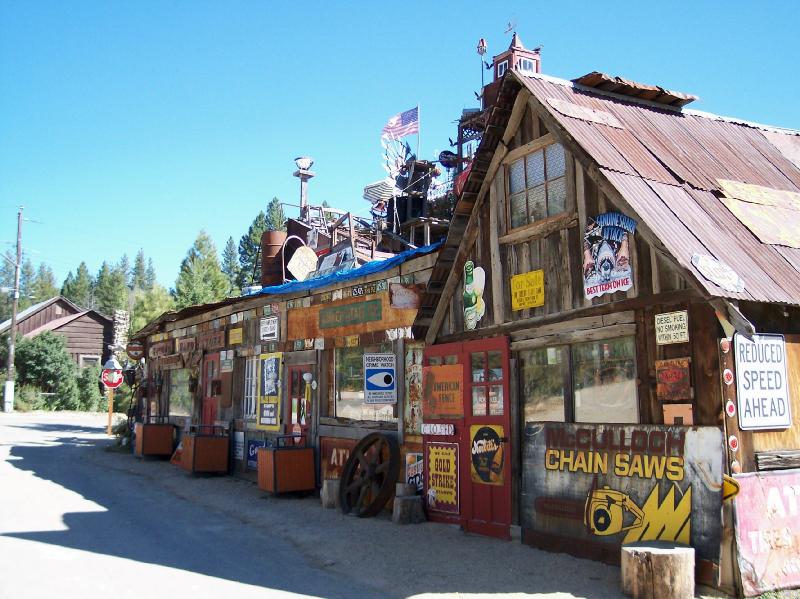
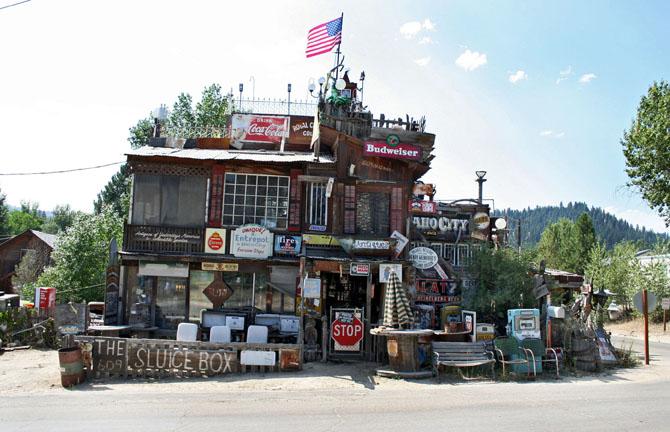
For sale in Idaho City
According to the woman who strolled up the street while Kay was taking photographs, it belonged to a fella who was “a little eccentric” whose surviving relatives didn’t want to continue “the business” so it has sat vacant for a couple of years waiting for a new owner. She said it could be ours for $350,000 – and not just the property, but ALL the valuables inside. It’s been vandalized several times, she said, but with a little attention, if the right person came along and “restored” the place, it could become a thriving operation. People would come from miles around.
Wouldn’t you like to meet the man who owned and operated The Sluice Box? Elsewhere on Views from the Edge we’ve noted famous people who were a little eccentric – people like Bishop James Pike – and suggested the world would be a better place if we were all a bit more eccentric. Whoever the man was who (sort of) maintained this old 1800s structure while collecting everyone else’s junk, he wasn’t into a throw-away culture.
A web search uncovered the current asking price: $249,900. Click HERE for the real estate listing. Turns out the house next door comes with it.
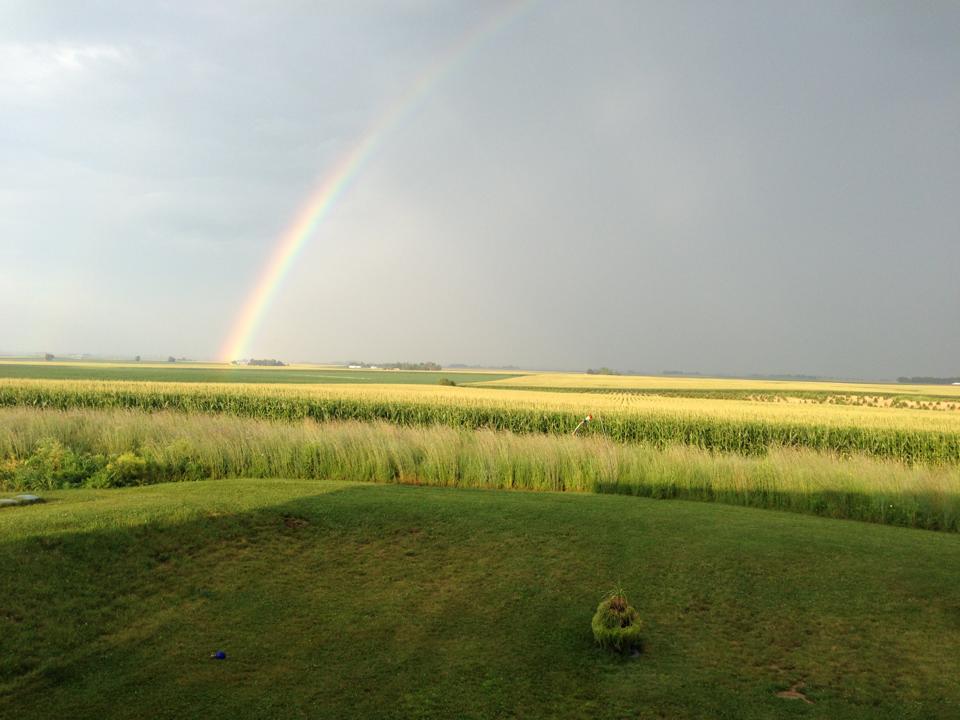
Rainbow over the IL prairie.
They can be seen by other eyes than mine–
but rainbows are mono-directional:
they disappear if you will face the sun.
If you move toward a rainbow you will fail
to ever reach it: always up ahead,
elusive, magical–the circle seen
only above the earth. Sometimes instead
of one, two bows appear, and in between
a darker band in contrast to the light
below the palette of diversity.
Beyond prediction, measurement or fact,
a rainbow’s truth will live inside the eye.
– Verse and photography by Steve Shoemaker on the
plain behind his prairie home in Urbana, IL.
Click HERE and then click the audio link on the Minnesota Public Radio website to hear yesterday’s commentary on the classical spiritual-philosophical-ethical premise we need to remember. This piece was written two days BEFORE the President delivered his speech yesterday at Knox College.
The English word “economy” comes from the Greek work “oikos” – the Greek word for house. The word “economics” derives from the Greek word “oikonomia”- -the management of a household.
Before it is anything else, economics is a perspective, a frame of reference. Before it decides anything about household management, it knows that there is only one house. Good household management – good economics – pays attention to the wellbeing of the entire house and all its residents.
Aired earlier today on All Things Considered (MPR, KNOW, 91.1 FM).
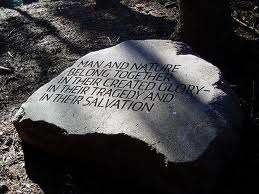
Paul Tillich quote in Tillich Park, New Harmony, IN.
Economics is about a household and how to manage it. The household is a family, a state, a nation, a planet.
The English word “economy” comes from the Greek work oikos – the Greek word for house. The word “economics” derives from the Greek word oikonomia–the management of a household.
Before it is anything else, economics is a perspective, a frame of reference. Before it decides anything about household management, it knows that there is only one house. Good household management – good economics – pays attention to the wellbeing of the entire house and all its residents.
In America and elsewhere across the world, we are coming to realize that the planet itself is one house. What happens in one room of the house – one family, one city, one nation – affects what happens everywhere in the house. Paul Tillich caught the clear sense of it when he wrote that “Man and nature belong together in their created glory – in their tragedy and in their salvation.” That is to say, there is only one house.
The essential question of economics is not about systems – capitalism, communism, socialism, or something else. The essential question is spiritual, philosophical, and ethical. It’s whether we believe that there is only one oikos, one house; the subsequent question is about how best to manage it for the wellbeing of all its residents and the fragile web of nature without which the house of the living would not exist.
Very often what we call ‘economics’ is not economics. It’s not oikonomia. It’s something else. It assumes something else, and when we forget what an economy and economics really are, we enshrine greed as the essential virtue, ignoring and imperiling everyone else and everthing in the one house in which we all live.
I dream that the President will preach the old Greek common sense: that in his own way, he will reclaim the essential premise of an economy and the ethical task of economics. By bringing the Greek origins to our television sets, headsets, and iPads, he can call us to move forward out of the partisan houses of nonsense.
There is only one house.
Remember Stevie Wonder’s song that lifted our spirits and brought tears to our eyes? Click We are the World.
There’s a choice we’re making
We’re saving our own lives
It’s true we’ll make a better day
Just you and me
Stevie Wonder got it then, and he gets it now. He’s made a choice to help save lives.
He has announced that he will no longer appear in the state of Florida. He’s boycotting Florida and every other place with “Stand Your Ground” laws in the wake of the Trayvon Martin jury verdict.
The acquittal of George Zimmermann brings to the fore once more gun violence, race, and the Stand Your Ground laws that move the right to defend one’s home without retreat into the streets.
The dark sun glasses are a trademark of the performer who cannot see, but he sees some things very clearly. This is one time the blind need to follow the blind man who sees. “Once I was blind, but now I see,” wrote John Newton, the captain of a slave-trade ship, after he came to his senses and refused to participate any longer in the evil of the slave trade.
It’s choices like Stevie Wonder’s that help us to save our own lives. Decisions like Stevie’s shine a light on the blindness of a society whose laws in Florida and elsewhere turn back the clock to the old days of vigilante violence.
Someday hence it will be said that America suffered years of temporary blindness – that we forgot that we are the world – and that a blind man named Stevie led America in singing with joy the hymn of the old slave ship captain: “Amazing grace, how sweet the sound…I once was blind, but now I see.”
Click We are the World.
My son once asked me “What is time?”
I answered, “I don’t know. It’s a perennial question of philosophers and theologians. But, so far as I can tell, time is what we have.”
Some people think that time isn’t real. It’s a human construct and only eternity is real. They think of time and place as the prison of the soul, the antithesis of, or the prelude to, eternal life.
It always seemed a bit strange to me. Like the imaginary friends children make up because they’re afraid of being alone in the dark. I could never understand.
“Time is what we have.”
The animals know what time is. They also know eternity. They wake and sleep with the rhythms of the sun – rising and setting daily – the markers of what we call time. They know nothing about clock time or the names of days, months, seasons or years, but they live in the reality of time.
Time is what we have between birth and death. Eternity is the depth of time, the Mystery beneath, within, and beyond the limits of time. We participate in the eternal, but we are not eternal. To think otherwise is to consider ourselves the exception to nature itself.
The illusion of superiority to nature – the idea that the human species is nature’s singular exception – is a fabrication peculiar to the species that considers itself conscious. The imaginary friend of eternal life may help us sleep better at night, but it leads to slaughter and, eventually, to species suicide.
Ernest Becker (The Denial of Death) saw the denial of death as bedrock to American culture. The denial of death – the refusal to acknowledge it as real; the flight from the knowledge of our mortality – not only deprecates life here and now; it takes into its hands the life and death of those different from ourselves. It builds towers to itself that reach toward the heavens while it plunders an earth it considers too lowly for its aspirations.
Time is our friend and time is our limit. We are meant for this. “Grace and pride never lived in the same place,” says an old Scottish proverb, for pride always seeks to exceed what is given (grace).
Time is what we have. Time is a participation in the glory of God. If there’s more, it will only by grace.
Thrice happy he, who by some shady grove,
Far from the clamorous world, doth live his own;
Though solitary, who is not alone,
But doth converse with that eternal love.– William Drummond, Urania
Next to the big barn attached to the big house on the big hill in South Paris, Maine was my favorite place: the pine grove.
It was a quiet place. The pine trees reached up to the sky, so tall that I wondered whether their tops could touch the blue sky and the white clouds I would watch floating over them through the filtered light of the trees, lying on the pine needles of the pine grove floor.
Sometimes Annie went with me to the pine grove. She lived just behind Grandpa’s and Grandma’s big house on the hill.
Annie liked my grandmother’s sugar cookies almost as much as I did…and the gingerbread cookies and the toll-house cookies, but mostly the big white sugar cookies my grandmother made every day because she knew we liked them best. We would settle on the granite steps outside the pantry with big glasses of fresh milk from real returnable glass milk bottles brought that morning by the milk man, and eat the cookies and drink our milk. Then a cookie or two would go with us into the pine grove.
We would lie there and look up…without talking…smelling the aroma of the pines. It was a sacred place of solitude and quiet – God’s greatest gift – where I could forget that my father was somewhere far away on the other side of some great big ocean in a great big war against a great big monster. I would retreat to the pine grove to get away from the radio broadcasts we listened to that might tell us whether my father was alive or dead.
There was no war in the pine grove. There were no people there. Just the great big pine trees that didn’t seem to care about the war. They just kept reaching up to the sky.
After we moved far away to Pennsylvania following my father’s return from the war, we returned to South Paris annually for vacation. Every year those pine trees were there waiting for my return.
During the 10 hour drive to South Paris, I looked forward to lying on the floor of the pine grove with a fresh-baked sugar cookie. As we drove up the road from Gray and rounded the bend by the Fair Grounds, the anticipation grew. I could almost smell the scent of the pines of the pine grove.
Until the year I looked up to see a franchise submarine sandwich shop standing where the pine grove had stood. The pine grove was gone. Clear cut. All the trees. All the pine needles. And the hill had been leveled to street level.
Someone had declared war on the pine grove, and the trees couldn’t fight back. Trees don’t fight. I sobbed like a baby.


 Views from the Edge