If I were a rich man…Labor Day Sunday 2015

Once there was a rich man with gold rings and fine clothes who was applauded by television viewers. “You’re fired!” he’d say with a smirk.  He showed no mercy. He took no prisoners.  He took no guff. Judgment triumphed over mercy, and the people lapped it up. It came from someone just like them, or so they thought, a true-blue American who stands up against intruders from Mexico.

Then some of those who followed him went to church on Labor Day Sunday where they had to square their enthusiasm for the man with the gold rings and fine clothes with the assigned Epistle for the day from New Testament’s Letter of James.

My brothers and sisters, do you with your acts of favoritism really believe in our glorious Lord Jesus Christ?  For if a person with gold rings and in fine clothes comes into your assembly, and if a poor person in dirty clothes also comes in, and if you take notice of the one wearing the fine clothes and say, ‘Have a seat here, please’, while to the one who is poor you say, ‘Stand there’, or, ‘Sit at my feet’, have you not made distinctions among yourselves, and become judges with evil thoughts? Listen, my beloved brothers and sisters. Has not God chosen the poor in the world to be rich in faith and to be heirs of the kingdom that he has promised to those who love him? But you have dishonored the poor. Is it not the rich who oppress you? Is it not they who drag you into court? Is it not they who blaspheme the excellent name that was invoked over you?

You do well if you really fulfil the royal law according to the scripture, ‘You shall love your neighbour as yourself.’ But if you show partiality, you commit sin and are convicted by the law as transgressors. For whoever keeps the whole law but fails in one point has become accountable for all of it. 11For the one who said, ‘You shall not commit adultery’, also said, ‘You shall not murder.’ Now if you do not commit adultery but if you murder, you have become a transgressor of the law. So speak and so act as those who are to be judged by the law of liberty. For judgment will be without mercy to anyone who has shown no mercy; mercy triumphs over judgement.

What good is it, my brothers and sisters, if you say you have faith but do not have works? Can faith save you? If a brother or sister is naked and lacks daily food, and one of you says to them, ‘Go in peace; keep warm and eat your fill’, and yet you do not supply their bodily needs, what is the good of that? So faith by itself, if it has no works, is dead.

[Letter of James 2:1-17, NRSV]

And the people left church thinking the preacher was being political and went back to their television sets imbibing the illusion that one day they, too, might be like The Donald.

  • Gordon C. Stewart, Chaska, MN, Labor Day Sunday, Sept. 6, 2015.

From Labor Day to Shopping Day

Remember Labor Day?

Violence against labor

Violence against labor – 1938 strike

There was a time when the nation closed down on Labor Day as a tribute to America’s working people.

Then something happened. The Labor Movement which brought about the end of child labor, the 40 hour work week, and won workplace safety laws, lost its steam. “Unions” became a four-letter word. Free market economists convinced the country that unions were responsible for America’s economic problems. The auto industry vacated Detroit for “Right to work” states or Mexico or outsourced parts production, as did other industries, to places where management would have free reign setting wages, benefits, pensions, and work conditions for employees.

This morning I asked a store clerk whether she’ll be working on Monday. “No,” she said, “We’re closed.” “Good,” I said, “you should be. Good for [name of the company]. Everyone should be off unless they’re working somewhere where  an essential public interest at stake.”

Then I came home and searched “Labor Day”.  9 Best Sales of Labor Day 2015 – US News popped up. It’s a shopper’s holiday in the free-market consumer society. Tenty-three percent of American workers work in retail. Amnesia reigns. But, in case you’re wondering, Costco will honor its workers Monday. Walmart invites you to “celebrate hard work with huge savings”.

Click HERE for the heart of Labor Day and why Labor Day is important in the year 2015 when America’s 1%, the class of J.P. Morgan, have succeeded in turning Labor Day into a shopping event when the laborers have to work.

  • Gordon C. Stewart, Chaska, MN, September 5, 2015

A Deeper Look @ the “Migrant” Crisis in Europe

This morning as the BBC reports on Hungarian migrants’ “Walk to the Border” of Austria, this report offers a different picture of the crisis’s origins and meaning for the future. Views from the Edge has added Maroon to draw attention to the humane impulse and to the too easily ignored question of who’s responsible for the crisis.

Victor GrossmanIMMIGRANTS, WELCOME AND UNWELCOME

by Victor Grossman – Berlin Bulletin No. 98, September 5 2015

After finishing off this bulletin late last night – actually early this morning – I sent off a first batch and finally went to bed after 2 AM. But in the morning I found it was already outdated on one important point: the Hungarian government, facing growing violence and the “Walk to the Border” mentioned below, gave in and agreed to the offer by the Austrian and German governments to skip strict rules and let the migrants cross the border into either country. Skeptical at first, fearing new tricks, the refugees, after waiting a few hours until the news proved genuine, have since been moving out of Hungary by the thousand, arriving exhausted but grateful in their hoped-for new Gardens of Eden, getting for a start a bottle of water, a banana and a new registration number. It all seemed a ragged replay of the journey of jolly, well-nourished GDR emigrants – or “freedom seekers” – along much the same border-crossing route in 1989, leading to major changes in all Europe. Will this also have seismic effects? Who knows?

Otherwise I think my bulletin is still valid.
+++++++

A silent three-year-old, lying drowned on a Turkish beach, the tearful protest of a Syrian man as he, his wife and baby are torn from the tracks next to a locomotive by Hungarian police, desperate families jammed into tiny, leaky vessels boats hoping to reach Europe alive or, if they do, facing ever new obstacles from weather, hunger and thirst to barbed wire fences and pepper spray – these pictures hammer at emotions here for one tragic week after another.

In truth, for many months and years such scenes caused those in power more irritation than dismay. British PM Cameron complained of immigrant swarms as if a nasty foreign ant species was threatening his island. He and French President Hollande viewed the miserable “Jungle” of asylum-seekers in Calais, icy-cold, as a problem for truck insurers and police squads. The officialdom of Germany and a largely obedient European Union focused on squelching hopes for true sovereignty, jobs and an endurable existence of the Greek people – or any others daring to follow their example.

But as more and more human beings fled the bloody fighting, the air raids and ruins in the Middle East or hopeless poverty in their homelands, events in Europe escalated. Far-right organizers, always present in Germany, took advantage of the growing numbers of refugees to denounce even planless, weak measures to help them and turn citizens’ dissatisfaction and fears for the future into hatred toward anyone weaker than they, suspected rivals for any improvement or assistance. Thousands marched with ugly signs and banners, at first aimed at “Islamists” but soon at anyone with a different culture or skin color. This was officially disapproved of but often tolerated, even protected.

Older buildings or container structures, renovated to house the growing numbers of arrivals, were often faced with mob protests, even riots. When buildings were set ablaze, usually but not always empty, Germany’s reputation demanded a response. Leaders like Vice-Chancellor Gabriel visited and denounced the “mob”. At last, on August 25th, Frau Merkel also visited Heidenau near Dresden, where xenophobia had reached fever heat. Quite horribly for Germany’s so very respected, calm and collected leader, she was confronted with posters and shouts calling her a “Traitor”. Some intoned a slogan, greatly admired in 1989 when directed against East German leaders, but now less welcome: “We are the people”.

It was ironic that Saxony’s police, so numerous and arrest-happy when leftists block Nazi march routes, were too pitifully understaffed to do much; despite barrages of rocks, bottles and fireworks they made only one paltry arrest. Saxony, the only East German state run by Christian Democrats ever since West Germany took over the GDR in 1990, is known for its lax attitude towards far-right forces, despite pious disclaimers – and that is where there are the most mobs and fires.

But then a change became apparent. The discovery of a truck on an Austrian highway with a hardly conceivable number of 71 corpses inside, refugee men, women and children suffocated and deserted by the “people-smugglers”, was a shock and one key element in much new thinking. Instead of a courageous but limited number of mostly young anti-fascists, large numbers of often less political Germans discovered their humane impulses – and increasingly acted on them. While most government officials on local, state and federal levels dillied and dallied, tied up with matters like officially registering people and always understaffed, more and more citizens moved in to help, bringing blankets, clothes, diapers, food, water and toys. They cooked, teachers organized German classes, some simply stood guard against the racists – with posters saying “Refugees Welcome!”

What has occurred is a real split in the German population, somewhere near the middle, with many people taking not only a humane position but often a courageous one, for nationalist grumbling about immigrants, at least as common as in some regions in the USA or elsewhere, has in Germany especially disturbing reverberations from the past and some potentially very violent elements.

It is unexpectedly interesting that German leaders, with open ears to all factors, began to welcome this huge wave, which may reach 800,000 this year, at least in words and with often hesitant steps.

Some media recalled that after World War II Germany, in ruins and reduced in size, absorbed 12 to 14 million refugees from Eastern Europe, especially Poland and Czechoslovakia. Of course, they were Germans who spoke the same language. Then, from 1969 to 1972, millions of so-called “guest workers” were taken in, originally to do the rough, dirty work and then leave. But a large number, especially Turks, stayed and settled down, although this time the integration has been far more problematic. But it was possible, and after the Berlin Wall went down there was another big wave, East German and Eastern European, with 700,000 arriving in 1992 alone. None of the waves ruined the economy! Economists point out that the demographic facts of life, with ethnic Germans having ever fewer children, demand many immigrants, especially young people with growing families.

Now, surprisingly, and despite rightist terror and foot-dragging politicians, Germany has become the main defender of the refugees in the European Union and a Mecca for the majority of them, like those in Budapest’s Main Station chanting “Germany, Germany”. Indeed, the Hungarian government had to trick them into thinking the trains they were crammed into were headed for Germany; instead they were soon halted so their misled passengers could be bussed off to a caged-in tent camp and registered. As I write, hundreds, probably thousands are defying this trick with a hunger strike or by trying to walk, with their elderly and their babies, to the Austrian border 150 miles away. The violence of a xenophobic Hungarian officialdom, at a total loss for any solutions, seems to be worsening, while the barbed wire fence built by Hungary to stop the refugees may recall to some the pageantry involved when it cut its fence to Austria in 1989, setting in motion the downfall of any form of socialism in Eastern Europe.

A few countries, led by Germany and the unwilling hosts to the arriving boats, Italy and Greece, now demand that the refugees be shared out through Europe, with quotas based on size and economic strength. Cameron responded with a vague hint at limited approval, Denmark, the Netherlands and above all Eastern Europe reject any such plan. At first Slovakia had said “We’ll take a few hundred – but only Catholics!” Now it and the Czech Republic, with Hungary and big Poland, are so stubbornly opposed that the whole wobbly structure of the European Union is trembling alarmingly.

To complicate matters even more, official Germany’s welcome smiles vanish when it comes to so-called “economic refugees”; many Africans but mostly discriminated Roma people of Eastern Europe and poverty-stricken people from Albania and all of former Yugoslavia – most of all Kosovo.

Cleo, the muse of history, must again turn to irony. It was the German government (all top parties) which was most active in splitting Yugoslavia into national slivers. Germany hotly encouraged the war to “liberate Kosovo”, joining in the merciless bombing of Serbia and leaving the “western Balkans” in wrecked, chaotic disarray. It promised Kosovo freedom and prosperity; what now reigns, in the presence of German and other UN soldiers, is described as “corruption, gang crime, poverty and discrimination against the Roma”. Wages average about 300 euro, youth unemployment is at 60 %, the health service hardly functions. But desperate attempts to reach the promised and once so grandly promising land in the north are almost hopelessly doomed to fail.

This raises a key question, almost agonizingly avoided in the media, which angrily denounces vicious, greedy “people-smugglers” but not those who caused this misery in the first place. Who provoked the wars in ex-Yugoslavia? Who unleashed “shock and awe” in Iraq, killing hundreds of thousands and driving millions from their homes? Who invaded Afghanistan, as vengeance for September 11th, with a “war on terror” unleashing fourteen years of killing and destruction and forcing thousands upon thousands to flee? Who wrecked Libya – to “protect its down-trodden” – opening the way for anarchy and a fleet of deadly cutters and rubber dinghies? And who massively armed the destructive hordes in Syria, in part via billion-euro contracts with Saudi Arabia, the United Emirates, Qatar and Turkey, all to fight Assad, all trying to hold or grab a bigger slice of that tragic land? True, one of those involved, Turkey, is filled with perhaps two million who fled from Syria. Another, the USA, agreed to welcome about 1000. The Saudis, Qatar and the UAE, so far as known, have taken none.

These forces, in different countries but all obscenely wealthy, are the real guilty ones, guilty in the long run for the rubble of Palmyra and for little Aylan Kurdi, now interred with his brother and mother in Cobane, another city destroyed by the highly profitable weapons of the fanatical, oil-rich ISIS while its erstwhile friend and customer, our NATO ally Recep Erdogan of Turkey, stood by. Aylan and his family were not allowed to enter Canada where their relatives had hoped to welcome them.

What is ahead? Let us hope the world is spared from more such blessed freedom battles against “Islamic terror” – and more unimaginable heartbreak! Iran has 75 million citizens. If some current people’s wishes and plans are not prevented we may yet be welcoming many of them, too – or as many as survive!

Daily Riches: Cutting Through Political and Religious Illusions (Vernon Howard, Thomas Merton and Dietrich Bonhoeffer)

Bill Britton's avatarRicher By Far

“Every day that you attempt to see things as they are in truth is a supremely successful day.” Vernon Howard

“It seems to me that the most basic problem is not political, it is apolitical and human. One of the most important things to do is to keep cutting deliberately through political lines and barriers and emphasizing the fact that these are largely fabrications and that there is another dimension, a genuine reality, totally opposed to the fictions of politics…. My own peculiar task in my Church and in my world has been that of the solitary explorer who, instead of jumping on all the latest bandwagons at once, is bound to search the existential depths of faith in its silences, its ambiguities, and in those certainties which lie deeper than the bottom of anxiety. In those depths there are no easy answers, no pat solutions to anything. It is…

View original post 297 more words

The Mason of God (Dennis Aubrey)

Dennis Aubrey's avatar

In a world where what passes for news are articles about the megalomaniac Donald Trump, the Kardashians, and the Jenners, we occasionally find something worth consideration.

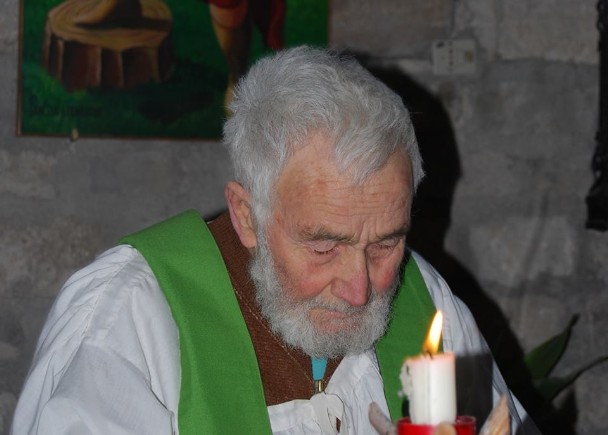
On August 25 a funeral mass was celebrated in the Italian town of Montefortino at the chiesa della Madonna dell’Ambro. The recipient of the mass was a Capuchin friar, Padre Pietro Lavini who lived as a hermit in the Sibylline Mountains near Rubbiano Montefortino and along the Gola dell’Infernaccio, the Gorge of Hell. A thousand people attended the service of the man who died two weeks prior, on August 9, 2015.

Why did they come to this mass? What did Padre Pietro accomplish with his life as a hermit?

Padre Pietro Lavini, photo from Santuario Madonna dell'Ambro Padre Pietro Lavini, photo from Santuario Madonna dell’Ambro

In 1971, Padre Pietro discovered the ruins of the Eremo di Santo Leonardo, an abandoned 12th century Benedictine monastery in the wilds of the Sibyllines. All…

View original post 251 more words

Political Humor

We hope these lines,  shared by a friend, bring a chuckle.

“When I was a boy I was told that anybody could become President; I’m beginning to believe it.” – Clarence Darrow

“If God wanted us to vote, he would have given us candidates.” – Jay Leno

“The problem with political jokes is they get elected.” -Henry Cate, VII

“We hang the petty thieves and appoint the great ones to public office.” -Aesop

“If we got one-tenth of what was promised to us in these State of the Union Speeches, there wouldn’t be any inducement to go to heaven.” -Will Rogers

“Politicians are people who, when they see light at the end of the tunnel, go out and buy some more tunnel.” –John Quinton

“Politics is the gentle art of getting votes from the poor and campaign funds from the rich, by promising to protect each from the other.” -Oscar Ameringer

“I offer my opponents a bargain: if they will stop telling lies about us, I will stop telling the truth about them.” -Adlai Stevenson, campaign speech, 1952

“A politician is a fellow who will lay down your life for his country.” -Tex Guinan

“I have come to the conclusion that politics is too serious a matter to be left to the politicians.” -Charles de Gaulle

“Instead of giving a politician the keys to the city, it might be better to change the locks.” -Doug Larson

“If you want a real friend that you can trust in Washington – get a dog.” -Harry Truman

Blameless and Exasperating

“Blameless people are always the most exasperating.”– Mary Ann Evans [pen name, George Eliot], Middlemarch,  A Study of Provincial Life, 1871.

Blamelessness and exasperation have characterized both sides of a recent conversation on Views from the Edge. Not blamelessness exactly, but certainty, positions that seem to each party to be apparent and true beyond a doubt. Each of us has become exasperated with  the other.

Jesus’ word to the harsh critic of others – “You hypocrite, first take the log out of your own eye, and then you will see clearly to take the speck out of your brother’s eye”- is forgotten or ignored. Claims to righteousness and suspicion of the other replace self-criticism and magnanimity.

We live increasingly trapped in separate bubbles of survival in the war of ideas, convictions, platforms, moralities, religions, and ideologies in the search for security.

Instead of bubbles, Dennis Aubrey’s A Patron for Prisoners uses the metaphor of prison, quoting a sage from the 5th Century C.E., Saint Léonard of Noblat, the patron saint of prisoners, whose “Song” (based on Psalm 107) describes a hope for liberation from the prison cell whose doors we have locked from the inside.

“A Patron for Prisoners” opens with The Song of Saint Léonard of Noblat (5th Century):

He has liberated those sitting in darkness and shadow of death and chained in beggary and irons,
Then they cried to the Lord in their trouble, and he saved them out of their distresses,
He brought them out of the path of iniquity,
For he hath broken the gates of brass, and cut the bars of iron in sunder,
He hath liberated those in bindings and many nobles in iron manacles.

– Song of Saint Léonard, quoted by Aymeri Picaud, translated by Richard Hogarth

Saint Léonard’s Song ends with the release of the nobles, the only class of people named among the liberated throng.  It is no mistake that he includes them among those to be blessed by release from iron manacles. We are all bound in the prison cells of logs and specks, blameless and exasperated, fearful of our survival on the other side of the release.

  • Gordon C. Stewart, Chaska, MN, August 19, 2015.

Simplicity

Leonard Bernstein’s “Simple Song” from the Bernstein Mass describes the kind of purity of heart of which Jesus speaks in the Sermon on the Mount. It is a simplicity in accord with Views from the Edge‘s earlier post “America – In Search of Wisdom“: a singleness of heart that refuses double-minded or dualistic thinking and practice. “God is the simplest of all.”

A tenor soloist from the Knox Choir sang it at the 1983 worship service that officially installed me to the office of Senior Minister of Knox Presbyterian Church in Cincinnati, which blessed me with its music for 11 years. The song, the soloist, and Knox Church will remain with me always.

  • Gordon C. Stewart, Chaska, MN, August 16, 2015.


America – In Search of Wisdom

Though we Americans disagree profoundly on many profound matters, we are often united by a deeper conviction regarding good and evil.

Today in America we’re taking sides. Left-Right. Democrat-Republican. Christian-non-christian. Religious-nonreligious. good-evil. All of the splits have something to do with perceptions of the dichotomy of good and evil, the good guys and the bad guys.

Wisdom is always the victim. Wisdom is crucified by the race to goodness. It sits in the middle of dichotomous thinking, a way of life that Danish Philosopher-theologian Soren Kierkegaard (1813-1838), who was anything but a joiner, called double-mindedness.

In the Bible wisdom is personified as female.  In the Book of Proverbs Wisdom is like a concerned mother calling to her children who prefer simpleness to insight:

“You that are simple, turn in here!” To those without sense she says,

“Come, eat of my bread and drink of the wine I have mixed.

“Lay aside immaturity, and live, and walk in the way of insight.” Provers 9:4-6

Wisdom is maternal. Wisdom calls her wayward children – the simple ones — to “turn in here” to her house. “Come, eat of my bread and drink of the wine I have mixed. Wisdom’ children are mature.

Could it be that the beatitude of Jesus “blessed are the pure in heart” is a call to return to Wisdom’s house of insight where the unity of all things is unbroken, instead of a call to simpleness? Simplicity of heart, then, is not simplicity of mind but rather to will one thing only: the goodness of wisdom (unity), as described by D. Anthony Storm‘s comments on  Kierkegaard’s Purity of Heart Is to Will One Thing Only:

God is presented as “simple”. I use this term in the same sense as Aquinas. God is singular of nature, and is not divided or contrary in any way. By this, I do not refer to unitarian versus trinitarian theology, but simply that Kierkegaard sees God as a unity of thought, will, and being. The nature of God is changeless (see The Changelessness of God). Man, on the other hand, is divided by nature. [Italics edited for purposes of emphasis]

Wisdom holds all things together, honoring the unity already present in the nature of reality itself. It seeks the simpleness or singleness with is God, not the simple-mindedness of the warring children of light and darkness, joining the right “side” in a battle of good versus evil. The heart of Wisdom recognizes and celebrates goodness, justice, and truth in whatever venue they appear.

“You that are simple – those without sense, you that are immature – turn in here!”

  • Gordon C. Stewart, Chaska, MN, August 16, 2015


Speaking very clearly


I’m going to speak very clearly now Gordon, in the form of a single question.

How in the name of God can you claim to be a Christian and a Democrat in the same breath?

I don’t know the person who put the question. We’re complete strangers.  We’ve never met. We live in different worlds.  Our understandings are foreign to each other, so strange that suspicion and name-calling, or the fear that the other is calling the other “a nut job”, undermines the possibility of real discussion.

I … read a few of your other posts, needless to say; everything I read merely confirmed my original “understanding” of who you are. In other words Gordon, (and I say this with both respect and disdain) You do not fool me, I knew you from your first words, your Credentials simply confirmed what was obvious from the start. Take that as you will.

At this point, I’m pretty sure that you are convinced that I am some sort of zealot or just another “right-wing nut job”, but in truth I am just another American. A Christian American.

I’m going to speak very clearly now Gordon, in the form of a single question.

How in the name of God can you claim to be a Christian and a Democrat in the same breath?

The writer was responding to Views from the Edge‘s post of Japanese theologian Kosuke Koyama’s speech on Hiroshima Day, 2006. Nothing in that post would lead a reader to assume, or to conclude, knowledge of my political party affiliation.

I asked myself how to respond. I pondered not replying at all. I chose to respond in writing as best I could, assuring the writer that I don’t call people right-wing nut jobs, and addressing other sections of the comment. After an exchange of blog comments and an email inviting a phone conversation, we shared some of the milk of human kindness over the phone long distance.

In further reflection I realized that the writer’s question articulates a point of view that rarely speaks so clearly. It assumes that Christian faith and the Democratic Party are polar opposites. Others on the left assume a Christian cannot be a Republican. Parts of America we are living in two separate worlds – on two different sides without much clear speaking. It’s not surprising that the “Nones” – those who now declare no religious affiliation in national polls – are growing in America.

The writer’s comments repeatedly refer to “the real war” in heaven and on earth, spiritual warfare between Satan and God. Until “the real war” is over, the argument goes, there will be cruelty and wars because of the fallenness of human nature, and there’s nothing we can do to change. In the midst of time we must chose which “side” we are on.

Views from the Edge’s first Hiroshima Day piece and the one that followed it had called attention to the hubris of all claims (Japanese or American) to national exceptionalism.

The writer therefore, as best I can tell, concluded I must be a Democrat, i.e. someone who doesn’t love his country, someone who thinks that America is not a Christian nation. Someone who might be a …. “You don’t fool me.”

The commenter was right that I’m a Christian but mistaken in assuming I’m a Democrat. The Democratic Party and the Republican Party are, in my view, the left wing and the right wing of a single American party. Both wings belong to Wall Street. They march in parades on Main Street at election time, but the parades are funded by Wall Street and America’s wealthiest 1%. We do not live in a democratic republic. We are living under an oligarchy.

Jesus has a few things to say about that.  J.J. Von Allmen (A Companion to the Bible, Oxford University Press, 1958) makes a powerful case that Jesus’s teaching about money is original to him. He is the first to call money “Mammon”: “No one can serve two masters, for either he will hate the one and love the other, or he will be devoted to the one and despise the other. You cannot serve God and Mammon” (Matthew 6:24). Jesus choice to personify wealth stands out as an exception to his normal way of speaking. Mammon and its distribution are at the heart of Jesus’s preaching and teaching. There is the Kingdom of God and there is the Kingdom of Mammon. One cannot serve both.

Had the commenter’s question been “How can you be a Christian and a socialist?” the answer would have been easy.

  • Gordon C. Stewart, Chaska, MN, August 15, 2015