
Vive la France?

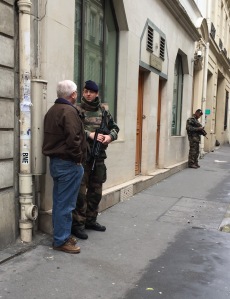
French soldier & GOne year ago the French soldier in Paris said, “I love America. Very patriotic!” I wondered what he meant. You Americans love your country? Or something else?

Today’s French election offers a moment to reflect more philosophically about the social, cultural and political dynamics that divide the French and Americans alike.

For starters, there is the age old question of the relation of the part to the whole. In this case, the part is a particular, and often unique, culture: French! French culture shares many similarities with its European neighbors, but the old joke about Hell – “Hell is a place where the police are German, the chefs are English, the car mechanics are French, the lovers are Swiss and it’s all organized by the Italians” – has some grounding in the real differences in the distinctive history and culture of each national culture.

The European Union is the sum of its distinctive parts; the parts make up the whole. The European Union created a common currency, relaxed the borders, and eliminated trade barriers among the member states of the E.U., a thing to celebrate in a world where it becomes increasingly clear that the planet itself is our home.

But what happens when the distinctiveness of the parts – the French in this case – are morphing quickly into something unrecognizable? What happens to the psyche of the traditional French citizen when the languages in the cafe, on the Metro, and in the apartment next door are not French – or the visiting German, Italian, English, and Spanish of tourists on holiday at the Louvre or on the beaches of Nice – but Arabic, Parsi, or Urdu spoken by Syrians, Moroccans, Indians, or Pakistanis?

A culture is a home, a kind of safe nesting place. A cardinal is not a robin, a wren, or flicker, and it’s not easy for any of them when they perceive their nests as under threat by the European Starling that would rousts them from their nests.

“I love America. Very patriotic!” said the Parisian French soldier guarding the Jewish synagogue against a terrorist attack while the headlines from America featured Donald Trump’s rise in the polls in May 2016. “Make America great again!” was the word from the  across the pond. “Which America?” I wondered then, as I wonder now what “Make France great again” means today in the French election.

Was the patriotic America in the mind of the French soldier the America that speaks Spanish, Parsi, Urdu, and Arabic as well as English or the one that speaks only English? The one that is white European in origin? The one where African-Americans take their seats again in the back of the bus? The America where there are no mosques; no sombreros; no anti-American leftists or immigrants – only starlings?  The America where being “very patriotic” means returning the U.S.A. to what it was before the starlings raided its nest?

Philosophically, the issues are not as simple as they sometimes seem. The question of the relation of the parts to the whole is as vexing today as at time in the course of human development. A year ago the world celebrated the signing of the Paris Accord on climate change in recognition that the whole is bigger than its parts and that every part depends on the well-being of the whole.

A parable of Jesus holds together the relation between the part and the whole: distinctive nests (cultures) in the the branches same shrub (world):

“The kingdom of heaven [the whole] is like a mustard seed that someone took and sowed in his field; it is the smallest of all the seeds, but when it has grown it is the greatest of shrubs and becomes a tree, so that the birds of the air come and make nests in its branches.” – Gospel of Matthew 13: 31-32.

Gordon C. Stewart, Chaska, MN, April 23, 2017.

The woman outside the window

She paces the sidewalk a few feet beyond our kitchen window, talking loudly to someone who’s not there, smoking a joint to calm her down, moving in sudden jolts as though someone has driven a spike through her less than cogent mind.

I watch and wonder who she is, this neighbor who lives behind us still three weeks after being served by the authorities with an eviction notice following the psychic “break” when she tore loose two towel bars and poked holes in the bathroom wall as uninvited as the screams of rage that harmonized with the spikes in the wall.

The police at the time of the incident told the owners there was little they could do without pressing charges, which they declined to do. She is a guest in their house, the girlfriend “of sorts” of their 35-year old son, a young man of consummate compassionate who had taken pity on her homelessness and invited her in.

Responding to the 911 call, the police had been greeted by an altogether sane young woman who presented a calm, cool, and collected self who came downstairs wondering what the fuss was all about. The 50-something year-old homeowners and the police agreed to call it a night on the “domestic dispute,” the young woman in question going peacefully upstairs to lock herself in her room, the three squad cars driving back to the police station where the officers would write up their incident reports, the husband and wife homeowners sitting in the living room staring past each other into blank space, and their generous adult son who lives in denial stepping outside for a much-needed smoke of something.

His invited houseguest had been institutionalized a number of times but he doesn’t know why or for what. Her father, he says, is some sort of pentecostal preacher. She’s badly scarred by her home experience – the “black sheep” of the family of Christian sheep wounded by the ram who rules the household.

A lamb spiked by the ram in her old sheep-fold, she looks for other pastures and sheep-folds where her damaged soul might find repose beyond a 911 call. But the spikes of terror keep coming, as they will, until, by some process of grace and merciful intervention, her reality breaks open the self that now wanders in torment outside our kitchen window.

Until then, she walks in the valley of the shadow of her own kind of death, as do the members of the family which has given her temporary shelter, crying out for green pastures and still waters that would restore their wounded souls.

  • Gordon C. Stewart, Chaska, MN, April 21, 2017.


The Make-Up Artist

Make-up artists in show business are the cosmeticians in the off-stage dressing rooms who paint the performers. In plays and films they make sure the actors look their parts. In television they apply make-up to the likes of Chuck Todd and Megyn Kelly.

Donald TrumpBut today ‘make-up artist’ takes on different meaning: “one who makes stuff up.” Like a Commander-in-Chief whose administration tells the world the USS Carl Vinson and its Navy fleet are headed for the coast of North Korea, knowing full well they’re still headed toward Australia. When the crews heard the news from news outlets, they must have wondered. Who or what was lying: their compasses or their Commander-in-Chief and his administration?

Make-up artists serve a purpose in stage productions and television programs like “The Apprentice”; they have a role to play behind the scenes of make-believe.

DI-Chicken-Little-9But when a made-up president makes stuff up that causes the armed forces he commands to choose between their compasses and their commander, the Commander-in-Chief becomes the Liar-in-Chief who commands as much credibility as did Chicken Little after announcing too many times that the sky was falling.
I wish to Heaven this was all made up.

  • Gordon C. Stewart, Chaska, MN, April 19, 2017.

Easter

Aside

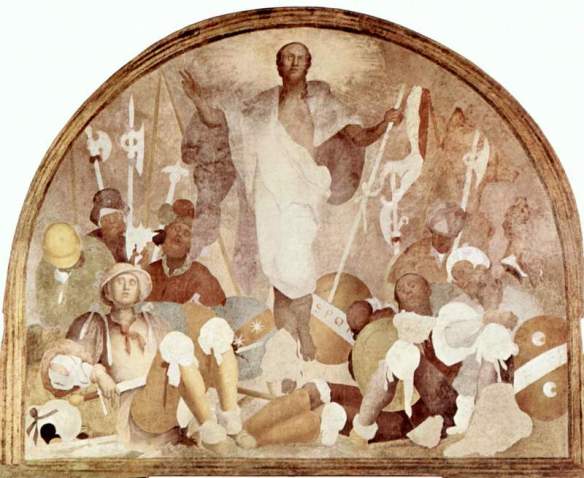
Artists often say it best. Jacopo da Pontormo‘s painting of the peaceful Christ rising above “the guards who shook and became like dead men” (see text below) invites us this Easter to ponder afresh Christ’s hidden reign in the world in which violence, militarism, and imperial ambitions still feign to rule.

Jacopo_Pontormo_026-medium

Jacopo da Pontormo (1494-1556)

For fear of him the guards shook and became like dead men. But the angel said to the women, “Do not be afraid; I know that you are looking for Jesus who was crucified. He is not here; for he has been raised, as he said. Come, see the place where he lay. Then go quickly and tell his disciples, ‘He has been raised from the dead,and indeed he is going ahead of you to Galilee; there you will see him.’ This is my message for you.” So they left the tomb quickly with fear and great joy, and ran to tell his disciples. Suddenly Jesus met them and said, “Greetings!” And they came to him, took hold of his feet, and worshiped him. Then Jesus said to them, “Do not be afraid; go and tell my brothers to go to Galilee; there they will see me”  [Gospel according to Matthew 28:4-10]

Jacopo da Pontormo helps me see what the mind cannot fathom. Christ is Risen! In spite of all appearances to the contary, Christ is Risen! Alleluia! He is risen, indeed!

Gordon C. Stewart, in Galilee of Chaska, MN, Easter, April 16, 2017.

A world holding its breath

Today the world is holding its breath, waiting in helpless silence as we’ve done many times before.

Last year we published a reflection following news of the terror in Brussels, Belgium. Today the darkness that clouds our hearts and minds comes from the madness of a two little boys playing with nuclear toys. (See “North Korea hits back at Trump ahead of Day of the Sun“.)

Nuclear-explosionNot since Hiroshima and Nagasaki has a nuclear bomb been used, but, today, Holy Saturday, the people of Japan are living in the memory of that holocaust, holding their breath as the bellicose standoff between Kim Jong-un and the man who promises to take care of him plunges them again under the nuclear cloud of post-traumatic stress of 1945, their peculiar Friday and Holy Saturday.

On Holy Saturday, the day between Good Friday and Easter, we experience the silence of nothingness.

The sounds of hammers, taunts, and screams, and the sight of three dead men very different in life but equal now in death leave us face-to-face with all that is cruel, hopeless, meaningless – the darkness of despair.

This Holy Saturday the world is on full alert. Dread and fear spread. We who live in the aftermath of the latest terror in Brussels experience Holy Saturday – the day between Good Friday and Easter, knowing that only a resurrection can redeem a Good Friday world. – Views from the Edge, Holy Saturday, 2016

One short year ago on Holy Saturday the world knew of one little boy playing with nuclear toys. This year there are two. And the Easter story of the empty tomb remains either a fanciful illusion or the good news of a deeper reality beneath the silence: the descent from the cross by a Word greater than every reason for dark despair.

Pontormo, Jacopo da, 1494-1556. Descent from the Cross,

Descent from the Cross – Jacopo da Pontormo (1494-1556)

  • Gordon C. Stewart, Chaska, MN, Holy Saturday, April 15, 2017.


Faux reality on Maundy Thursday

Views from the Edge re-publishes this piece from March 24, 2010. In November 2016 the American people were sucker-punched by an alarmist apocalyptic spirituality underlying the alt-right politics of Rush Limbaugh, Steve Bannon, and the candidate for president who led and funded “the birther movement”.

Maundy Thursday and Good Friday call for sober reflection on the difference between faux-reality and reality. We republish it here without updates or edits – except for a new title – for the sake of historical perspective. – GCS

Ecce homo -  "Here is the man" Albrecht Durer

“Ecce Homo” (Behold the Man), Albrecht Durer

Something from the Christian tradition – the idea of ‘the Anti-Christ’ – is lifting its ugly head, a word and concept that could trigger unthinkable tragedy unless we clean up our civil discourse.

According to Harris Interactive Poll taken between March 1 and 8, “more than 20% believe [President Obama] was not born in the United States, that he is ‘the domestic enemy the U.S. Constitution speaks of,’ that he is racist and anti-American, and that he ‘wants to use an economic collapse or terrorist attack as an excuse to take dictatorial powers.’ Fully 20% think he is ‘doing many of the things that Hitler did,’ while 14% believe ‘he may be the anti-Christ’ and 13% think ‘he wants the terrorists to win.”

The poll reflects what we all know: our civic health as a nation is being poisoned by inflammatory rhetoric from both sides of the political aisle. This toxic disregard for truth lies behind the results of the Harris Poll. Trigger words like ‘socialist,’ ‘communist,’ ‘terrorist,’ ‘anti-American,’ and ‘the Anti-Christ’ and the allegation that America’s first black president is the nation’s chief domestic enemy take us beyond the McCarthyism of the ‘50s. This cocktail is lethal.

As a Christian pastor I rue the use of Christian scripture to stoke the fires of fear and hate. The Christian life – or spiritual life of any sort, for that matter – is a life of discernment about the powers that shape ordinary life. It is not blind to evil. But loud spirituality is an oxymoron. We need to be reminded that all the great religions hold some version of the essential tenet expressed in the First Letter of John. “Whoever says he is in the light and hates his brother is in the darkness still” and “If any one says, ‘I love God,’ and hates his brother, he is a liar, for he who does not love his brother whom he has seen cannot love God whom he has not seen. And this commandment we have from him, that he who loves God should love his brother also.”

Labeling the President of the United States ‘the Anti-Christ” gives deranged minds a license to kill . . . in the name of the non-violent, crucified Jesus. If some deranged American patriot like the Marine who plotted to assassinate the President should succeed . . . God forbid! . . . the blood will be on the hands of all who remained silent when the hate speech was being poured into the public stream of consciousness. And if you claim to be a disciple of Jesus, get yourself to church Maundy Thursday and Good Friday to ground yourself again in the love that conquers hate and fear.

  • Gordon C. Stewart, Chaska, MN, Maundy Thursday morning, Chaska, MN.

The Stubborn Donkey and the Asses

“[T]hey brought the donkey and the colt, and put their cloaks on them, and he sat on them.” – Matthew 21:7

In advance of today’s annual Palm Sunday parade through downtown Excelsior, Trinity Episcopal‘s e-newsletter issued the sad, tongue-in-cheek announcement:

Between services the Trinity community will come together in a joyful parade, with music, laughter, and bubbles! Unfortunately, the donkey that was going to lead us is being a bit stubborn so he will not be with us.

Jesus on two donkey’s – Jean de Limbourg (c. 1385-1416)

Perhaps today’s cancellation serves as a reminder that the donkey is stubborn by nature, and that, if you manage to tame one, there will always be another nearby waiting to take its place.

Some churches today celebrate only Palm Sunday – “the Triumphal Entry” into Jerusalem. It’s all about palm-waving and “Hosannas!” shouted and sung to the victorious King of kings and Lord of lords.

Other churches honor the paradox of palms and fists, stubborness and spears, appearance and reality: the king who refused to be King who rode an ass (or two) into the city that wanted something more than the mortal it could raise on a cross.

Today there will be no donkey on the streets of Excelsior. The donkey is just being stubborn. Or perhaps it refuses to participate in this year’s re-enactment when palms and hosannas take her rider to the cross again in a world where asses still rule.

  • Gordon C. Stewart, Chaska, MN, Passion/Palm Sunday, April 9, 2017.


Blessed are the not so pure

There is a kind of purity that is not pure: partisan purity, which bears no resemblance to the purity of the Sermon on the Mount, “Blessed are the pure in heart . . . .”

The U.S. Senate is poorer today because of partisan purity on both sides of the political aisle. Politics is a brutal game made more civil by rules that seek to set boundaries on partisan purity. The 60-40 rule was one of those long-standing Senate rules that helped insure some measure of long-term wisdom by the 100 members of the U.S. Senate.

The onus of responsibility for weakening the Senate – lowering the bar for simple majority votes on matters once believed to be of such gravity as to require a higher threshold – falls to both purist parties. The one for pushing the envelope knowing the consequences, the other for rescinding the rule. From now on, whichever party is in the majority shall rule without restraint.

The Constitution of the Presbyterian Church (USA) asks officers to promise “to further the peace, purity, and unity” of the church in recognition that though, in an ideal world, peace, purity, and unity are in accord, they are often in conflict in the real world.

This week the U.S. Senate exercised a different kind of purity that violates all three values – peace and unity, as well as purity – leaving the country the poorer in restraint and wisdom.

Blessed are the not so pure.


  • Gordon C. Stewart, Chaska, MN, April 7, 2017.


Like a Mustard Seed

I needed John Buchanan’s commentary this morning. Maybe you do too.

Family of John M. Buchanan's avatarHold to the Good

I was in a pew with in the Kensington Community Church, United Church of Christ, with our San Diego family last Sunday. The preacher, the Rev. Darryl Kistler, reminded us that Jesus talked a lot about the Kingdom of God and that whenever he was asked about the Kingdom, when it was coming and what it would look like, his answers were enigmatic, not at all what people expected or wanted. “The Kingdom of God is among you,” he said once. On another occasion he said that the Kingdom would be quiet, almost invisible: like a tiny mustard seed or like the yeast that does its important work in bread baking without fanfare.

It was the reminder I needed this morning because I am worried about the particular kingdom I am currently living in. It has not been an easy, hopeful time since the presidential inauguration in January. Not long…

View original post 632 more words

Frame Up! Remembering Martin Sostre

Video

Yesterday Views from the Edge published several posts re: the case of Martin Gonzalez Sostre. Today we post this documentary film that jars the memory and human sensibilities. Martin Sostre speaks on camera about the recanted testimony of Arto Williams and the Erie County Sheriff Department frame-up. Sortre’s appeal was denied in March, 1974.  Seven months later The Christian Century published the sermon “Worship and Resistance: the Exercise of Freedom”; 20 months later New York Governor Hugh Carey commuted his sentence.

This story is especially useful for younger generations whose experience may lend to the belief that the concerns that led to Black Lives Matter are of recent origin.

  • Gordon C. Stewart, Chaska, MN, April 2, 2017.