The devil’s playground

Be embraced, you millions!
This kiss is for the entire world!
Brothers! over the starry canopy
Must a loving Father dwell!.

Beethoven’s 9th, Movement III.

Retired University of Pennsylvania music librarian and lifelong friend Carolyn brought Beethoven’s line to our attention in response to today’s earlier post, “Now (regretfully) I Know.”

“Hitler,” she said, “was purportedly extremely partial to Beethoven’s 9th,” especially to the lines above. Her comments remind me again that even beauty itself can become the source of ugliness. Good and evil lie next to each other in this world, just a breath away from the other.

It’s not just an idle mind that is the devil’s workshop. [H. G. Bohn, “Hand-Book of Proverbs,” 1855]. It’s also a lofty mind, propelled by the best in us.

High ideals – a world at one, a world at peace; feel the embrace, you millions, this kiss is for the entire world – are not just lofty. They are also the devil’s playground where light is turned into darkness, love into hate, hope into despair, hugs into gropings, and kisses into kisses of death.

Thank you, Carolyn, for the comment. The physically blind Beethoven surely would cherish the prospect that the world will not allow Hitler’s distortion to become the the last interpretation of the last movement of Beethoven’s 9th.

It is left to us to redeem the hug and the kiss with the spirit of hope and contrition we know by heart:

“Our Father, who art in heaven, hallowed by thy name. Thy kingdom come. Thy will be done on earth as it is in heaven. Give us this day our daily bread.” (Just enough bread for one day.) “Forgive us our trespasses, as we forgive those who have trespassed against us. And lead us not into temptation, but deliver us from evil.”

  • Gordon C. Stewart, Chaska, MN, November 5, 2016.


Now (regretfully) I Know

Exhausted by the 2016 election, and knowing that undecided voters are few and are unlikely to be persuaded by anything I might say, I nevertheless decided to speak up one last time here. There’s a knot in my stomach. Silence only makes it worse. Silence – even for a day – would contribute to evils I’ve long deplored.

From the time I became conscious of the world, I have asked how Hitler could rise to power.

Now I know.

A child of World War II, I have learned that the questions are more important than the answers, and that sometimes the answers don’t come. Yet, as I look back on my life story, the question was not about Hitler. It was about the German people who elected him.

It still is. But this year, it’s not about the Germans. It’s about us, the Americans.

I’ve spent a lifetime living in the shadow of Adolf Hitler and the societal madness that elected him, determined from very early in life to oppose the darkness, the terror, the long shadow of Dachau, Buchenwald, and Auschwitz. Of nationalism, militarism, Arian racial superiority, global imperialism, and the startling echoes that still ring out from the gas chambers and gallows of the same society that bequeathed the world with the high culture of Bach, Beethoven, Mozart, Schopenhauer, Hegel, and Thomas Mann. How, I have asked myself forever, could this have happened? I’ve looked inside myself and wondered what I might have felt and done during the rise of the German Third Reich.

Now I know.

The question is no longer hypothetical. No longer abstract. No longer just philosophical, psychological, or sociological. It’s immediate and practical. It’s staring me in the face every day as I watch the crowds clapping for a presidential candidate whose name is on everything he’s ever touched as a businessman and who has made it his business to put his hands where they have not been welcome.

The crowds that support Donald Trump are drawn by an irresistible force to make America great again. In Germany it was the same. It’s a page out of Hitler’s playbook, but the differences between the United States in 2016 and Germany in 1930s are strikingly different. Germany had been defeated in World War I. America was victorious. Its economy was in shambles. Ours is the envy of the world. Germany’s post-war sovereignty was limited.Ours is not. The German people perceived the Weimar Republic as weak, powerless, and ineffective, a refrain echoed in the American far right’s cacophonous contradictions that charge the Obama Administration with too much power in domestic policies, on the one hand, and weakness against international terrorism.

During the 1920s and early ‘30s, the people of Bach, Beethoven, Mozart and Hegel felt humiliated, their national pride had been assaulted. But. . . assaulted by whom?

Jews, gypsies, and homosexuals became the scapegoats against which the pure Germans could define themselves and make Germany great again. Today in America Muslims, Mexicans, and LGBTQ have become the equivalent scapegoats of the Donald Trump campaign, and a copy of Hitler’s speeches is in the Trump master bedroom.

If the German people were drawn like iron to a magnet by a charismatic personality who gave singular voice to their grief and anger, it was not the last time a nation would go down that road to fascist madness. It begins as a kind of love affair. Looking into the human psyche, Schopenhauer (1788 – 1860) wrote:

The ultimate aim of all love affairs … is more important than all other aims in man’s life; and therefore it is quite worthy of the profound seriousness with which everyone pursues it. What is decided by it is nothing less than the composition of the next generation …. (The World as Will and Representation, Supplements to the Fourth Book).

The next generation and generations to come are at stake in the U.S.A. on November 8, 2016.

As every American president has said, “May God bless the United States of America.” I add, and may God save us all from the worst in ourselves.

  • Gordon C. Stewart, Chaska, MN, November 5, 2016

A Leg up on the FBI

It happened on Block Island, RI years ago on the driveway of William (“Bill”) Stringfellow and Anthony Towne’s home, the temporary home of fugitive war protester Father Daniel Berrigan, S.J.ap_7307250162_271648b88100da8bfbf05ff0fe92116d-nbcnews-ux-2880-1000

As the FBI loaded Dan into the back  of the squad car, Marmaduke, the canine member of the household, walked to the passenger side of the vehicle, and – as if on behalf of Bill and Anthony and all things just – lifted his left leg on the front passenger side tire.

“It was,” said Bill, a theologian as well as Father Berrigan’s lawyer, “an act of God.”

maxresdefaultNoting the FBI Director’s selective decisions that may affect the outcome of the 2016 national election, I lift my glass to Mamaduke, the latter day biblical prophet, for getting a leg up on the FBI.

`- Gordon C. Stewart, Chaska, MN, November 3, 2016

American Echo and Narcissus

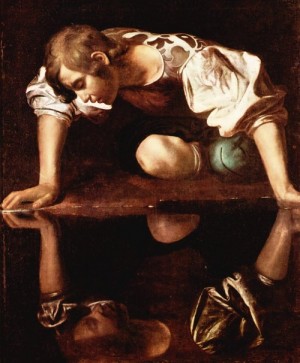
During the course of this election season much has been written about Narcissus, the self-absorbed figure of the classical myth of Narcissus. Less attention has been paid to the larger context in the myth itself and its application to the American political scene: the figure of Echo and the Pond which reflect back Narcissus’s claims for himself.

Without Echo, the scorned, talkative nymph who loses her voice except to echo Narcissus’s words, and without the Pond which reflects back the beautiful image Narcissus lives and dies to see, there would be no Narcissus.

narcissus-caravaggio-300x363

Narcissus painting by Caravaggio

The American Psychiatric Association’s Diagnostic and Statistical Manual of Mental Disorders (DSM-5) describes Narcissistic Personality Disorder as “a pervasive pattern of grandiosity (in fantasy or behavior), need for admiration, and lack of empathy, beginning by early adulthood and present in a variety of contexts . . . .”

The Mayo Clinic summarizes DSM-5’s symptoms of Narcissistic Personality Disorder as follows:

• Having an exaggerated sense of self-importance
• Expecting to be recognized as superior even without achievements that warrant it
• Exaggerating your achievements and talents
• Being preoccupied with fantasies about success, power, brilliance, beauty or the perfect mate
• Believing that you are superior and can only be understood by or associate with equally special people
• Requiring constant admiration
• Having a sense of entitlement
• Expecting special favors and unquestioning compliance with your expectations
• Taking advantage of others to get what you want
• Having an inability or unwillingness to recognize the needs and feelings of others
• Being envious of others and believing others envy youBehaving in an arrogant or haughty manner.

If Donald Trump is elected President, it will be because he successfully channeled long-festering sources of anger—“Make America Great Again” as in a former age when Mexican immigrants, blacks, and non-Christians knew their place in a white, Christian nation with a manifest destiny—or because he echoed the American public’s deep frustration with political gridlock and partisan posturing.

If, on the other hand, Mr. Trump is refused the Oval Office, Echo will continue to be obsessed with his voice. Though not as alarming as a Narcissist with a nuclear arsenal at his command, there is little comfort in a disentitled Narcissus manipulating global media as his mirror.

The socio-psychic health of Echo and the Pond (the social mirror) will determine the extent to which the dynamics of the Narcissus myth become the permanent disorder of American political life.

It may help to remember that, according to Tiresias, the blind prophet of Thebes, Narcissus will “live to a ripe old age, as long as he never knows himself.

How long Narcissism prevails in American society depends on the American Echo and the mirror into which Narcissus looks—whether the American electorate will choose to see Narcissus and ourselves as we really are —a sad man with a public echo without self-knowledge.

In the ancient myth, Narcissus grows increasingly thirsty, but his reflection in the water is more important than slaking his thirst. Enamored with his own reflection but dying of thirst, he refuses to drink because he loses the reflected image whenever he gets close enough to sustain his life. Narcissus dies of thirst, and, according to the Greek myth, at that moment, a lovely flower – a Narcissus (daffodil or joncus) – blooms next to the pond.

narcissus-flower

Narcissus (daffodil)

In the wake of this electoral flirtation of Echo and Narcissus, the story won’t be over no matter who occupies the Oval Office. Yet there remains the hope that something more beautiful and natural than a personality disorder will rise next to the pond of what remains of the American democratic republic, and that Echo will get back her own voice.

• Gordon C. Stewart, Chaska, MN, Oct. 25, 2016

Chicken Sh*t Sermons and Polite Company

America’s four-year presidential election cycle poses a unique challenge for churches, synagogues, and mosques, and for their priests/ministers, rabbis, and imams.

Retired after years behind the pulpit, I now take my rightful place in the pew. I come to pray, sing the hymns, listen to the Scripture readings, and hope for a word from the pulpit that speaks a powerful Word into the wordy world that has hurt my ears all week.

Like author Annie Dillard, I wear a crash-helmet to worship. I expect something to happen. I expect to be “in an accident” with the Word of God, a word that rattles my bones, awakens me from lethargic acquiescence, and—as it did to Isaiah in the temple in the year that old king Uzziah died,—fills the house with the smoke of divine majesty, shakes the foundations, and elicits Isaiah’s response. “Here am I. Send me. (I have a crash-helmet.) Send me!”

I don’t go to worship to escape. Nor do I go for a partisan rally. I go on Sunday morning for worship—to make what the psalmist called “a joyful noise to the LORD”, my only rock and salvation, and to celebrate the gospel’s transforming assurance and challenge which my own troubled heart and mindI cannot produce for myself. I need the worshiping community. I need public worship that cuts through the partisan babel that saturates America’s anxious public life. Divine worship is a public event.

But religious institutions and their leaders live on the razor’s edge between public engagement and spiritual irrelevance.The tax code’s 501c(3) status recognizes the importance of religious traditions and institutions to the health of the body politic. It also prevents them from endorsing candidates for public office, which poses an interesting dilemma for leaders adherents.

The last two weeks, worship has been down in the church I attend. I’ve wondered why.

Research shows that worship attendance soars on Sundays following national tragedies like 9/11. People need a word to console and strengthen them. In the midst of a national election campaign the likes of which we’ve never seen, one might logically suppose attendance would rise, not fall. Unless . . . .

“Unless what?” I ask myself. Unless a church’s leaders are ignoring the faithful who come into the pews wearing crash-helmets? Or unless, perhaps, the people expect from the pulpit the rancorous echoes of partisan righteousness? Or, perhaps, the worship experience itself is failing to awaken the ears of worshipers to hear the chorus Isaiah heard in the Temple in the year that the political order was at stake: “Holy, Holy, Holy Lord! God of power and might. The whole Earth is filled with your glory. Hosanna in the highest!”

I’m old. I still expect something momentous — something I don’t yet expect — to happen during worship.

The Rev. Dr. John Fry, who taught our preaching class at McCormick Theological Seminary, introduced us to crash-helmets long before Annie Dillard put the metaphor in writing. Senior Minister of Chicago’s First Presbyterian Church, John would later be summoned before The U.S. Senate Government Operations Committee’s Permanent Investigations Subcommittee, chaired by John L. McClellan (“The McClellan Committee”) because of allegations related to civil disturbances in south Chicago.

John had reached beyond the church walls to develop a relationship of trust with the gang that ruled the streets. It was John’s work that resulted in the Blackstone Rangers surrendering their guns, which were then locked in the church safe awaiting the pending truce among the Rangers, their rival gang, the Disciples, the Chicago Police Department, and the U.S. Treasury Department. When the Chicago Police Department broke terms of the agreement by shooting a disarmed gang member, the street quickly returned to its old established order. The McClellan Committee laid the responsibility, in part, on the doorstep of the Rev. Dr. John Fry and the board of First Presbyterian Church-Chicago.

The first session of our seminary preaching class is etched in our memories. John pulled the chairs into a circle to critique the student sermon we had just heard in the chapel. We commended the preacher re: matters of form, not substance: a fine introduction, good development, and solid conclusion. Then John asked,”You want to know what I think? That was a chicken sh*t sermon. The gospel cuts with a knife! Anyone who does that again in this class will get an ‘F’” We were all like chickens with our heads cut off, but we never forgot the difference between real preaching and :chicken sh*t.

John’s words have rung in our ears for 52 years. Now I sit the listening side of the pulpit, relieved of that onerous responsibility but still waiting for a word that cuts through the crap. Sometimes it comes; sometimes it doesn’t.

When it doesn’t come from the pulpit, it still comes through the Scriptures. Or it comes from a line tucked away in the Eucharistic Prayer (the prayer that precedes the Sacrament of Holy Communion), as it did yesterday:

“At the meal tables of the wealthy where he (Christ) pled the cause of the poor, he was always the guest. Unsettling polite company, befriending isolated people, welcoming the stranger, he was always the guest.”

That little line, along with the communion itself , spoke a clear word to a distressed heart and mind.. The polite company was disturbed by Christ the guest, and the service ended with a Dismissal that seemed to place Isaiah’s age-old response to God’s glory— “Here am I.Send me!” on the worshipers’ lips anew during a presidential campaign that is anything but holy:

“Take us out into the world to live as changed people because we have shared the Living Bread and cannot remain the same. Ask much of us. expect much from us, enable much by us, encourage many through us. May we dedicate our lives to your glory.”

  • Gordon C. Stewart, Chaska, MN, October 17, 2016.

“Global conspiracy” – Psychology 101

What psychological vocabulary best describes the belief that one is the target of a global conspiracy?

“Wait! Wait! Don’t tell me!”

P a _ _ _ _ _ _ i d?

N a _ _ _ _ _ _ _ _ i c?

D e _ _ _ _ _ _ _ a l?

S o _ _ _ _ _ _ i c?

  • Gordon C. Stewart, Chaska, MN, October 14, 2016

Steve Shoemaker and his hearse

Searching through the archives following Steve’s death last Monday, his verse “Kissing in a Hearse”- originally posted July 1, 2016 – cried out for republication. Knowing of his eventual demise with pancreatic cancer, his humor was always bigger than a hearse, a continuing gift to his family, friends, and readers.

Verse – Kissing in a Hearse

1947 Pontiac hearse

Steve’s Hearse

Only college seniors were allowed
cars on campus in those ancient days.
Four guys, Juniors, searched car lots and found
just the thing, a ’47 hearse,
Pontiac, straight 8, just fifty bucks
each. A Senior said he’d claim the beast
legally was his. Quadruple dates
were the thing: one couple in the seat,
driving, six would lounge on pillows where
caskets usually rode. Of course, at times
two young people would kiss, death be damned.

Steve Shoemaker, Urbana, IL, July 1, 2016

  • Reposted October 13, 2016 in thanksgiving for Steven Robert Shoemaker (December 19, 1942 – October 10, 2016).

Steve Shoemaker at Peace

With deep sadness but with great thanksgiving for his life and friendship, we share Steve’s CaringBridge post for readers of Views from the Edge:

Daddy died last night on October 10th, the anniversary of his own father’s death.

He is survived by his wonderful wife of 51 years, Nadja, two marvelous children, Daniel and Marla (as well as their spouses, Rachael and Craig), and two fabulous grandchildren, Carter and Grace.

Born and raised in Urbana, he played trombone and basketball at Urbana High School, while also wooing his future wife, Nadja. He then attended Wheaton college, where he participated in pranks, such as padlocking the chapel doors before a service. After becoming more serious about his studies (and receiving an ultimatum from his wife), he received a Master of Divinity Degree and Master of Sacred Theology Degree in 1969 from McCormick Theological Seminary in Chicago. In a further pursuit of education, he then earned a PhD in Religion from Duke University in 1979.

Steve Shoemaker served as pastor at Pittsboro and Mount Vernon Springs Presbyterian churches in Pittsboro, NC, as well as campus pastor at North Carolina State University and McKinley Presbyterian Church in Champaign. He finished his career as Director of the University YMCA at the University of Illinois. For many years, Steve also taught one course a semester in Religious Studies at either Parkland College or The University of Illinois.

Devoted to his community, Steve served as Chair of the Committee for the Homeless, Co-Chair of the Men’s Emergency Shelter Steering Committee, member of the Dr. Martin Luther King Committee, member of the Muslim Committee, and served on the Champaign County Board, the United Way Board, and the local ACLU Board. He was also an active Urbana Rotary Club member since 1982 and acted as president in 2013.

With a passion for writing, particularly poetry, Steve was nominated for Illinois Poet Laureate in 2003 and has been published in a plethora of journals ranging from Christian Ministry to Judaism. After his cancer diagnosis, he published his first book titled “A Sin A Week.” He has also received thousands of Likes for poems posted through social media. In addition to the printed word, Steve reached out to the community through his weekly radio program, Keepin’ The Faith on WILL AM 580, which provided interviews and discussions highlighting relevant social topics.

Steve donated his rich bass voice to various choirs and was a member of the Real Fire band. He also donated his time to be an integral part in the lives of others as he joined couples in marriage, performed funerals, and provided counseling and support (while never accepting payment).

However, to this writer, Steven Robert Shoemaker’s greatest accomplishment was his role within his family. In over 50 years of blissful marriage, he modeled how to sincerely love and respect another. He gave corsages, coached soccer, and cooked Cheese Surprise. He took his children out of school to see baseball games and go to museums. And although his children did not always recognize it in the moment (as they were dragged to organ concerts or tours of Frank Lloyd Wright houses), Steve Shoemaker demonstrated how to embrace life (Fly kites! Eat dessert first!) and how to make the world a better place.

Despite a host of shortcomings, including but not limited to leaving used toothpicks around the house and eating other people’s chocolate bars, Steve was an accomplished author, compassionate pastor, devoted leader, and loving husband and father. He is greatly missed.

Memorial gifts may be made to the University YMCA, 1001 S. Wright Street, Champaign, IL 61801.

Services will be arranged and announced as soon as possible.

There is a deep stillness in the Stewart household this morning. Even when I know death is coming, it still stops me in my tracks. The world is a smaller today.

  • Gordon C. Stewart, Chaska, MN, October 11, 2016

Fall

Leaves are falling. The sap is finished running. Flowers fade — red,  green, yellow, purple falling into brittle brown.

Each season reflects the eternal motion of the seasons we sense within ourselves. Over a lifetime we move from the temporary wrinkles of the newborn babe to the well-worn lines and wrinkles of aging. We love to look at babies; old folks not so much.

In 1857 Adalbert Stifter pondered this in Der Nachsommer (The Post-Summer) published in English under the title Indian Summer:

“Great beauty and youth capture our attention, excite a deep pleasure; however, why shouldn’t our souls gaze at a countenance over which the years have passed? Isn’t there a story there, one unknown, full of pain or beauty, which pours its reflection into the features, a story we can read with some compassion or at least get a slight hint of its meaning? The young point toward the future; the old tell of a past.”

Fall is the favorite time for many of us. At my age, I no longer wonder why.

  • Gordon C. Stewart, Chaska, MN 55318

Time is what we have

“What is time?” asked the 11 year-old son of his father.  Finally, the father, who was supposed to know about such things, offered the briefest of answers. “Time is what we have.”

The answer  begged for more explanation, but it spoke out loud the frailty and wonder of the human condition. What is time? It’s what we have but, like everything else mortals have, or think we have, time runs out. Time is like the sand in the hour-glass. It sifts slowly through the funnel from top to bottom until there is nothing left. Dust to dust, ashes to ashes. Remember that you are dust, and to dust you shall return.

The relation of time to eternity is the relation between mortality and immortality. Our hour-glass contains eternity but it does not define it or confine it. We experience eternity in the now of time as we look at the heavens on a starry night, feel a gentle breeze or the rush of a mighty wind, or watch the shorelines of human construction eroding, pushing back the illusion of ownership and control of nature and of time.

My poet friend and Views from the Edge colleague Steve Shoemaker is coming to the end of his time. After many decisions that prolonged his life far beyond the original prognosis, he opted last Saturday to give way to time. Steve chose to spend whatever days are left at home at Prairie Haven on the plains of Illinois.

The news came less than a week after five old friends who call ourselves the Dogs traveled from Texas, Arizona, Illinois, Indiana, and Minnesota to gather one last time with Steve at Steve’s room in the care center. We barked and growled watching the first presidential debate. We laughed. We sang some hymns. We prayed with and for Steve, Nadja, and their children, Daniel and Marla. We prayed for ourselves. The time was right.

When news arrived only days later that Steve had opted to end further medical treatment to go home, the conversation with my 11 year-old son years ago and Steve’s verse “When to Stop Praying” (April 2, 2016) came quickly to mind. The prayer now is for an end of striving. An end of pain. “Pray for my peace, not my life.” The end of time.

  • Gordon C. Stewart, Chaska, MN, October 5, 2016.