The Distant Murmurs of Prayer

“In our imaginations, we listen for the distant murmurs of prayer,” wrote Dennis Aubrey in his post “In Seclusio at Thines” posted on Via Lucis Photography.

Listening for the distant murmurs immediately brought to mind a hymn composed by Anne Quigley in 1992. The tune is LONGING. The textual refrain is:

“There is a longing in our hearts, O Lord, for you to reveal yourself to us. There is a longing in our hearts for love we only find in you, O God.”

It was the recollection of the text that drew me to LONGING. I searched YouTube for possible videos for this post but found that the lightness of the tune, like so much contemporary Christian music, left me longing for “the distant murmur of prayers” that echo down the ages in the Gregorian Chants once sung in the now empty or mostly empty monasteries and churches that inspired Dennis to conclude “In Seclusio in Thines”:

“[PJ and I] … hear the echoes of sandaled footsteps in lonely churches long deprived of their monastic communities. And in our imaginations, we listen for the distant murmurs of prayer.”

I long for gravitas awakened by the beauty of silence.

Two Presidents – November 22, 2014

Today is the anniversary of the assassination of President John Fitzgerald Kennedy (JFK), 35th President of the United States of America.

Who killed JFK remains a question for the ages. Someday, perhaps, we will learn the truth of why and by whom he died, but for now the story must be told again, remembered for what it was and for what might have been.

Some things are,
or, so it seems,
“not meant
to be”

Things like
Jack and us
that almost
were

Yet some things,
I repose,
never fade
or die away

Some things not
“meant to be”
like Jack and me,
live on

As things that are,
I surmise,
not meant
to die

For love is not
a thing,
an object that
can die

It hangs around,
like time,
in spaces all
its own

– GCS, Nov. 22, 2014


It must be remembered and mourned afresh today when hatred for his successor runs rampant and “lapses” in White House security inexplicably abound. One theory of President Kennedy’s assassination includes not only a rogue element of the CIA but also the Secret Service, charged to protect the President. Prayers are in order for the President who stood tall this week in his speech on immigration reform.

For our President, Barack, for the leaders of the nations, and for all in authority, let us pray to the Lord. Lord have mercy.

For the poor and the oppressed, for the unemployed and the destitute, for prisoners and captives, and for all who remember and care for them, let us pray to the Lord. Lord have mercy.

Defend us, deliver us, and in Thy compassion protect us, O Lord, by Thy grace. Lord have mercy.

[Excerpts from The Book of Common Prayer, Form I, 1979 Pew Edition, page 384.]

Verse – How and Why?

Some say “God has a
plan for you.” But I say,
“There is no plan. There is
no meaning we find;
only the meaning we make.”

But how do 12 Bald Eagles circle
overhead during simultaneous
memorial services for the slain
children of Red Lake – six over
Red Lake; six over Saint Paul?

Why does the Egret wading in
the pond suddenly stop its fishing
and fly across to the window on
the other side where a mother
grieves her daughter’s death?

Are you and I the only makers
of meaning or is there Another
outside or inside of nature,
a Meaning-Maker inside, between
and among everything that is?

– Gordon C. Stewart, November 22, 2014


Idealism and Terror

When one thinks of idealism, Martin Luther King, Jr. or Gandhi comes to mind. Moral and spiritual giants who stand for ideals that make the world a better place. We think of Idealism as good in the face of evil, or of ideals lifting us up from the dirt of reality, purifying life from its toxins. Ah, but there lies the fatal flaw in idealism itself.

George Will’s Washington Post opinion piece “A Murderer’s Warped Idealism” looks afresh at idealism and evil, not just evil masquerading as idealism, but idealism as a source and form of evil itself.

Will’s commentary zooms in on Adolf Eichmann, executed at midnight 1961 for his role in the German State’s systematic extermination of 6,000,000 Jews. During the trial in Jerusalem Eichmann minimized his role in the Holocaust, presenting himself as a thoughtless functionary carrying out the orders of his superiors.

Referring to newly discovered writings by Eichmann which form the backbone of a new book by German philosopher Bettina Stangneth, Will writes:

Before he donned his miniaturizing mask in Jerusalem, Eichmann proclaimed that he did what he did in the service of idealism. This supposedly “thoughtless” man’s devotion to ideas was such that, Stangneth says, he “was still composing his last lines when they came to take him to the gallows.” (Bolding added by Views from the Edge)

Eichmann and Hitler were not without ideas or ideals. They were not thoughtless. Nor were they irrational, as those who believe that reason can sea us believe. They were idealists who sought to lift up a super race, burning away the world’s impurities as their deranged hearts conceived of them.

The late Dom Sebastian Moore, O.S.B. shone a different light on idealism and the remedy for human madness. He put it this way in The Crucified Jesus Is No Stranger:

“We have to think of a God closer to our evil than we ever dare to be. We have to think of [God] not as standing at the end of the we way take when we run away from our evil in the search for good, but as taking hold of us in our evil, at the sore point which the whole idealistic thrust of man is concerned to avoid.”

We are, says Moore, “conscious animals scared of our animality and seeking to ennoble ourselves.”

Eichmann, Himmler, and Hitler were idealists. Nationalist extremists are idealists. Racial and religious extremists are idealists. ISIL is idealist. American exceptionalism is idealist. Whether behind the banner of the State, or of religion, gender, ideology, scientism, or rationalism – idealistic terrorism lives to rid the world of evil as its adherents understand it, projecting evil as “the other” while fleeing “the sore point” that we conscious animals seek to avoid.

Only the God who meets us at the sore point of our shared animality can save us from fantasies. In his last book, Remembered Bliss ((Lapwing Publications: 2014), Dom Sebastian told the reader, “I’m ninety-six, and for most of my life I’ve been a monk. My life as a monk has been, for the most part, the search for God as real.” RIP.


Verse – Invitations

Invitations once came in the post,
Now emails & voicemails are lost
Amid FaceBook & Twitter,
In Texts & e-clutter:
I can’t RSVP the host!

– Steve Shoemaker, Urbana, IL, Nov. 20, 2014

Finding Our Tree

We walk the rows of silent trees,
some smell of resin, some of lime
or lemon–six varieties.
Young families rush, we take our time,

enjoy the shades of green, the feel
of needles, sharp or soft into
our mittens. We will cut the real
tree with the saw, then shake a few

brown needles to the frozen ground.
At home the Christmas tree will light
the room and spread love all around
to neighbors who will catch the sight

of the one tree that spoke to you
and said, “It is for you I grew.”

– Steve Shoemaker, Urbana, IL, Nov. 18, 2014

Prayer

“She saw him standing in the parlor with his beautiful old head bowed down…praying looks just like grief. Like shame. Like regret.”
Lila, p. 95, Marilynne Robinson, 2014

Head bowed is the posture of humility, the position of a supplicant, petitioner, intercessor, or giver-of-thanks that looks to the eyes of the misinformed like grief or shame or regret. There is certainly all of that in those who pray, but it’s so much more, so much deeper, so much more reassuring.

We are often our own worst enemies. Every experience of the Beloved causes the head to bow and a tear to fall.

Verse – The Choir

The choir’s BASS was to be the Foundation,
And his low “C” was quite the sensation,
But so flat was he,
His “C” was a “B,”
So elation became consternation.

The ALTO could sing like a bird.
And her beauty the males all allured,
But her tempo was slow,
And her voice was so low,
She never could really be heard.

The TENOR was a prima donna;
His tux had bright diamonds upon a
Stud here and there,
But when we’d despair,
His voice would shake all of La Scala!

Our conductor said “I am the BOSS!
Without me you all would be lost.
So watch me explore
This musical score:
The fast notes will make your eyes cross!”

– Steve Shoemaker, Urbana, IL, Nov. 14, 2014

Verse – Limerick

There was a young singer from Oslo,
A soprano with such a vibrato,
Across a fjord
You could hear her record:
She always sang FORTE, not piano.

– Steve Shoemaker, Urbana, IL, Nov. 13, 2014

NOTE: In his retirement, Steve sings in three choirs: his church choir of about 12 , a community choir of 60, and a University choir of 30 that sings music from the Baroque. These are mainly a pleasure–except for an occasional soprano soloist.

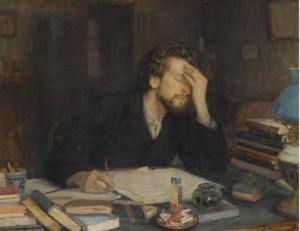
The Throes of Creation – Tomorrow I write

http://en.wikipedia.org/wiki/Writer#mediaviewer/File:Leonid_Pasternak_001.jpg

The Throes of Creation – Leonid Pasternak

I’m newly retired.

Today was rough. All day.

Didn’t want to get up, semi-awake, my mind become a subatomic particle collider of memories, facts, people – confused, whirling, disoriented.

Got up, had coffee, but couldn’t write. Didn’t want to. Didn’t want to do anything.

Searched the emails, rummaged through the morning paper for something of interest. Nothing.

This house is dark in the morning. Not just at 5:00 a.m. It’s dark all morning. No sun. And the skies are cloudy. Gray. Like my spirit. Purposeless. Alone. Disinterested. Blah.

It’s the first taste of retirement. The congregation is gone, or, rather, I am gone from them. I miss them. I am without role. Without work. Without routine. No longer a shepherd. Nor am a sheep within a flock. Adrift. Aimless. Dead to what was. Unclear about what is or will be. I am alone.

Except for Barclay who doesn’t get it. He want’s to play. It’s just another day. Go out. Come in. Get the ball. Drop the ball at Dad’s feet. Play ball with Dad, eat food, play some more, go out, wonder why Dad isn’t paying attention and why we’re not getting exercise when there’s such nice snow outside.

Barclay drove me nuts today. Not his fault. He’s a dog. He knows nothing about retirement, nothing yet about aging, about hearing loss, about depression.

Barclay knows nothing about the Mayflower, the Pilgrims, the Puritans, the Congregationalists or the Presbyterians. He’s lucky. He carries no existential guilt, no multigenerational trauma, only the Now. Only the present. Sit. Roll Over. Get the ball. Heel. Treat. “Good Dog.”

I realize that today is Veterans Day and I think of my father, the Chaplain who shipped out for the South Pacific when I was a year-and-a-half old. I hear the train whistle near our house here in Chaska and remember being on the train with my mother after his ship left Los Angeles, the horror of being alone hearing and watching my mother’s inconsolable sobbing in the birth of the night train on the cross-country trip home to Boston. I hear the whistle and feel forlorn.

I remember years later being in the Lebanon Valley Hospital at the age of 14, two hours from home, and 15-minutes from losing a kidney from a football accident. It didn’t strike me as strange then that my parents weren’t there. Strange that their absence didn’t strike me as strange. I just thought they were busy. Now I wonder why they were not there. My mother didn’t drive. Why did my father not come until he arrived a week later with the ambulance driver to take me home? I was alone, forlorn, and thought it was normal. What could have been more important at the church or in the family than being there for their son who was in serious condition in a distant hospital?

The role – his robe – defined my father until the end of his life. It defined him. For most of my adult life it defined me. Until the sullying of the robe and the eight years without it at the Legal Rights Center. At LRC I learned to live without the robe among the criminal defendants and the lawyers and community advocates who pled their cases before the court. I lived the life of a “retired” pastor, a shepherd without a flock.

It’s that time again. I am not unprepared for this thing called retirement. But I realize tonight: I’ve been there. I need no robe to be the person I am and always was. A Stewart, a Titus, and an Andrews with a long ancestral history of dealing with life and death, flight and fight, denial and courage, faltering faith and faithfulness, cruelty and kindness, beheading blocks and pardons.

It’s time for the pardon. Time to let go of the past. Time to let go of the robe. Time to be open to the freshness of a life as it was at the beginning: naked and glorious, crying out for meaning and the wonder of anything at all.

Tomorrow I write!
