Why is pop culture fascinated with the end of the world?

Minnesota Public Radio’s Public Insight Journalism asked the question after release of the film Seeking a Friend for the End of the Earth. Here’s how I responded.

Ernest Becker’s The Denial of Death makes the case that our culture is death-denying.

One could argue that our fascination with end of the world films and stories is an entertaining and objectified way of dealing with one’s own personal destiny. Every death is “The end of the world.” The end of the world writ large on the planetary screen moves the issue into the world of fiction, fantasy and myth from which, like all cultures before ours, we create meaning in the midst of time.

There are other reasons for our fascination, of course. Supreme among them, in my view, is the dualism and the violence that saturate Western culture: God/Satan, Good/Evil, Moral/Immoral, Saved/Damned, Blessed/Cursed.

It is this misreading of ancient Jewish and Christian texts that makes the will to power the central theme of our time. The late Japanese Christian theologian Kosuke Koyama said that all “sin” has the same root. It is the claim of “exceptionalism.” Under the banner of nationalist exceptionalism’s shameless stealing of the metaphor of “the city set on a hill” away from its proper setting in Jesus’ nonviolent Sermon on the Mount, we assume Western Culture and the U.S.A. to be the Golden City and the agent of divine will. The exercise of that fallacious conviction results in wars of foreign intervention, occupation, and “pre-emptive strikes” in the name of national security.

We have become a national security state. The “end of the world” fascination in our time is heightened by the knowledge that global destruction – nuclear night – is entirely possible. We fear it. We know it. Yet we are also a culture addicted to entertainment where our worst nightmares get projected onto a movie or television screen where we know that what we’re watching is fiction. The fiction is almost always a high-tech version of the old racist and xenophobic dualism my generation grew up on: cowboys and Indians.

Beneath the question of why our culture is fascinated with end of the world is human nature itself. We human beings, like all other animals, are mortal. We may be exceptional in that we are (more) conscious and self-conscious, but first and last, we are animals. We are born. We live. We die.

As conscious animals, we are capable of great feats. We are also, so far as we know, the only animal capable of self-deception, denial, illusion, and species suicide. The denial of death is the great denial, and immortality is the human species’ great illusion.

The fact of death looms over life for each of us existentially and for the species itself from the beginning and in the middle, not just at the end.  Death is our shared destiny. Death is extinction. Our fascination with the end of the world is a strange Molotov cocktail comprised of all of the ingredients of the human condition, most especially the spiritual terror of annihilation, and the illusion of winning. It is the ongoing legacy of the biblical myth of Cain, humanity’s “first-born” who kills his brother Abel, the myth that describes our time and place in history.

If, like in the movie, you had only three weeks left before the end of the world… What would you do?

I’d do what I’m doing now only more consciously. I’d continue to write each morning. I’d do my best to live gratefully, attending to beauty in nature and in art (classical music and paintings) and to family and friends. I’d pray more thoughtfully. I’d walk my dogs more joyfully, stop yelling at them for barking, and find a place on the North Shore to look out to the horizon of Lake Superior. I’d eat lobster and Dungeness crab with lots of hot butter and salt, rib-eye steaks, garlic mashed potatoes. I would avoid Brussels sprouts! I’d end each meal with a Maine blueberry pie, flan, or Graeter’s ice cream, and a Makers Mark Manhattan.  Then I’d settle down on the couch next to the love of my life, Kay, by the fireplace, turn off the news, see if we can make a little fire of our own, get anchored again in the Sermon on the Mount, and return to sources of joy and laughter in the poems of Hafiz. I’d give up being intentional/purposive. I’d live in the moment.
Seeing with the Ears

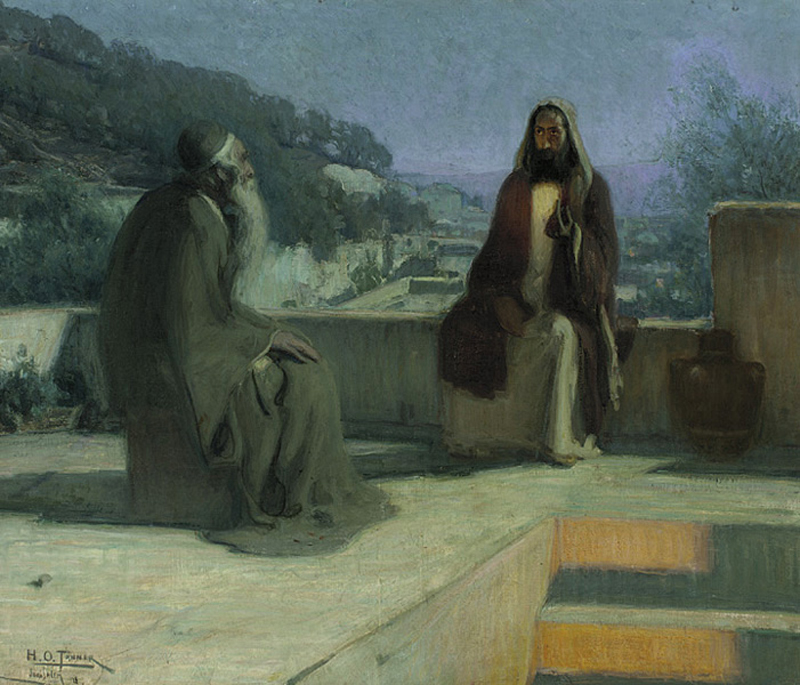
Nicodemus and Jesus on a rooftop, Tanner, Henry Ossawa, 1859-1937

Nicodemus and Jesus on a rooftop

He comes by night. He slips along the buildings of the city streets in hopes that no one will notice. He is a man of position and authority, a learned teacher with a Ph.D. in religion on his way to the kindergarten teacher. “Everything I need to know in life I learned in Kindergarten,” wrote Robert Fulghum. Nicodemus has a sense that he has lost a thing or two along the way, that he needs to start over again.

He’s sent a private message asking for a confidential meeting. The arrangements have been made for the time and place…under the cover of darkness… at Nicodemus’ request.

Dressed in a hooded sweatshirt pulled up around his face and wearing an old trench coat to blend in with displaced people who spend the night on the street, Nicodemus changes his normally stately gait on the way to his secret meeting.

Arriving at the appointed address at the appointed time, he ducks quickly to his left into the alley and darts up the stairs to the flat roof where the kindergarten teacher is waiting.

“Shalom!”

“Shalom aleikem!”

They kiss each other on the cheeks, the left and then the right, as is the custom among their people.

The teacher motions to the wood stool his hands have made for  occasions like this. The stool is well-worn by others who have come it at night, some by advance arrangement, others on the spur of the moment, when the darkness outside or within themselves has overwhelmed them and a hot cup of chamomile tea or warm milk won’t help them get back to sleep.

Nicodemus sits on the stool. But there is no second stool or chair. The teacher takes his customary place on the wall at the roof’s edge, his body and face partially lit by a full-moon, the city landscape and the whole world over the teacher’s shoulder, a strange kind of classroom. Nicodemus can see him – sitting calmly, erect, at full attention, his eyes fixed on his eyes, steady and searching and seeing, it seems, what even Nicodemus does not yet know about himself and the real reason he has come.

The man on the wall sits and waits for Nicodemus to break the silence. The wordlessness does not trouble him. He is at home with silence.

“You are a teacher who has come from God because no one can do what you do apart from the presence of God,” declares Nicodemus.

Nicodemus awaits a response to his declaration of honor, but there comes no response except for the eyes beholding him.

Nicodemus fidgets, uncomfortable with the silence. He repeats his declaration, increasing the decibels in case the teacher is hard of hearing, but not so loud as to wake the neighbors, the street people, or the police:

“You are a teacher who has come from God because no one can do what you do apart from the presence of God.”

Jesus gives a slight nod and looks at him from the wall.

“No one can see the kingdom of God unless he is born anew,” he says.

“So it’s about seeing?”

“Yes. It’s about seeing.”

Turning and pointing to the world over his shoulder, he asks Nicodemus, “Do you see this magnificent landscape behind me?… Look at it… Really look… What do you see?”

“I see a mess.”

“Ah, but look again, Nicodemus. You’re looking with the wrong eyes. It is a mess. Anyone can see the mess. If you look, you can see a different outline through the darkness. Maybe you need glasses. Maybe your ears will help you see.”

They fall again into the silence, but the words – “Maybe your ears will help you see” – speak to an inner darkness. Nicodemus looks with his ears at the night landscape and the distant horizon and the stars over the teacher’s shoulder, listening to the faintest sound of a familiar tune they both had learned in kindergarten at the synagogue.

Jesus, is humming.  Softly. Without thinking, Nicodemus joins in humming the tune, and then begins to mouth the words, the familiar words spoken quietly by every faithful Jew living under Roman occupation and in the dark nights of the soul, the words sung or spoken in silence by every Jew on the way home from synagogue, a kind of lullaby of faith, a way of seeing with the ears:

“Peace unto you, ministering angels, messengers of the Most High, of the supreme King of kings, the Holy One, blessed be He.” (repeat twice)

“May your coming be in peace angels of peace, messengers of the Most High, of the supreme King of kings, the Holy one, blessed be He. (repeat twice)

“Bless me with peace, angels of peace, messengers of the Most High, of the supreme King of kings, the Holy one, blessed be He.” (repeat twice)

“May your departure be in peace, angels of peace, messengers of the Most High, of the supreme King of kings, the Holy one, blessed be He.” (repeat twice)

“For He will instruct His angels in your behalf, to guard you in all your ways. The Lord will guard your going out and your coming in from now and for evermore.”

Pentecost Jazz

Whenever I hear Dave Brubeck, I think of Pentecost. Here’s a video of Brubeck and Al Jarreau that came to mind after reading my friend Steve’s poem (below) on Pentecost and jazz as the music of the Spirit.

PENTECOST (acrostic)

In Memory of Charles Reynolds*

(TO BE READ ALOUD )

Perhaps a jazz improvisation says

Exactly what is thinkable about

New life, fresh breath…the Holy Spirit.  Has

There ever been a music without doubt

Except jazz?  Faith, improvisation cause

Circles of sound to rise and fly throughout

Our cosmos.  Tongues of flame are seen on heads

Singing or playing solos.  Then without

Time passing–a new language:  Jesus!  Jazz!

*Charles Reynolds was Organist at the McKinley Church at the University of Illinois where Steve was the Senior Minister.

– Steve Shoemaker, Urbana, IL. Steve’s Sunday evening program “Keepin’ the Faith” can be heard anytime @ www.will.illinois.edu/keepinthefaith, including archive programs, “two of  which,” says Steve, “feature Gordon C. Stewart,my ‘publisher'”.

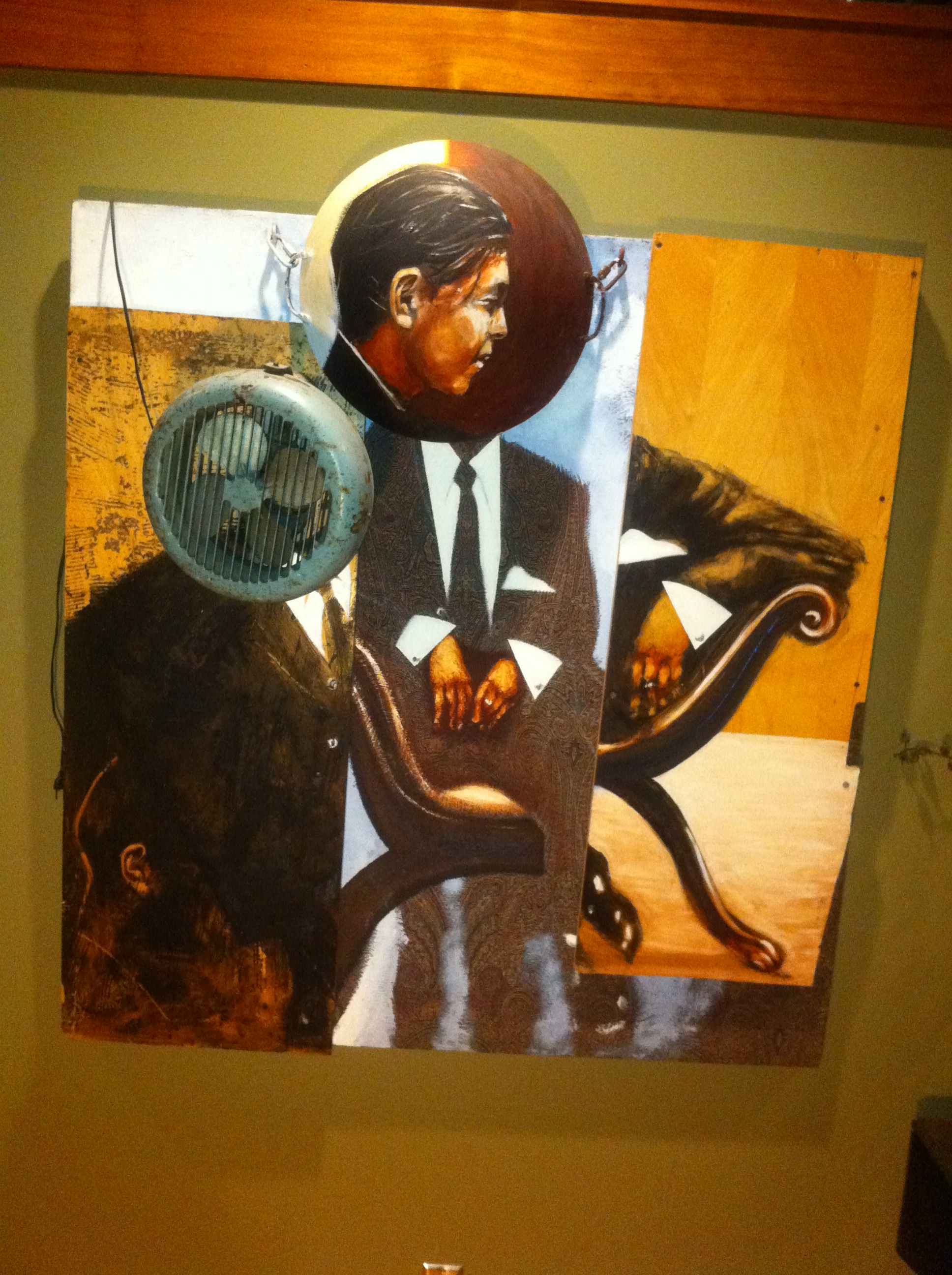
The Trinity

The Trinity

This piece of art hangs in my friend Steve’s living room on the Illinois prairie. I’ve always thought it was a little weird.  Actually, more than a little. Here’s Steve’s interpretation. I never would have guessed. He calls it

“The Trinity”

It is a triptych, three panels joined together.

There are three hands, three feet, three heads (see the profile– lower left).  White triangles are found everywhere.

The fan (pneuma) is, of course, the Holy Spirit.

The prayer- hearing ear of the unseeable God is just barely discernible in faint profile.

The painted wok, an ethnic face, a real human naturally is Jesus Christ. Christians remember him with food…  The brand of found fan is “Tripl-aire.”

Dave Ellis, a big city, secular painter, is the grandson and the son of a pastor.

Steve Shoemaker, Urbana, Illinois, is host of  “Keepin the Faith…” @ http://www.will.illinois.edu/keepinthefaith. This Sunday (May 20), his guest is Pulitzer Prize-winning author and Professor Garry Wills of Northwestern University on “Ambrose, Augustine and the Mystery of Baptism”


Yours truly’s favorite form of adoration

Sebastian

Click to learn more from rawgrief.com: Yours truly’s favorite form of adoration.

Heaven on the Bridge at Big Sur

Sometimes the present is heavenly. Click HERE for one of those times. This photo of the Bixby Bridge, Big Sur, California, by Max Granz posted on Photobotos.com is ethereal…and Eartlhy real. Leave the photo up for a few minutes to relax your day…or bring calm to your night.

You cover Yourself with a garment,

who has stretched out the heavens like a tent,

who has laid the beams of Your chambers on the waters    …who makes the winds Your messengers,

fire and flame (and headlights?) Your ministers.”

– Psalm 104

Leave a comment here or on the Photobotos site, as I did, to appreciate the photograph and to thank the patient photographer.

The Tower

Tower, Ray Erickson photo used by permission

Tower, Ray Erickson photo used by permission

Of course a tower is built by starting from

the bottom. Strong arms and shovels make

a joint to earth with wet, gray gravel, and form

with time, a foundation almost like rock.

Orange steel is welded, riveted and made

to stand naked pointing skyward.  Then blocks

and bricks are hoisted slowly up the side

providing covering flesh the tower lacks.

Small children make towers in trees, and these,

though only made of rotting boards, still stand

as proudly strong (in the children’s eyes)

as those from which much older ones descend.

But both kinds of towers seem built to say

with their builders–we look down on the sky.

Steve kneeling behind Sheldon Jackson’s pulpit

– 6’8″ Steve Shoemaker

Anglican Theological Review, April, 1973

Steve wants you to know that we’re both important. He has his tower. I have mine. Steve is host of “Keepin’ the Faith,” a Sunday evening program on on WILL – archive programs, “including two with Gordon Stewar” (Steve ordered me to put this in here – he’s taller, so I do everything he says), can be heard anytime, anywhere @ www.will.illinois.edu/keepinthefaith

The Web of Sanity and Fullness

Pond with morning mist evaporating

Pond with morning mist evaporating

A newspaper reporter asked me some questions. We were preparing for a First Tuesday Dialogues series on sustainability called “The Good Green Earth.”

The series would bring five speakers, including  spokespeople from the Gulf of Mexico deeply engaged in hazard assessment, technology, and recovery in the wake of Deepwater Horizon.

What’s your sense of the possibilities and trends for sustainability in your work now and what does it look like in the future?

I responded that one of my inspirations is Paul Tillich, according to whom:

Being religious means asking passionately the question of the meaning of our existence and being willing to receive answers, even if the answers hurt.

Faith consists in being vitally concerned with that ultimate reality to which I give the symbolical name ‘God’. Whoever reflects earnestly on the meaning of life is on the verge of an act of faith.

The Spider’s Web with Morning Dew

My calling as a pastor was to help us here at Shepherd of the Hill and here in Chaska literally “go out of our mind.”

Because the collective mind that has delivered us to this place is killing us and destroying the balance of nature.

My calling is to shake us loose from the mental and spiritual chains of species superiority, My calling is to shake us loose from the mental and spiritual chains of species superiority, the mistaken notion that we – humankind – are the exception to Nature.  It’s a call to help re-shape our understanding of ourselves as participants rather than owners, participants rather than conquerors or manipulators, members of a diverse natural order of interdependent life. The spiritual resources are there in Hebrew scripture, in the New Testament epistles to the Ephesians and the Colossians, and in the ancient respectful spirituality of some of America’s indigenous people. By “going out of our mind” we will come back into a the web of sanity and fullness.

What factors do you see pushing towards or against sustainability?

Historian of science and technology Lynn White said flat-out that the root problem of the sustainability crisis is religious or spiritual, and so is the solution.

So, number one, we have to address the old and emerging questions about what Tillich called “Ultimate Reality” and the meaning of our existence.  We have to go into labor to set the new theological and anthropological  paradigm free from of the old destructive thinking.  What we are beginning to find as we go into this spiritual labor is that this more respectful, more holistic way of thinking is not new at all – it’s the older paradigm that got side-tracked by greed and pride.

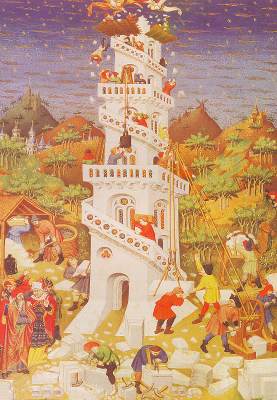
Building of the Tower of Babel – Master of the Duke of Bedford

God has “come down,” as it were, to frustrate our attempts at building the secure city called Babel; God is making us nomads again who recognize that we and the Earth are already full, not empty. Every settlement comes to nothing. Every tower built as a monument to pride falls. And number two, and I’m afraid there is no other way to say this – we will never make it without leaving behind the economic system of greed. Capitalism is killing us.

The consolidation of wealth and corporate power have a stranglehold on national, state, and local public policy. The members of the boards of the oil companies sit on the boards of General Motors and Ford.  So it’s no wonder that U.S. federal policies on transportation are car-friendly and suspicious of mass-transit, regardless of a car’s gas mileage. Osalescence is built in because you can’t sell something five years from now if the old model is still like new. Our health care and the FDA are in the palm of the insurance and drug company’s so that it’s illegal to go across the border to fill your prescription in Canada.

Finally, the sustainability of the human species itself is, I believe, imperiled by chemical alterations that are meant to do good but that, in the long run, make us biologically less resistant and resilient. Our natural immune systems are being weakened by pesticides in the food we eat and by the pharmaceuticals we ingest from the drug store.

Black tar heroin - U.S. Drug Enforcement Administration

Black tar heroin – U.S. Drug Enforcement Administration

We have become a nation of addicts.  Addicted to illusionary dreams of abundance.  Addicted to prescription drugs.  Addicted to fast food and faster short-term solutions. Even instant gratification is too slow. Controlled by advertizing that sells us prescription drugs that’ll give you an immediate erection but may send you to the emergency room if it last more than four hours,or drugs that may ruin your liver or land you in a casket, and the real pushers are not the petty drug peddlers on Minneapolis’s North Side. The real pushers are legal. They’re given license, while those who would shut them down are looked upon as crackpots and throw-backs who are opposed to progress.

So…what’s stopping real progress, a more Earth-friendly way of organizing human affairs that embraces reality itfself, “Being-Itself”?  The intransigent, legal, institutionalized arrangements of power and money, on the one hand, and our willing compliance with the de-democratization of America that salutes the system of greed. We have to learn again, and we are – very slowly –  pushing and screaming, that “the Earth is the Lord’s and the fullness thereof”. We have turned it over to the forces of greed and destruction.

The Good, Good Earth: Our Island Home

The Good, Good Earth: Our Island Home

We need to recover the gratitude and spiritual paradigm of a natural abundance in order to push against the false promises of those who would have us believe that our lives and the world would be empty without all the stuff that ends up in the landfills or washes ashore in the estuaries of the Gulf of Mexico.

So……Chime in, friends. How would you answer the reporter’s questions?

Ephemera (Dennis Aubrey)

Profound and humorous personal story by Dennis Aubrey of Via Lucis.. “…And so I read these books in the library, but I carried them around the school halls in order that young women would be impressed.”  Lessons from Bertrand Russell, Alfred North Whitehead, Das Capital, libraries, books, and the raging hormones of  “the juvenile medieval monks who worked diligently in the scriptorium.”

Click Ephemera (Dennis Aubrey) for the photos and the story. Well worth the read.

The Estate Sale and a Thousand Years

Last Saturday I bit my tongue and went to an estate sale in hopes of buying a patio set. It was sold by the time I got there. Here and gone in a heartbeat.The rest of the stuff, except for the men’s suits (wrong size) was junk.

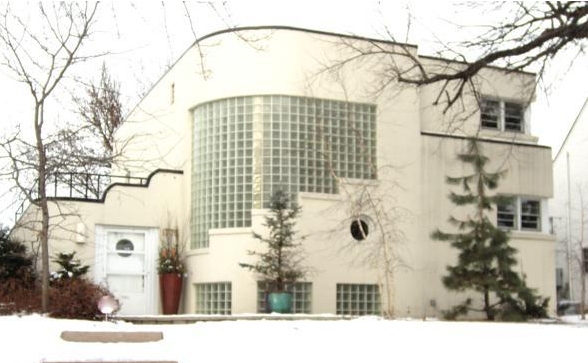
The memory that lasts is the house itself. Highland Park is a lovely neighborhood in Saint Paul. Beautifully constructed old Tudor homes on a tree-lined street…except for…the house with the estate sale…a lavishly done white retro Art Deco house…plopped down like a fly on top of a French Soufflé.

I blurted out to another shopper, “This place is really strange.”  “Yes!” she said. “What were they thinking?”

Right then I thought of the ongoing conversation with Dennis Aubrey of Via Lucis Photography about the Romanesque and Gothic churches that still inspire reverence and awe eight centuries after they were built.

Dennis: “One of the wonderful things about these [Gothic and Romanesque] churches was that they took so long to construct and design that the intellectual currents that drove the builders were deep and powerful, not short, erratic eddies of fashion.”

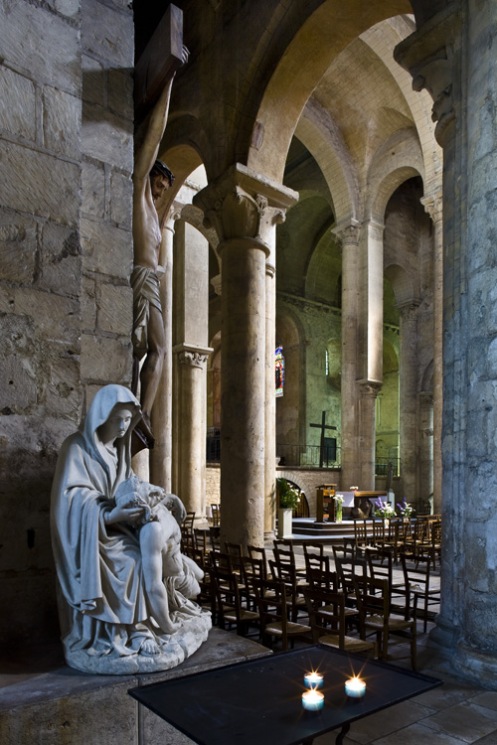
Dennis had posted a question about a contemporary artistic installation at the Church of Saint Hilaire in France.  Would the newly created installation at the Church of St. Hilaire stand the test of  time. Might it also come from sources that are “deep and powerful, not short, erratic eddies of fashion”? Would it stand the test of time as compared with Gothic and Romanesque structures with their high vault ceilings that lift our eyes and hearts to something else for which we human beings long?  I had shared with Dennis that I find most contemporary church architecture banal and uninspiring.

I wrote to Dennis: “The culture of individualism is NOT Romanesque or Gothic where the glory is directed away from the individual, where the individual gets to feel…well…very small, humble, rather insignificant in the best way. I, too, see wonderful works of contemporary architecture, and I hope I’m not just being a cranky old man here. The comment about banality is not about those magnificent creations but rather about what I believe is the prevailing dumbing down of our time that leaves us bereft of awe, the sense of grandeur, wonder, or humility [one feels in Gothic and Romanesque spaces]. There’s a flattening, a leveling of existence itself to human proportions. The belief in species superiority displaces everything that suggests otherwise. My comments, I think you know, are not so much about the new installation at St. Hilaire – which, in and of itself, strikes me as quite lovely – but more about the age in which we live where nothing much seems to be of lasting value.”

Dennis: “Gordon, I think it was a form of this ‘prevailing dumbing down’ that inspired us to these churches in the first place. I became increasingly disturbed by rampant      commercialism, when the point of commerce is to create obsolescence so that goods can be replaced whether necessary or not. Fashion and styling is substituted for value. PJ and I wanted to concentrate on something that had intrinsic value, and when we began exploring these churches in  2006, we found that something.

“One of my favorite books of all time is Raymond Chandler’s The Long Goodbye [published in 1953]. In it, there is a speech by the wealthy Harlan Potter:

“’You can’t expect quality from people whose lives are a subjection to a lack of quality. You can’t have quality with mass production. You don’t want it because it lasts too long. So you substitute styling, which is a commercial swindle intended to produce artificial obsolescence. Mass production couldn’t sell its goods next year unless it made what it sold this year look unfashionable a year from now. We have the whitest kitchens and the most shining bathrooms in the world. But in the lovely white kitchen the average American housewife can’t produce a meal fit to eat, and the lovely shining bathroom is mostly a receptacle for deodorants, laxatives, sleeping pills, and the products of that confidence racket called the cosmetic industry. We make the finest packages in the world, Mr. Marlowe. The stuff inside is mostly junk.’”

Well, the kitchens today aren’t just for the “housewives,” thank goodness, but the rest hit too close to home.

I think of the height of the Gothic arches and the things that will last when someone says at my departure “Dust to dust, ashes to ashes” and holds an estate sale.

I sit down with the Scriptures for something longer lasting than deodorants, laxatives, sleeping pills, or a plastic patio set.  I want something like the lasting value of the Gothic and Romanesque architecture “took so long to construct and design,” where “the intellectual currents that drove the builders were deep and powerful, not short, erratic eddies of fashion.”

I’m drawn to the English translation that preserves the clear distinction between the Divine and the human – the use of the archaic word “thou” for God. Like the vaults of St. Hilaire, the language lifts up my heart from the flat banality of our self-preoccupations and species grandiosity.

Basilique Saint Hilaire, Poitiers (Vienne) Photo by PJ McKey

“O Lord, how majestic is thy name in all the earth!

When I look at the work of thy heavens, the work of thy fingers,

The moon and the stars which thou hast established;

What is man that thou art mindful of him…?


O Lord, our Lord, how majestic is thy name in all the earth!” (Psalm 8)


“Lord, thou hast been our dwelling place in all generations.

Before the mountains were brought forth, or ever thou hadst formed the earth and the world,

From everlasting to everlasting thou art God.

Thou turnest man back to the dust, and sayest, ‘Turn back, O children of men!’

For a thousand years in thy sight are but as yesterday when it is past, or as a watch in the night.” (Psalm 90:1-4)