How the doubting father’s son became a shouter

A BIBLICAL FATHER-SON STORY: ZECHARIAH & JOHN THE BAPTIST
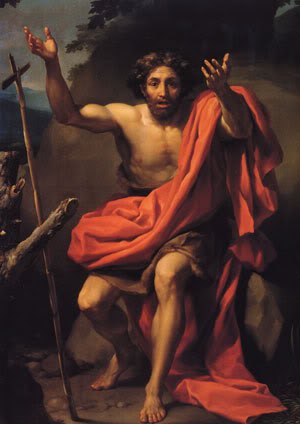
John the Baptist
John the Baptist

Ever wondered why John comes out of nowhere with a fiery message?

He has a bone to pick. Why? With whom? What’s his story?

The Eastern Orthodox Christian tradition preserves a story about John’s father, Zechariah, a Temple priest, sending his wife, Elizabeth, and their son, John, into hiding. Zechariah hides his son to protect him from Herod’s “Slaughter of the Innocents” by which all males below the age of two were to be killed following rumors of a newly-born king, a threat to Herod’s rule.

According to the story told by The Infancy Gospel of James [the mid-Second Century C.E.], John and Elizabeth remain in hiding – far away from their husband and father, Zechariah – until John is five or six years old when Zechariah risks visiting their hiding place. The result is the brutal murder of Zechariah by Herod’s soldiers.

As the son of a Temple priest, John descended from the priestly lineage of Aaron. John was destined to be a Temple priest. Father-son dynamics become more difficult when the father is a public religious figure. Zechariah’s son sounds like an angry preacher’s kid.

When [John] saw the Pharisees and Sadducees coming to be baptized, he said to them, "You brood of vipers, who warned you to flee from the wrath to come? Bear fruit that befits repentance, and do not presume to say to yourselves 'We have Abraham as our father ....'" (Mt. 3:7-9a).

The Pharisees were lay people with a more liberal religious bent than the Sadducees. The Sadducees were Temple authorities and Temple supporters, the folks who aligned themselves with John’s father Zechariah and a conservative reading of the Torah. The Pharisees and the Sadducees were in conflict during the time of John and Jesus. Only the Pharisees survived the later destruction of Jerusalem and the Temple in the Roman-Jewish War of 70 C.E.

By the time the Gospels are written, the Temple had been destroyed. So we have the Temple priests and their supporters, the Sadducees, and John the Baptist in the Gospel of Matthew scolding both the Pharisees, who will carry on their tradition without accepting one of their likely members, Jesus of Nazareth, as the awaited Anointed One (Messiah), and the Sadducees who have disappeared into history.

Whether the Orthodox tradition and The Infancy Gospel of James are taken as historical fact or mythic truth, John’s real fight was with his father and the Sadducees who had compromised Jewish identity and integrity by their accommodations to Rome.

John is certain, bold, and in-your-face. His father, Zechariah, according to Matthew’s Gospel, had doubted the news of John’s conception. As a result of his doubt, Zechariah was struck dumb. He remained unable to speak until Elizabeth had named their son ‘John’, at which point his mouth was opened. “Yes,” said Zecahariah, “his name is John.”

Zechariah had been a doubter; John was no doubter. Zechariah sent John into hiding. The John who returned from safety was no hider. John became a shouter who minced no words. Far from Jerusalem and the Temple, out in untamed space by the Jordan River, he took his stand for the return of his people from the false choice of the pious laity (the Pharisees) and his father’s priestly class (the Sadducees): “You brood of vipers!”

Baby vipers were said to eat their mother’s stomachs. Israel was the Mother whom the Pharisees and Sadducees were eating from the inside out.

John wanted nothing to do with the killing of his Mother or with those who had killed his father. In the interest of protecting his Mother from the vipers, he had run from the Temple into the wilderness, returning to the place where his Mother, Israel, had been born after the Exodus. He did not go into the wilderness to hide. He went out to rescue his Mother from being eaten by her children. When the vipers arrived, he shouted in ways his mute father never did. Yet, in the end he died by the same hands as his father when Herod delivered his head to Salome on a platter.

Like father, like son. His younger cousin Jesus carried on.

  • Gordon C. Stewart, Chaska, MN, January 7, 2015

The Manifestation of Christ: Epiphany

Ever wondered what an authentic disciple of Jesus might look like in 2016 following a year of deadly gun violence? Today is Epiphany when Christians celebrate the manifestation of Christ to the gentiles, remembering the Wise Men who presented their gifts to the Prince of Peace.

President Obama, Jan. 5, 2016

President Obama, Jan. 5, 2016


The Psalter Reading for Epiphany: Psalm 72:1,2,7-14 (NRSV)

Give the king your justice, O God, and your righteousness to a king’s son.

May he judge your people with righteousness, and your poor with justice.


In his days may righteousness flourish and peace abound, until the moon is no more.

May the kings of Tarshish and of the isles render him tribute, may the kings of Sheba and Seba bring gifts.

May all kings fall down before him, all nations give him service.

For he delivers the needy when they call, the poor and those who have no helper.

He has pity on the weak and the needy, and saves the lives of the needy.

From oppression and violence he redeems their life; and precious is their blood in his sight.

  • Gordon C. Stewart, Chaska, MN, January 6, 2016, The Day of the Epiphany on the Western Christian liturgical calendar.


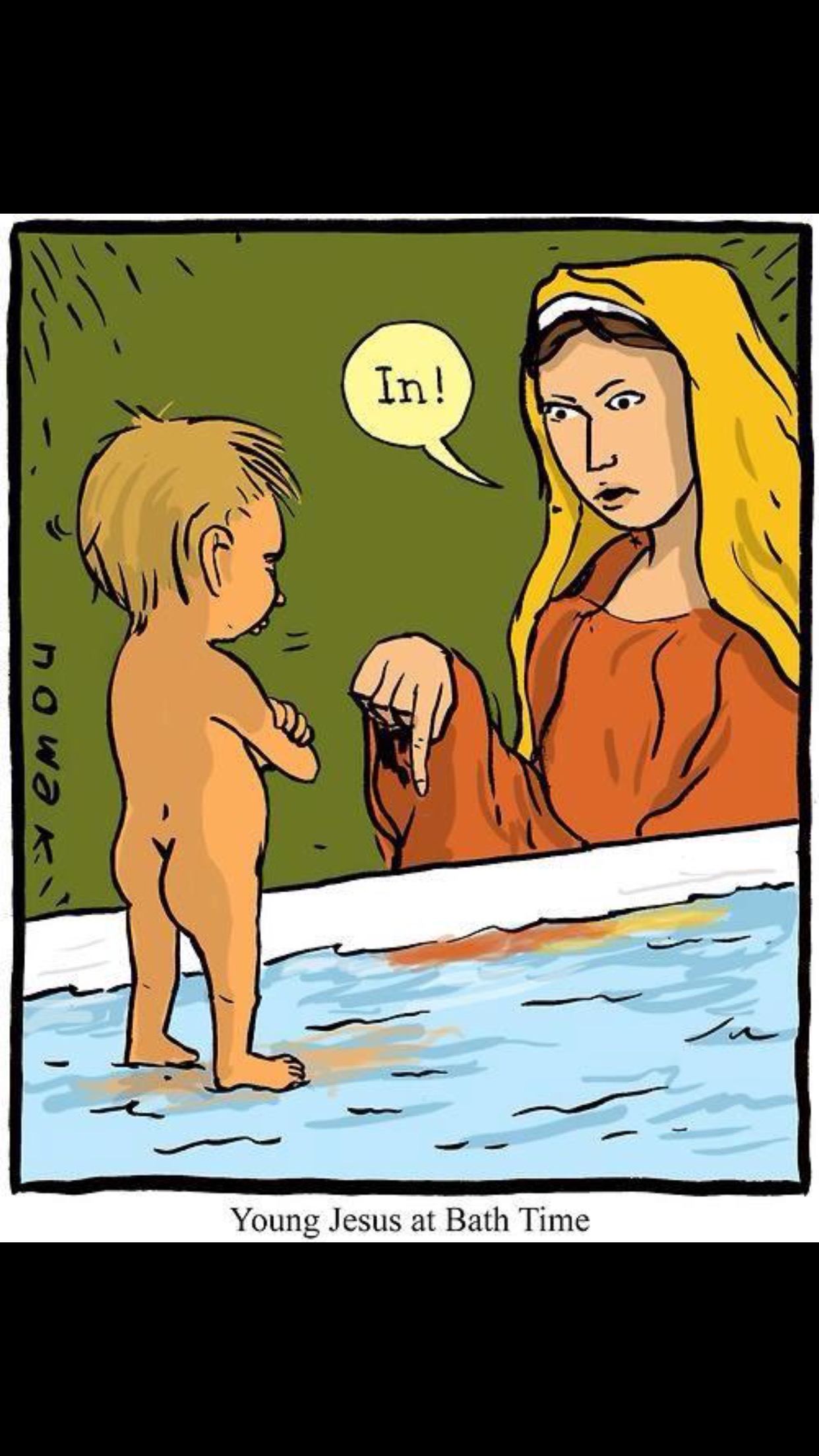
Young Jesus at Bath Time

Image

Young Jesus at Bath Time

Young Jesus at Bath Time

Talking about death and dying

Talking openly about death is a rare thing. We don’t like talking about it. We prefer it go away and stay away, like rain: “Rain, rain, go away. Come again some other day.”

When someone dies, it’s often said they’ve passed, passed away, or passed on, a sentiment dating back to a Greek idea of the immortality of the soul. It was/is assumed the soul at death is set free from its mortal cage to live forevermore.

The likes of Barbara Brown Taylor, of whom I consider myself one, have different idea. “Matter matters,” she says. Flesh and blood matter. Flesh, blood, and matter matter. Christians, following the older view of the Hebrew Bible, do not share the belief in a part of us – a soul – that survives our mortal frame. Instead, we profess a curious hope that affirms the essential goodness of corporal existence. Belief or hope in the resurrection of the body may seem even stranger than the immortality of the soul.

I have no more reason to believe in the resurrection of the body than I do to believe in an immortal soul. Watching the life go out of my dogs, I did not imagine some invulnerable part of them leaving their bodies to pass on to some other state of being. They were dead. I cried. I grieved. I mourned their loss. I never thought I would see them again. If they, or we, had a future, it seems more natural, so to speak, to think of them in their bodies all over again.

But which body would it be? Would Maggie, our West Highland White Terrier-Bichon Frise, be the playful pup or the one with the tumor on her hip? Would I be the 73 year-old me, the new-born me, or the teenager with the raging hormones?

Passing away has always made more sense to me than passing or passing on. “You are dust and to dust you shall return” makes better sense to me. The Earth will go on, as will those I love … for a time … but not forever, so far as any of us really knows. I say the Nicene creed on Sundays and ponder what it means to say “I look for the resurrection of the body and the life of the world to come.” The world to come, so far as I can tell, is the Earth where Cecil the lion doesn’t get killed by a dentist, and the lion and the lamb…and the dentist…lie down together in peace and hurt one other no more.

My friend Steve talks openly about death and dying. “I’m dying,” he says, not with a morose or maudlin sensibility but as a fact. It’s not a great surprise to him. Would he and we prefer the rain to go way and come back some later day? You bet. But it won’t, and even it if would, it would be back some other day. There’s great grace in the acceptance of death and the maturity to speak of it aloud, enjoy old friends when one can, laugh and cry and hug and kiss those one loves.

That we would want something more or fear death as the end is part of being human. The time of death is not time to debate philosophy or theology. It’s time for compassion, and for grace and courage to recognize our creatureliness – the distinction between every creature and the Creator, mortal life and the Immortality, the finite and the Eternal.

– Gordon C. Stewart, Chaska, MN, Dec. 29, 2015

An NRA Christmas

But Mary was much perplexed by his words and pondered what sort of greeting this might be. The angel said to her, “Do not be afraid, Mary, for you have found favor with God. Conceal and carry!

Luke 1: 26-28  NRAV [National Rifle Association Version]

  • Gordon C. Stewart, Chaska, MN, Dec. 22, 2015

“Do not be afraid”

A sermonic reflection for the Fourth Sunday of Advent, Dec. 21, 2014, Gordon C. Stewart.

Text: Luke 1:26-38

El_Greco_044-medium-3

The Annunciation {El Greco]

Mary has every reason to fear the appearance of Gabriel. Every demure depiction to the contrary, the Angel Gabriel’s “annunciation” to Mary is no private affair. It’s a public matter of the first order. According to tradition’s lore, Gabriel is the archangel commissioned to destroy the offspring of the rebellious angels and human women. (see below). Mary shrinks back.

“Do not be afraid,” says Gabriel.

Why should she not be afraid? This is not just any angel.

This is the Angel Gabriel, whose trumpet will summon the people, sweep away the occupation forces that substitute their rule for the Kingdom of love and delight. This is an angel of revolution. The Archangel of conflict who inspires both hope and fear.

”Do not be afraid!”

El Greco’s painting of the Annunciation illustrates the problem of textual interpretation. Gabriel’s appearance is not frightening. It’s feminine. Even to the point of appearing perhaps pregnant himself. The great masters did not paint an angel messenger as male, even when his name is Gabriel or Michael, the only two angels named in Holy Scripture.

Gabriel in Hebrew means “God is my Warrior”. Gabriel is a warrior angel, announcing to Mary that she too is to become a warrior, a mother whose birth-giving will lead to conflict with the Empire and the religious authorities who collaborate with it.

As described by New Testament scholar Carol Newsom, any annunciation by Gabriel inspires fear.

In the Book of Daniel, Gabriel is preeminently an angel of eschatological revelation. He is sent to Daniel to explain a vision of ‘the time appointed for the end’ (Dan. 8:15-26)…. Gabriel’s functions are more varied in I Enoch. In the Book of the Watchers (I Enoch 1- 36) he is listed as ‘the one of the holy angels who is in charge of paradise and the dragons and the cherubim (20:2). He is commissioned to destroy the offspring of the rebellious angels and human women (10:9-10)….

In the War Scrolls from Qumran (IQM) the names of 4 archangels, Michael, Gabriel, Sariel, and Raphael, are written on the shields of the 4 towers of the army. The positioning of the 4 archangels around the throne of God or other sacred space has a long subsequent history in both Jewish and Christian tradition…. [Carol Newsom, “Gabriel.” The Anchor Bible Dictionary, Vol. 2]

So why does Gabriel look the way he does in the art museums and literature of Christian interpretation? Why does Gabriel look so benign? And why does Mary look so calm, perhaps even demure, as in El Greco’s Annunciation?

The Jesus story has been neutered. The End Time has been re-interpreted by the Constantinian Church as a paradise beyond time, a state of afterlife, not this life. In no way political. In no way economic. In no way conflictual. Peaceful. Serene. Calm. Quiet. Passive. “Let it be to me according to your word.” Never disquieting. Never disrupting. Never revolutionary.

Gabriel has been transformed, neutered, rendered harmless by the Constantine religion whose adherents can no longer see the conflict between Christ, or his mother, Mary, and his father, Joseph, with the systems of unbridled greed and poverty under which they live. The Gabriel spoken of in most pulpits is not the Angel Gabriel that came to Mary.

We’ve re-created Gabriel in our own image. But though we may tame him in our hearts, our paintings and our sermons, we can erase neither the need to be afraid nor his invitation to fear not. Gabriel’s finger points at us, asking whether we will rally to the trumpet sound, the sound of his coming. We can repaint the young girl Mary as an icon of passive obedience and tranquility. But it will be a different Mary than the courageous one painted by the Gospel of Luke, the one who sings the Magnificat.

Luke and his Mary know that “Do not be afraid!” makes no sense unless there really is something to fear, and that we cannot overcome fear unless we hear Gabriel’s word of favor, “Hail, O favored one! The LORD is with you. Blessed are you among women…You shall conceive….”Do not be afraid…. For with God nothing will be impossible.”

“Then Mary said, ‘Here am I, the servant of the Lord; let it be to me according to your word.’

“Then the angel departed from her” for parts unknown to make his visits down through the ages, making the impossible possible. Word has it he appeared last week in Washington, D.C. and Havana, Cuba to turn the impossible into the possible, a new Order being born from the old.

If you listen with faith, you might hear him. If you look, you will see him.

  • Gordon C. Stewart, Chaska, MN, Dec. 22, 2015

Verse on the first Christmas

“No Christians Were There”

No Christians were there at the birth
of Jesus. (For “…disciples were
first called Christians in Antioch”
years later.) But were those who were
there believers? the shepherds, the wise
astrologers, the non-father,
the Blessed mother? Did they see
with eyes of faith, or more like we
do: wonder, ponder, doubt and stare
at the small baby stabled there…?

That three were Jews, we know for sure.
The genealogies we read
in Matthew, Luke, go back as far
as Abraham. Eight days, we read,
then circumcision for the babe.
The Arab wise guys may be from
the land we call Iran. The sheep
herders may have been aliens
in the land illegally: cheap
pay for smelly foreigners.

The barn contained no royalty–
the stock had better pedigree…
and yet some say a King was born
to poor folks that the rich would scorn…

– Steve Shoemaker, Urbana, IL, Dec. 21, 2013

Verse – Who is worshiped at Wheaton College?

The Atlantic published “Professor Suspended for Saying Christians and Muslims Worship the Same God” yesterday.  Tenured political science Associate Professor Larycia Hawkins [Click HERE for Wheaton College’s faculty profile] was suspended by the Wheaton Administration for saying Christians and Muslims worship the same God.

Steve Shoemaker, Wheaton College, Class of 1965, and co-publisher of  Views from the Edge’s wrote this response this morning:

Who Is Worshiped at Wheaton College?

We worship the God of Abraham. (Jews)

We worship the G_D of Abraham (but consider his name so Holy, we do not say it or write it.) (Orthodox Jews)

We worship the God of Abraham. (Christians)

We worship Jesus, our Savior, and the Holy Spirit, our Comforter, along with God the Creator, a Trinity, who we believe was The God of Abraham.

We worship the God of Abraham. (Muslims)

We worship Allah, whose prophet was Mohammad, the same God as the Christians, whose prophets were John the Baptist, and Mary, and Joseph and Jesus; and the same God as the Jews, whose prophets were Moses and Aaron and Miriam, and Jonah, and David.

Steven Robert Shoemaker, BA, Psychology, Wheaton College, 1965.

O Adonai, a second Advent reflection and sonnet

Malcolm Guite

Malcolm Guite

NOTE: Anglican priest, songwriter and poet poet Malcolm Guite is becoming a favorite of VFTE. His work reflects that playful but profound interplay between the particular and the universal that is poetry’s great gift. Here’s Malcolm’s post for today.

  • Gordon C. Stewart, Chaska, MN, Dec. 18, 2015. Malcolm writes from Cambridge, England. Click the link:

O Adonai, a second Advent reflection and sonnet

Joseph and Mary living in our pantry

La Posada Festival poster

La Posada Festival poster

It’s almost Christmas. Joseph and Mary stayed at our house last night as part of La Posada, a Mexican tradition re-enacting Mary and Joseph’s search for lodging in Bethlehem.

We welcomed them to our home for safe lodging, food, and a warm place.

When they arrived we sat them on the floor.

Barclay welcoming Joseph and Mary to our home.

Barclay welcoming Joseph and Mary to our home.

Unfortunately, Barclay  quickly took a liking to Joseph’s left ear, so we moved Joseph and Mary into the pantry where they’d feel safe from a domestic terrorist attack.

Last night, after Barclay had gone to bed, I invited Joseph and Mary to join me  watching the presidential candidate debate.  Last night’s debate topic was terrorism. Refugees fleeing persecution and immigration policy were also discussed.

Our guests stayed very still. They were very quiet. They watched the faces on the TV screen. They listened to every word. As I went to the kitchen for a drink, Mary cuddled up to Joseph needing reassurance. She whispered, “Joseph, we have to get out of here before one of them gets elected -these people don’t like us! They’re mean. They sound just like Herod!”

I took them back to the safety of the pantry, put them back on the shelf, said goodnight, and closed the door so they’d feel more secure. Today they came out of the closet when another family came to protect them from Herod on their way to Bethlehem. But before they left, Joseph told Mary, “Don’t worry, honey, as soon as you give birth and are strong enough for the journey, we’re leaving for Egypt.”

  • Gordon C. Stewart, Chaska, MN, December 17, 2015.

The Holy Family traveling to Egypt

The Holy Family traveling to Egypt

An angel of the Lord appeared to Joseph in a dream and said, “Get up, take the child and his mother, and flee to Egypt, and remain there until I tell you; for Herod is about to search for the child, to destroy him.”  Then Joseph got up, took the child and his mother by night, and went to Egypt, and remained there until the death of Herod. This was to fulfill what had been spoken by the Lord through the prophet, “Out of Egypt I have called my son.” – Matthew 2:13-15