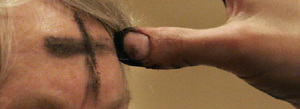
Somebody has my ashes!

Gordon C. Stewart's avatarViews from the Edge

It’s Ash Wednesday. I put on my ministerial robe 15 minutes before the traditional Service that marks the beginning of Lent with the imposition of ashes and go the drawer of the credenza.

Ash Wednesday“They’re missing! Where are the ashes?!” 

Every year I store the ashes in the credenza in my office. I’ve forgotten that we’d moved the credenza from my office last fall. I rush downstairs to look for it. No credenza anywhere. Then…I remember. We sold it at the Annual Fall Festival!

“Somebody has our ashes!”

What to do with no ashes? Burn some newspapers? Smoke a cigar and use the ashes? No time.

I grab a pitcher and pour water into the baptism font.

We begin the Service with the story of the missing ashes. Smiles break out everywhere. Maybe even with signs of relief. “Instead of the imposition of ashes this year, we will go to the…

View original post 245 more words

Let your ‘Yes’ be ‘Yes!’

If the choice in the 2016 Presidential election had been between Donald Trump and Senator Bernie Sanders, I believe now, as I did then, that Sanders would have won.

What the two had in common was that they were “outsiders” to the political status quo. Both spoke about strengthening the working class, creating jobs, bolstering the economy with infrastructure investment, getting Washington, D.C. out of the Wall Street bedroom, refusing to take big donor money. Both spoke with passion. Both sometimes spoke like unvarnished straight-talking guys comfortable in the “no B.S.” Truck Stop locker rooms. They said what they meant and they meant what they said.

Bernie was the first democratic socialist since Eugene Debs to capture the attention of the American electorate. Many believe his socialist views, the opposite of the billionaire capitalist, would have condemned him to defeat in the 2016 election.  I argued that, to the contrary, Bernie would have exposed Trump as a fraud, a phony whose business record proves him to be the opposite of the working class – a spoiled brat member of the Billionaire Class, a 1 % beneficiary of crony capitalism. Bernie was the straight-talking common man and woman’s candidate who spoke truth to power and presented himself as the candidate who would take back the power on behalf of a fairer society.

The straight-talking democratic socialist Bernie was and is my guy.

But listening to him on “State of the Union” yesterday, I found myself wanting to whisper into his headset: “Just let your ‘Yes’ be a simple ‘Yes,’ and your ‘No’ a simple ‘No’; anything more than this has its origin in evil” (Matthew 5:37, CJB).

Like the political insiders he had opposed, Bernie wasn’t answering the question.

“State of the Union” Moderator Jake Tapper’s question was simple and direct.

“Are you going to give your list (of campaign donors) to the Democratic National Committee so that you can help them become more grassroots?”

I hoped for a straight ‘yes or ‘no’, followed by an explanation, but got neither. Bernie was answering like a politician with an answer that, in effect, said ‘no’ without saying ‘no’, playing the cat-and-mouse game straight-talking truck drivers and folks at the union hall and the neighborhood bar-and-grille voted against in the 2016 election.

“Power tends to corrupt and absolute power corrupts absolutely. Great men are almost always bad men,” said Lord Acton (1834-1902) more than a century ago. Bernie is a good man. But he was exercising his power against corruption by controlling the large list of small donors who had contributed to the campaign of the candidate whose ‘yes’ was ‘yes’ and whose ‘no’ was ‘no’.  And while the DNC and the Sanders campaign engage in a political trade war over the list, the Billionaire Class that controls the DNC, the RNC and Congress, and the billionaire behind the desk in the Oval Office obfuscate reality, refusing the hear that “anything more than (‘Yes’ or ‘No’) has its origin in evil,” and contributing further to the erosion of trust and hope for something better.

  • Gordon C. Stewart, Chaska, MN, Feb. 17, 2017.


Our Father who art in heaven…

It began with “Let us pray,” and a one person recitation of the Lord’s Prayer. The First Lady was flawless. The crowd went wild.

It wasn’t a worship service. It was something else – a post-election presidential campaign rally not far from the home of Mickey and Minnie Mouse, and Goofy.

When was the last time you saw a political campaign rally begin with “Let us pray”? And, if you’re a church-goer, when was the last time the Lord’s Prayer was “recited” by a single voice rather than prayed in unison by the entire congregation?

It was a political stunt. Chills ran up and down my spine as I watched the prayer of Jesus being used to rally fellow Christians for purposes other than political purposes antithetical to the purpose of prayer.

Ecce homo -  "Here is the man" Albrecht Durer

“Ecce Homo” (Behold the Man) -Albrecht Durer

Yet, as I watched the First Lady in front of the crowd, it was hard not to feel sympathy for her as well as apoplexy over the abuse of Jesus’s prayer. “Give us this day our daily bread,” she prayed – a line that presumes a humble dependence upon divine providence. “Give us today the bread we need just for today” is another way to say it. It assumes a kind of poverty. An ultimate dependence.

The New Testament Gospel stories of the wilderness temptation of Jesus begin with the need for bread and the control of it. After forty days of fasting, Jesus is hungry. “If you are the Son of God,” says the Devil in the story, “turn these stones into bread.” Jesus responds that human beings do not live by bread alone but by every word (bread) that proceeds from the mouth of God.

The Devil takes him to a high mountain where the hungry Jesus can see all the kingdoms (empires and nations) of the earth. “These can all be yours!” says the Tempter. Jesus replies that the kingdoms of the world do not belong to mortals. “Get behind me, Satan!” Then the Devil leaves him.

Watching the First Lady praying the Lord’s Prayer with the crowd cheering left me, for a moment, wondering what the wilderness must be like for Melania Trump. Despite the smile, it’s hard to imagine a hell farther removed from “Our Father in heaven” than performing the Lord’s prayer all by yourself in an Orlando airport hangar on the way back to living among the gilded stones of a New York penthouse.

“…lead us not into temptation, but deliver us from evil. For Thine is the kingdom, and the power and the glory forever.”

  • Gordon C. Stewart, Chaska, MN, Feb. 19, 2017


God will not be found in our mirror

I crave solitude.

I’m tired of public conflict. Tired of politics. Tired of the parades of vanity. Turned off by the newspaper headlines. Turned off by the stories that pop up when I turn on the internet. Tired of visual and verbal assaults that dissipate the capacity for solitude and ridicule losers.

Ralph Waldo Emerson must have felt something like this when he wrote

“The people are to be taken in very small doses. If solitude is proud, so is society vulgar.” – Society and Solitude (1870).

We pick our poison: the pride of solitude or the vulgarity of society. Today the vulgarity of society is driving me deeper into the pride of solitude.

Views from the Edge is a title that seeks to balance society and solitude. The views are from the edge of society. It is a proud title that assumes a place apart from the vulgarity of mass movements of society’s collective madness.

But so often lately the voice that seeks to speak from the edge echoes the whirlwind into which I had sought to speak. My voice is proud in its solitude and as vulgar as the society to which I wish to speak. It’s a rare accomplishment to do both at the same time!

Pondering Emerson’s aphorism led me to think more about pride. Pride is vanity. Vanity is pride. The equivalence of pride and vanity led me to one of the Ten Words Moses brought down from Mr. Sinai: “You shall not take the Name of the LORD (YHWH – the Name that cannot be spoken aloud because it is too holy, too sacred, too hidden from human knowing, for human naming) your God in vain.” ‘Vain’ as in proud?

The commandment about vanity is commonly misunderstood as a commandment against vulgar speech, i.e, You shall not curse. That would be easy. Just use the word “God” carefully and you will have fulfilled the commandment.

But the Ten words of Moses are not that cheap, this one perhaps least of all because it speaks to how, and whether or not, we honor the Reality that is beyond every reason for human pride, individually or collectively, in our solitude or in society itself.
Solitude is proud and society is vulgar, not the other way around, according to Emerson, and we need to get away. “The people are to be taken in very small doses.”

Elie Wiesel’s story of a Hasidic Rabbe’s conversation with his grandson Yahiel expresses the dilemma of solitude and society (Four Hasidic Master sand Their Struggle Against Melancholy, University of Notre Dame Press, 1978).

Yahiel comes to his grandfather in tears. He’s been playing Hide-and-Seek with his friend. “He cheats!” says Yahiel. “I hid so well that he couldn’t find me. So he gave up; he stopped looking. And that’s unfair!”

“Rebbe Barukh began to caress Yahiel’s face, and tears well up in his eyes. ‘God too, Yahiel,’ he whispered softly,. . . God too is unhappy. He is hiding and man is not looking for Him. Do you understand, Yahiel? God is hiding and man is not even searching for Him.’”

Yahiel had been playing the game our society loves to play. His friend had left him alone in solitude. His friend was a cheater because he abandoned the search.
Meantime, we in 2017 play our own games of Hide-and-Seek. We seek to balance solitude and society, self and nation, individual liberty and national security, personal responsibility and care of the neighbor. So often the voices are proud and the society is vulgar.

Vulgarity and pride are Siamese twins. They go together. Pride point to Vulgarity as sinful; Vulgarity shifts the blame to Pride. Each is the mirror image of the other. They spend their time looking in the same mirror. All the while they abandon the search for the God whose Name is used and abused by mortal Pride and mortal Vulgarity alike.

God will not be found in our mirror.

  • Gordon C. Stewart, Chaska, MN, Feb. 5, 2017.

An American in a Strange Land

The title of Jim Yardley’s essay in the latest New York Times Magazine –“An American in a Strange Land“–reminds me of William Stringfellow’s book An Ethic for Christians and Other Aliens in a Strange Land and the biblical roots of “the strange land” metaphor. But the longer I pondered Yardley’s montage of American life, my heart went back to Jesus’s familiar, albeit misunderstood, invitation to the weary.

“Come to me, all you that are weary and are carrying heavy burdens, and I will give you rest. Take my yoke upon you, and learn from me; for I am gentle and humble in heart, and you will find rest for your souls. For my yoke is easy, and my burden is light.”
[Gospel of Matthew 11:28-29 NRSV].

On his month-long trip across America in search of answers to what had changed during his 10 year absence, Yardley pieced together the vastly different experiences he encountered into a montage that cries out for further explanation. The montage includes the residents of El Paso, Texas, no more than a long baseball throw across the border from Ciudad Juárez, who disdain Donald Trump’s claims about the border.

Jesus’s invitation is offered to the anxious. The church gets that. Trump gets that. They know we are anxious. Anxiety fills the pews and packs the rallies. Anxiety sends folks running to the gun shops and to the offices of the very same government whose existence they decry for permits to conceal-and-carry or for open carry licenses. Anxiety feeds on itself until the size of it no longer fits within the small confines of a king size bed. Few of us in America fit well in our beds these days.

Churches, gun shops, and politicians who thrive on feeding this frenzy sometimes appeal to Jesus’s call to the weary faithful, ignorant of the specific audience to which Jesus invitation was issued—laborers! The “weary” were the landless poor, ploughing the fields the landowner’s field, driven cruelly like an ox-teams (the word “you” is plural) whose yoke chafes and hurts. Their yoke is anything but “easy”; it is ill-fitting. It chafes. It hurts. The landowner’s yoke allows no rest.The burdens are “heavy” (crushing). ‘They are “heavy-laden.”

“Come to me…for my yoke is easy and my burden is light.”

Placed in its First Century context, it is an invitation to what many now describe as the underclass. Its audience is not the middle class, and certainly not the upper class. The invitation is issued to the working poor of a top-down economic system that offered cushions to landowners and yokes for everyone else.

In Jesus’s time the line between the landless poor and the wealthy landowners was more obvious perhaps. You were either in the field, so to speak, or you owned the field managers who managed the laborers. But, as I’ve pondered Yardley’s article about the America that strikes him as strangely different, and as I ponder my own anxiety, it strikes me that most of us share a common sense of having become dispossessed.

The pace of change and the nature of change leave us in a state of conscious, subconscious, and unconscious turmoil. The anxiety that is intrinsic to the human condition – we are mortals who die no matter how hard we fight against death —quickly turns in one of two directions. Both directions spiritualize what was not an individual invitation to block out the world’s realities. In the one, we sweep aside its political-economic reference point (the collective ‘you’) and use it to anesthetize ourselves against the unsettling social realities of our time. No one appreciates that more than the one-percent who own the land. In the other, sharing the misappropriation of Jesus’s words as spiritual only, we run to the gun shops and the politicians who feed the frenzy, hoping to defend and secure ourselves against the coming calamity of an Armageddon bought on by our own government’s “rigged electoral system” that favors Muslims, Mexicans, and LBGTQ over Christians, Euro whites, and heterosexuals.

Reading Jim Yardley’s article days before the 2016 election, I realize how anxious and irritable I have become. I’ll go to church this morning hoping for a word that sends me home with a less anxious heart and mind but that also charges to take sides with the landless poor. Our numbers are growing in America. The greatest irony of all is that a billionaire businessman who doesn’t pay federal taxes, views women as “bitches” in heat, exploits cheap foreign labor, out-sources jobs to the countries he decries as America’s cheating enemies, and has Hitler’s speeches in his bedroom is drawing the landless poor to the voting booth of the democracy he says is fake.

“Come to me, all you that are weary and are carrying heavy burdens, and I will give you rest. Take my yoke upon you, and learn from me; for I am gentle and humble in heart, and you will find rest for your souls.Take my yoke upon. For my yoke is easy and my burden is light.”

I’m trying, as best I know how, to dismantle the old yoke and the old yoke system and to replace it with the more easy, gentle yoke that better fits us all. In the meantime, we all are foreigners and strangers in a strange land.

-Gordon C. Stewart, Chaska, MN 55318

The devil’s playground

Be embraced, you millions!
This kiss is for the entire world!
Brothers! over the starry canopy
Must a loving Father dwell!.

Beethoven’s 9th, Movement III.

Retired University of Pennsylvania music librarian and lifelong friend Carolyn brought Beethoven’s line to our attention in response to today’s earlier post, “Now (regretfully) I Know.”

“Hitler,” she said, “was purportedly extremely partial to Beethoven’s 9th,” especially to the lines above. Her comments remind me again that even beauty itself can become the source of ugliness. Good and evil lie next to each other in this world, just a breath away from the other.

It’s not just an idle mind that is the devil’s workshop. [H. G. Bohn, “Hand-Book of Proverbs,” 1855]. It’s also a lofty mind, propelled by the best in us.

High ideals – a world at one, a world at peace; feel the embrace, you millions, this kiss is for the entire world – are not just lofty. They are also the devil’s playground where light is turned into darkness, love into hate, hope into despair, hugs into gropings, and kisses into kisses of death.

Thank you, Carolyn, for the comment. The physically blind Beethoven surely would cherish the prospect that the world will not allow Hitler’s distortion to become the the last interpretation of the last movement of Beethoven’s 9th.

It is left to us to redeem the hug and the kiss with the spirit of hope and contrition we know by heart:

“Our Father, who art in heaven, hallowed by thy name. Thy kingdom come. Thy will be done on earth as it is in heaven. Give us this day our daily bread.” (Just enough bread for one day.) “Forgive us our trespasses, as we forgive those who have trespassed against us. And lead us not into temptation, but deliver us from evil.”

  • Gordon C. Stewart, Chaska, MN, November 5, 2016.


All Saints Day

This  All Saints Day —the first without Steve Shoemaker, a lifelong Chicago Cubs fan whose life ambition was to see the Cubs win the World Series –I took the liberty of re-writing a stanza of the signature hymn sung on All Saints Day, Sine Nomine, “For All the Saints Who from their Labors Rest”. Tonight the Cubs try to even the World Series at 3-3 in Cleveland, OH.

Oh, may Thy Cub-bies, faithful, true and bold,
Fight as the saints who nobly fought of old
And win with them the victor’s crown of gold.
Alleluia! Alleluia!

With apologies. Go Cubs! Do it for Steve on All Saints Day.

https://www.youtube.com/watch?v=qoO-7M_bXAw

Gordon C. Stewart, Nov. 1, 2016

If the Answer is “Yes.”

Fourth Presbyterian Church-Chicago Pastor Emeritus John Buchanan stood with other worshipers to applaud Shannon Kershner’s sermon calling for people to stand with the widow in this election year. The sermon “The Persistent God” was posted here yesterday.

Family of John M. Buchanan's avatarHold to the Good

I have resisted the temptation to weigh in more than I already have on the Donald Trump phenomenon because we are saturated. Television news and the newspapers can’t keep their eyes off of him and I confess that I watch the 7:00 a.m. news because I don’t want to miss the latest outlandish thing he has said or done. I am changing my mind about writing because I heard a superb sermon yesterday by the Rev. Shannon J. Kershner, at the Fourth Presbyterian Church of Chicago. Shannon skillfully inverted the traditional interpretation of Jesus’ parable of the persistent widow and unresponsive judge who finally gives the widow the justice she is pleading for simply to make her stop asking and go away. Shannon said that maybe God is not the judge here. We are the judge. God is speaking through the widow, persistently urging and pleading to us for justice…

View original post 564 more words

Love – Lisa Larges’s statement of faith

After years of struggle, Lisa Larges will be ordained and installed October 10 at Lake Nakomis Presbyterian Church in Minneapolis. Here Statement of Faith is unusually creative and spot on. Last Tuesday, the Presbytery of the Twin Cities Area approved her call to ordination with standing applause. Here’s Lisa’s statement of faith:

Love.

And from love grace.

And through grace we claim what is beyond us to know:

That the source of all that is, is for us.

And that this source, expressed love, is sovereign over

all of life and death, all that is, has been, and is yet

to be.

And because love is not in itself alone, therefore love

creates.

In love, through love, by love, we were created.

Created together with the whole world.

And not world, worlds.

So that star and worm, soil and sea, rock
and leopard – life known to us and life unknown was

claimed by the Holy and called by the Holy,

“Good”.

And still there is this in us:

Something that fights life.

Something broken, even yes, violent.

Call it sin.

Sin in me, in this world.

In this world, but also in me.

So that love, and by love grace Must come in to this

world.

Must be here in the midst of us.

Abiding in this broken, wrecked world, to bring life,

restoration, wholeness.

So call this love, this grace, God.

And this breaking in to the world, call Christ.

Christ in a person who was Jesus.

And this Jesus among us, healing, teaching, confronting,

reconciling.

In everything, one of us. In everything, holy.

And then, death came.

Because death comes.

Christ. The resurrection of Jesus.

And, that restoration, that wholeness, that life, call it

salvation.

And we now, seeking in the Way,

We have the gift of one another.

Call that gift church – “God’s provisional demonstration”

For he was love in a time of terror.

And love is always a threat to usurped power.

So by injustice, fear, and force, he was put to death.

Death came.
– – – – –

Then life came.

Then life came.

Then, life came.

Life the last word.

Life, the Word.

Life for us, for freedom, for love.

Life that is resurrection, the resurrection of the

of the holy intention for all living things.

And we learn with and through one another forgiveness

and reconciliation, repentance, and beginning again.

And this love in us, this capacity to turn to one another,

to learn and forgive, is grace at work in us – and

that work is the mystery we call the Holy Spirit.

And together we enact the eternal promise of welcome

and belonging, of community and service, and

that
enactment we call sacrament: Baptism and

Communion, by which community is made with

and through us.

So that by this love, and through this grace, and in the

gift of the spirit and by the tending of community and

the call to lay our hearts down in service, we may be

love for this world.

This world that God so loved.

Love.

Thee years before the decision, Lisa wrote a long description of her personal journey as a very public focus of church debate and discussion. An excerpt is republished here:

My friend and mentor Janie Spahr has counseled many LGBT folks like me struggling with the questions of whether to stay in the church, whether to pursue a call in our church, or come out to their congregation. The question she will ask is, “Are you willing to be curriculum for the church?”

All of the ups-and-downs and ins-and-outs of this long judicial process have been part of what it means to be curriculum for the church. We have to learn together, and we don’t seem to learn well in the abstract. And I can’t say that it’s been anything but a privilege to do this work. At the same time, even as I understand in a deep way that the whole of this journey, and the good work of being “curriculum” has been a part of my sense of calling, this judicial process has also been personally painful. The many delays, and the waiting, have exacted a cost. There’s a kind of spiritual pain here that I’m still figuring out. Suffice it to say that our judicial process, as necessary as it may be, is hard on everyone, from the commissioners to the legal counsels on both sides, to the individuals whose lives are directly affected.

But we believe in a God who is the redeemer of time, and we strive for that equanimity of thanksgiving that Paul speaks of and practiced in his own life. “Gratitude in good times,” Calvin said, “patience in adversity, and [most of all] a wonderful security respecting the future.”



Coming up for air

Hello there!

It’s been forever since we posted something of our own here. For very different reasons.

Steve is still with us but only writing on CaringBridge and FaceBook to keep friends up-to-date about his daily life with pancreatic cancer. A group of seminary friends will swoop in on the Shoemakers’ from Texas, Colorado, northern Illinois, Indiana, and Minnesota to groan and moan together at the September 26 presidential debate.

Gordon is still with us, too, but has been under water preparing Be Still! Departure from Collective Madness for publication by Wipf and Stock Publishers (Eugene, OR). Steve’s poetry is featured in the book as well as Gordon’s essays on religion, culture, and the  news. He hit the “send” button Sunday evening for final submission.

At this moment, Steve is in the hospital, which is both a concern and a hope. He was admitted because he needed immediate medical attention the required surgery. But Steve has joined Jimmy Carter as a beneficiary of the cancer protocol credited with saving Jimmy’s life. Last night he wrote on Caring Bridge:

Family, friends, neighbors, church, Synagogue, mosque,
Club members–what would sick folks do without you?
New friends from nurses, Doctors, aides, who move in with skills, caring, short-term help help, help!
How to say thanks?  $ helps a little.  But who are the poorest of helpers?  Some of the poorest cannot even receive tips, gifts, or gratuities…
Mutual kindness…charity…love…

Hours before Steve’s latest CaringBridge post, the “statement of faith” by Lisa Larges arrived in Gordon’s in-box.

Why mention Lisa, a complete stranger to most Views readers?

The Presbyterian Church (USA), Steve and my church, denied ordination to Lisa Larges many years ago because of sexual orientation. Some changes take a very long time. Lisa’s statement on love itself illustrates love’s forbearance. It speaks of love, as does Steve’s CaringBridge post, and it’s all the more telling because of who said it.

Love wins.

Not indifference. Not fear.

Love wins.

Lisa’s statement will be posted next on Views from the Edge.