
Respect for Religious Freedom

“In a time when hard actions and sharp words have been directed at our Muslim neighbors,” (see text below), The Minnesota Council of Churches issued this statement today:

Respect for Religious Freedom and Love of Neighbor: A Call to Offer These Christmas Gifts

As Christian leaders who serve as the board of the Minnesota Council of Churches, we want to speak to our communities of faith and to the larger community of people living in Minnesota.

To begin, we want to address the members of all our communities of faith. We call on people to speak with respect in a tender time when we all feel vulnerable and unsafe after acts of mass violence. “Be not afraid…” is an exhortation in the Bible, again and again. Let that be the deep value in which we rest. Courageously reaching out to our neighbors, learning more about their stories, and supporting our newest neighbors is a gift worth giving in this Advent and Christmas season.

Secondly, we express appreciation for and commend consideration of all candidates in our political process who are respectfully engaging the issues of how we best build up the life of our state and nation and serve the common good. We encourage people in political conversations in family, communities and work contexts to speak with care. Our words matter. Let us commit to refrain from using speech that reflects hatred of others and contributes to the division of our society.

We also ask media outlets to tell the stories of candidates, who in their campaigns, debates and addresses are offering constructive proposals for our shared life together. Your choice of stories matters and can build up or tear down the common good. When we focus only on the negative or inflammatory, we do not have time to hear the larger conversation and participate in discernment about our shared future together.

Most importantly, in a time when hard actions and sharp words have been directed at our Muslim neighbors, we want to speak a word of support and pledge to walk with them and support their freedom to practice their religion.

This country is built on that freedom. We pledge to walk respectfully and to learn from one another. The Islamic community in Minnesota is vibrant and diverse, contributing much to the state – as citizens, teachers, police officers, medical workers, tradespersons, community leaders, mothers and fathers. We stand in solidarity with the Muslim communities of Minnesota and are ready to denounce the vitriol that comes their way. As Christians, we are called to love all our neighbors. Muslims are our neighbors, and we love them.

Finally, we are committed to continuing our long experience of working with diverse faith communities and of welcoming refugees into our midst, without regard for religion or ethnicity. We are committed to building communities of respect. We call for respect, support and helpful curiosity, instead of critique and attack, in the days to come from all people as we seek to build the best Minnesota possible.

We invite the sharing of this statement

MCC Members – Minnesota Jurisdictions of the following:

African Methodist Episcopal Church
American Baptist Churches, USA
Christian Church (Disciples of Christ)

Church of God in Christ
Church of the Brethren
The Episcopal Church in Minnesota
Evangelical Lutheran Church in America
Greek Orthodox Archdiocese of America
Mennonite Church
Moravian Church
National Association of Congregational Christian Churches

National Baptist Convention
Pentecostal World Assemblies
Presbyterian Church (USA)
United Church of Christ
United Methodist Church
 

The Mr. Bean-like Wedding

The wedding I’m remembering took place in August, 1972 at Shalom House, the ecumenical campus ministry center at the University of Wisconsin-Whitewater that housed a collaborative Roman Catholic and Protestant campus ministry.

The bride and broom were students active in the campus ministry. Max, we’ll call him, a counter-cultural jazz flutist with long hair down his back raised in the arch-conservative Wisconsin Synod Lutheran Church, had become involved in the progressive protestant campus ministry. The bride, whom we’ll call Elizabeth, was raised Roman Catholic and was active in the Catholic Campus Ministry.

Because it was a “mixed” marriage involving at least one Christian tradition that viewed the other as going to Hell, Father Charlie and I officiated together at the wedding. Charlie, a much loved priest known for his light touch and quick laugh, and I were colleagues and best of friends.

Imagine the scene in the small Shalom House living room.

Father Charlie and I take our places at one end of the living room, followed by Max, who has replaced his normal attire of blue jeans and a tie-dyed shirt with the light tan polyester suit purchased just for this occasion. Elizabeth enters wearing a lovely traditional white gown every bride still wears, forgetting the ancient meaning of the symbolism. They’ve “known” each other, as the Good Book puts it, for quite awhile.

The mid-afternoon temperature is in the high 90s. There is no air conditioning. Max is sopping wet, sweat pouring from his nose and chin onto the new polyester suit.

It seems he’s in danger of fainting. “Don’t lock your knees,” I whisper to Max, just hang loose.” The whole room feels more than a little uptight. Wisconsin Synod Lutherans and Roman Catholics don’t share the same space, except at the drug store.

Because the guests are from war traditions, Father Charlie and I have printed out every word of the service. The bride and groom, and each of the 50 guests has a copy of the service. Every word of it.

Father Charlie’s and my words are in regular type; responses by the bride, groom, or congregation are in bold type. Charlie and I had agreed to alternate leading. But we have also decided that whichever one of us is not leading will help prompt the congregation in the bold type responses.

All is well until we come to the consent questions, the “I will” questions.

Charlie, reading the regular type, asks Max the question. Max responds: I will.

I ask Elizabeth, “Will you have Max to be your wedded husband, to live with him and cherish him, in the holy bond of marriage?”

The bass voice from next to me answers I Will! before Elizabeth can respond. I look at Charlie, Charlie puts his hand to his mouth, opens his eyes wide and says, “Oops!”

Father Charlie and I worked together for four fun-filled years. The day of Max and Elizabeth’s celebration of Holy Matrimony was a Mr. Bean kind of day.

  • Gordon C. Stewart, Chaska, MN, Dec. 11, 2015


Verse – Packin’ heat for Jesus

“Pack some heavy heat, Boys,”
said Jesus to the Apostles
on his way to pray in the
Garden of Gethsemane

and off again to the Mount
of Olives – that liberal
haunt with olive branches,
doves, and sh-t like that –

“Conceal and carry, Boys,”
he’d said, in the Upper Room
where that sissy John
laid against his breast –

“Get your guns, Boys,
the Fags, Commies, and
Mohammad-lovers are
comin’ to kill our faith.

“You have heard that it was
said, ‘love your neighbor’,
but I say, take ‘em out, Boys,
we’re ‘the home of the brave’.”

by J. Feelwell, Re-imagining Jesus, Crusaders Press, Lynchburg, VA, Dec. 9, 2015

  • Gordon C. Stewart, Chaska, MN – Satire Press :-), Dec. 9, 2015.

Donald: Pray for THESE things

Donald Trump proposes a travel ban on all Muslims. We invite Mr. Trump and those who applaud him to read the U.S. Constitution prohibiting the establishment of religion, and to pray for these things posted several weeks ago on FB from an anonymous source.

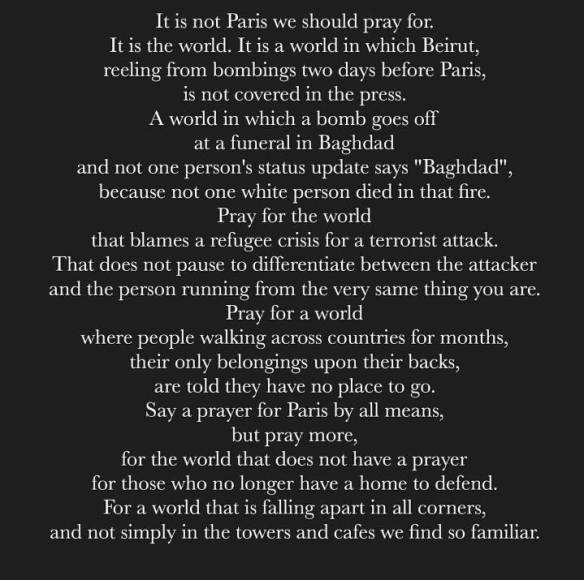
Prayer for the World

Growing Mob Mentality

Click “If Unchecked, The Growing Mob Mentality in the United States Will Lead to Our Self-Destruction” to read Mark Karlin’s piece today on  Moyers & Company.

Two Universities: Liberty and Paris

When the president of “the largest Christian university in the world” in Lynchburg, Virginia urges every student to buy a gun and get a permit to carry a concealed weapon, for whatever reasons, it seems a little oxymoronic and moronic. It’s neither Christian nor smart. It’s not what people do in college. They buy books, not guns. It’s not consistent with the traditions and standards of higher learning. Real universities don’t talk like that.

At one of the world’s first universities, the University of Paris (the Sorbonne), way back in the 13th century, a young Thomas Aquinas was a student of philosophy and Christian theology. His professors introduced him to great critical thinkers like Aristotle, Plato, and Maimonides in their original Greek and Latin languages.

Lynchville, Virginia in the 21st Century is long way from Paris in the 13th Century, and that’s too bad for all of us in America where what Aquinas later called “willful ignorance” has become the order of the day.

 It is clear that not every kind of ignorance is the cause of a sin, but that alone which removes the knowledge which would prevent the sinful act. …This may happen on the part of the ignorance itself, because, to wit, this ignorance is voluntary. …  For such like negligence renders the ignorance itself voluntary and sinful, provided it be about matters one is *bound and able to know.” [Thomas Aquinas, Summa Theologica, I-II, q. 76, a. 1, a. 3.]

Today’s Catholic World, an online encyclopedia, adds these footnotes to Aquinas’s text:

*Catholics are bound (required) to learn and know their Faith. A sin against faith (often caused by willful ignorance) is the gravest of all sins according to St. Thomas Aquinas.

St. Augustine, cited by St. Thomas, characterizes sin against faith in these words: Hoc est peccatum quo tenentur cuncta peccata. “This is the sin which comprehends all other sins.”

Liberty University is not a Catholic university. It’s not big on Catholics. It’s fundamentalist protestant.  It prides itself on its knowledge of the Bible.

But don’t we have to suppose that somewhere in that auditorium in Lynchburg, there was a professor who cringed? Someone there who resonated with the old student at the University of Paris? Someone who thought that telling young professing Christians to arm themselves was a deliberate act of willful ignorance, a sin against faith, the sin that comprehends all others?

“Put away your sword. Those who live by the sword will perish by the sword” – Jesus of Nazareth to Peter after Peter had cult off the High Priest’s servant’s ear at Jesus’s arrest, 1st Century, according to The Gospel of Matthew 26:52.

Gordon C. Stewart, public theologian, author of Be Still! Departure from Collective Madness (2017 Wipf and Stock) host of Views from the Edge. Brooklyn Park, MN. Originally published 2015.  Re-posted here June 13, 2022.

A Presbyterian Call to Welcome Refugees

“Our Call to Support Refugees from Syria and the World”

NOTE: Views from the Edge has added colored highlights to the text.

Presbyterian Church (U.S.A.) congregations have supported refugee resettlement since the refugee crisis created by World War II. The 160th General Assembly (1948) of the Presbyterian Church in the United States of America stated, “The United States should pass legislation to bring in at least four hundred thousand displaced persons during the next four years. … As they arrive, our church people should stand ready to open their homes and provide work for these unfortunate victims of war” (Minutes, PCUSA, 1948, Part I, p. 204). The people from the pews who approved that policy did so because they knew that scripture calls us to shelter the homeless (Isaiah 58:6–12) and welcome the stranger (Matthew 25:31–46).

The call is no less necessary today. Nearly 60 million people are displaced by war and persecution; 30 million of those displaced are children (UNHCR).  The crisis in Syria alone has displaced 11 million (UNHCR). Families are risking their lives and fleeing their homes to seek safety. They are spending months journeying, sleeping outside, paying smugglers for safe passage, and praying for a future for their families in a place that is safe from conflict.

They fear and flee many of the organizations that we also fear: ISIS, Boko Haram, Mara 18, Los Zetas. Right now governors are attempting to block the resettlement of Syrian refugees into their states because members of ISIS are sometimes Syrian. Ask yourself, should a victim’s shared nationality with perpetrators of violence exclude them from protection in this country?

Entering the U.S. as a refugee is not a quick or easy process. Refugees are the single-most scrutinized migrant group to enter the U.S. They undergo rigorous screening by multiple security agencies at multiple times during their pre-arrival processing (U.S. Committee for Refugees and Immigrants). This process can take more than two years. Once they arrive in the United States, they continue to be screened every time they leave and reenter the country and when they apply for employment cards, green cards, or naturalization.

The risk is low and the humanitarian need is great. While, technically, governors cannot dictate where the federal government resettles refugees, the State Department only resettles refugees in areas where they know communities will thrive (USA Today). Governors are saying for their states, “No room at this inn.” Now is the time for the faith community to speak up on behalf of refugees, from all countries. Do not let the noise of a fearful few drown out compassion, facts, and logic. Answer the call to act prayerfully and recommit as an individual, congregation, or mid council through co-sponsorship, volunteer hours, and donations through your local resettlement agencies. Then send or personally deliver a letter, like the one at pcusa.org/immigration, to your governor about the kind of society we should be. If you personally deliver your letter, please take photos and post on Facebook and Twitter using the hashtags #ChooseWelcome and #RefugeesWelcome. …. Thank you!


  • Gordon C. Stewart, Chaska, MN, Nov. 29, 2015.

Sermon: Testify to the Truth

Yesterday’s Christ the King Sunday sermon by Rev. Anne Miner-Pearson on John 18:33-37 at Trinity Episcopal Church in Excelsior deserves a greater audience. We’re pleased to publish it on Views from the Edge.

“Testify to the Truth”

Pontius Pilate with his Prisoner - Antonio Ciseri

Ecce homo – “Here is the man”

Pilate and Jesus are an odd couple. We usually meet them in Holy Week when their conversation is part of Jesus’ journey to his crucifixion. Because Good Friday and the cross are looming closer and larger, we pause only briefly in Pilate’s headquarters. But today is Christ the King Sunday and we encounter this odd couple under different circumstances. We are on the cusp of the Church year – the end of 52 Sundays facing into Sunday, Advent I, awaiting God’s move to enter human flesh as Jesus, beginning his life in birth like us, and ending his life in death like us.

Yet, before our church year begins, tradition asks us to pause and hold on to the bigger story of Jesus. There is a larger and more eternal back-story to the one that opens with shepherds, a star, some straw in a manger and even Mary. There is another birth story in John’s gospel and we enter toward the end as Pilate and Jesus talk. What an unlikely conversation it is. Pilate, Pontius Pilate, the 5th prefect of the Roman province of Judaea calls – no, “summons” – an accused religious heretic to his headquarters. Pilate has already questioned the Jewish leaders and could be done with the matter. Undoubtedly, he has more important issues awaiting his attention than dealing with the process leading to a crucifixion. They happen all the time and aren’t on his radar.

So, they are an odd couple. A man with impeccable Roman familial and political credentials, Pilate stands in expensive robes, perfumed and fresh from his morning bath. Jesus’ home address is Nazareth. His profession listed as carpenter. His clothing hardly deserve the name – practically rags after the torture and stripping, smelly from sweat and blood. But Jesus is no country bumpkin. He knows at least 4 languages – Aramaic, Hebrew, Greek and the Latin he uses with Pilate. However, Jesus’ linguistic skills don’t make him a king. Yet, that is the direction the conversation goes.

“Are you the king of the Jews?”, Pilate begins, a question Jesus later returns to. “My kingdom is not from this world.”, Jesus answers. “So you are a king?”, Pilate inquires. With that question, Pilate introduces what makes him and Jesus the oddest pair. They are both “kings”, but the descriptions are polar opposites: Power-Love, Higher-Lower, Divided-One, Hold on-Give away, Boundaried-Open, Petty-Generous, Unjust-Just, Manipulating- Embracing, Triumphant-Humble.

Yet, Jesus, without actually answering, takes the title of “king” in a whole different direction. “For this I was born, and for this I came into the world, to testify to the truth.” Here Jesus tells his own “nativity” story, but remember, this is John’s gospel. To understand what Jesus is saying to Pilate as his earthly life is about to end, we have to go back to the beginning, way back to the beginning to understand Jesus’ kind of king.

“In the beginning was the Word and the Word was with God, and the Word was God. He was in the beginning with God. All things came into being through him, and without him, not one thing came into being. What has come into being in him was life, and the life was the light of all people….. And the Word became flesh and lived among us…”

Jesus understands himself as king and where his kingdom is from radically different. Pilate doesn’t get it. The crowds don’t get it. Even Jesus’ close disciples haven’t gotten it yet. In that humble peasant, from the virgin womb of Mary, God entered the world, breaking through all categories, possibilities and imaginings. The Word of God who first spoke all creation and universes into being now has spoken again. A second holy Word took form but this time the birth came as God was and is willing to become empty. The apostle Paul captures it in the mystical hymn in Philippians: “…thought he was in the form of God, did not regard equality with God… but emptied himself, … being born in human likeness.” Jesus’ kingdom is not from this world, but in this world, grounded in and flowing from the eternal God, what we now call the Trinity: God, Creator, God, Christ, and God, Spirit.

It’s like when God birthed the created worlds, God already had another birth in mind. God’s Word would speak another creation. The Spirit Breath who give human life and form from the dust was not finished. The Trinity was not complete until the human experience could join in the circle, the abundant, ever-flowing Love. And now God’s experience in human form nears the end, the pain and suffering of crucifixion.

But, ponder this thought by a contemporary mystic, Bernadette Roberts. Maybe the hardest thing for Jesus was not the crucifixion, but the incarnation – to leave the circle and connection of Love to learn and teach how to hold on to and live in that flow of Love caught in bodily form. And we can picture that Circle, can’t we, the world of Christ the King, the kingdom Jesus is from. It’s the picture we see on the icon of the Trinity by Rublev.

Angels at Mamre Trinity, Rublev

Angels at Mamre Trinity, Rublev

We all know it – the beloved the one we take with us on vacation and hold up for photos on Facebook. I brought my personal one this morning and it’s on the altar. It was “written” in 2000, (the verb used when making an icon) by Eugenia. At that time, she was imprisoned in the largest women’s prison in Europe, outside of St Petersburg, Russia. Her crime was counterfeiting. However, Father Nicolai, pastor to the prison, thought her counterfeiting skills could be redeemed. Released under Father Nicolai’s watch, Eugenia was taught icon “writing” to help support her 3 daughters. Before she paints the copy of an icon, Eugenia goes through all the traditional rituals, including prayer and fasting.

Through the vision of a monk on Mount Athos, Greece, around 1260, and the hand and heart of an alcoholic felon, we see the “dance of the Trinity” – gathering in communion, gazing in a circle of love, pouring out within and beyond that Love to all creation. Given the three figures dominating the scene in their bright robes and adoring gazes, perhaps you have missed a small detail in the icon. I have. It was just pointed out to me recently. It’s under the table, a small brown box.

An ancient story about the the Rublev icon is that originally there was a mirror on top of the box. So, as one sits in front the icon and ponders the kingdom of God, the Trinity, one is able to see oneself as the fourth figure in the circle, at the table, in the flowing love always moving, expanding, tumbling out to all creation, in all time. From the beginning, God envisioned a fourth place in the Love.

Jesus said, “For this I was born, and for this I came into the world, to testify to the truth.” “Pilate asked him, ‘What is truth?'” Jesus spoke no answer that day. His life was and is the answer. The truth Jesus lived and died is that each of us, Eugenia, Pilate, all people have a place at God’s Table, in God’s heart, in Christ the King’s kingdom. Our response is to see ourselves in the mirror and claim our place. Amen.

Stephen Colbert’s test of Christian faith

Stephen Colbert offered the following statement on The Late Show after presidential candidates Ted Cruz and Jeb Bush spoke of admitting only Christian Syrian refugees to the U.S.:

“If you want to know if somebody’s a Christian just ask them to complete this sentence,” Colbert said pulling out his Catechism card. “‘Jesus said I was hungry and you gave me something to eat. I was thirsty and you gave me something to drink. I was a stranger and you….’

And if they don’t say ‘welcomed me in’ then they are either a terrorist or they’re running for president.”

Click HERE to watch and listen to Colbert’s remarks on Syrian refugees, Ted Cruz and Jeb Bush.

You gotta love Stephen Colbert, the good Catholic boy who remembers his Catechism and takes it dead seriously.

  • Gordon C. Stewart, Chaska, MN, Nov. 21, 2015

“Fear is the ammunition of terror”

On November 17, the  Office of the General Assembly of the Presbyterian Church (USA) issued the following letter from its top official following terrorist attacks in Paris, Beirut, Baghdad, and Egypt:

“We are a world grieving. We mourn the many deaths, not only in Paris, but also in Beirut, Baghdad, and Egypt. Any sense of security we have had is badly compromised by these horrific events; moreover, our fear of ISIS grows with every successful execution of its violent agenda.

“Much has been taken from us but we still hold the choice as to how we react in our grief and fear. Many politicians have rushed from grief to fearful judgment. More than half of the governors of our states have attempted to protect their citizens by issuing declarations denying entry of Syrian refugees into their states (as if all of the potential terrorists are Syrian). Some have gone so far as to call for denial of entry to all refugees at the present time, as if that will guarantee safety to the citizens of their state.

“As U.S. governors pledge to refuse Syrian refugees within their states and some presidential hopefuls promise to abandon the refugee program altogether, we the people have a choice to make. We can choose to follow those who would have us hide in fear or we can choose hope.

“Our nation, for decades, has chosen hope and welcome for those fleeing war and persecution. Since 1975, more than three million refugees have found safety and security within our nation’s borders. Right now 11 million Syrians cannot go to school, tend to their land, or raise their children in the place they know as home. They cannot do these things because they, themselves, have been terrorized for far too long by numerous factions, including their own government.

“Do we choose to abandon our plan to protect these Syrians because the people who have been threatening them are now threatening the West as well? ISIS has taken lives; they have taken our sense of security. Do we now hand over our hope and compassion to them?

“Obviously, we need to move forward with a disciplined response, expediting security checks such as those employed by the U.S. refugee admission program. To refuse certain persons who are fleeing terror and persecution because they are “Syrian” or of some other particular ethnic group is unjust and may be illegal under U.S. law. We can be disciplined and, at the same time, led to love beyond our own limited, fearful vision.

“After the crucifixion of Jesus, the disciples hid in fear. They locked the doors but God had another plan. Jesus appeared to them and said, “Peace be with you. As the Father has sent me, so I send you” (Jn. 20:21). We were not meant to hide. We were meant to walk out in hope and compassion. Author, poet, and peace activist Wendell Berry wrote, “Healing is impossible in loneliness; it is the opposite of loneliness. Conviviality is healing. To be healed we must come with all the other creatures to the feast of Creation” (The Art of the Commonplace: The Agrarian Essays, “The Body and the Earth,” p. 99). The way to end terror is to prove that those who demonize us are wrong. We are not a heartless secular culture. We must witness to the Gospel with generous hospitality. To hide in fear is a mistake. Fear is the ammunition of terror. Hope is the best defense.

Gradye Parsons, Stated Clerk

Office of the General Assembly, Presbyterian Church (USA)

Louisville, KY

  • Gordon C. Stewart, Chaska, MN, Nov. 21, 2015.