Christ the King

Poet Malcolm Guite’s poetry holds the essential paradox of the Christian faith and life. Open the re-blogged piece to read and listen to his poem for the last Sunday of the Christian liturgical year, Christ the King Sunday.

malcolmguite's avatarMalcolm Guite

20111119-111210We come now to a feast of Ends and Beginnings! This Sunday is the last Sunday in the cycle of the Christian year, which ends with the feast of Christ the King, and next Sunday we begin our journey through time to eternity once more, with the first Sunday of Advent. We might expect the Feast of Christ the King to end the year with climactic images of Christ enthroned in Glory, seated high above all rule and authority, one before whom every knee shall bow, and of course those are powerful and important images, images of our humanity brought by him to the throne of the Heavens. But alongside such images we must also set the passage in Matthew (25:31-46) in which Christ reveals that even as He is enthroned in Glory, the King who comes to judge at the end of the ages, he is also the hidden King…

View original post 215 more words

Thanksgiving for The Boston Declaration

This Thanksgiving I’m thankful for The Boston Declarationissued several days ago by 300+ Christian theologians on the state of Christianity in the United States in 2017 and a call for repentance by evangelical Christians.

Susan Thistlethwaite’s Huffington Post article gives the background and more detail on The Boston Declaration. Click Original Signatories for a listing of the original signers of the Declaration.

Boston Declaration original signatories.

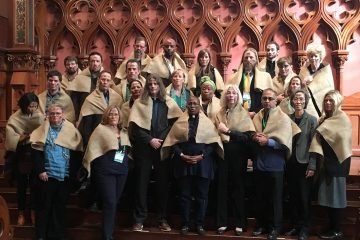
I’m thankful for Rev. Dr. Reggie Williams, Associate Professor of Ethics at my alma mater, McCormick Theological Seminary, and author of Bonhoeffer’s Black Jesus: Harlem Renaissance Theology and an Ethic of Resistance, one of the original signers. Reggie is the tall one in the center of the photo.

Rev. Dr. Reggie Williams, professor of ethics at McCormick Theological Seminary, talked of the heavy hearts carried by himself and other African-Americans in this current moment. “These are sinister times, but they are not new. As a black person educated in Evangelical Christian institutions, I am familiar with a Christianity that has a history of ignoring my being, and providing theological justification for my non-being.”

But, he emphasized, what is “new in my lifetime to have such an over embrace of it.” How can people say it is Christianity “to proclaim good news to the rich or push the differently embodied person to the margins? Now is the time to follow Jesus the poor Jewish prophet whose teaching of the Kingdom was the inspiration for the Boston Declaration.” – Susan Thistlethwaite, Huffington Post.

The Trump Administration’s 18-month deadline for 60,000 Haitian refugees to leave the U.S. strikes me as the latest confirmation of white supremacy as the nation’s “original sin.” The order makes no sense apart from shoring up a base that sees white supremacy in peril. What’s happening in America today is only secondarily ‘political’. The primary  issue is theological and ethical — how we understand ultimate reality (God) and ourselves. It is what the Boston Declaration says it is.

Grace and Peace to all on this Thanksgiving holiday.

  • Gordon C. Stewart, Chaska, MN, November 23, 2017.


Taking Heart in Heartless Times

1Nessan

Rev. Dr. Craig L. Nessen

by Craig L. Nessan

Wartburg Theological Seminary

Dubuque, Iowa

“I have said this to you, so that in me you may have peace. In the world you face persecution. But take heart; I have conquered the world!” John 16:33

We live in unprecedented times. Polarizing discourse, red versus blue, the failure of public reasoning, name calling, and denial of facts are the order of the day. The post-modern yields to the post-truth era. Some political leaders simply make it up as they go along.

There is a public heartlessness evident about the needs of others, especially the most vulnerable, that concludes with repeated assertions of privileged self-interest. Public discourse is diverted daily from focusing on the needs of those in harm’s way, including the well-being of creation. In the church many contend that it is useless even to try and engage in civil conversation about what makes for the common good.

All this unfolds in a world of enormous and increasing disparity in wealth between an economic elite and those struggling to make ends meet. This economic disparity is visible everywhere, in every state and local community. Moreover, it is the secret in plain sight behind the movement of people across borders, the unprecedented numbers of displaced persons and refugees.

The need for political advocacy is urgent. Yet it is extremely hard to know where to begin. There appear a dozen new issues or tweets each day against which to react. It becomes crucial to search out reliable information, as from church based advocacy organizations, to help us discern wisely in this political moment. In my own analysis I seek to distinguish between what might be considered the “substantive agenda” of the current administration, which primarily has to do with executive orders and legislative initiatives intended to increase private profit for a few, and the symbolic agenda, especially designed to daze, distract, and confuse us.

To make this distinction is not, however, to minimize the harmful effects of the symbolic agenda, grounded in a white male identity politics that operates in binary categories to incite fear, anger, and hatred against all categories of difference, whether based on race, gender, sexual orientation, immigration status, or religion, especially against Muslims. By contrast to this white male identity politics, we seek to articulate and enact a neighbor politics, embracing of all, especially the marginalized.

In these heartless times we are called actively to participate in spiritual disciplines, in order to reduce our reactivity and seek to remain oriented to the mind and character of Jesus Christ. How does one remain centered and grounded in these heartless times? How does one remain rooted in the peace of Jesus Christ, taking heart and courage amid the whirlwind?

The mystical and political always belong together. Consider the witness of Mahatma Gandhi and Dietrich Bonhoeffer, Dorothy Day and Thomas Merton, Rosa Parks and Martin Luther King, Jr., Gustavo Gutiérrez and Elsa Tamez, Walter Brueggemann and Elizabeth Johnson. As with Jesus, prayer and praxis belong together. Retreat for prayer leads to prophetic engagement: acts of healing, feeding, exorcizing, welcoming, sharing, and publicly demonstrating. The rhythm of the Christian life is both inward and outward.

“Radix,” the origin of “radical” means going to the root of the matter in a twofold movement—the mystical as inward movement and the political as outward movement. Both movements are needful. Counter-intuitively, a heartless political climate makes the inward mystical movement even more needful.

The Mystical

How do we move ever more deeply into relationship with God?

Spiritual practices draw us into the depths of classical disciplines. Personal practices include prayer, meditation, walking, breathing. Communal practices encompass worship, study, dwelling in the Word. Practices that involve colleagues lend us encouragement and accountability in life-giving relationships

Spiritual practices and worship contribute to a mysticism of the ordinary, by which we detect the holy in what is right in front of us, even in what may appear chaotic in these heartless times. We need to attune the eyes to see and the ears to hear.

Hearing the Word of Christ in Scripture stories and participating in sacraments at worship provide the lens for recognizing divine presence in the everyday. Liturgy entails formation in life practices: truth telling, peacemaking, listening, confessing, interceding, offering thanks, welcoming, feeding, and blessing. At worship we participate in the divine economy where all are welcome and there is enough for all. All of this provides the means for us to perceive the shalom of God in the commonplace, even in heartless times like these.

The Political

The mystical movement toward God always turns us inexorably toward political movement for the sake of our neighbors. In the Great Commandment the vertical and horizontal dimensions are inextricable. Should we persist in efforts to provoke change from above? Yes, advocacy at the national and state levels remains essential. Following the guidance of trusted organizations—denominational advocacy organizations, Fellowship of Reconciliation, Bread for the World, 350.org, Amnesty International, and many others—remains imperative.

Even more in heartless times, however, we need to redouble efforts at change through organizing at the grassroots in local communities. Not only by making financial donations or sending advocacy letters, this means engaging people in one’s community. For all their limitations, congregations remain the most intact neighbor-directed communities on the local level, faith communities such as already exist in every locale across the country. We need to become very intentional and proactive in building coalitions with others in local communities—through one on one conversations, writing personal viewpoints for social media or in newspapers, and engaging in symbolic actions. When asked by a reporter whether he really thought that he could change the world by lighting a candle in a demonstration, A.J. Muste replied: “Oh, you’ve got it all wrong. I’m not doing this to change the country. I do it so the country won’t change me.”

The theory and practices of active nonviolent resistance are still in their infancy in human history, but these offer our best hope for lasting change in establishing the foundations for democracy and building up an equitable civil society. In this regard the research of Erica Chenowith and Maria Stephan published in their book, Why Civil Resistance Works: The Strategic Logic of Nonviolent Conflict, needs to become widely known.

I encourage us not to underestimate the ripples of difference our efforts can make, as we remain spiritually centered and especially as we join together in ecumenical and interfaith groups, as well as with all those ethically engaged but not religiously affiliated people who are committed to common good, reaching out to one neighbor at a time. We are called to create safe places and spaces of trust where people can be together, listen to each other, and learn from one other.

Taking Heart

While through the mystical movement we put on the mind and character of Christ—which is peacemaking, social justice, eco-justice, and respect for the inalienable dignity of each person—in the political movement we engage through reasoned and persuasive arguments that are not overburdened by religious jargon. In our public articulation we remain deeply grounded in faith, as strategically we may choose to express our political convictions in categories not freighted with explicit religious references. We do so to communicate effectively in the public square and to transcend the off-putting rhetoric of the religious right.

There are times and occasions for making explicit theological claims, as did Dr. King. Yet in this heartless time of excessively hyperbolic discourse, including that by religious people, we are called to communicate clearly through reasoned, publicly accessible language. In this polarized climate, where Christians are assumed to take regressive political stances, it is of even more value for Christians to make compelling arguments that are understandable to those who may not share our theological categories. This helps us move beyond the religious identity politics of the religious right to an expansive neighbor politics. This honors too what Bonhoeffer meant by the nonreligious interpretation of biblical concepts.

Finally, we are on this journey for life. We may not now see many signs of effectiveness, yet we take heart in even small signs of the kingdom’s appearance. As our bottom line we seek to live by integrity, searching to align our lives with the things of God in Christ, especially in times like these when we cannot see that it makes a difference. We trust that the things that make for peace, like generosity, a healthy creation, and human respect, are the things that last forever. In the words of Carrie Newcomer, in the end, only kindness matters.

 “And let us consider how to provoke one another to love and good deeds, not neglecting to meet together, as is the habit of some, but encouraging one another, and all the more as you see the Day approaching.”  Hebrews 10:24-25

  • Rev. Dr. Craig L. Nessan is Academic Dean & Professor of Contextual Theology and Ethics, The William D. Streng Professor for the Education and Renewal of the Church at Wartburg Theological Seminary in Dubuque, Iowa. Views from the Edge is pleased to have the honor of being the first to publish “Taking Heart in Heartless Times” with the author’s permission.

 

Geoengineering and the Climate Crisis

Rex Tillerson clearly stated his views of climate change during remarks in 2012 at an event sponsored by the Council on Foreign Relations.

“And as human beings as a — as a — as a species, that’s why we’re all still here. We have spent our entire existence adapting, OK? So we will adapt to this. Changes to weather patterns that move crop production areas around — we’ll adapt to that. It’s an engineering problem, and it has engineering solutions. And so I don’t — the fear factor that people want to throw out there to say we just have to stop this, I do not accept.” 

earthwrenchGeoengineering now seems to have become the de facto climate policy of the Trump White House and the GOP as they, on the one hand, deny the apparent fact of climate change, and on the other hand, prepare to fight it by employing poorly tested technology with unknown long term effects! 

In Conservative circles, seductive but superficial reasoning exists for Geoengineering being so popular.  One is that on a large scale, it can make several corporations and individuals very rich.  Another is that the effects of carbon based fuels can be downplayed by government and industry now.  After all, any atmospheric heating caused by burning fossil fuels and a buildup of carbon dioxide can be minimized by employing geoengineering technologies.  In short, the current state of Conservative thinking, Jobs, Jobs, Jobs translates into Burn, Burn, Burn.

Globally, the atmospheric carbon dioxide level reached 403 ppm this year (it held between 180 ppm and 290 ppm for the previous 800,000 years).  Even so, fossil fuels still reign supreme as the power source of world economies.  With no end in sight for the abatement of atmospheric carbon dioxide levels or the employment of alternative/renewable power sources, carbon dioxide levels will continue to rise.  Planet cooling by geoengineering will just mask the warming effects of elevated carbon dioxide levels.  At some point, as yet undetermined, Earth will depend upon geoengineering to remain within livable limits.  It is apparent that once we are hooked on geoengineering in a world with high atmospheric carbon dioxide levels, any cessation of geoengineering efforts will be accompanied by rapid and severe global climate changes to unacceptable levels.

Obviously, clear thinking is in short supply.  At best, geoengineering is the environmental equivalent of the opioid crisis and at its worst it is applied asininity, if not a downright “Faustian Bargain” of epic proportions.

If you want deeper insight into geoengineering and the climate emergency, please read the following:

https://cleantechnica.com/2017/11/09/new-computer-modeling-helps-scientist-analyze-effects-geoengineering

http://www.mcclatchydc.com/news/nation-world/national/article183547911.html

http://www.npr.org/sections/thetwo-way/2017/11/02/561608576/massive-government-report-says-climate-is-warming-and-humans-are-the-cause

https://www.usatoday.com/story/news/politics/2017/11/08/pruitt-says-alarming-climate-report-not-deter-replacement-clean-power-plan/839857001

https://www.theguardian.com/environment/2017/nov/06/how-indias-battle-with-climate-change-could-determine-all-of-our-fates

https://www.theguardian.com/environment/2017/nov/08/seven-megatrends-that-could-beat-global-warming-climate-change

https://qz.com/index/1116160/for-800000-years-carbon-dioxide-levels-moved-between-180-ppm-and-290-ppm-last-year-they-got-to-403-ppm/

DOOM DESTRUCTION AND THE DNC. AGAIN! – BY TOM CURLEY

Like Tom Curley of SERENDIPITY, I get apocalyptic, or hyped, emails every day that assume I’m a member of a certain club.

tomcurley1's avatarSerendipity - Seeking Intelligent Life on Earth

I wrote this on election day 2017. It reminded me of a post I wrote a while back that sadly is still as current as it was back then. And it will be current next year too. And the year after that.

I don’t know about anybody else but I usually spend about five minutes every day deleting the junk email from my account.

I’ve had an AOL account from literally when they first started. I briefly worked for them and got the account for free. Yes you had to pay for an email account back in those dark early days.

I have other email accounts, but I like this one. I’ve had it for over 20 years. I know that if you have an AOL email account millennials think it’s funny and it means you’re old.  And do you know what I say to that? Fuck you, you little…

View original post 249 more words

Stepping Up: Running for Congress

Moments ago Tabitha Isner, a highly respected friend and ministerial colleague, sent an email announcing she’s running for Congress.

You can meet Tabitha and learn why she’s running on her campaign website Tabitha Isner for Congress, on FaceBook, or that thing that issues early morning messages that make us groan: Twitter.

Tabitha is the only Tabitha I’ve ever met in person. I do remember another Tabitha whose Bewitched TV  sit-com daughter Samantha could change the world with the twitch of her nose. Tabitha is no Samantha! knows it will take more than the twitch of a nose to make democracy work in America.

Thank you, Tabitha, for stepping up and stepping out.

  • Gordon C. Stewart, Chaska, MN


H.L. Mencken — American prophet

H.L. Mencken wrote it in The Baltimore Evening Sun, Sunday, July 26, 1920:
“As democracy is perfected, the office of the President represents, more and more closely, the inner soul of the people. On some great and glorious day, the plain folks of the land will reach their heart’s desire at last and the White House will be occupied by a downright fool and complete narcissistic moron.”
23353-004-D77B30AD Mencken

Henry Louis Mencken @The Baltimore Evening Sun

Mencken was known as “the Sage of Baltimore.” These days, I listen to Bill Moyers, Christopher Hedges, and watch the PBS News Hour Friday nights with Mark Shields and David Brooks.
David Brooks’ “The Week Trump Won” (Oct. 26 NYT) confirms — in chilling detail  — H.L. Mencken’s status as a prophet. Yet it ends with the faint hope that the better angels of the American character still lie buried in the people’s DNA, waiting for a spokesperson, a leader, to give voice to sanity and vision.
– Gordon C. Stewart, Chaska, MN, Oct. 28, 2017.

“A Soulless Coward”

The President’s lies about former presidents Obama and Bush in reaction to criticism that he had not made presidential calls to the families of four soldiers killed in Niger struck me as just one more example of his unfitness for office.

Then The Nation exclusive interview — “‘A Soulless Coward’: Coach Gregg Popovich Responds to Trump” — popped into my inbox. “[T]o lie about how previous presidents responded to the deaths of soldiers—is as low as it gets. We have a pathological liar in the White House.”

Gregg Popovich, the United States Air Force Academy alumnus and head coach of the San Antonio Spurs, is affectionately called “Pop” but one has to wonder how long the affection will last after calling the president a soulless coward.

The interviewer, Dave Zirin, The Nation‘s sports writer, concludes the article: “Should be one hell of an NBA season.”

  • Gordon C. Stewart, Chaska, MN, October 17, 2017.


Between Here and There

A CNN report caught my attention this morning. Anticipating today’s Congressional vote on the president’s $36.5 billion disaster relief aid package, Rep. Tom Cole, R-Oklahoma, said the following.

“People want to be helpful here. They’ve turned on the television. They know these are awfully genuine needs,” he said, arguing that Republicans simply want to fund the measure in a “prudent” way.

Early this morning the president took to twitter with a series of tweets about Puerto Rico.

“Puerto Rico survived the Hurricanes, now a financial crisis looms largely of their own making.” says Sharyl Attkisson. A total lack of…..

..accountability say the Governor. Electric and all infrastructure was disaster before hurricanes. Congress to decide how much to spend….

We cannot keep FEMA, the Military & the First Responders, who have been amazing (under the most difficult circumstances) in P.R. forever!

Rep. Cole spoke truth that “people want to be helpful here. They’ve turned on the television. We  “know these are awfully genuine needs….” But the “here” is a question. Where is “here“? Is “here” Houston, northern California, Puerto Rico? All of them? Or only some of them?

Or is “here” Congress and the Oval Office, the seats of authority and power in a constitutional republic — the branches of government where the television-watching American public hopes against hope that those we elect to represent us get their information from something other than their televisions.

The Commonwealth of Puerto Rico, unlike Houston and the wine country of northern California, is poor. Its history is that of a pawn in the chess game of powerful nations.

The Smithsonian website article “Puerto Rico — History and Heritage” — offers a brief history of Puerto Rico.

Puerto Rico remained an overseas province of Spain until the Spanish-American war, when U.S. forces invaded the island with a landing at Guánica. Under the Treaty of Paris of 1898, Spain ceded Puerto Rico (along with Cuba, the Philippines and Guam) to the U.S.

As a result, the turn of the century saw Puerto Rico under United States sovereignty. At that time, Puerto Rico’s economy relied on its sugar crop, but by the middle of the century, an ambitious industrialization effort, called Operation Bootstrap, was underway. Cheap labor and attractive tax laws attracted American companies, and soon the Puerto Rican economy was firmly grounded in manufacturing and tourism. Today, Puerto Rico is a leading tourist destination and manufacturing center; the island produces high-tech equipment and many top-selling American pharmaceuticals.

Puerto Ricans received U.S. citizenship in 1917 and Puerto Rico officially became a U.S. Commonwealth in 1952. The issue of political status is one under constant debate, with some in favor statehood, others independence, and still others the continuation of commonwealth status.

During World War II, the U.S. Navy purchased two thirds of the island to use as a naval base. The Navy used the area for military exercises and bombing practice for nearly 60 years until a civilian was killed during a bombing exercise in the 1990s. This sparked a wave of protests that finally ended when the base closed in 2003. Since then, the Navy’s lands have become wildlife reserves.

Today Congress faces a moral issue that begins with the question of where “here” is and with a couple of early morning tweets that divide the world between here and there, and want to leave “there” behind, ignoring the wisdom of The Letter of James:

If anyone thinks he is religious and does not bridle his tongue but deceives his heart, this person’s religion is worthless. Religion that is pure and undefiled before God the Father is this: to visit orphans and widows in their affliction, and to keep oneself unstained from the world” [i.e., the world divided by here and there; us and them; rich and poor]. – James 1:26-27.

  • Gordon C. Stewart, Chaska, MN, October 12, 2017.


The beginning of an uprising

“To clasp the hands in prayer is the beginning of an uprising against the disorder of the world.”

Question: Who said that?

Wait! Wait! Don’t tell me! Choose one (click the names for more information):


Or . . . someone else?

Answer: We know it’s not Bill Maher, though Bill does call for an uprising, but the uprising would be against religion itself as the source of disorder, even though Bill often invites Cornel West to be his guest on Real Time with Bill Maher.

Cornel West clasps his hands in prayer and, like Bill, rises up to resist the present order/disorder, but it’s not Cornel.

So maybe it’s Karl Barth. The statement often is attributed to Barth, the Swiss theologian who resisted Hitler and the Third Reich in the name of Christ. But a more-or-less careful internet search yields no confirmation of its source.

Because no one really seems to know for sure, perhaps the correct answer is someone else from an altogether unexpected different source.

Like someone’s twitter account.

  • Gordon C. Stewart, Chaska, MN, October 9, 2017.