Saturday “Views from the Edge” re-posted David’s piece on the Bishop with dreadlocks, originally posted on “In the Company of Hysterical Women.”
Today’s piece offers an interesting personal reflection by someone who left the church in disgust because it had become insular and irrelevant to the larger world, returned to it because of marriage, and now rejoices that the walls may be tumbling down.
Oakritchie left a comment on the earlier posting of the Bishop with dreadlocks that merits a thoughtful response. I’m still working on it. Perhaps David, too, will choose to weigh in on Oakritchie’s observation about “us” and “them”.
Thank you, David, Oakritchie, and all of you who have so thoughtfully engaged the conversation.
Steve’s walk down memory lane arrived as I prepare to moderate a public meeting tomorrow night (Tuesday, May 1) that could repeat the history of religious arrogance. Pro and con positions will be offered on the proposed “marriage amendment” to the MN State Constitution that would define marriage as between one man and one woman. Lord, help the moderator…and the speakers…and all who attend to speak boldly and clearly, but also with some meekness. This is not a laughing matter.
This post is by historian and friend Gary Severson. I asked him to put his reflection in writing not because it says someting nice about you-know-who, but because I thought it should reach a larger audience. Views from the Edge added the photos of Atlas holding up the world to supplement Gary’s commentary.
Rockefeller Center Plaza with sculpture of Atlas
“When in NYC this past week I made my way to Rockefeller Center just to see a part of the city I had never seen. As it turns out my NYC experience in Rockefeller Center related to Gordon’s sermon this morning, “The Estate Sale & 1000 years”. His sermon related to the impermanence of many things in our society including its architecture. Gordon was surprised to see the estate sale he attended taking place at an “art deco’ style house that was totally out-of-place in a neighborhood of Tudor houses. This is a style that has disappeared compared to more traditional styles.
“As I arrived in Rockefeller Center Plaza I was taken by the immense architecture of places like NBC, News Corp., Time Life, Citibank etc. The tremendous sense of the power represented by these buildings was overwhelming in the sense that they represent a huge influence in terms of their ability to generate propaganda about America.”These buildings are generally of a sterile style described as spires of steel & glass. I stopped to talk to a security guard and by his demeanor it was clear he even took on the arrogance these buildings exuded. I walked into another RC building where I saw a $137,000 necklace in a window display & saw the clerk inside & thought that isn’t a place I would be welcome in either. As I turned around I noticed a sign that said “Onassis Museum”. I went in and could see it was free admission and contained 100 or so priceless sculptures, tiles, metal work etc. from Greece & Rome.
“As I listen to Gordon’s sermon I realize I’d been experiencing what he is describing in terms of permanence and impermanence. These skyscrapers in Rockefeller Center will be imploded while these ancient artworks represent eternal ideas right here in the midst of the impermanence of these modern buildings. In fact the exhibit in the Aristotle Onassis Museum was about the changes taking place in the artwork of the period in the transition from paganism to Christianity.
“When I left I saw across the street St. Patrick’s Cathedral, built during the Civil War. It rivals the cathedrals of Europe. It stands out in stark contrast to the surrounding modern glass structures with its spires pointing 300 ft. into the air. I went in and again saw the amazing sanctuary with its 250 ft. ceiling & spectacular stained glass windows.
Saint Patrick Cathedral
“Here we have a building that is already 160 yrs. old and will outlast the surrounding towers of crystalized guilt, a reference to the attempt by modern man to deny his mortality by replacing traditional religious worship with the worship of Earthly money and power. Today’s sermon was a wonderful example for me of the connections we can make between our seeming separate spiritual & everyday lives to create meanings that allow us to gain a deeper understanding of who we are.”
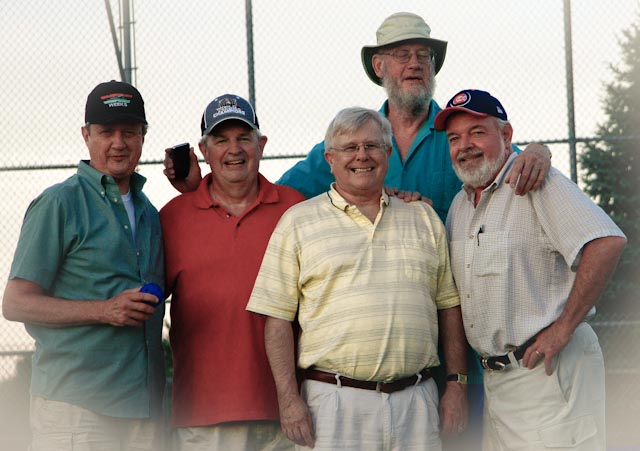
Picture of classmates - Harry Strong on the far right
Yesterday classmate Harry Strong,sent this by email in response to Steve and my reflection “Words from childhood” posted on Views from the Edge. I asked Harry for permission to publish part of his email here. Harry’s reflection ends with questions for your reflection.
– by Harry Lee Strong, San Juan Mountains, Colorado, sent April 28, 2012
While teaching adult classes at the Church of the Wildwood in Green Mountain Falls, I led a course called: “Could I Sing That Song and Mean It?” We sang and listened to a number of sacred and secular pieces on various topics. This was one of them.
“Child Again” (Beth Nielsen Chapman)
She’s wheeled into the hallway
Till the sun moves down the floor
Little squares of daylight
Like a hundred times before
She’s taken to the garden
For the later afternoon
Just before her dinner
They return her to her room
And inside her mind
She is running
She is running in the summer wind
Inside her mind
She is running in the summer wind
Like a child again
The family comes on Sunday
And they hover for a while
They fill her room with chatter
And they form a line of smiles
Children of her children
Bringing babies of their own
Sometimes she remembers
Then her mama calls her home … CHORUS
Playmate, come out and play with me
(It’s raining, it’s pouring, the old man is snoring)
And bring your dollies three
(Bumped his head on the edge of the bed)
Climb up my apple tree
(Never got up in the morning)
Slide down my rain barrel
(Rain, rain, go away)
Into my cellar door
(Come again another day)
And we’ll be jolly friends
(Little Johnny wants to play)
Forevermore
(Some more) … CHORUS
Do you have family members or friends who are suffering from Alzheimer’s or dementia?
What counsel, wisdom, or inspiration do you have to offer to caregivers and loved ones who are trying to be helpful companions to those whose mind is not what it used to be?
Profound and humorous personal story by Dennis Aubrey of Via Lucis.. “…And so I read these books in the library, but I carried them around the school halls in order that young women would be impressed.” Lessons from Bertrand Russell, Alfred North Whitehead, Das Capital, libraries, books, and the raging hormones of “the juvenile medieval monks who worked diligently in the scriptorium.”
“In the Company of Hysterical Women” sent this today – the appointment of a bishop with dreadlocks in New Zealand. Read the story and watch the video interview with the pastor whose ministry has stood with the homeless and marginalized people.
Personal reflection – a Visit with Red – written April 28, 2012
I walk through the door to his room…quietly. He is lying on his left side, his back to the door, his body turned toward the windows, in a fetal position.
His wife of 50 years had put him there. Couldn’t care for him anymore at home. That was a year ago.
Now he didn’t know her name or recognize her face.
The usual visits are the theater of the absurd. Becket’s’ Waiting for Godot. Blank stairs. Monologues. Boredom. Wondering why I go…except…he’s there. I could be too.
I tiptoe around the foot of the bed. I hear his voice. His eyes are closed. His lips are moving. “Now I lay me down to sleep, I pray the Lord my soul to keep. If I should die before I wake, I pray the Lord my soul to take” – the prayer he committed to memory as a child.
Slow - Children
He finishes and seems at peace. I pause…quietly speak his name…and place my hand gently on his shoulder. He opens his eyes.
“Good morning, Red. It’s Gordon.”
Blank stare.
“Your pastor…from Knox Church.”
His eyes grow wide. He smiles. He reaches out his hand…and looks me in the eye – a memory unlocked from deep within his soul…beyond the reach of Alzheimer’s.
“The Church Choir” – Steve Shoemaker, Urbana, IL, April 28, 2012
Words sung can be remembered long
after words said. A person with
Alzheimer’s still may sing a song
recalled from church or school. The myth
that music is a gift for few
blessed with a perfect pitch is just
malicious: any in a pew
who talk can sing! Of course, they must
speak S-L-O-W-L-Y and (the hardest thing
of all) must listen to others
around them–and follow the fingers
or baton of conductors
who beg and plead, talk loud or soft
to lure folks into the choir loft
All these years later…I wish I’d sung with Red that day. “Jesus loves me; this I know…” S-L0-W-L-Y… from the choir loft… in the nursing home.
Old family sawmill of Andrews Casket Company, Woodstock, Maine
My great-great-great-grandfather Isaac Andrews founded the Andrews Casket Company and Funeral Home next to the trout stream in Woodstock, Maine more than 250 years ago. Isaac was a minister.Because there was no carpenter in town, he not only stood at the graves. He built pine boxes for those he buried.
Over the course of time, the simple boxes became the caskets of the Andrews Casket Company and Funeral Home. You might say Isaac had a monopoly in those Maine woods.
Only recently did the Andrews property leave the family when Pete Andrews, my late mother’s favorite cousin, sold it to some whippersnapper who just wanted to make a buck.
My mother used to chuckle as she recalled playing hide-and-seek with her siblings in and among the caskets at the casket factory. The land, the mill, the old homestead,the funeral home and the trout stream that had belonged to the family all those years belongs to someone new…which means that it, like Garrison Keillor’s fictional “Lake Woebegone,” never really did belong to us and does not belong to them. It does not belong to time.
Last October my brother Bob and I stood with my cousins at the open grave of my 99 year-old Aunt Gertrude – our one remaining Andrews elders. I recited from The Book of Common Worship the prayer I have prayed a thousand times at the open grave, the one my classmate Steve and I learned as young, naive pastors, a prayer for the living that feeds me day and nigh until the lights go out. I wonder if Isaac Andrews did the same way back when.
“O Lord, support us all the day long until the shadows lengthen, and the evening comes, and the busy world is hushed, and the fever of life is over, and our work is done. Then, in your mercy, grant us a safe lodging and peace at the last.”
Book of Common Worship
Here’s the poem from Steve from a few days ago that inspired the above reflection.
When I was just a young and naive pastor, an old man in the congregation would always arrive long before the rest of the people at the grave site. He’d shun the funeral, but haunt the cemetery… Standing by the open grave, he’d state his opinion of the deceased and share with me the type, style and brand of casket he’d told his wife he wanted when he died. As the morticians say, he “predeceased” his spouse, and when we met to plan, she tried to grant his wishes to the very last She blessed their common gravestone with her tears, but smiled through life for many happy years.
“The Man Who Loved Graves” – Steve Shoemaker, April 24, 2012
Like the widow of the man who loved graves, I smile through tears for all the years, and I take ancestral solace in knowing that I don’t really “own” a thing.
Gordon C. Stewart, the not-so-great great-great-great grandson of Isaac Andrews
Sojourners today re-published “A Song for Each Kind of Day” on their blog – “God’s Politics: a blog with Jim Wallis and friends.” Click HERE to see it on their blog.
Yesterday they picked up “I Wish We Were All that Crazy.” Click HERE to see it.
Thank you, Sojourners – and thank you Steve Shoemaker for the heart of the piece.







 Views from the Edge