What is happening in Portland and American cities where Black Lives Matter continues to oppose the violence and lawlessness of those sworn to protect and serve. A search through previous Views from the Edge posts led back to August 22, 2014.
Click THIS LINK to read “Homeland Militarization — tanks in Ferguson, Blackhawks in Minneapolis — must be stopped” published by MinnPost.com. The conversation — 38 comments — was more telling than the piece. In 2017 the MinnPost commentary became the 30th of the 48 brief social commentaries of Be Still! Departure from Collective Madness(2017, Wipf and Stock).
Today’s NYT sounds an alarm with a picture from the June 6, 2020 cover of Der Spiegel (6.6.20) depicting Donald Trump with a match. What German readers see feels chillingly familiar. They still smell the smoke from 1933.
Thanks for coming by. Be careful out there. Wear a mask to stay safe, and tonight –while mourners pay their respects to John Lewis in sanctuary of the African-American Episcopal Church of Selma and prepare for his last trip across the Edmund Pettus Bridge — make some good trouble, the only kind that heals a broken world.
John Lewis never knew and had no reason to care that we held some things in common. We shared a point of view that comes from reading the Psalms (“The earth is the LORDS’s and the fullness thereof…”[Ps. 24:1]), and the Book of Micah (“What does the LORD require of you but to do justice, love mercy, and walk humbly with your God?” [Micah 6:8]), singing the same hymns in our Baptist and Presbyterian hymnals, and finishing theological educations at Fisk and McCormick.
John Lewis knew what a cracked head was
Yesterday’s Views from the Edge’s post pointed to what might be considered the centerpiece of John Lewis’s life — the conviction that “we all live in the same house.” John Lewis lived that conviction before and after the batons cracked his skull at Edmund Pettus Bridge.
John Lewis knew what a cracked skull was, and he knew that the Crackers’ skulls were cracked worse than his.
John Lewis and Kosuke Koyama
There is no evidence that John Lewis met Japanese theologian Kosuke Koyamaor read any of Koyama’s books on the anguished heart of God. But focusing on the Congressman’s witness in word and action brought the two of them together in my cracked head. I’m even more confident that John Lewis never knew of or read “The Economy: Only One House,” “Only One Sin: Exceptionalism” or “The World in an Oyster” in Be Still! Departure from Collective Madness, the collection of essays dedicated to Koyama. (Note: Click the above link to Amazon, click “Look Inside,” open the Table of Contents, and click the titles to glimpse the essays, or read “Just One Country” published May 2, 2012 by Views from the Edge.
A Poet’s bow to gentleness and strength — Peggy Shriver’s Haiku to Koyama
The haiku tribute to Koyama by his friend and faculty colleague at Union Theological Seminary in the City of New York featured on Be Still!‘s dedication page, expressed how I felt after Ko’s death in 2009. Today the last stanza of Peggy’s haiku puts words to what I feel about John Lewis.
Gentle and strong, as trees Bend gacefully in wind, You stand — and I bow.
As a child you may have scanned the shoreline for just the right flat rock to skip. When you were lucky, the stone you picked skimmed the the water, skipping five, six, seven or —if you had thrown it side-arm like the ageless Satchel Paige — eleven or twelve times, or more. Some day you might make it to the Bigs!
You lost all sense of time. It was you, the water, and the latest stone you had freed from among the millions of unremarkable rocks and pebbles on the shoreline. The stone couldn’t be too big or too small. It couldn’t be too heavy or too light. It couldn’t be round, rough, or jagged.. It had to be flat to skim across the water, or it would sink like a stone and disappear. Or cause a loud splash that only losers make.
Last Friday, in the darkness, a little boy picked a jaggest stone, hoping against reason, that, if he commuted its sentence as worthy of skipping its sentence, it would draw little attention. The boy leaped for joy until the splash was heard around the shoreline. The Stone did not skip or sink. It floats like styrofoam. The boy insists the Stone was flat and worth the skip. The ripples from the splash grow wider by the hour.
Three days later: Washington, D.C.
A federal judge on Monday demanded more information about the boy’s selection of the stone for special treatment.
Later in the day, the boy told reporters that he was getting “rave reviews” for picking Stone and restated his position that the Russia investigation “should have never taken place.”
Who we shall become is as cloudy as who we have been. Whatever pasts and futures we Americans imagine differently, we know we are in the midst of a national and global crisis. Whether or not we wear a mask, social distance, or march on the streets, we sense it in our bones. Anxiety is everywhere. We cover our eyes and wait to see who and what shall become of us.
Crisis as terrible, wonderful, and . . . .
Crisis – that is, the serious encounter of a man (sic) with exactly that which now threatens his own life, with that which represents, signifies, and warns of his own death – is always terrible, wonderful, eventually inescapable, saving and holy. ― William Stringfellow, A Private and Public Faith.
Re-imagining America
Re-imagining America begins with facing reality as we experience it, and asking why. No two people experience America the same way, yet all of us experience the same America. How it looks from the shores of Palm Beach and La Jolla or the banks of the Potomac is different from East Harlem where “street lawyer” William Stringfellow worked and bore witness in “Jesus the Criminal” in Christianity and Crisis in 1970:
We who are Americans witness in this hour the exhaustion of the American revolutionary ethic. Wherever we turn, that is what is to be seen: in the ironic public policy of internal colonialism symbolized by the victimization of the welfare population, in the usurpation of the Federal budget—and, thus, the sacrifice of the nation’s material and moral necessities—by an autonomous military-scientificintelligence principality, by the police aggressions against black citizens, by political prosecutions of dissenters, by official schemes to intimidate the media and vitiate the First Amendment, by cynical designs to demean and neutralize the courts.
Yet the corruption of the American revolutionary ethic is not a recent or sudden problem. It has been inherent and was, in truth, portended in the very circumstances in which the Declaration of Independence was executed. To symbolize that, some 30 white men who subscribed to that cause at the same time countenanced the institutionalization in the new nation of chattel slavery, and they were themselves owners of slaves. That incomprehensible hypocrisy in America’s revolutionary origins foretells the contemporary decadence of the revolutionary tradition in the USA. — “Jesus the Criminal,” Christianity and Crisis, June 8, 1970.
Some things remain the same
Some things remain. Some things never go away. Some things that look different are the same. Jesus of Nazareth and Jesus Barabbas shared more than a name. Both were criminals in Roman custody. One was convicted and executed; the other was released. Both are with us still.
A numbing detachment from others
In 2020, it is no longer only the descendants of slaves in East Harlem who cope with the horrifying sense of meaninglessness, hopelessness, and lovelessness Cornel West described in Race Matters.
THE PROPER STARTING POINT for the crucial debate about the prospects for black America is an examination of the nihilism that increasingly pervades black communities. Nihilism is to be understood here not as a philosophic doctrine that there are no rational grounds for legitimate standards of authority; it is, far more, the lived experience of coping with a life of horrifying meaninslessness, hopelessness, and (most important) lovelessness.
The frightening result is a numbing detachment from others and a self-destructive disposition toward the world. Life without meaning, hope, and love breeds a cold-hearted, mean-spirited outlook that destroys the individual and others. — Cornel West, Race Matters (1994).
Alternative revolutions
Two revolutionary Jesuses are with us still. The prisoner who was released re-builds the haunted house on sand. The other builds a house on rock. We can rebuild the house on shifting sands that wash away our loftiest intentions, or we can build a house on the rock of meaning, hope, and love.
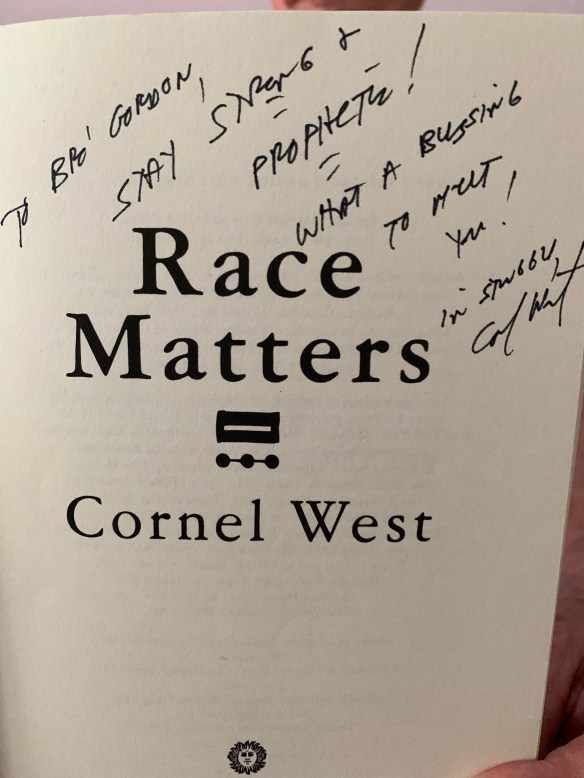
While visiting the Westminster Town Hall Forum in Minneapolis years ago, Cornel West inscribed Race Matters with a gracious personal charge and benediction.
All these years later, I still don’t know how to fulfill the charge or honor his blessing. I have not stayed strong, I am not, and never have been, prophetic. But the instruction and the blessing are with me still.
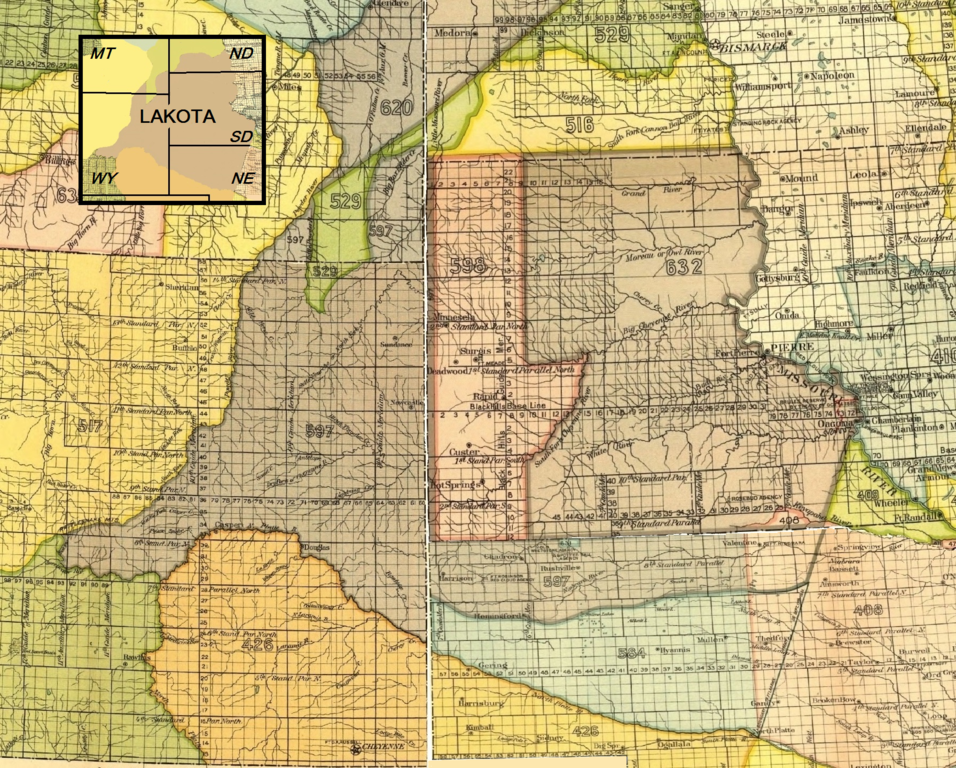
The Fourth of July in 2020 is different. You could see it and hear it at Mount Rushmore. The crowd was as colorless as the ones I remember in my childhood. But before they took their seats to sing the national anthem, salute the flag, and look up at the Blue Angels’ aerial display of military power, some of them had heard the chant “Land back!” and seen the fireworks between the police and National Guard and demonstrators whose skin was darker the their’s. On the road to Mount Rushmore they may not have known — or knew but didn’t care — that they were trespassing on stolen property; but they could not remain unaware that some people were not happy. The Lakota had regarded the Black Hills as sacred ground and still does. No one “owned” land before the Nation that celebrated its independence from the British crown saw it as property and stole it by breaking a treaty.
Lakota Territory
Lakota 1851 treaty territory
A White Nationalist Revisionist History
Inside the red-white-and-blue bannered stadium, the president targeted the protestors. “If we tear down our history we will not be able to understand ourselves or America’s destiny,” he declared, with no apparent consciousness of longer American history of the Black Hills. “The left wing mob and those practicing ‘cancel culture’ are engaged in totalitarian behavior that is completely alien to American life — and we must not accept it.” Did anyone inside the make-shift stadium catch the irony? Did anyone know that the original proposal for what became Mount Rushmore featured different faces — heroes of the American West, such as Sacagawea and Lewis and Clark, Oglala Lakota chief Red Cloud, Buffalo Bill Cody, and Oglala Lakota chief Crazy Horse? Did anyone in the white Fourth of July crowd shout “Land back!”?
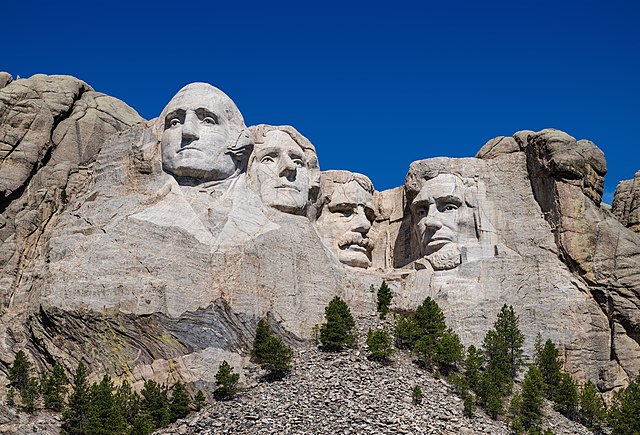
Four U.S. Presidents on Mount Rushmore
According to Tony Schwartz, the real writer of Donald Trump’s autobiography, Art of the Deal, the president knows a thing or two about desecration and deception. He is a master at tarnishing those who will not bow to him with a brush dripping paint from the can of his own empty soul.
If Mr. Trump had known American history, he would have flown to the Black Hills with Desmond Tutu to announce formation of an American Truth and Reconciliation Commission to lead the nation through the healing process of confession, repentance, and reparation instead of a white nationalist campaign rally that trespassed on another nation’s sacred ground.
The Nation of Sheep
Donald Trump may be ignorant of America’s unvarnished history, but he’s not stupid. Those cheering him at Mount Rushmore most likely never read, or had forgotten, William J. Lederer’s 1961 Best Seller, A Nation of Sheep. “We are acting like a nation of sheep — not a vigorous community of bold, well-informed Americans,” Lederer wrote. We are “uneasy, but too apathetic and uninformed to know why — endorsing any solutions which appear cheap and easy and which come from a source better informed than themselves.” Perhaps the president had read Lederer’s book and decided a nation of sheep was ripe for a shepherd.
The Sheep and the Shepherds
It seems less likely he has read the Parable of the Good Shepherd in the book he hasn’t read –the one he displayed in front of Saint John’s after clearing the demonstrators from Lafayette Square. “Very truly, I tell you, anyone who does not enter the sheepfold by the gate but climbs in by another way is a thief and a bandit. The one who enters by the gate is the shepherd of the sheep” (Gospel of John 10:1-2, NRSV).
The Fourth of July entertainer at Mount Rushmore knows about thievery and sheep. He senses we are uneasy. He is well-schooled in the skill of shearing sheep too apathetic and too uninformed to know why they are uneasy. He knows how prone hungry sheep are to feed on quick and how easily we fall for the illusion that ours is the only sheepfold and that we are exceptional to all other sheep. One need not believe The Art of the Deal‘s ghost writer Tony Schwartz’s claim that Mein Kampf was the only book in Donald Trump’s bedroom to recognize in his bellicose language and behavior the political philosophy of the Strong Man who climbed into a sheepfold by blaming the nation’s problems on black sheep, the unpatriotic “left wing” non-Aryans whose color and history threatened the ideology of racial superiority and national manifest destiny.
Nations which no longer find any heroic solution for such distress can be designated as impotent, while we see the vitality of a people, and the predestination for life guaranteed by this vitality, most strikingly demonstrated when, for a people’s liberation from a great oppression, or for the elimination of a bitter distress, or for the satisfaction of its soul, restless because it has grown insecure – Fate some day bestows upon it the man endowed for this purpose, who finally brings the long yearned-for fulfillment.
Adolf Hitler, “The Strong Man,” Mein Kampf, an autobiographical political manifesto, 1925.
Last night — the Eve of July Fourth 2020 — I thought I saw in the Black Hills a flock of sheep, restless because it had grown insecure, and I heard the distant sound of clippers fleecing an earlier flock.
I couldn’t take it anymore. I closed the Bible, grabbed my COVID-19 mask, and ran out for a Fifth for the Fourth –a fifth named Redemption.
The Fourth of July feels a bit different this year. When the sculptors chiseled the 60-foot faces of Presidents George Washington (1732–1799), Thomas Jefferson (1743–1826), Theodore Roosevelt (1858–1919), and Abraham Lincoln (1809–1865), they could not have imagined a pyrotechnic desecration of national monument, although they knew their defacing of the granite desecrated the land once enjoyed by America’s vanquished First People. They could not imagine that in 2020 the four celebrated presidents’ statues would be toppled on public squares for having owned other human beings while their successor ignores a pandemic to shine the light on himself.
“Too much faith in ‘just one man'”
Weeks ago I learned that FoxNews host Tucker Carlson had asked my question. I have to check it out. Finding a YouTube of that particular Tucker Carlson Tonight episode, I can’t believe my ears or eyes.
“Many of our leaders believe his every word is tantamount to law, and in effect it has been,” says Tucker. “Just how wise is the man making these laws? Has America put too much faith in just one man?”
Who is the man?
Answer? Dr. Fauci. “Is he really a man of science?” We’re living in parallel universes. While the president who doesn’t drink was taking — or alleged to be taking — a cocktail of hydroxychloroquine against the medical counsel of Dr. Fauci and Dr. Birx. Replying to a White House corrrespondent’s question about the drug he claims is a “game changer,” Mr. Trump responded, “Yeah, I’m taking it. I’ve been taking it for two weeks,” adding that he follows up the antimalarial drug with an antibiotic.
Misplaced Faith and Displaced Science
Two weeks later, Lancet, the weekly peer-reviewed medical journal that began in 1823, published a study of the risks and benefits of treating COVID-19 with antimalarial drugs, based on the medical records of 96,000 hospitalized COVID-19 patients on six continents. “Nearly 15,000 of the 96,000 COVID patients in the analysis were treated with hydroxychloroquine or chloroquine alone or in combination with a type of antibiotic … within 48 hours,” as reported by the Washington Post (May 23, 2020).
The death rate of the patients treated with antimalarial drugs increased by 45%. Risk of serious heart arrhythmias increased by 411%. They found no benefits.
“If there was ever hope for this drug,” said Cardiologist Eric Topol of the Scripps Research Transatlantic Institute, “this is the end of it.”
Not the End of It
But it’s not the end of it. A president who has claimed to know more about the military than the generals and the Pentagon; more about Afghanistan, North Korea and China than career professionals at the State Department and the intelligence community; more about medicine than the CDC, Dr. Fauci, Dr. Birx, and the public health professionals licensed to practice medicine; the man who shifts the global spotlight from the coronavirus pandemic to his own sorry self; the law-and-order president who fires inspectors-general who do their jobs of protecting the rule of law from political influence — this is the president who will continue shamelessly shamming and scamming the American public on the road to re-election.
The Man Who Does Not Bow
President Donald Trump bows to no one but himself. The Fourth of July firework display at Mount Rushmore will be hosted by a man who believes there will be a fifth face chiseled in the granite with the former presidents who were not as great as he. Assuming Mr. Trump’s cocktail doesn’t take him before the November election, he can count on Fox to bow to continue the propaganda campaign to “Keep America Great.”
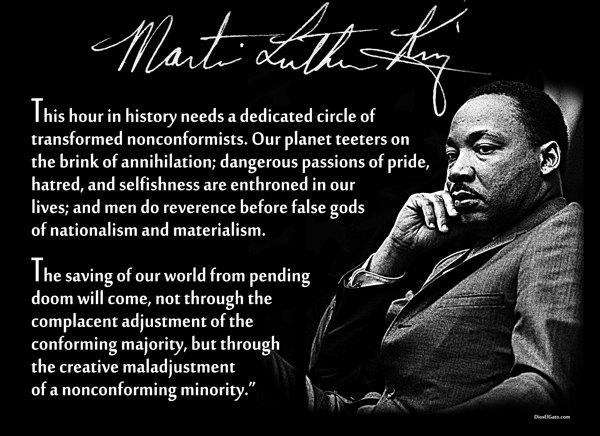
This hour of history – The Rev. Dr. Martin Luther King, Jr.
Scene: Calm on the streets the Night Dr. Martin Luther King, Jr. was Shot
“Dr. King’s been shot!” came the shout to the large gathering of youth and adult advisors in the church recreation room fifty years ago on April 4, 1968.
Several hundred teenagers from Decatur’s public housing (“the projects”) were doing their normal thing after Teen Town when Melvin’s shout from the stairwell changed everything. “Dr. King’s been shot! Dr. King’s been shot!”
Teen Town was an outreach program of First Presbyterian in downtown Decatur, Illinois and the Decatur Office of Economic Opportunity (OEO). Charles Young of OE., a former Chicago gang member, and I, the 26 year old Assistant Pastor of First Presbyterian, oversaw the program with a cadre of adult volunteers.
The room was hot. What do do?
We quickly rounded up tape recorders, organized the kids into small groups, and gave each group a tape recorder to speak their hearts and minds to anyone who might listen. There was anger –“I told you the m—-fs would kill him! Malcom’s next!” (“Malcolm” was Malcolm X.) There was shock. There were tears. There was shouting. But there was no violence in Decatur that night. A young reporter for the Decatur Herald paid credit to Teen Town’s importance to the larger community. We shared the tapes with the city authorities, the Superintendent of Schools and teachers, and the Decatur Chief of Police as a way of deepening the majority white population’s education in blackness.
Scene: The Police Riot on the Church Parking Lot and the Kerner Commission Report
Some Kerner Commission members with President Lyndon Baines johnson (1967)
Not long after the night one might have expected an “urban disturbance,” the same site became a different scene. Two kids came to fist-a-cuffs just after Teen Town’s 10:00 p.m. closing time. Again a voice yelled news to the lower-level recreation room: “There’s a fight outside!” We sent Melvin upstairs to stop the fight. Moments later we saw the racially-inspired police violence reported by the National Advisory Commission on Civil Disorders (Kerner Commission) erupting on the church parking lot: Melvin in a choke-hold behind the paddy wagon, billy clubs flying, white cops spraying mace into the crowd, Teen Town teenagers whose only crime was that they were black running for their lives.
Forty store windows were broken out that night. The church and chief of police went toe-to-toe on the front page of the Decatur Herald. Facing loud cries to shut down the program, the church board voted unanimously to stand behind Teen Town and our partnership with the Office of Economic Opportunity.
First Presbyterian Church was itself a kind of death and resurrection. Before 1953 it was known as “Power’s Towers” referencing Jack Powers, the CEO of the Staley corporation. I was a place of white privilege and power whose members worship Sunday morning and went out to rule the city for another week. By the early ’50s its membership had shrunk to less than an unsustainable membership of less than a hundred. Then something happened that transformed a dying church into a beacon of racial justice and peacemaking.
In 1953 First Church’s new minister, Rev. Jay Logan, and an African American foundry worker walked the short distance from the church to the YWCA across the street to sit-in at the YWCA segregated lunch counter. By the time I arrived in 1967, First Presbyterian had become a vibrant 1200 member multi-racial congregation. It grew because two disciples of Jesus put their feet and rumps where their mouths were, followed by a great cloud of witnesses who dared to do the same.
In this tumultuous time of wrestling with white privilege and choke holds, the Kerner Commission conclusion that “our nation is moving toward two societies, one black, one white – separate and unequal,” and the commission’s call for “programs on a scale equal to the dimension of the problems” seem prophetic.
Today I’m remembering Jay Logan, and Ruling Elders Jim Smith, Art Tate, Ken Varney, Larry Baer, and Ralph Johnson who quickly gathered the tape recorders five decades ago, and weeks later bore witness to their faith in the midst of a police riot… without flinching.
The sight of a white police officer pressing his knee on George Floyd’s neck is horrific, and because it is so egregious, it is a teachable moment of why and how different people see things differently. Things like law enforcement. . . or the Bible . . . or the news. Black churches in America are likely to rejoice in biblical texts that white Christians avoid as too harsh, too “us v. them,” too black and white, so to speak.
This morning I’m hearing Psalm 70 as the voice George Floyd’s brother Philonise bearing testimony before a committee of the United Sates Congress 401 years after Jamestown.
Be pleased, O God, to deliver me; *
    O LORD, make haste to help me.

Let those who seek my life be ashamed
and altogether dismayed; *
    let those who take pleasure in my misfortune
    draw back and be disgraced.

Let those who say to me "Aha!" and gloat over me turn back, *
    because they are ashamed.

Let all who seek you rejoice and be glad in you; *
    let those who love your salvation say for ever,
    "Great is the LORD!"

But as for me, I am poor and needy; *
    come to me speedily, O God.

You are my helper and my deliverer; *
    O LORD, do not tarry.

-- Psalm 70, Book of Common Prayer Daily Office Lectionary, p.970.
Seeing America from on Top or from Below the Knee
“My concern is to understand America biblically,” wrote street lawyer theologian William Stringfellow, “– not the other way around, not (to put it in an appropriately awkward way) to understand the Bible Americanly.” — William Stringfellow, An Ethic for Christians and Other Aliens in a Strange Land (Reprint, Wipf and Stock, 2004).
Be pleased, O God, to deliver me. I, a child of privilege, need help. Let me not be ashamed. O Lord, do not tarry.
Gordon C. Stewart, by the wetland, Minnesota, June 14, 2020.
THE TRUMPETER SWANS


The pen sits and waits
Upon her nest among
The reeds where no
Man’s greed can steal
Or break the eggs
Beneath her breast

She blares no trumpet
To call attention to
Herself and the unborn
Cygnets she soon will
Carry on her back to
Keep them safe

She waits patiently in
Silence among the
Cat-tails where red-wing
Black birds soon will
Soar and swoop around
Her nest to feed their kind

She sees no red, no
Black, no white, and
Hears no honking from
The noisy swamp where
Black birds die beneath
A rogue cob’s knee.

- Gordon C. Stewart, with the trumpeter swans by the wetland, June 3, 2020
George Floyd killed under Minneapolis police officer Derek Chauvin knee – Taken by onlooker with a mobile phone.
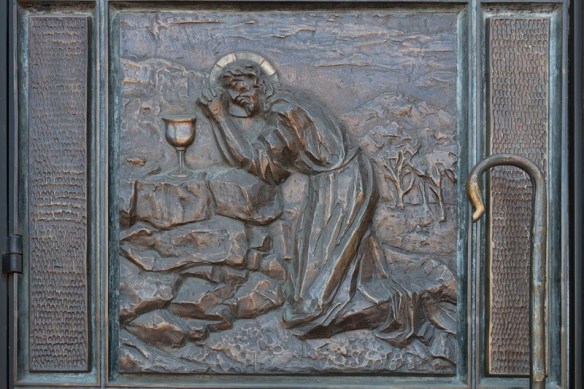
Jesus on bended knee in the Garden of Gethsemane
“If you don’t dominate, you’re wasting your time. They’re going to run all over you, you’ll look like a bunch of jerks.” Donald J. Trump to governors, June 1, 2020.
The Anguished Heart of God
“Now the whole earth was corrupt in God’s sight and was filled with violence.” “The Lord was grieved that he had made man upon the earth, and his heart was filled with pain.”
Genesis, chapter 6, verses 11 and 6.
— Gordon C. Stewart with the trumpeter swans by the Minnesota wetland, June 4, 2020.on’t
At Indian Town Gap National Cemetery, where my mother and father are buried, “Taps” from a single bugle will ring over the silence of the fallen. That is as it should be. No band. No orchestra. No choir. No parades. No “bombs bursting in air.” Just a single bugler breaking the silence “in the dawn’s early light.”
Other tears will fall today for those who did not die or serve in war — 98,035 and still climbing here in the U.S.A. ( ); 345,000+ and climbing worldwide. They were sent to their graves by a deadly virus that knows nothing about wars and borders between nations. You can’t shoot or bomb a virus. Calling the new coronavirus an ‘enemy’ may strike up the band to rally the troops for a crusade, but it’s easily misused to divide the living and the dead. This is a time for Taps, not “”Reveille.”
You will find me where the wounds are
The lock-down to protect ourselves from exposure to COVID-19 led me to the strange encounter between the Crucified-Risen Christ and Thomas — and for all who come to faith in future time: “Blessed are those who have not seen but believe.” The following interpretation is original and speaks for no one else.
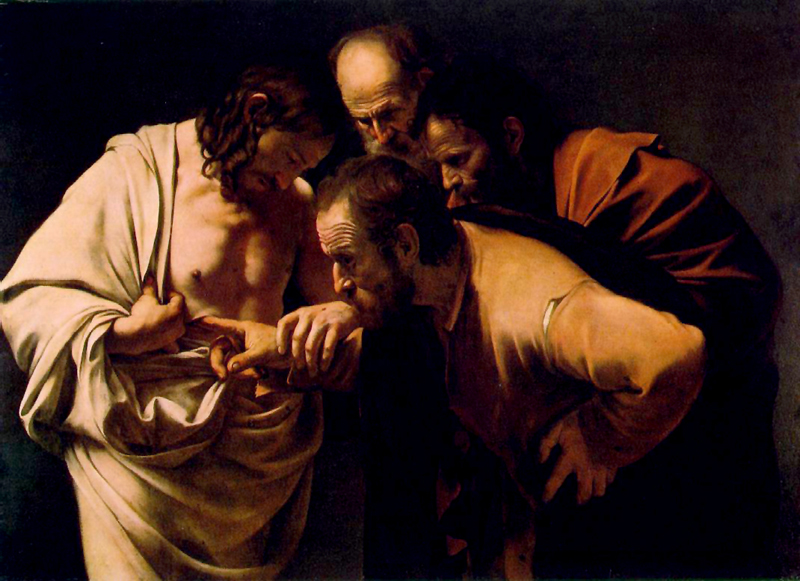
Caravaggio’s painting of Thomas putting his finger in the wound in the Risen Christ’s side is exquisite, but no painting can capture the strangeness of the invitation to Thomas in The Gospel of John (Jn. 20:26-29).
Translating New Testament Greek texts into English often involves a translator’s decision as to the meaning of a word. The story of Thomas is one such text. Most often βάλε in English becomes ‘place’ or ‘put — a rendering that paints a beautiful word picture of a unique moment of tenderness with Thomas. But “put your hand in my side” avoids the jarring sense of the Greek text — “Bring your hand and βάλε (thrust/throw [it] into) my side.”
The Wounds, the Marks, and the Type
“See the τυπος (marks) in my hands.” τυπος can mean ‘wound’ or ‘mark’ but it has another meaning – ‘type’. A τυπος originally meant a mark created by a blow or impression. Eventually it came to mean a mold or form into which something is shaped. Those who are being molded into the life of the Crucified-Risen Christ are called to behold the marks and throw themselves into the enduring gaping wound in Christ’s side.
The Jesus of Locked Doors
John tells the story found in no other Gospel. He tells it in the present tense, drawing the reader into the scene as it is happening. It is not an event happening only then. It is happening now. “Jesus έρχεται (is coming). Th syntax raises the question of how to render the placement of the word κεκλισμενων (‘locked’). Does the text describe the physical circumstances of an unrepeatable moment? Or does ‘locked’ modify Jesus? “Jesus of locked doors/gates έρχεταιs (is-coming) into the midst of them.” and us?
Becoming Faithful: Encountering God in the Wounds
“Do not γίνου (be becoming) faithless (ἄπιστος) but πιστός (faithful),” Jesus is saying to Thomas, and to all who will never see the historical Jesus directly, that faith and faithfulness are more than mental constructs and belief systems. To follow Christ is to throw ourselves into the gaping wound in Christ’s side all around us. He will meet us there.
The story of Thomas is the final word in the original of the most metaphorical Gospel. It is as though John is leaving us with another way of telling the Parable of the Last Judgment, turning our lives from distant observation and hiding ourselves from the wounds to throw ourselves into the place where we come to faith and faithfulness. “I was hungry and you gave me food. I was thirsty and you gave me drink. I was in prison and you visited me. I was a stranger and you welcomed me. I was naked and you clothed me. I was sick and you looked after me. I was in prison and you came to visit me”. (Gospel according to Matthew 25:25-26)
The Life of Compassion
Dietrich Bonhoeffer described the Christian life as an ongoing conformation into the pattern of Christ, “the Man for Others.” Writing from prison cell #6 of Tegel Prison where he awaiting state execution two days before the defeat of the German Third Reich, Bonhoeffer wrote the poem that addressed the question of where Christ is today. The three stanzas move from crying out from distress (“when we are sore bested”) to “standing with God in God’s hour of grieving” to God “hanging dead for Christians, pagans alike . . . and both alike forgiving.”
Men go to God when they are sore bestead,
Pray to him for succour, for his peace, for bread,
For mercy for them sick, sinning, or dead;
All men do so, Christian and unbelieving.

Men go to God when he is sore bestead,
Find him poor and scorned, without shelter or bread,
Whelmed under weight of the wicked, the weak, the dead;
Christians stand by God in his hour of grieving.

God goes to every man when sore bestead,
Feeds body and spirit with his bread;
For Christians, pagan alike he hangs dead,
And both alike forgiving.
There is no life inside locked doors, and if we lock them out of fear or for protection, the Jesus of the Locked Doors will find us and break us free.















 Views from the Edge