Unknown's avatar

About Gordon C. Stewart

I've always liked quiet. And, like most people, I've experienced the world's madness. "Be Still! Departure from Collective Madness" (Wipf and Stock Publishers, Jan. 2017) distills 47 years of experiencing stillness and madness as a campus minister and Presbyterian pastor (IL, WI, NY, OH, and MN), poverty criminal law firm executive director, and social commentator. Our cat Lady Barclay reminds me to calm down and be much more still than I would be without her.

Why a Manger?

“This will be a sign for you: you will find a child wrapped in bands of cloth and lying in a manger.” [Gospel of Luke]

mfa_46-1430-medium

Tintoretto, 1518-1594. The Nativity from Art in the Christian Tradition, a project of the Vanderbilt Divinity Library, Nashville, TN.

Why a manger, the animals’ feeding trough? Why does Tintoretto’s babe seem to be so interested in the animals? Why are the animals so comfortable around him?

Luke is doing theology, which is not everyone’s cup of tea! But we all engage in it. It’s about Reality and what we believe most deeply about it.

“Good” theology — if we may be permitted to use the word in a world which is of the opinion that one opinion is just as “good” as another — seeks to connect the dots between the past, the present, and the future. Traditional Christian theology arcs back to the “goodness” of the beginning (creation) and anticipates the redemption of all things in light of the Christ-event – the birth, death, and resurrection of Jesus.

As often happens, I heard Luke’s birth narrative this year in ways I had yet to put into words.

Could Luke himself have been arguing for what we now know in light of climate change: that we humans are of the same order as the cows, the chickens, goats, and sheep among whom Jesus of Nazareth was born? That is, we are not a superior species. We are not the exception to nature. And the redemption of reality itself includes the entirety of nature — the rescuing of nature from its despair and destruction by human hands.

So it was to poor shepherds, tending their flocks by night that the angel said,

“Do not be afraid; for see -I am bringing you good news of great joy for all the people: to you is born this day in the city of David a Savior, who is the Messiah, the Lord.This will be a sign for you: you will find a child wrapped in bands of cloth and lying in a manger.”

Joyous Nowell, Merry Christmas, Happy Earth Day,

Gordon C. Stewart, Chaska, MN, Christas Day, Dec. 25, 2016.


Tweet for Today:

“#Glory to #God in the #HIGHEST, and #on Earth #peace.” [Gospel of Luke]

Angelic blessings to all who live in #a land of deep darkness!

  • Gordon C. Stewart, Chaska, MN, Christmas Even, December 24, 2016

Pledging Allegiance

Yesterday an email from MoveOn invited me to host a gathering as part of a national resistance movement to the soon-to-be U.S. Administration. I began to fill out the form, but something didn’t feel right. I’m not a good groupie, but it was more than that.

The article that appeared in my inbox this morning puts its finger on what feels right and what feels wrong with almost everything I seek to do with respect to the specter of losing most everything for which I’ve worked over a lifetime. Thanks to Michael, the psychologist we met last week on The Nation cruise, for sharing this thoughtful piece. In it’s light, I think I’ll fill out the form and plan a candlelight vigil in the town square. No yelling. No screaming. Just a pledge to, and prayers for, the future.

The sections in green were added to this reposting for those who wish to get to what we take away from the commentary.

I Pledge Allegiance to . . .

I pledge allegiance to . . . what?

The Electoral College, to no one’s serious surprise, voted Donald Trump in as the nation’s 45th president, and the pot of outrage in the American spectator democracy begins to boil.

No, no, no, no, no, no, no — no to all his right-wing and idiotic cabinet and Team Trump appointments, no to his conflicts of interest and serial tweets, no to his sexism, his reckless arrogance, his ego, his finger on the nuclear button.

The word of the day is resistance. For instance, Nancy Altman and Ira Lupu, writing at Huffington Post, point out that Trump, though legally the new American president, lacks political legitimacy, thanks to widespread voter suppression, his huge loss in the popular vote and the anachronistic absurdity of the Electoral College; and even more disturbingly, is a thin-skinned, dishonest, immature jerk, utterly lacking the moral authority a national leader must project. These are flaws that cannot be ignored.

“Other elected officials, the media, and the citizenry at large have no obligation to afford him the slightest political respect,” they write. “Rather, the next four years should be a time of resistance and outright obstructionism. Opponents of Trump should be at least as aggressive in challenging the political legitimacy and moral authority of his presidency as Republicans were in disrespecting President Obama, whose political legitimacy and moral authority were beyond reproach.”

Wow, I get it. Don’t let Trump get away with anything! Fight every alt-right and nutcase appointment he tries to make, every racist or reckless policy he tries to implement. Above all, don’t let him shift the paradigm of normal.

There’s only one problem here, and it’s the same problem the Hillary Clinton campaign faced and had no way to overcome. The “old normal” — the Washington consensus, the status quo — that Trump is so successful at selectively mocking, even as he remains utterly enmeshed in it, is a ravenous predator and looming disaster of global proportions.

I pledge allegiance to the United States of War? To the United States of Prisons? To the United States of Poverty and Infrastructure Decay and Contaminated Water?

Indeed, the concept of American exceptionalism ensconced in the old normal and thoughtlessly touted by the corporate media is Trumpesque in its narcissism. And its time is running out. The economy is breaking down for much of the working class and some of our deep, foundational flaws — the racism, the militarism, the environmental exploitation — are getting increasingly difficult to avoid noticing.

The challenge presented by Trump requires something more than resistance. I believe it requires reaching for, and pledging our allegiance to, a much larger, more compassionate and peace-oriented country than the one we have now. It requires pledging allegiance to the planet and the future.

But what does this look like?

Half a century ago, the emerging nation could be seen in the civil rights movement. Today, perhaps the best place to look is Standing Rock, where an old wound, you might say, is insisting on its right to heal.

“What can we learn from their struggle?” Audrea Lim asks in The Nation. “Bombarded for months with tear gas, sound cannons, rubber bullets and water hoses (often in freezing temperatures, no less), the camp at Standing Rock grew from around ten in April to thousands by fall. They transformed what might have otherwise been a remote, invisible, rural struggle into national headline news.”

The struggle, she notes, had blatantly racist origins: “Originally meant to traverse the Missouri River north of Bismarck, city residents complained that it would threaten their municipal water supply, and the pipeline was re-routed to nearer the Standing Rock reservation in September 2014.”

She adds: “It is significant that Bismarck is 92.4 percent white.”

This could have been just one more isolated wrong, but for some reason the national or perhaps global moment was ripe for it to be something else. The struggle for water rights, for the sanctity of the land, for a wounded people’s dignity, sent a tremor through the whole country. Something sacred — to use a risky, old-fashioned word — had been violated. And maybe we’re no longer simply Consumer America, using up our resources, destroying our rivers, clotting our veins, to consequences born only by the racially and culturally marginalized. We used to be, but this is changing.

“We live today at a moment of transition between worlds.”

So writes Charles Eisenstein in The More Beautiful World Our Hearts Know Is Possible. The world that’s giving way — and the story, or mythology, that sustains it — is the world of “survival of the fittest” and winner takes all, the world of domination and conquest, isolation from nature, a dismissal of life itself as less than sacred.

“Today,” writes Eisenstein, “it is increasingly obvious that this was a bubble world built atop massive human suffering and environmental degradation.”

It isn’t merely resistance that will replace the bubble world of exploitation, but a new and deeper consciousness of connection with all of life and a reawakening to what is sacred.

I pledge allegiance to the world that is coming into being.

This work is licensed under a Creative Commons Attribution-Share Alike 3.0 License.

Robert Koehler

Robert Koehler is an award-winning, Chicago-based journalist and nationally syndicated writer. His new book, Courage Grows Strong at the Wound is now available. Contact him at koehlercw@gmail.com or visit his website at commonwonders.com.

Old Friends on FaceBook

Ted Bonsall and I became lifelong friends back in Kindergarten in Broomall, Pennsylvania. We played ball in each other’s yards every day for years. I have pictures to prove it!

All these years later, FaceBook invited me to wish Ted (“Russell”) Happy Birthday!”

FaceBook wasn’t around way back in 1947 in Broomall. It didn’t know Ted then and doesn’t seem to know him now. Although Ted died of cancer several years ago, his Facebook page is still up. Like memory itself, his page can never be erased by time.

Miss you, good buddy!

  • Gordon C. Stewart, Chaska, Minnesota, December 22, 2016


My, O, My! How things (don’t) change

Returning from a week with thoughtful speakers from The Nation magazine, including Vegans Dennis and Elizabeth Kucinich, took this  guilty but yet-to-repent meat-eater back to a guest commentary that aired on Minnesota Public Radio inelizabeth_harper_kucinich 2010.

Back then, the Affordable Care Act had just become law. My, O, my, how things do change! And not always for the better, although Elizabeth still hopes it’s a matter of time before the world wakes up to the industrial agricultural devastation that contributes to climate departure. As for health care? Who knows?

Click Commentary: Processed foods making us sick to listen to MPR’s “All Things Considered” guest commentary of May 22, 2010 when we assumed believed passage of the Affordable Care Act had put the national health care issue behind us.

  • Gordon C. Stewart, Chaska, MN, Winter Solstice, December 21, 2016


The Gophers and the Groper

Until University of Minnesota President Eric Kaler shared with the university football players (“the Gophers”) the investigation report of alleged sexual assault that led to the suspension of 10 of their teammates, the team was ready to boycott the Holiday Bowl. The grizzly details — and lots of parent tweets urging them to protect their own futures — put the young Gophers between a rock and a hard place: stand with your 10 teammates and be tagged forever as condoning sexual assault, or reverse the decision to stand together — all for one and one for all — and admit that some things go far beyond “boys will be boys”.

Early yesterday morning, team spokesman Adam Wolitarsky announced the team’s decision to play in the Holiday Bowl.

Rumor has it that the Gophers immediately received a tweet from someone in New York:

“Win one for the Groper!”


Is Democracy Threatened?

After a brain stretching week with The Nation‘s Katrina Vanden Huevel, John Nichols, Laura Flanders, Sasha Abramsky, Dorian Warren, Peter Kornbluh, Dennis and Elizabeth Kucinich, my head is still spinning. Too much to write about.

We return to Views from the Edge with this thoughtful NYT Sunday Review op-ed that addresses what The Nation speakers, panels, and guests spent the week discussing.

Click HERE to read  “Is Donald Trump a Threat to Democracy?”

  • Gordon C. Stewart, Chaska, MN, Dec. 17, 2016

Pinocchio and Pinochle in America

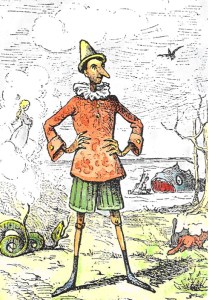
pinocchioWorking in his carpenter shop in Florence, Italy, Geppetto, the marionette-maker, could not have imagined that Pinocchio would become President of the United States of America. Neither could Carlo Collodi whose The Adventures of Pinocchio (1881) painted a more complex, less likable Pinocchio than the Walt Disney film version (1940) that popularized the story in America.

My generation grew up on Pinocchio. How could we not? He was eternally boyish. He was charming. When we told a fib to our parents, we empathized whenever poor little Pinocchio’s nose told on him. Pinocchio was a lovable liar in whom we saw our own flawed but lovable selves without the less attractive dimensions of Collodi’s original Pinocchio who, on the day he is born, cruelly snatches the wig from his marionette maker’s head. From his very first day, Pinocchio has a mind of his own far beyond and quite different from Geppetto’s imagination.

Neither Carloddi nor Geppetto could have imagined that on January 20, 2017 Pinocchio would raise his right hand to take the oath of office as President of the United States. If Geppetto were still able to pull the marionette’s strings, it would not happen. Geppetto would remember his stolen wig. And, if perchance, Geppetto were on the dais when the humanized Pinocchio raises his right hand, he might stretch out his own hand to check whether Pinocchio is wearing his wig.

Pinocchio has a way with words. He calls those who question his integrity ‘liars’ and ‘criminals’ He rallies people with his limited vocabulary. He gropes women and brags about it — it’s not every wooden marionette who gets to do what Geppetto would find deplorable. When he makes promises he cannot keep, his nose grows, but not everyone can see it. It grows slowly, inch-by-inch so that the original image blinds people to its peculiar length.

But there’s another dimension to Pinocchio’s personality that is largely unknown to the general public. He loves to play Pinochle, the game for four that is includes a trump suit, with his family. It’s harder to lie to three family members than it is on stage, and it may be that Pinochle may yet shrink the length of Pinocchio’s nose. Ivanka and Melania didn’t appear in Collldi’s The Adventures of Pinocchio or the Disney version of the story, but their parts in the ongoing story may save us yet.

Those who cringe at the thought of Pinocchio with his groping hands on a nuclear arsenal can always hope Pinocchio’s third wife and favorite daughter will transform the evening Pinochle game as a way to serve the people. In Pinochle the trump suit get spread among the players; no one can dominate. If we’re lucky, Ivanka and Melania will gentle the meanness Pinocchio exhibited when he snatched Geppetto’s wig the day he was ‘born’, keep his nose short, and do for Pinocchio’s what Eva Braun was never able to do: keep his right arm from rising to a salute.

Standing firm @ Standing Rock

Tomorrow, December 5, is a watershed moment.

It’s the government-ordered deadline for the oil pipeline protesters to vacate the federal land where they have camped for water preservation since early 2016.

Today, the eve of the confrontation, several thousand U.S. military veterans are joining the protesters. So is a large group of religious leaders from around the country and world. Why? Because some moments are watershed moments, times when the watershed itself is in danger. Times when the earth cries out, as in the biblical story of Cain and Abel. Times like today when, according to the World People’s Conference on Climate Change and the Rights of Mother Earth, “our Mother Earth is wounded and the future of humanity is in danger.” The People’s conference document continues as follows.

We confront the terminal crisis of a civilizing model that is patriarchal and based on the submission and destruction of human beings and nature that accelerated since the industrial revolution.

The capitalist system has imposed on us a logic of competition, progress and limitless growth. This regime of production and consumption seeks profit without limits, separating human beings from nature and imposing a logic of domination upon nature, transforming everything into commodities: water, earth, the human genome, ancestral cultures, biodiversity, justice, ethics, the rights of peoples, and life itself.

Under capitalism, Mother Earth is converted into a source of raw materials, and human beings into consumers and a means of production, into people that are seen as valuable only for what they own, and not for what they are.

Capitalism requires a powerful military industry for its processes of accumulation and imposition of control over territories and natural resources, suppressing the resistance of the peoples. It is an imperialist system of colonization of the planet.

Tomorrow those who stand firm at Standing Rock face forcible removal, arrest, and violence. In this watershed moment, they will do what America’s First Peoples have always done. They will beat the drums and lift their voices in prayer to the Great Spirit, standing firm at Standing Rock to honor Mother Earth and future generations.

Today, tomorrow, and for years to come, Standing Rock will symbolize the necessary turn from a civilizing model that insists on “man over nature”. A time when we turned to believing we (the human species) are above nature.  A watershed moment when we came to see that water is us. We are water. We are nature. Nature is us.

  • Gordon C. Stewart, Chaska, MN, December 4, 2016.


Lazarus and “the rich man”

gustave_dore_lazarus_and_the_rich_man

Gustave Dore print of Lazarus and the rich man. (1890)

Jesus told a parable about a man with a name ‘Lazarus’ – a poor man – and a man who has no name – “a rich man”. The parable begins like this:

“There was a rich man who was dressed in purple and fine linen and who feasted sumptuously every day. And at his gate lay a poor man named Lazarus, covered with sores, who longed to satisfy his hunger with what fell from the rich man’s table; even the dogs would come and lick his sores.” [Luke 16:19-20 NRSV]

The scene then shifts from the difference between their earthly circumstances to the imagined differences between their circumstances in an afterlife. Lazarus is soothed in the bosom of Abraham. The rich man is in torment, pleading that if only he had known, he would have lived differently. He asks Abraham to send Lazarus to his five brothers to warn them. tell his living relatives. If he can come back to them from the dead, they will understand, change their ways, and avoid the coming judgment.

Abraham’s reply?

“‘They have Moses and the prophets; they should listen to them.’ [The rich man said, ‘No, father Abraham; but if someone goes to them from the dead, they will repent.’ [Abraham] said to him, ‘If they do not listen to Moses and the prophets, neither will they be convinced even if someone rises from the dead.’” [Lk. 16:29-31].

Jesus’ parable is not about the dead. It’s about the living. About how are to live together as neighbors. It’s about waking up to destitution and privilege and heeding the parable’s calling to a society beyond these extremes, a society known for its compassion.

Ask your friends to discuss the news in light of Moses’ response to the rich man. Ask your pastor, priest, or minister how she or he connects the dots with the news in 2016. Ask yourself the question as you listen to the morning and evening news. Ask yourself whether you’re getting the parable or whether the parable got you. Ask God for guidance, for mercy, for change, for transformation of a world of us and them. And give thanks for Jesus, Moses, and the prophets.