I've always liked quiet. And, like most people, I've experienced the world's madness. "Be Still! Departure from Collective Madness" (Wipf and Stock Publishers, Jan. 2017) distills 47 years of experiencing stillness and madness as a campus minister and Presbyterian pastor (IL, WI, NY, OH, and MN), poverty criminal law firm executive director, and social commentator. Our cat Lady Barclay reminds me to calm down and be much more still than I would be without her.
“Wouldn’t it be great to have all of the churches full [on Easter]? You know the churches aren’t allowed, essentially, to have much of a congregation there,” said President Trump in a Fox News interview. “You’ll have packed churches all over our country. I think it would be a beautiful time.”
Christianity Lite
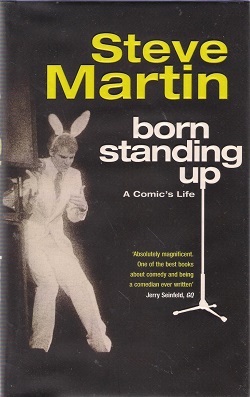
It won’t happen. Except, maybe, at the Tampa Bay megachurch, whose pastor’s arrest made headlines. But if it should happen that the churches are packed this Eastern, they would be filled with six-packs of “Christianity Lite” — the religion of “The Life of Brian” (Monty Python) and “Happy Feet” (Steve Martin).
The book cover for Steve Martin’s book Born Standing Up: A Comic’s Life draws laughs because comedy routines like “Happy Feet” are wonderfully outrageous critiques of real life rip-offs that masquerade as Easter joy -“the power of positive thinking” and “the prosperity gospel” — that replace the real joy that comes out of horror.
Out of sorrow and death
“Agony in the Garden” from door of cathedral in Beaumont, Texas
Easter is not about the Easter Bunny and Happy Feet. It’s the Church’s celebration of the resurrection of the Jesus who was “crucified, dead, and buried” (Apostles Creed). It’s not “happy”; it’s thoughtfully joyful.
Easter comes after Holy Week’s contemplation on the Passion, focusing the mind and heart on Jesus moving steadily toward his own state execution while his closest companions betray him, deny knowing him, fail to stay awake with him, abandon him in the moment he feels utterly abandoned — Eli, Eli, lema sabachthani(“My God, my God, why have you forsaken me?”) — and return home in that dead silence when nothing but death seems certain.
Reaping what we sow
Ralph Drollinger of Capitol Ministries is a White House “faith advisor” who leads a weekly Bible study attended by White House staff, members of the House and Senate, their staff, and other federal workers. He and Paula White, the other “faith advisor” in the White House, have the President’s ear. That’s deeply troubling.
As COVID-19 circles the globe ignoring national boundaries and borders, Mr. Drollinger attributes the coronavirus pandemic to “the consequential wrath of God.” We are reaping the consequences of what we have sown: radical “environmentalism” that goes against our Creator”; “the suppression of truth” by atheists and those who don’t believe the Bible is the inerrant, literal word of God; and the acceptance of what he calls “a sensation toward homosexuality.”
The Parable of the Sower in the Gospel of Matthew
And he told them many things in parables, saying: “Listen! A sower went out to sow. And as he sowed, some seeds fell on the path, and the birds came and ate them up. Other seeds fell on rocky ground, where they did not have much soil, and they sprang up quickly, since they had no depth of soil. But when the sun rose, they were scorched; and since they had no root, they withered away. Other seeds fell among thorns, and the thorns grew up and choked them. Other seeds fell on good soil and brought forth grain, some a hundredfold, some sixty, some thirty. Let anyone with ears listen!” -- Matthew 13:3-9 NRSV
The focus of the parable is not “the consequential wrath of God” and, perhaps, we are not the sowers but the soil into which God sows the seed. The Parable of the Sower offers an invitation to live now as the good soil that produces a joyful harvest in the Sower’s field.
In the time of American essayist Ralph Waldo Emerson, prudence (wisdom) was still held in high regard. People were no less foolish in Emerson’s time than we are in ours and folks lied back then, but truth was the measure against which speech and opinion were tested. Emerson’s essay on “Prudence” speaks of truth and the damage to the self and society when truth is violated.
Every violation of truth is not only
a sort of suicide in the liar,
but is a stab at the health of society.
— Ralph Waldo Emerson
ESSAYS: FIRST EDITION (1841)
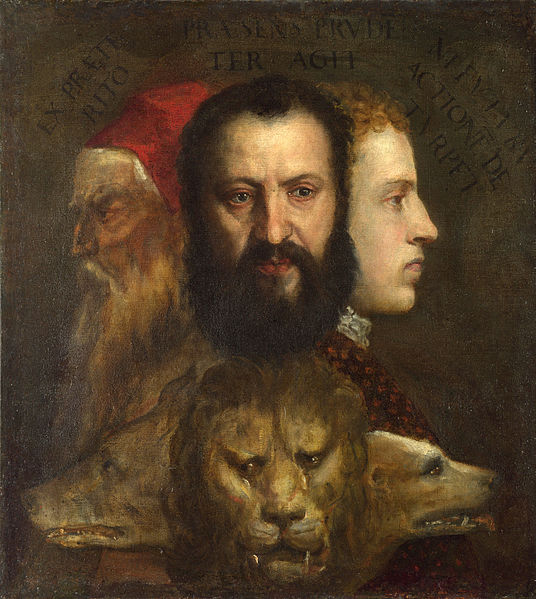
Emerson’s essay on Prudence put to paper what Titian (1490-1576) had painted on canvas in his “Allegory of Time Governed by Prudence” four centuries before.
The old man on the left (Titian himself) is turned toward the past. The boldest figure at the center (Titian’s oldest son, Orazio) represents the present. His cousin, Marco Vecellio, at the right is facing the future. The triple-headed beast — wolf, lion, and dog — represent the cardinal virtue Prudence.
In classical western philosophy dating to Plato’s Republic, Prudence (Wisdom) has been regarded as the thoughtful supervisor or manager of the other three moral virtues (Temperance, Fortitude, and Justice). Prudence (Wisdom) brings the insight to distinguish between the semblance of reality and reality itself, and the considered intelligence to act accordingly.
Titian’s painting, like Emerson’s essay, offers guidance during the coronavirus pandemic of 2020. Why? There is a parallel. Titian and his heir both died in the same year during the Plague.
Reality and the semblance of reality; truth and the distortion of truth
We in our time face a threat of two simultaneous plagues: the COVID-19 pandemic, and the violation of truth that “stabs a society” and commits “a sort of suicide in the liar.” Little attention is paid to the past or the future. A society without the Wisdom to discern the difference between truth and falsehood, reality and the semblance of reality, temperance and impulse, fortitude and facades, justice and privilege, and between a democratic republic and autocracy is a society in trouble. How we manage our way through the COVID-19 pandemic will determine the American character and the nation’s future.
The postcard
In the last two weeks, every home received the post card guiding the American public through the coronavirus pandemic. In a normal year, one might expect the guidelines to arrive from an authoritative source — the Center for Disease Control and Prevention, perhaps in conjunction with the U.S. Department of Health and Human Service.
But 2020 is not a normal year. It’s and election year. The President who called the coronavirus threat a hoax, played to the myth of national exceptionalism with references to “the Chinese virus,” assaults the patriotism of the Speaker of the House, members of the opposition party, and the Fourth Estate (the free press of the First Amendment), substitutes his personal feelings for the knowledge of the medical science professional, and puts himself at the microphone and television cameras of the daily coronavirus updates — this is the President who sends a post card presuming to provide guidance by post card to every American household at taxpayer expense.
Post card offering guidance for America, paid for by taxpayer money
Emerson knew that truth-telling was an essential virtue that protected the American republic from homicide and its citizens from killing their own souls. Prudence and imprudence in government were not strangers to Emerson or those whose genius crafted the balance of powers the became the U.S. Constitution.
How does a wounded country heal?
How and why it happened requires a look at American history. How we move forward leaves many of us scratching our heads. But one thing is certain. If we allow our disparate passions and partisan allegiances to replace Wisdom, we will have chosen personal suicide and societal homicide.
Emerson’s essay and Titian’s “Allegory of Time Governed by Prudence” found a friend in Anglican priest and poet Geoffrey Anketell Studdert Kennedy (June 27, 1883 – March 8, 1929), the WWI British Chaplain nicknamed ‘Woodbine Willie’ for the Woodbine cigarettes he gave injured and dying soldiers.
After World War I Studdert Kennedy became a pacifist and a socialist whose books and sermons were on the front line of the political-economic debate over the country’s future. He stood for his convictions, but saw himself as a member of a commonwealth who, like all other citizens, was called to search for wisdom “outside the prejudices and passions that arise in party strife.”
There is, and there must be, a plane upon which we can think and reason together upon questions arising out of our wider human relations, social questions, that is, apart from and above party prejudice and sectional interest. If that is not so, and there is no such plane, and we can not think of these big questions outside the prejudices and passions that arise in party strife, then it is safe to assert that there will never be a solution of the problem whatsoever. The idea that politics in the true sense — that is, the art of managing our human relationships on a large scale — must remain a separate department of life, distinct from morals and religion, is ultimately irrational and absurd.
One of the great public and religious dangers of the day is the use of the words socialism and capitalism without any real attempt to define their meaning.
– G.A. Studdert-Kennedy, “The Church in Politics” sermon preached at the 1926 annual meeting of the Industrian Christian Fellowship at St. Martin-in-the-Fields, London.
This April Fools Day, may God grant courage to all us fools to let Prudence lead us to find Truth again and save us for each other and our better selves.
I was five years old the morning I screamed from the top of the new chain-link barbed-wire fence that separated my next door buddy, Buddy Singleton, and me. Moments before, we had been speaking through the fence Buddy’s father had just put up to protect his property. We were friends. We wanted to play.What to do? One of us had to scale the chain-like fence. Clinging to the chain links, I climbed to the top where the barbed wire was. I lost my footing and screamed, hanging by one hand from the barbed wire that had spiked my hand. I hung there until my mother heard the screams and rushed to take me down. I never climbed a chain-link barb-wire fence again. The scar on my left hand reminds me every day.
Making mistakes is part of life. It’s just human. Sometimes our mistakes hurt ourselves, sometimes they hurt others. Sometimes they hurt both. But mistakes also teach us to look closely before trying to climb over a fence, no matter how lofty our intentions.
Today the fence I’d like to get over is harder to scale. “C’mon over,” says Buddy. “I can’t!” I say. “Sure you can. Just climb over the fence!” I’ve learned not to listen to a dangerous invitation. Having made that mistake, I now look up to the top, see the barbed wire, and decide to stay safe in my yard on my side of the fence. I don’t understand the Singletons, the Singletons don’t understand me, but each of us is sure we do.
Fences and neighbors
Today the invitations to “c’mon over” are hard to find. It’s not so much that we’re cowards; it’s that we don’t want each other in our yards. The Shadow’s question “What evil lurks in the hearts of men?” is no longer a question about all of us; it has become specific: “What evil lurks in the hearts of the Singletons?” “What evil lurks in the hearts of the Stewarts?” We no longer talk through the chain links. We call each other names, sure that, whatever evil is, its place is the other side of the fence. We get our news from different sources. We tell stories about the fence that separates good and evil, and the people on the other side of it. We don’t just see things differently. We see different things. We buy the stories about the fence and the people on the other side of it. The Stewarts watch MSNBC and listen to NPR; the Singletons tune into FOXNews and Rush Limbaugh. We’re worlds apart. Or so it seems, but . . .
“Something there is that doesn’t love a wall [a chain-link barb-wire fence] (Robert Frost in “Mending Wall”) bubbles up from a deeper memory in the year a virus locks us in our homes on both sides of the fence. COVID-19 knows nothing about fences and walls, good and evil, or state and national borders. Sometimes it takes a poet to take us to our deeper selves.
Before I built a wall I'd ask to know
What I was walling in or walling out,
And to whom I was like to give offense.
- Robert Frost, "Mending Wall"
Gordon C. Stewart, at home in Chaska, MN, March 31, 2020.
Sharing comes naturally to Elijah. In this scene recorded by Gramma, Elijah surprises Grampa (Wumpa) with a piece of his pizza. Elijah has no knowledge of hoarding. He demonstrates the generosity of the widow of Zarephath who shared her last provisions with Elijah.
Elijah offers a piece of his pizza to Grandpa (“Wumpa”)
Is not this the fast that I choose:
    to share your bread with the hungry,
    and bring the homeless poor into your house;
when you see the naked, to cover them,
    and not to hide yourself from your own kin?
-Isaiah 58:6a-7 NRSV
Gordon C. Stewart (“Wumpa”) with Elijah and Gramma in Chaska, MN, March 26, 2020 in this period of social distancing.
Feel-good stories are becoming fewer during this period of self-isolation. There’s a virus out there that has kept us alone at home for 10 days, but we still talk with the two year-old grandchildren on Skype — or drop in on Elijah at daycare. Remotely, of course.
Elijah at daycare on St. Patrick’s Day
Elijah loves his daycare. What’s not to like? He has close friends. There are only four other playmates. They all adore Lidia, their daycare provider. Lidia only speaks Spanish — of the Cuban variety. Elijah and his friends speak only Spanish in Lidia’s home. But on St. Patrick’s Day Lidia make green smoothies. She called them “immunity drinks”. If it weren’t for the language and the ages, you’d think they were in a pub with a pint. Take a look.
Elijah and friends with Lidia at daycare.
A Brief Conversation — Elijah and Grampa (Bumpa)
Elijah, it makes me happy to see you like daycare so much.
No me gusta la guardería, abuelo.
I’m sorry, Grampa only speaks English. What did you say?
I said, “I don’t like daycare.”
Sure you do.
No! Amo la guardería. Oops, I’m sorry, I forgot. I said “No! I don’t. I LOVE daycare!”
I can see that. I used the wrong word.
It’s okay Grampa, you and Gramma never had daycare, right? You never learned Spanish, right?
Right.
So you didn’t have a girlfriend til you were really old, huh?
Do you have a girlfriend, Elijah? You’re only two.
I’m almost three! My girlfriend’s older. I LOVE Nora and Nora loves me.
Elijah and his girlfriend Nora at daycare.
A feel-good story for the homebound, brought to you by Elijah’s abuerlo, Chaska, MN, March 24, 2020.
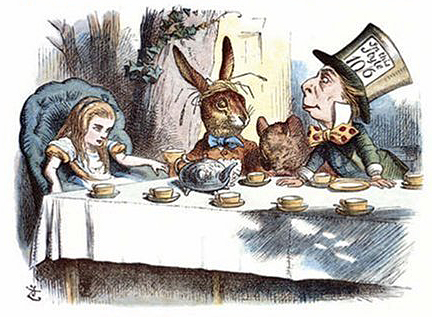
No, not THAT Tea Party –the one that turned Boston Harbor into a sea of tea; and not THAT Tea Party — the 20th Century movement to strip government to its bare bones. THIS one is from Lewis Carroll’s Alice’s Adventures in Wonderland.
The Daily Briefings
Watching the White House daily briefings on the coronavirus, I feel like Alice at the Mad Hatter’s Tea Party. “Wouldn’t it be nice,” I mutter to myself, “if something made sense for a change?”
The Mad Hatter, who recently cut the pandemic disease office of the National Security Council as fat and who has no medical education or expertise, presumes to know better than Dr. Anthony Fauci and the other health professionals standing behind him. I talk to the president through the television broadcast to explain what I see and hear.
“When you’re at the microphone facing the cameras, you can’t see what I see on the faces of the doctors standing behind you. You don’t see the stares or feel the energy it takes to hide their disdain. They cringe when you give assurances that everything is under control, declare with authority that the risks are minimal to none, and make announce remedies that don’t exist or are dangerous to our health.”
I shout at the television, “‘If you don’t think . . . , you shouldn’t talk.’ You haven’t made sense since you called the coronavirus a hoax. We’re all guests at your Tea Party, doing our best to be respectful while kicking each other under the table, winking, and passing notes with the scones and tea cozy.
“Those who know their history have read the book(s) your co-author Tony Schwartz and first wife, Ivana, claim to have seen in your bedroom. We know that history repeats itself for those who ignore their history. Our grandparents and great-grandparents risked their lives and died to save us from the day when those books might become America’s Bible. We hear in your manner of speaking, repetition of phrases, framing the free press as America’s great enemy, and see in your facial expressions and body posture, the projection of the Strong Man. What you say and how you say it has a ring to it.”
The Strong Man’s Script
“As the last factor I must in all modesty describe my own person: Irreplaceable. Neither a military man nor a civilian could replace me. Attempts at assassination may be repeated. I am convinced of my powers of intellect and of decision. Wars are always ended only by the annihilation of the opponent. Anyone who believes differently is irresponsible. Time is working for our adversaries. Now there is a relationship of forces which can never be more propitious for us. No compromises. Hardness toward ourselves. I shall strike and not capitulate. The fate of the Nation depends only on me. No one has ever achieved what I have achieved. My life is of no importance in all this. I have led [the nation] to a great height, even if the world does hate us now.”
“I believe today that my conduct is in accordance with the will of the Almighty.”
“The Strong Man is mightiest alone.”
“Strength lies not in defense, but attack.”
“Do not compare yourself to others. If you do so, you are insulting yourself.”
“The leader of genius must have the ability to make different opponents appear as if they belonged to one category.”
“The victor will never be asked if he told the truth. ”
“If you tell a big enough lie and tell it frequently enough, it will be believed.”
“But the most brilliant propaganda technique will yield no success unless one fundamental principle is borne in mind constantly and with unflagging attention. It must confine itself to a few points and repeat them over and over. Here, as so often in this world, persistence is the first and most important requirement for success.”
“I know that fewer people are won over by the written word than by the spoken word and that every great movement on this earth owes its growth to great speakers and not to great writers.”
“Through clever and constant application of propaganda, people can be made to see paradise as hell, and also the other way round, to consider the most wretched sort of life as paradise.”
“The receptivity of the masses is very limited, their intelligence is small, but their power of forgetting is enormous. In consequence of these facts, all effective propaganda must be limited to a very few points and must harp on these in slogans until the last member of the public understands what you want him to understand by your slogan.”
“I use emotion for the many and reserve reason for the few.”
“Humanitarianism is the expression of stupidity and cowardice.”
“Life doesn’t forgive weakness.”
“Strength lies not in defense but attack.”
“It is the press, above all, which wages a positively fanatical and slanderous struggle, tearing down everything which can be regarded as a support of national independence, cultural elevation, and the economic independence of the nation.”
“My feeling as a Christian points me to my Lord and Savior as a fighter. It points me to the man who once in loneliness, surrounded only by a few followers, recognized these Jews for what they were and summoned men to fight against them and who, God’s truth! was greatest not as a sufferer but as a fighter. In boundless love as a Christian and as a man I read through the passage which tells us how the Lord at last rose in His might and seized the scourge to drive out of the Temple the brood of vipers and adders. How terrific was his fight against the Jewish poison. Today, after two thousand years, with deepest emotion I recognize more profoundly than ever before the fact that it was for this that He had to shed his blood upon the Cross.”
“To truly ‘learn’ history means to open your eyes and discover the forces that cause historical events to happen. The art of reading and of learning means remembering the important parts and forgetting the unimportant.”
All the above are quotations from Mein Kampf or speeches of Hitler
There Will Be No Throne Here
The original Tea Party threw the tea into Boston Harbor to protest a colonial power’s taxation of the colonists without representation. They were telling the King of England to go home. There would be no palace or gilded throne in the new American Republic.
Little could the colonists at the original Tea Party have imagined a king rising from American soil — a free electorate allowing a would-be king to shred its own Constitution.
Neither could they have imagined another democratic republic which de-throned Kaiser Wilhelm II turn back the clock for the Strong Man promised to make Germany great again and re-paint the Jewish Jesus as an Aryan-race anti-Jewish fighter who gave his blessing to the nationalist purge and purification we now call the Holocaust.
The Mad Hatter’s Tea Party of 2020 is not in Germany, and pundits have been well-advised to refrain from any comparisons, especially when the need to unite is so apparent. But we cannot pretend not to see what we see and hear what we hear.
“That’s very important,” the King said, turning to the jury. They were just beginning to write this down on their slates, when the White Rabbit interrupted: “Unimportant, your Majesty means, of course,” he said in a very respectful tone, but frowning and making faces at him as he spoke.
“Unimportant, of course, I meant,” the King hastily said, and went on to himself in an undertone, “important—unimportant–unimportant–important–” as if he were trying which word sounded best.
Some of the jury wrote it down “important,” and some “unimportant.” Alice could see this, as she was near enough to look over their slates; “but it doesn’t matter a bit,” she thought to herself.
Members of the Jury: “important . . . unimportant . . . important”?
The danger to an America locked down to safeguard public health is greater than the coronavirus. It is the threat that we will come to see the Boston Tea Party and the U.S. Constitution as partisan mistakes, and plug our ears lest we hear even the faintest hint of the shredding of the Constitution and see no similarity to the Strong Man’s Script.
Gordon C. Stewart, Be Still! Departure from Collective Madness, available in paperback and kindle through Wipf and Stock and Amazon.
There’s no need to hang about waiting for the Last Judgement — it takes place every day.
Albert Camus, The Fall (1956)
The Influenza Pandemic of 1918-19
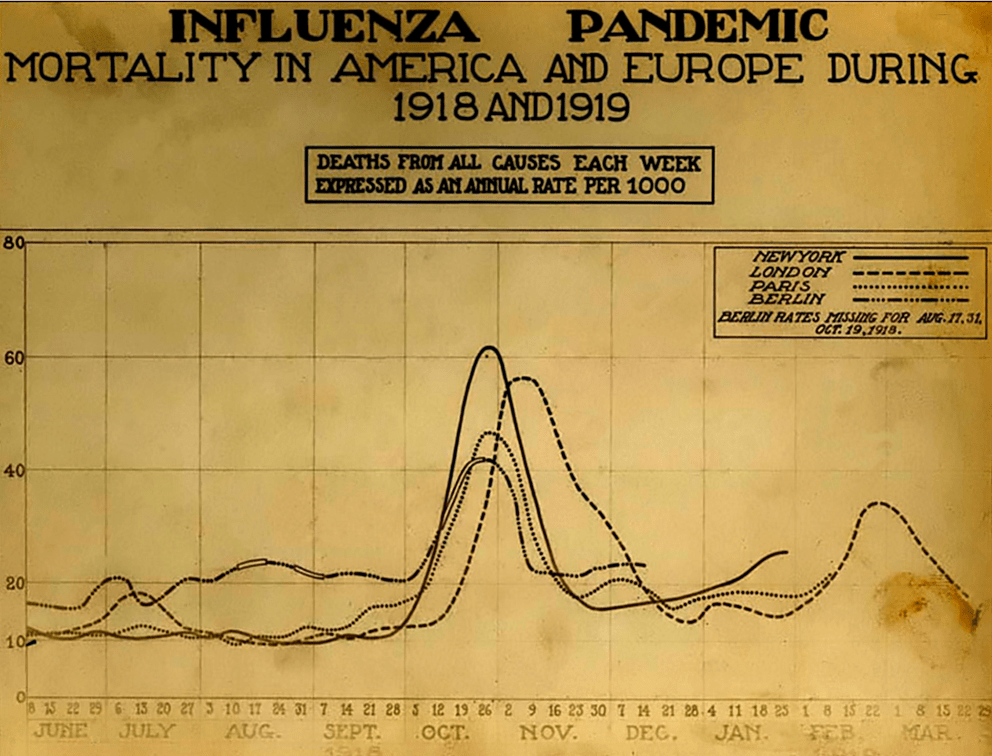
The COVID-19 pandemic was not the first and will not be the last. Historical contexts, memory, and what we believe make a difference to how we live/die in the 2020 pandemic.The influenza pandemic of 1918-1919 killed between 20 and 40 million people, more than all the deaths in World War I. “It has been cited as the most devastating epidemic in recorded world history. More people died of influenza in a single year than in four-years of the Black Death Bubonic Plague from 1347 to 1351” – Stanford Encyclopedia.
In the United States, 195,000 Americans lost their lives in the month of October, 1918 alone. The influenza of 1918-19 became known as “the Spanish Flu” after it took the life of the King of Spain, but it was no more Spanish than COVID-19 is Chinese. A virus is a virus. It pays no attention to nations or the propensity of nations and peoples to target a scapegoat — another nation unlike one’s own — as though a virus knows the difference.
Chart showing mortality from the 1918 influenza pandemic in the US and Europe, courtesy of the National Museum of Health and Medicine
The Parable of the Last Judgment (Matthew 13:31-46)
First appearances can be deceptive, few more so than the teachings of Jesus. The Parable of the Last Judgment is not what it seems –it is not about future end of time. It’s a parable inviting the listeners to get their heads out of the clouds and put their feet on the ground. Its message? Pay attention to people in front of you, or nearby, living under the interstate bridge in the dead of winter. Feed the hungry, clothe the naked, care for the sick, visit the prisoners — put yourself squarely in the midst of human suffering.
We might say, the measure of life is compassion in the midst of a world that makes no good sense. What happens at the end is not yours to know. Pay attention to today. Every day is the Last Judgment.
But there’s something else that goes unnoticed in individualistic cultures. Jesus’s parable it is not about the individual. The parable is not about you. It’s not about me. It’s a story that calls the nations to account for their behavior. In that sense, the parable is political. It’s about the polis and its values. There are no privileged nations. All are measured by one standard. The last judgment– the judgment of compassion, kindness, and humility — takes place every day.
The Opportunity of Trouble
Like the Influenza pandemic of 2018-19, the coronavirus pandemic of 2020 is a crisis in the Chinese sense of the word — danger and opportunity. The danger seems obvious, but perhaps the opportunity is greater. We are at war with each other across the U.S.A., shouting across a deep chasm that the other is a goat. We are in very deep trouble, but we’re in it together because of a deadly virus. In hopes we will come to the deeper knowledge of who we are.
“The human mind and the human heart move to truth through trouble,” said Irish Anglican priest G.A. Studdert Kennedy. “It does not really matter what sort of truth you seek. Bunyan faced with the problem of the soul, and Newton faced with the problem of the stars, are both alike in this: they are troubled spirits. They brood over a mass of apparently unconnected, unrelated, and meaningless facts. Bunyan mutters, ‘There is no health in me’; and Newton mutters, ‘There is no sense in them.’ For both it is dark, and they do not know the way. Both walk at times into the dungeon of despair. The pilgrim’s progress of the scientist and of the saint is made along much the same road, and it begins with a troubled brooding, and a heavy heavy burden at the back of the mind and heart. We must all start there. Life begins in Lent. But there comes to both a supreme and splendid moment, the moment when they cry, ‘I see! I see!’ Bunyan sees a Cross and a Man who hangs in agony upon it. Newton sees an apple falling to the ground. But into the minds of both there comes a blaze of light.” — G.A. Studdert Kennedy (“Woodbine Willie”) sermon “The Word with God.”
Perhaps a blaze of light will flood this moment of trouble, we will rediscover each other, find our better selves, and cry out with fresh joy, “I see! I see!”
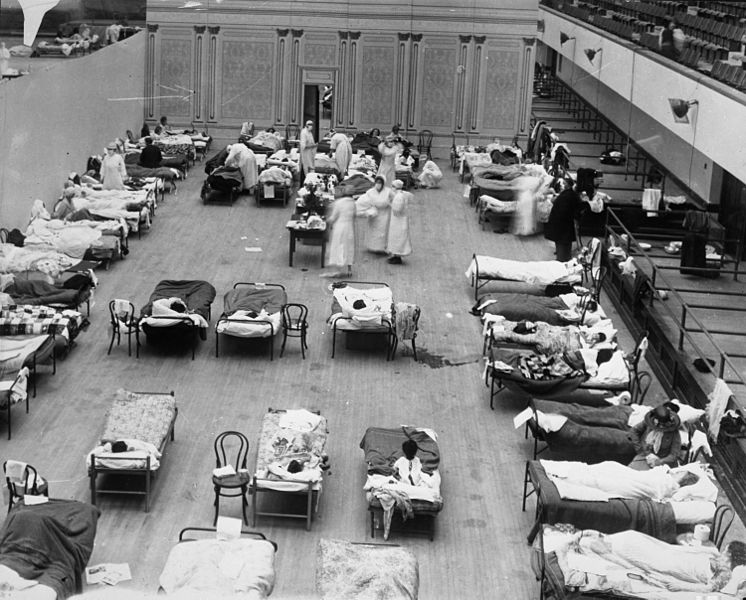
1918 flu epidemic: the Oakland Municipal Auditorium in use as a temporary hospital. The photograph depicts volunteer nurses from the American Red Cross tending influenza sufferers in the Oakland Auditorium, Oakland, California, during the influenza pandemic of 1918.
This is Elijah. I want to be your friend, but grampa says I can’t be. Maybe if we can’t be friends we can talk like this on our iPads on my way to daycare.
I hope you’re staying safe like gramma and grampa. They won’t go out of the house anymore because the germs are outside. They’re old, like you. We haven’t seen each other for a week because of the torona biris. Mommy says I won’t get it cause I’m just two, but I might carry the biris into gramma and grampa’s house and make them sick and die. How do you carry something you can’t see?
Grampa says he hopes you get the biris. I told him that’s not nice! But he says you’re the one who’s not nice. A lot of people listen to you on TB. They believe you, and sometimes you confuse them. Like when you said the torona biris was a hokes grampa made up, but then changed your mind and said it was real, that it used to be a hokes, but now it’s not. Did you lie? Did you really believe grampa was bad?
You owe grampa and Nancy an apology. So does Mr. Limball. Grampa says Mr. Limball is a lot like you. He throws a lot of stuff against the wall to see what sticks and it gets all over people who believe him on the radio. But Mr. Limball has cancer. We’re supposed to pray for him. Grampa prays for you and Mr. Limball all the time. He says you’re both cancers and we should pray for those who prosecute us. He prays you will just shut up. But his prayers are never answered. Do you believe in prayer?
Have you told everybody you were wrong about grampa and Nancy and the torona biris? Grampa says you should confess. You changed your mind about the biris. So did the president. That’s good. But you still owe grampa and Nancy an apology. Grampa says it’s easy. Just tell them you’re sorry, stop prosecuting them, ask for their forgibnis, and then tell the truth, and tell Mr. Limball to do it too.
Anyway, I hope you listen to grampa. Stay in your house, and don’t say a thing to anybody except Mrs. Hannity about anything until the torona biris is gone. That will make life more peaceful for grampa, and what’s good for grampa and gramma is good for me.
Your friend,
Elijah
“Love your enemies and pray for those who prosecute you.”
Everything is shutting down. Almost. But not memory, and not love.
This story of a quarantine is not from the 1930s or the quarantines social-distancing of 2020. It happened in 1950, but, in some respects, it feels the same.
THE ROOM WITH NO LIGHT
Live & Learn‘s post quoting Pat Schneider’s “Blessing of a Writer” (see below) brought back the memory of a two-week quarantine as an eight year-old diagnosed with Scarlet Fever.
For the next 14 days, the second floor bedroom of the 120 year-old house on Church Lane was dark. Pulled shades and extra drapes blocked the light. Fourteen dark days and nights of enforced solitude.
May you hear in your own stories the moan of wind around the corners of half-forgotten houses and the silence in rooms you remember…
Abstract

In Illinois after the diagnosis of scarlet fever and other hemolytic streptococcal infections of the upper respiratory tract is made, "Isolation is required for a minimum period of 14 days after onset and thereafter until the nose, throat, glands, and ears are normal on inspection or until the physician reports complete clinical recovery."1
Other states have essentially the same regulation except that the minimum quarantine period is 21 days instead of 14.
SILENCE IN THE HALF-FORGOTTEN HOUSE
The house on Church Lane was in Pennsylvania, not in Illinois, but the Scarlet Fever and the quarantines were the same. No baseball. No backyard games of hide-and-seek or tag. No evenings with the fireflies. No school. Not everything felt like a curse.
To prevent blindness, the room was dark. Other than Mom delivering meals, checking the fever, and reminding me not to scratch, the room was empty and quiet with one exception: the purring of Buddy, the cross-eyed cat with the crooked tail. Even a cat needs company sometimes. I like silence. A lot! But not that much. We’re not meant to be alone. Everyone needs a friend like Buddy.
FINDING OURSELVES IN SOLITUDE
Old memories return in times that awaken them. Live & Learn’s gift of a “Blessing for a Writer” came at just the right time. I fancy myself a writer, but words worth writing have been hiding during the spread of the latest pandemic when the fever and isolation are everywhere..
Might the solitude lead us to find each other?
“Only in solitude do we find ourselves; and in finding ourselves, we find in ourselves all our [neighbors] in solitude.”
— Miguel de Unamuno, “Solitude,” Essays and Soliloquies (1924), tr. J.E. Crawford Finch.
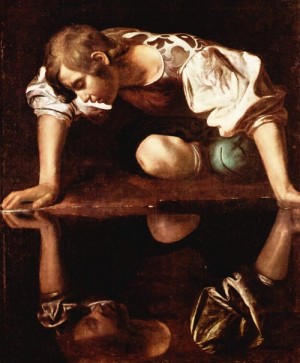
Narcissus of the Greek myth slowly wastes away. Refusing to look away from his reflection in the pond, he dies of thirst and starvation.
The myth assumes that the pond is placid. There are no ripples. But what if a storm troubles the waters, rippling the pond –something like a virus that does not notice Narcissus’s need to see his own reflection in the pond.
Narcissus mutters to himself until, at last, his voice falls silent, except for Echo, repeating his words, forgetful of what she had surrendered to his power: the confidence and beauty that come only from within.
Teach me, like you, to drink creation wholeAnd, casting out myself, become a soul.
- Richard Wilbur, “The Aspen and the Stream,”
Advice to a Prophet (1961)












 Views from the Edge