Steve wants you to know that we’re both important. He has his tower. I have mine. Steve is host of “Keepin’ the Faith,” a Sunday evening program on on WILL – archive programs, “including two with Gordon Stewar” (Steve ordered me to put this in here – he’s taller, so I do everything he says), can be heard anytime, anywhere @ www.will.illinois.edu/keepinthefaith
Steve’s walk down memory lane arrived as I prepare to moderate a public meeting tomorrow night (Tuesday, May 1) that could repeat the history of religious arrogance. Pro and con positions will be offered on the proposed “marriage amendment” to the MN State Constitution that would define marriage as between one man and one woman. Lord, help the moderator…and the speakers…and all who attend to speak boldly and clearly, but also with some meekness. This is not a laughing matter.
Steve Shoemaker standing at historic pulpit of Sheldon Jackson Church, Colorado
“Views from the Edge” note: Steve is not a Deacon and he’s not a lawyer. He’s a retired Presbyterian minister, poet, and activist living on the prairie near the University of Illinois. Steve was Pastor and Director of the McKinley Presbyterian Church and Foundation at the University of Illinois. He concluded his ministry as Executive Director of the University YMCA at the University of Illinois, a vigorous campus student center as big in heart and mind as Steve. His voice is heard every Sunday evening as host of “Keepin’ the Faith” an interview show on the University of Illinois’s radio station, WILL AM – Illinois Public Radio.
Old family sawmill of Andrews Casket Company, Woodstock, Maine
My great-great-great-grandfather Isaac Andrews founded the Andrews Casket Company and Funeral Home next to the trout stream in Woodstock, Maine more than 250 years ago. Isaac was a minister.Because there was no carpenter in town, he not only stood at the graves. He built pine boxes for those he buried.
Over the course of time, the simple boxes became the caskets of the Andrews Casket Company and Funeral Home. You might say Isaac had a monopoly in those Maine woods.
Only recently did the Andrews property leave the family when Pete Andrews, my late mother’s favorite cousin, sold it to some whippersnapper who just wanted to make a buck.
My mother used to chuckle as she recalled playing hide-and-seek with her siblings in and among the caskets at the casket factory. The land, the mill, the old homestead,the funeral home and the trout stream that had belonged to the family all those years belongs to someone new…which means that it, like Garrison Keillor’s fictional “Lake Woebegone,” never really did belong to us and does not belong to them. It does not belong to time.
Last October my brother Bob and I stood with my cousins at the open grave of my 99 year-old Aunt Gertrude – our one remaining Andrews elders. I recited from The Book of Common Worship the prayer I have prayed a thousand times at the open grave, the one my classmate Steve and I learned as young, naive pastors, a prayer for the living that feeds me day and nigh until the lights go out. I wonder if Isaac Andrews did the same way back when.
“O Lord, support us all the day long until the shadows lengthen, and the evening comes, and the busy world is hushed, and the fever of life is over, and our work is done. Then, in your mercy, grant us a safe lodging and peace at the last.”
Book of Common Worship
Here’s the poem from Steve from a few days ago that inspired the above reflection.
When I was just a young and naive pastor, an old man in the congregation would always arrive long before the rest of the people at the grave site. He’d shun the funeral, but haunt the cemetery… Standing by the open grave, he’d state his opinion of the deceased and share with me the type, style and brand of casket he’d told his wife he wanted when he died. As the morticians say, he “predeceased” his spouse, and when we met to plan, she tried to grant his wishes to the very last She blessed their common gravestone with her tears, but smiled through life for many happy years.
“The Man Who Loved Graves” – Steve Shoemaker, April 24, 2012
Like the widow of the man who loved graves, I smile through tears for all the years, and I take ancestral solace in knowing that I don’t really “own” a thing.
Gordon C. Stewart, the not-so-great great-great-great grandson of Isaac Andrews
Five visitors from Germany were guests of an international service club recently where my friend Steve Shoemaker is a member.After the meeting, they asked Steve some questions.
Why ask Steve?
For starters, he’s 6’8″ and he’s up for Club President soon…unless he’s impeached before taking office for his Letter to the Editor.
Dear Editor,
Five folks from Germany recently visited central Illinois as part of a local service club program to improve international understanding.
At one point they asked me about something they did not understand: why do Americans begin so many gatherings with a ‘”patriotic” song, the Pledge of Allegiance, and a prayer?
As foreign visitors, of course, they felt excluded from at least the first two–often at events designed supposedly to welcome them… And if from a non-Christian religious tradition, they felt excluded from all three.
Perhaps especially because they were from Germany, remembering the horrors of two world wars begun partly from excessive beliefs in the superiority of their nation and religion, they were sensitive to expressions of exceptionalism at U.S.A. sports events and service club meetings.
Can we welcome others better by showing the American virtue of hospitality, finding rituals that affirm the equality of all, and treating others the way we wish to be treated?
Steve’s an affable chap and hard not to like. At the next meeting Steve and some of the members had a nice chat. There’d been some conversation, they had a different opinion, they said, and the good thing was they were all free to disagree.
Hmmm.
Click HEREfor a quick history lesson on the evolving text of the Pledge of Allegiance.
What do YOU think? Chime in with a comment to expand the discussion. I’ll send them to Steve for the next meeting.
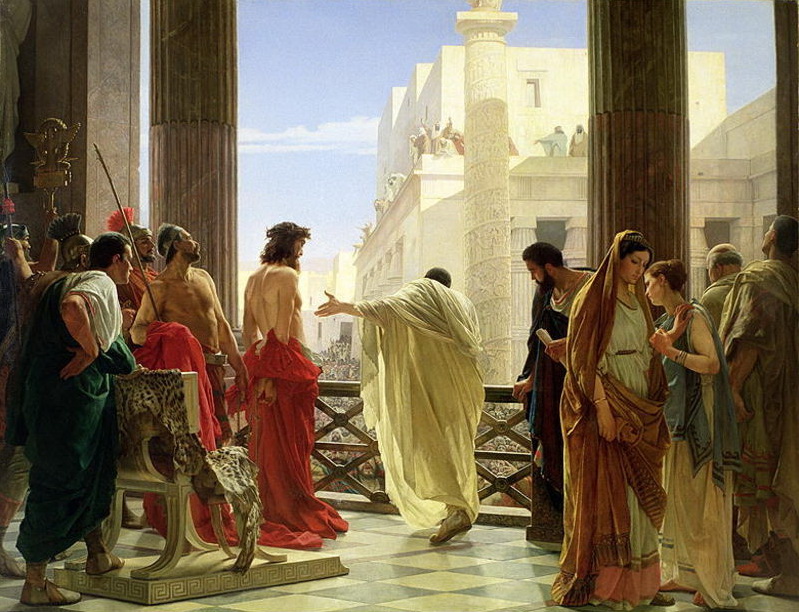
“PONTIUS PILATE” – (acrostic) – Steve Shoemaker – April 14, 2012
Position is the most important thing,
Of course… You say your reign is not in this
Nasty world, but here you are suffering…
Total power is mine. If this grim choice
I make (and ignore my wife’s dream), nothing
Untoward will come back to haunt me! I wash
Sand and dirt from my hands as I wash you…
Prefects are not required to be perfect.
If I send tax money to Rome, a few
Lies told against me soon will die.
A sect or uprising I stamp out now will do
The most to make my name remembered. Fact:
Even if I call you “King,” you die a Jew….
If you like Steve’s poem, you might also be interested in “You don’t get to have a non-Jewish Jesus” (CLICK HERE), posted earlier on Views from the Edge on Christian anti-Semitism.
Art work Ciseri, Antonio, 1821-1891. Ecce Homo – “Here is the Man”, from Art in the Christian Tradition, a project of the Vanderbilt Divinity Library, Nashville, TN. http://diglib.library.vanderbilt.edu/act-imagelink.pl?RC=55115 [retrieved April 14, 2012].
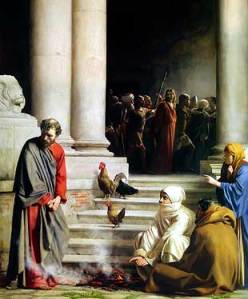
Any faith worth its salt recognizes our capacity for denial, betrayal, and flight, as well as our capacity for truth, love, and courage. Steve Shoemaker’s poem about the Apostle Peter, “the Rock” who crumbled, takes us into the heart of the matter. It;s a reflection on Peter denying that he knew Jesus (represented by Carl Bloch’s painting where he looks away from the woman who claims he knows him) and the post-resurrection appearance where the resurrected Christ offers forgiveness.
“DENIAL”– Steve Shoemaker, 2012
The future Bishop began badly. He
was “rude, crude and lewd,” as they say.
His fist would shake, would hit,
his mouth could often be a sneer, or leer…
but Jesus chose him first.
The fisherman was big and brash, yes,
bold as well at times. But after the arrest
a servant girl confronted him and
told those listening that Peter was with Christ.
He swore and then denied it, then again
and still again–she would not stop.
The cry then came of rooster telling of the dawn,
and he wept because he had told a lie.
But Peter felt forgiveness full and deep
when Jesus three times told him,
“Feed my sheep.”
Peter “the Rock” was no rock. Nor are we. He was sinking sand. So are we.
Like “the future Bishop,” we slip badly and yet we are raised up. Betrayal, denial, flight are part of every human story. But grace… even more….so much more, abounds! And to the likes of Peter and of us, there comes to our three-fold denial the Voice of forgiveness with a gentle but bold command: “Re-gain your courage. Live in love!”
It’s Good Friday. Why would anyone call it “GOOD”? Today the Roman Empire executed Jesus. Beat him, stripped him, mocked him, jeered at him, hoisted him intot he air on cross, threw dice for the purple royal robe in which they had clothed him, pierced his side with a soldier’s spear, heard him cry from the cross, “Eloi, Eloi, lema sabachtani!” “My God, my God, why have you forsaken me!” Why would anyone in their right mind call this horror “GOOD”?
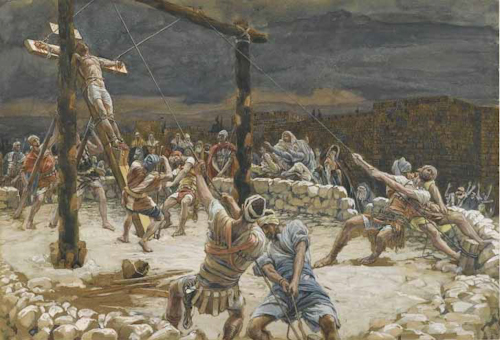
The raising of the cross - James Tissot
Sebastian Moore, O.B, speaks to this in The Crucified Jesus Is No Stranger (Seabury Press, 1977).
The meaning of the Christ-event is that in it the wrestle of man with his God-intended self is dramatized and led through the phases of rejection, hatred, crucifixion, destruction, surrender, new life. Oscar Wilde said, “each man kills the thing he loves.” Those who stop short of evil in themselves will never know what love is about. They will never receive the crucified. – p. 37
The human race thinks it can go on with all its Narcissistic human normalities, of war, of politics, of religion, and that somehow the vast other side of the picture will look after itself. So in opting for “himself as conscious”, man is opting for an ultimate solitude.
And ultimate solitude is death. It is to be cut off from the tree of life, and to wither. – pp. 69-70
For your further reflection, this poem received today from Steve Shoemaker.
Good Friday?
What makes this Friday Good is not what Rome
did to Jesus: torture, false witnesses,
and finally capital punishment.
In all regimes these standard practices
preserve the powerful, but then foment
disgust, infamy, abroad– shame at home.
The dying one, the empty tomb was good
only if we are justified by trust,
mysteriously by God’s grace made whole.
The goodness cannot stay with us, it must
be passed on to the world–this is our role.
The Good is recalled in the feast: soul food.
In a few moments I will host the Good Friday meditation – readings from the Gospels, long silences, the movements of Garbriel Faure’s Requiem…silence…reading… until it all soaks in.
I can’t get to Easter by by-passing the cross. Click to hear the music.
Click HERE to read and view the photos of religion on the campaign trail in Michael Gerson’s opinion piece in this morning’s Washington Post. Comment below to generate the discussion her. But…before you do…ponder Steve Shoemaker‘s “The Donkey” sent to me this morning in preparation for Palm/Passion Sunday.