The President’s Speech on the Economy

Aired earlier today on All Things Considered (MPR, KNOW, 91.1 FM).
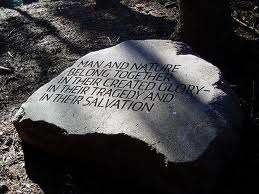
Paul Tillich quote in Tillich Park, New Harmony, IN.

Paul Tillich quote in Tillich Park, New Harmony, IN.

Today President Obama began a series of speeches about the future of the American economy. I hope he takes us back to the basics of what an “economy” is.

Economics is about a household and how to manage it. The household is a family, a state, a nation, a planet.

The English word “economy” comes from the Greek work oikos – the Greek word for house. The word “economics” derives from the Greek word oikonomia–the management of a household.

Before it is anything else, economics is a perspective, a frame of reference. Before it decides anything about household management, it knows that there is only one house. Good household management – good economics – pays attention to the wellbeing of the entire house and all its residents.

In America and elsewhere across the world, we are coming to realize that the planet itself is one house. What happens in one room of the house – one family, one city, one nation – affects what happens everywhere in the house. Paul Tillich caught the clear sense of it when he wrote that “Man and nature belong together in their created glory – in their tragedy and in their salvation.” That is to say, there is only one house.

The essential question of economics is not about systems – capitalism, communism, socialism, or something else. The essential question is spiritual, philosophical, and ethical. It’s whether we believe that there is only one oikos, one house; the subsequent question is about how best to manage it for the wellbeing of all its residents and the fragile web of nature without which the house of the living would not exist.

Very often what we call ‘economics’ is not economics. It’s not oikonomia. It’s something else. It assumes something else, and when we forget what an economy and economics really are, we enshrine greed as the essential virtue, ignoring and imperiling everyone else and everthing in the one house in which we all live.

I dream that the President will preach the old Greek common sense: that in his own way, he will reclaim the essential premise of an economy and the ethical task of economics. By bringing the Greek origins to our television sets, headsets, and iPads, he can call us to move forward out of the partisan houses of nonsense.

There is only one house.

Time

My son once asked me “What is time?”

I answered, “I don’t know. It’s a perennial question of philosophers and theologians. But, so far as I can tell, time is what we have.”

Some people think that time isn’t real. It’s a human construct and only eternity is real. They think of time and place as the prison of the soul, the antithesis of, or the prelude to, eternal life.

It always seemed a bit strange to me. Like the imaginary friends children make up because they’re afraid of being alone in the dark. I could never understand.

“Time is what we have.”

The animals know what time is. They also know eternity. They wake and sleep with the rhythms of the sun – rising and setting daily – the markers of what we call time. They know nothing about clock time or the names of days, months, seasons or years, but they live in the reality of time.

Time is what we have between birth and death. Eternity is the depth of time, the Mystery beneath, within, and beyond the limits of time. We participate in the eternal, but we are not eternal. To think otherwise is to consider ourselves the exception to nature itself.

The illusion of superiority to nature – the idea that the human species is nature’s singular exception – is a fabrication peculiar to the species that considers itself conscious. The imaginary friend of eternal life may help us sleep better at night, but it leads to slaughter and, eventually, to species suicide.

Ernest Becker (The Denial of Death) saw the denial of death as bedrock to American culture. The denial of death – the refusal to acknowledge it as real; the flight from the knowledge of our mortality – not only deprecates life here and now; it takes into its hands the life and death of those different from ourselves. It builds towers to itself that reach toward the heavens while it plunders an earth it considers too lowly for its aspirations.

Time is our friend and time is our limit. We are meant for this. “Grace and pride never lived in the same place,” says an old Scottish proverb, for pride always seeks to exceed what is given (grace).

Time is what we have. Time is a participation in the glory of God. If there’s more, it will only by grace.

It’s raining, its pouring

Maybe we bumped our heads getting a little snack last night! And the night before that, and…. Will it ever stop?

Deep Water Horizon Three Years Later

This conversation about BP, the oil companies, coastal erosion, and the distribution of the BP Settlement Fund took place at Shepherd of the Hill Presbyterian Church in Chaska one week before the 3rd Anniversary of the Deep Water Horizon explosion.

Albert Naquin is Chief of the Isle de Jean Charles Band of Biloxi-Chitimacha-Choctaw, a subsistence fishing community whose traditional land and way of life are vanishing quickly.

Kristina Peterson is Pastor of the Bayou Blue Presbyterian Church in Gray, LA and a disaster recovery professional and researcher with the University of New Orleans Center for Hazard Assessment, Response, and Technology. Kristina was a speaker at First Tuesday Dialogues in Chaska, MN one year after the explosion of Deep Water Horizon. She returned with Chief Albert for this conversation on their way to a conference in Duluth, MN of indigenous people who live along the Mississippi River from its headwaters in Minnesota to its mouth in the Louisiana Delta of the Gulf Coast.

The off-camera voice later in the conversation is the editor of Views from the Edge and Pastor of Shepherd of the Hill.

“Something is very wrong with a system that puts corporations above people.” – Kristina Peterson

Sebastian

Sebastian

Sebastian

The puppy shyly made his way across the living from floor to Kay’s feet.

At six-weeks old, he was cute, but he was a “he”. We wanted a “she”.

We had called ahead to ask whether any females were left from the half Bichon Frise – half Shih Tzu litter.

By the time we arrived, the females had been taken. Since we were there and the puppies were out, we stayed to watch them play and to get a better sense for the breed.

Disappointed that there was no female, but unable to forget the pup that came to Kay, we got back in the car and headed for home.

Two blocks from the kennel, Kay broke the silence. “I can’t leave him. I love that puppy. We have to go back and get him.” We went back and got him. Kay held him in a blanket on the way home.

We named him Sebastian. He just seemed like a Sebastian.

Thirteen years later, April 20, 2013, Kay held him once more in a blanket … on the way to the veterinarian.

I keep waiting for him to follow me up or down the stairs, settle by my feet at the computer desk, nuzzle up to my thigh during our nap, pester us to go upstairs when it’s bedtime. The house is not as full.

We got a “he” for a little while. A gift named Sebastian. We never “owned” him. We don’t really own a thing.

Dog strikes back at cyberspace

Think dogs don’t reason as we do? Think their reasoning is less precise? That they act only on instinct? Have no purpose of forethought? Think they can’t talk?

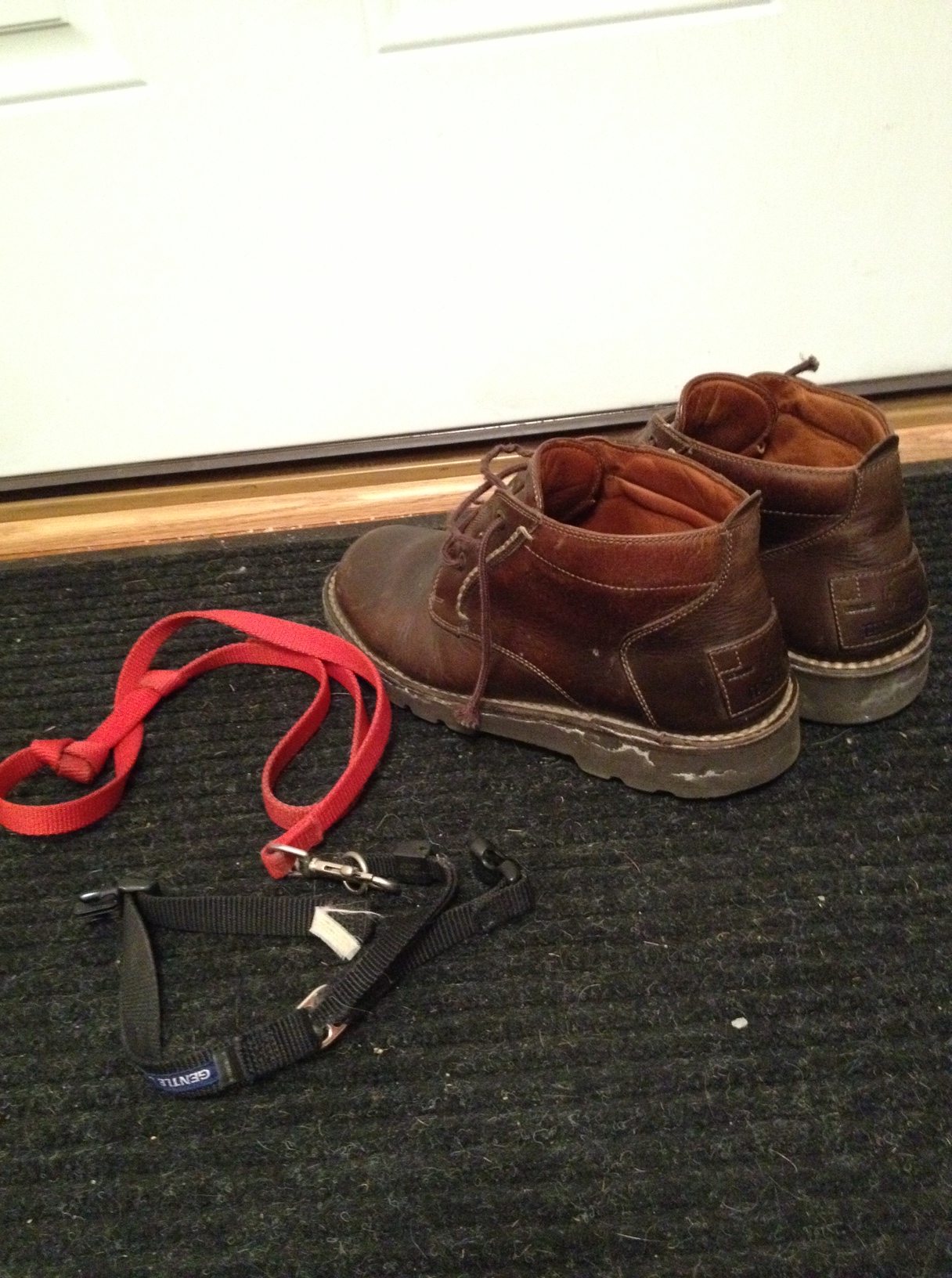
Consider the shoe by the front door.

boots by front door

The shoes belong to the “dog-owner” who has been upstairs blogging obsessively, ignoring his dog’s persistent pestering. Sebastian pawed, scratched his back feet on the carpet, and barked. At first the blogger ignored him and then chastened for interrupting the important message he was preparing to send into cyberspace.

Dog surrenders. Disappears for 10 minutes. Returns and quietly, without a word, jumps up to his customary place on the sofa in the blogger’s office.

Blogger completes his thoughtfully reasoned cyberspace communication and decides it’s time to take the little guy out.  Blogger goes downstairs, takes off his slippers, puts on the left shoe next to the leash by the front door, and winces.

Sebastian has left a perfectly directed, perfectly contained puddle in the shoe. No evidence to the side of the shoe or the back or front of the shoe. All of the message is IN the shoe, nature striking back at cyberspace with the clearest of messages carefully delivered with forethought and drone-like precision:

“Dad, you really pissed me off!!”

Sebastian

Nature

The tick that carries spotted fever

malaria that mosquitos pass

on to mere kids, and then the cancer

that twists, subverts, deforms normal cells–

who can ever say this world is good?

The mind that in an empty room hears

loud voices saying run, hurt, be bad

not good, rape, kill, then die yourself.  Fears

are all around.  There is no hope left.

We can be as deformed as our world.

Can someone befriend us when bereft?

Join us with our demons in the cold?

Maybe not help us to understand

evil all around, but hold our hand?

– Steve Shoemaker, Urbana, IL, June 7, 2012