Amid the Flood

Days before reading and re-publishing Linn Ullman’s lines about memory and the loss of it (“You just can’t think too deeply about it”), one of the four remaining classmates of what we’ve called The Chicago Seven, The Gathering, and now The Old Dogs, sent the rest of us an article on Alzheimer’s our latest deceased brother, Wayne, had published years ago.
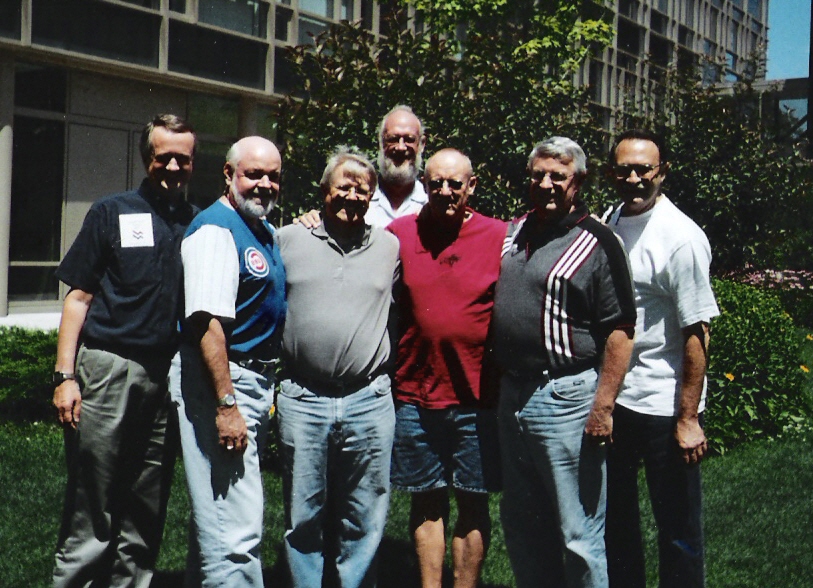
Chicago Seven Gathering L to R: Wayne Boulton, Harry Strong, Gordon, Steve Shoemaker, Dale Hartwig, Don Dempsey, Bob Young@ McCormick Theological Seminary, Chicago, IL, 2004.

As Wayne had imagined his ship going over the far horizon, his worst thought was not death. It was that he would live on, like his father had, without remembering how to tie his shoelaces and without recognizing Vicki, the love of his life, his sons Matt and Chris, daughters-in-law Liz and Libby, and the grandchildren who brought him such joy.

That nightmare didn’t happen. He went out with his mind in tact, as much as a hospice patient’s mind is ever fully there. Aside from his last few days, Wayne’s mind was clear and his heart was full. The article Harry sent the three other surviving Dogs is a reflection on Psalm 90:10, 12 (RSV):

The days of our life are seventy years,
    or perhaps eighty, if we are strong;
even then their span is only toil and trouble;
    they are soon gone, and we fly away. teach us to count our days
that we may gain a wise heart.

When he died in 1989, the sum of Dad’s years came closer to fourscore than to threescore and ten. With the psalmist, I attribute this number to his strength, but I would not wish the manner of his death on anyone. He died of complications due to Alzheimer’s disease.

It was my first experience with the death of an immediate family member, so I was no veteran. I found myself up against a more complicated reality than I had anticipated. I remember thinking at the time that some portion of this is just plain death: nasty, sad, the way death always is. But it is not natural death. It is something else. In the words of Martin Luther’s signature hymn, the disease threw every member of Dad’s little nuclear family—his wife, daughter-in-law, and myself—into a “flood of mortal ills prevailing.”

Amid the Flood,” Wayne G. Boulton, Reformed Review, Western Theological Seminary, December 1, 2000.

Wayne died the way he lived and lived the way he died. Faithful son, husband, grandfather, and friend. Wise. Compassionate. Pastoral. Realistic. Hopeful. Consoler. Prayerful. Private. Counselor. Social critic. Political wonk. Brilliant Christian theologian-ethicist. Follower of truth wherever it led him. All of that and so much more. But, if I had the pen to engrave his epitaph on the simple grave stone in the cemetery of the Mount Vernon Presbyterian Church, if might read,

A sheep of Your own fold, a lamb of Your own flock, a sinner of Your own redeeming, humble servant his Lord and Savior Jesus Christ amid the flood of mortal ills.

  • Gordon C. Stewart, Chaska, MN, March 5, 2019.

You just can’t think too deeply about it

Consolation following a loved one’s death comes hard sometimes. Wayne died of pancreatic cancer. But his greatest fear was that he would die the way his father did: living with Alzheimer’s, staring at his shoes. He still remembered how to tie his shoelaces. ~ Gordon, remembering Wayne G. Boulton (1941-2019).

Live & Learn's avatarLive & Learn

Think about the work that goes into tying your shoelaces. It calls for physical exertion, dexterity, and cleverness, any child between the ages of six and nine years old knows it, early in life it is a serious matter, the bow the greatest mystery, the fingers, the hands, the laces, altogether an apparently unsolvable riddle. But once you have mastered it, you forget how complicated it is, the years pass until one day—having put your socks on—you look down at your feet, unsure of how to proceed.

Linn Ullmann, ”Unquiet: A Novel” (W. W. Norton & Company, January 15, 2019)


Notes: Photo titled Self Perfection by Randy’sPhotography

View original post

Elijah stands up for democracy

Good morning, Bumpa!

Well, good morning to you, Elijah! It’s cold, but it looks like a great day.

Yeah, the sun’s out. I get to see the sunshine on the drive to daycare.

That’s a long drive.

Yeah, last Wednesday it took us two hours! But that wasn’t the worst thing, Bumpa.

What was the worst thing?

Television!

Didn’t the TV work?

No, it worked. It was on all day!

So what was the problem?

We’re a democracy, right, Bumpa?

Well, Sort of. Yes. What’s that have to do with the television?

Democracy’s where everybody votes and majority wins, right?

Pretty much. I’m not following. What’s majority rule have to do the television?

Marissa got the only vote last Wednesday! That’s not fair!

Well, it is her house. It’s Marissa’s television, and she’s the only adult in the house. Majority rule doesn’t apply. Daycare’s not a democracy.

Yeah, it’s authoritarian! She was a tyrant, Bumpa! We couldn’t watch Sesame Street and our other kids programs.

What did you watch instead of Sesame Street?

The Michael Cone Show. All day. In Congress. The people were mean, Bumpa!

You watched the whole hearing?

Well, not all of it. We kept protesting and Marissa was making a lot of noise shouting at the Show.

Was she mad at you?

No.

Was she mad at Michael Cone?

No.

So, who was she mad at, Elijah?

The Publicans! Every time one of the Publicans was mean to Michael, Marissa yelled, El que está sin pecado, tire la primera piedra!”*

— Grandpa (“Bumpa”) Gordon, Chaska, MN, March 4, 2019.

*In English for others of you who don’t speak Spanish: “Let him who is without sin cast the first stone!”


The Magician’s Bargain in 2019 America

Beneath the surface of the obvious turmoil in American lies a fissure deeper than our differences. More than just a fissure. A seismic shift in the ground that has traditionally held the nation together, as suggested by this adaptation of L. Robert Kohl’s “The Values Americans Live By”:

Traditional American Cultural Values

1. PERSONAL CONTROL OVER THE ENVIRONMENT
People can/should control nature, their own environment and destiny. The future is not left to fate.
Result: An energetic, goal-oriented society.

2. CHANGE / MOBILITY
Change is seen as positive and good. This means progress, improvement and growth.
Result: An established transient society geographically, economically and socially.

3. TIME AND ITS IMPORTANCE
Time is valuable - achievement of goals depends on the productive use of time.
Result: An efficient and progressive society often at the expense of interpersonal relationships.

4. EQUALITY / EGALITARIANISM
People have equal opportunities; people are important as individuals, for who they are, not from which family they come.
Result: A society where little deference is shown or status is acknowledged.

5. INDIVIDUALISM, INDEPENDENCE AND PRIVACY
People are seen as separate individuals (not group members) with individual needs. People need time to be alone and to be themselves.
Result: Americans may be seen as self-centered and sometimes isolated and lonely.

6. SELF-HELP
Americans take pride in their own accomplishments.
Result: Americans give respect for self achievements not achievements based on rights of birth.

7. COMPETITION AND FREE ENTERPRISE
Americans believe competition brings out the best in people and free enterprise leads to progress and produces success
Result: Competition is emphasized over cooperation.

8. FUTURE ORIENTATION / OPTIMISM
Americans believe that, regardless of past or present, the future will be better and happier.
Result: Americans place less value on past events and constantly look ahead to tomorrow.

9. ACTION AND WORK ORIENTATION
Americans believe that work is morally right; that it is immoral to waste time.
Result: There is more emphasis on "doing" rather than "being". This is a no-nonsense attitude toward life.

10. INFORMALITY
Americans believe that formality is "un-American" and a show of arrogance and superiority.
Result: A casual, egalitarian attitude between people is more accepted.

11. DIRECTNESS / OPENNESS / HONESTY
One can only trust people who "look you in the eye" and "tell it like it is". Truth is a function of reality not of circumstance.
Result: People tend to tell the "truth" and not worry about saving the other person's "face" or "honor".

12. PRACTICALITY / EFFICIENCY
Practicality is usually the most important consideration when decisions are to be made.
Result: Americans place less emphasis on the subjective, aesthetic, emotional or consensual decisions.

13. MATERIALISM / ACQUISITIVENESS
Material goods are seen as the just rewards of hard-work, the evidence of "God's favor."
Result: Americans are seen as caring more for things than people or relationships.

Adapted from http://“The Values Americans Live By”, L. Robert Kohls

Thoughtful people may quibble with Robert Kohl’s list. But few would erase the 11th valuehonesty/trustworthiness –as bedrock to the American experiment in democracy. 

The Magician’s Bargain

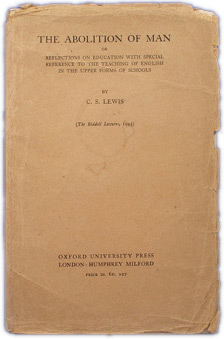
Looking each other in the eye and “telling it like it is” has been chipped away, replaced by the twists of tongue and cunning to get and hold power. In our time, truth has been reduced to a function of circumstance in the road to power. We live with the consequences of what C.S. Lewis called the magician’s bargain.

It is the magician’s bargain: give up our soul, get power in return. But once our souls, that is, ourselves, have been given up, the power thus conferred will not belong to us. We shall in fact be the slaves and puppets of that to which we have given our souls.

C.S. Lewis, The Abolition of Man

The surrender of soul in return for power is the seismic shift in the America of 2019. Honesty/openness/directness have never been a fact of our common life. The 11th traditional value is aspirational. There have been and always will be lies. But never in my lifetime has truth-telling been less valued than it is today in the highest places of government. To the chagrin and sadness of George Will and other principled traditional conservatives, it is the children of Jerry Falwell‘s Moral Majority who engage the moral magician’s bargain.

The Irony of the American Magician’s Bargain

Michael Cohen testified last week before the U.S. House Oversight and Reform Committee. The minority members of the Committee attacked the credibility of the convicted criminal who had served for 10 years as the president’s personal lawyer and “fixer” and chose to ignore the hard evidence the president’s “rat” had placed before them.

The only difference between Michael Cohen and those who refused to exercise their duty to uphold the Constitution was that Michael had confessed.

Do we feel the rumbling of the common ground beneath the partisan divide?

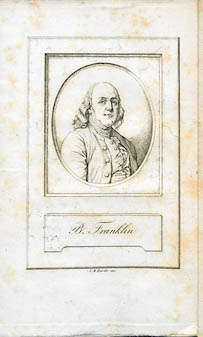
How deep is the loss! How much greater the challenge. Ben Franklin would have a cow!

“We laugh at honor and are shocked to find traitors in our midst.”  — C.S. Lewis, The Abolition of Man.

— Gordon C. Stewart, Chaska, MN, March 2, 2019.

I chose to show him empathy

When the killer of 11 Shabbat worshipers at Tree of Life synagogue in Pittsburgh was admitted to the hospital emergency room, he had no idea the E.R. nurse who showed him compassion was Jewish. In this piece, Ari  Mahler, R.N. writes of his experience. It was originally published on Blogspot.com.

“The Jewish Nurse”

I am The Jewish Nurse.

Yes, that Jewish Nurse. The same one that people are talking about in the Pittsburgh shooting that left 11 dead. The trauma nurse in the ER that cared for Robert Bowers who yelled, “Death to all Jews,” as he was wheeled into the hospital. The Jewish nurse who ran into a room to save his life.

To be honest, I’m nervous about sharing this. I just know I feel alone right now, and the irony of the world talking about me doesn’t seem fair without the chance to speak for myself.

When I was a kid, being labeled “The Jewish (anything)”, undoubtedly had derogatory connotations attached to it. That’s why it feels so awkward to me that people suddenly look at it as an endearing term. As an adult, deflecting my religion by saying “I’m not that religious,” makes it easier for people to accept I’m Jewish – especially when I tell them my father is a rabbi. “I’m not that religious,” is like saying, “Don’t worry, I’m not that Jewish, therefore, I’m not so different than you,” and like clockwork, people don’t look at me as awkwardly as they did a few seconds beforehand.

I experienced anti-Semitism a lot as a kid. It’s hard for me to say if it was always a product of genuine hatred, or if kids with their own problems found a reason to single me out from others. Sure, there were a few Jewish kids at my school, but no one else had a father who was a Rabbi. I found drawings on desks of my family being marched into gas chambers, swastikas drawn on my locker, and notes shoved inside of it saying, “Die Jew. Love, Hitler.” It was a different time back then, where bullying was not monitored like it is now. I was weak, too. Rather than tell anyone, I hid behind fear. Telling on the people who did this would only lead to consequences far worse.

Regardless, the fact that this shooting took place doesn’t shock me. To be honest, it’s only a matter of time before the next one happens. History refutes hope that things will change. My heart yearns for change, but today’s climate doesn’t foster nurturing, tolerance, or civility. Even before this shooting took place, there’s no real evidence supporting otherwise. The FBI and the Southern Poverty Law Center note that Jews only account for two percent of the U.S. population, yet 60% of all religious hate crimes are committed against them. I don’t know why people hate us so much, but the underbelly of anti-Semitism seems to be thriving.

So now, here I am, The Jewish Nurse that cared for Robert Bowers. I’ve watched them talk about me on CNN, Fox News, Anderson Cooper, PBS, and the local news stations. I’ve read articles mentioning me in the NY Times and the Washington Post. The fact that I did my job, a job which requires compassion and empathy over everything, is newsworthy to people because I’m Jewish. Even more so because my dad’s a Rabbi.

To be honest, I didn’t see evil when I looked into Robert Bower’s eyes. I saw something else. I can’t go into details of our interactions because of HIPAA. I can tell you that as his nurse, or anyone’s nurse, my care is given through kindness, my actions are measured with empathy, and regardless of the person you may be when you’re not in my care, each breath you take is more beautiful than the last when you’re lying on my stretcher. This was the same Robert Bowers that just committed mass homicide. The Robert Bowers who instilled panic in my heart worrying my parents were two of his 11 victims less than an hour before his arrival.

I’m sure he had no idea I was Jewish. Why thank a Jewish nurse, when 15 minutes beforehand, you’d shoot me in the head with no remorse? I didn’t say a word to him about my religion. I chose not to say anything to him the entire time. I wanted him to feel compassion. I chose to show him empathy. I felt that the best way to honor his victims was for a Jew to prove him wrong. Besides, if he finds out I’m Jewish, does it really matter? The better question is, what does it mean to you?

Love. That’s why I did it. Love as an action is more powerful than words, and love in the face of evil gives others hope. It demonstrates humanity. It reaffirms why we’re all here. The meaning of life is to give meaning to life, and love is the ultimate force that connects all living beings. I could care less what Robert Bowers thinks, but you, the person reading this, love is the only message I wish instill in you. If my actions mean anything, love means everything.

Respectfully,

Ari Mahler, RN.
4th December 2018

A follow-up post will appear on Views from the Edge.

–Gordon C. Stewart, Chaska MN, March 1, 2019.

We’re better than this!

Elijah spoke yesterday. Elijah preached yesterday. Elijah spoke from the heart yesterday. Elijah was kind yesterday. Elijah warned us yesterday. Elijah spoke of destiny yesterday. Elijah challenged all of us yesterday:

“C’mon now! We’re better than this! We really are!

Congressman Elijah Cummings, Chair of the U.S. House Committee on Oversight and Reform, is named after the Hebrew prophet.

Rep. Elijah Cummings’ closing remarks at House Oversight and Reform Committee hearing examining Michael Cohen, February 27, 2019.

— Gordon C. Stewart, Chaska, MN, Feb. 28 2019.

Elijah made Elijah proud yesterday!


The Cohen Moment

This morning Michael Cohen testifies publicly before the House Oversight Committee. He’s lied before. Will he lie again? Whether he does or doesn’t, how does one discern what’s true and what’s not?

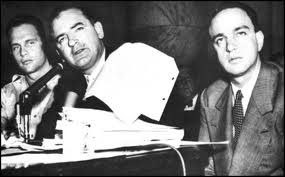
Michael Cohen walks in the long shadow of Roy Cohn (R in this photo), right-hand man and fixer for Sen, Joseph McCarthy (C in photo), and the lawyer, fixer, mentor for Donald Trump.

Roy Cohn continued to practice law and “fix” things until his fixing led to disbarment five weeks before he died. Like Roy, Michael Cohen will never practice law again. Unlike Roy Cohen, Michael Cohen may yet redeem himself from the darkness and unqualified public scorn.

Michael Cohen is going away for three years. But am I imagining that I see a different countenance since his sentence? That his face looks different — less troubled — and his walk lighter because he has little reason deny or twist the truth? Who’s to say?

Watching Michael on C-Span today, the Leonard Cohen’s There Is a Crack in Everything. That’s How the Light Gets In will play in my head. Will Michael be a Roy or a Leonard? Will Michael “sing” or sing? Or are “singing” and singing the same thing when there’s a crack in everything?

— Gordon C. Stewart, Chaska, MN, Feb. 27, 2019.


I’m sorry to disturb you again!

When was the last time you had time to waste before boarding a flight? The uber drops you off at the curb in plenty of time. You check your bag. You pass through security. You have an hour or so to kill before the 11:10 boarding of your flight on Concourse C.

You haven’t had breakfast. You go to the food court, buy a coffee and a breakfast sandwich, and take a seat at a small table in the food court. You reach for your iPhone to check the time, read the texts and tweets, and read the e-edition of your favorite news source. But it’s missing! You rummage though your pockets or your purse. You’ve forgotten or, God forbid, lost your iPhone. You never do that. Never, never, never!

You scarf down the coffee and croissant sandwich and go across the hall for a newspaper. You buy a copy of today’s New York Times, return to the table in the food court, read the front page headlines, open to the sections of interest, and get absorbed in the latest news or this morning’s crossword puzzle or sudoku.

Suddenly, you realize you’ve lost track of time. You reach for your iPhone and remember. You look for a clock, but there are no clocks. You leave the food court in search of a clock. There are no clocks.

You race down the concourse toward your gate, looking for a clock to see whether you’re late for your flight. But there are no clocks. None. Anywhere. Not even on the flight arrival and departure boards. The flight boards display the schedule and whether your flight is on time, delayed, or cancelled, but they do not tell you what time it is now.

Arriving at the gate, there is no line for boarding. You breathe a sigh of relief when you learn you’re not too late. You sit down in the waiting area and sheepishly ask a stranger for the time. She checks her phone and gives you the time, while you explain that you’ve left home without your new iPhone6, or maybe you’d lost it, as though she cares.

On board the flight, you fasten your seat belt and break the rule of privacy. “Hi, my name’s Bob. Is this home, or do you live in Denver?” “Denver,” he says without looking up from his smartphone. You might as well have asked for his Social Security number. This flight will be a long exercise with silence, a chance for meditation, but you can’t do meditation without the meditation app on your iPhone.

After take-off, you take out the New York Times. It’s been awhile since you read a newspaper in print, and you’d missed out on an aisle seat where you could spread out. Your left arm is flush against the window. As you unfold the newspaper, you intrude again into the space of the guy from Denver in the middle seat. He looks up and shakes his head. You apologize for your rudeness and carefully fold the newspaper in half the way commuters do on trains on their way to work in the city. You settle down with the properly-folded newspaper. A headline leaps from the page:

Do Not Disturb: How I Ditched my Phone and Unbroke My Brain”(Kevin Roose, Feb. 23, NYT) comes to the rescue. It begins:

“My name is Kevin, and I have a phone problem. And if you’re anything like me — and the statistics suggest you probably are, at least where smartphones are concerned — you have one, too.”

I do! Yes! I do! you say to yourself. You wonder whether Kevin also has a clock problem. Whether he’ll lament our isolation in a world missing the one thing we all had in common before smartphones: public clocks on the tower of the old village square . . . and in airports!

On the way to baggage claim, the problem is bigger than the absence of a friendly clock. You’re in a strange city without information on where you’re supposed to go. The address of your hotel, how to get there, contacts, e-mail and text information, phone numbers, and the name of the restaurant where you’re to meet the headhunter for the job interview are carefully stored on your iPhone.

What to do? At baggage claim, a stranger takes pity on you. She lends you her smartphone. A family member answers your call, finds your phone, follows your instructions for unlocking your iPhone, and begins to give you the information you’ve asked for. But without a phone to take down the information, you’re still helpless!

“Hold on a minute,” you tell the family member back home, and return to the stranger. “I’m sorry to disturb you again, but do you have a pencil and a piece of paper?”

Monday Morning Wake-Up Call

David Kanigan’s Monday Morning Wake-Up Call popped up this morning while pondering a reference to Jacques Ellul’s “meditation on inutility” cited in a footnote of Walter Brueggemann’s The Psalms and the Life of Faith. The sentence which leads the reader to the Ellul footnote on inutility reads, “In the end — not before, but in the end — praise is a useless act.” (p.122, footnote 21)

Thank you, David for drawing attention to this current meditation in praise of inutility by Kevin Roose in the New York Times.  Jacques Ellul and Walter Brueggemann would call it an act of praise.

Live & Learn's avatarLive & Learn

For the rest of the week, I became acutely aware of the bizarre phone habits I’d developed. I noticed that I reach for my phone every time I brush my teeth or step outside the front door of my apartment building, and that, for some pathological reason, I always check my email during the three-second window between when I insert my credit card into a chip reader at a store and when the card is accepted.

Mostly, I became aware of how profoundly uncomfortable I am with stillness. For years, I’ve used my phone every time I’ve had a spare moment in an elevator or a boring meeting. I listen to podcasts and write emails on the subway. I watch YouTube videos while folding laundry. I even use an app to pretend to meditate.

If I was going to repair my brain, I needed to practice doing nothing…

It’s an…

View original post 37 more words

The Bridge

For those of us who live far from the U.S. southern border, John Buchanan’s impression of the daily humaneness of Mexican and American workers, families, shoppers, and visitors crossing the bridge provides a visual of hope.

Family of John M. Buchanan's avatarHold to the Good

We drove down from San Diego to the border last week. It’s a huge operation. Long lines of automobiles are lined up on both sides, driving south from the United States into Mexico and north from Mexico into the United States. 70,000 people cross that border every day; more than 1,000 walk over the border bridge. Many Mexicans have jobs in the United States and return to their Tijuana homes nightly. It was a Sunday afternoon and we watched a steady stream of men, women and children crossing the border bridge after shopping at the Outlet Malls on the American side.

I was impressed with the simple, ordinary humanness of it all. Families walking toward the bridge, elderly on walkers, babies in strollers, children eating ice cream cones following their parents, adults carrying their purchases. I know our brief visit did not reveal the complexity nor the danger associated with…

View original post 485 more words